Beyond ‘Good’: Creating Client Experiences That Stick in an AI World with Steven Van Belleghem - 319
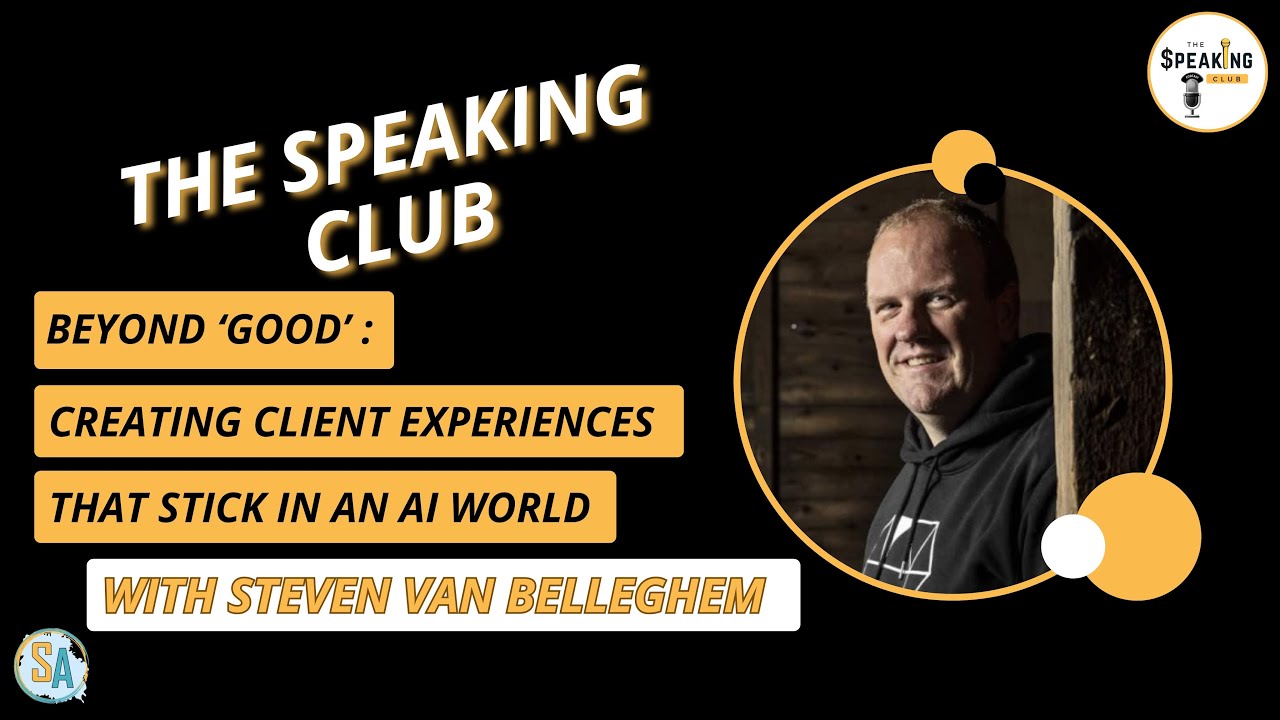
Steven Van Belleghem argues that 'good' customer experience isn't enough anymore. Companies like Chewy and Coolblue create memorable moments through unexpected gestures: oil paintings for grieving pet owners, handwritten cards, free car repairs. He outlines a four-layer framework that builds trust and turns customers into lifelong partners.
Chapters
Hello, you are watching and listening to Sarah Archer and episode 319 of The Speaking Club podcast. And I want to open this show with a quote from Simon Sinek, he of the viral TED Talk and the book Start With Why, amongst many other things. Technology will always be a wonderful servant, but a terrible master. The human touch will always be the antidote. I started this podcast for 2 reasons: because I want to help people recognize the power of stories and humor in speaking, and because I believe it's your message that counts, not the number of ums and ahs you use. There are some organizations that want to create robot speakers. They want you to sacrifice your personality in order to speak perfectly. I want to let you know that you can be yourself and a sensational speaker. So, if you want to be a speaker that connects and engages authentically through stories, a speaker that gives value as well as a great performance, then welcome home. Hey, it's great to be here. I hope that you are well. It's been a while. And, uh, yeah, I've been taking a bit of time out to regroup. But just because I haven't been doing stuff on here does not mean I haven't been busy. I have been doing all sorts of stuff. I was a judge again at the Speaker Awards, 55 entries in 2 categories I judged there, and I'm going to be sharing stuff with you that will help you, A, if you want to do some award stuff in the future, but just generally with your speaking. I have been creating some new products, which I'm really looking forward to sharing with you over the coming weeks and months. And I have been keynote speaking at an international event in Lithuania. It's one of the biggest sales conferences in Europe, and it was at that event that I came across the guy that I'm bringing to talk to you today. His name is Stephen van Bellechem, and he was another keynote speaker at the same event, uh, in Vilnius. And when I saw him speak, I knew that I wanted to bring him onto the show for a number of reasons. One, because in his specialist subject of customer experience, he has got a really interesting take on AI and how to use it and not use it to give your customers the best experience. And I was really interested in that, and I think it will help you, um, to see things potentially from a new perspective around that whole area, but also From a speaking perspective, he is an international, global keynote speaker. He's a seasoned keynote speaker, been doing it for a long time, and his talks are full of great stories, and I just knew that he would be bringing some insights to this forum that maybe you haven't had before from other speakers. So, Yes, it's— I'm really looking forward to sharing his stuff. He is a bestselling author. He's a trusted advisor to brands that wanna balance tech innovation with human connection. And as I said, he has walked the talk on over 1,000 stages across the world, and he's got a really refreshingly honest take on what it takes to create moments that matter for your audience. So if you want to future-proof your brand, wow your customers and connect with audiences in a way that gets remembered, then listen up. Enough of me. Let's head over to the interview with Steven van Bellechem. Welcome to The Speaking Club, Steven van Bellechem.
Hey, Sarah. Good to be here. Thanks for the invitation.
Oh, I couldn't not invite you. You and I were both speaking at part of EMU Formulae in Lithuania, and when I heard your talk, I thought I need to get Steven on the show and here you are, which I'm really thrilled about.
So, and then luckily we were together in the taxi to the airport, so we could actually meet and have a little chat. So that was really pleasant.
Yeah, exactly. That was a good, it was a good conversation.
Yeah.
And that cemented, that cemented it for me. Good. Okay. Well, my first question is, is this, you've spent over a decade exploring the evolution of the customer experience. which is kind of what you speak on. What do you think is broken right now in how most businesses connect with their customers?
I think one of the biggest issues today is that we had so many, let's say, big problems that were heading into companies in the past few years. Think about COVID We had inflation. We had Russia and Ukraine. We have geopolitical tensions. We have trade wars. I mean, there's so many big things that usually only happen once every 10 years. Now, every year we had something that a lot of companies are now more internally focused than ever. They need a lot of their resources, they need a lot of their skills and talent to deal with all these substantial events that are happening, that the focus of the customer is lower than it was before COVID Gosh, okay, cool.
And I guess one of those new big challenges, which is something that you spoke about, PV was the rise of AI.
Yeah, that's a new one again, and it's a superpower on the one hand and it's scary on the other hand, and it's moving so rapidly that many organizations are uncertain about what to invest in. They feel they don't have the right qualities on board to make the right decisions. So because of that, some of them, yeah, remain stable, remain in the status quo rather than to move forward. That's a challenge. The other thing is that the big game that you see in here of artificial intelligence is about increasing productivity. It's about increasing efficiency. What I notice if I'm at an event and companies present their AI projects to the team, what I see is that 90 to 95% of all these projects are internally focused. It's about efficiency. It's about automated transcripts of Teams meetings. It's about lowering headcount in certain divisions. It's all focused on that productivity gain. There's not that much conversation happening in organizations about AI and customer experience. What I see is that customer behavior is changing rapidly. The way how people search for information has evolved over the past year. If people look for a product, they have some sort of a salesperson conversation with a tool like ChatGPT now. And their first filter is happening on an AI platform. And now you see how OpenAI, for instance, but Google as well, is investing in new end-user interfaces where you will get more shopping advice, more neutral shopping advice, and eventually you will get the opportunity to buy stuff through the AI platforms, through agents that will do the purchasing for you. So if you think that's true, That means that the entire sales and marketing funnel could happen on an AI platform like ChatGPT or Google Gemini, which fundamentally changes the way how we should go to market, how we will, you know, make sure that people will buy our product. And this is happening right now. This is no futuristic view. This behavioral change is happening as we speak.
Mm-hmm.
My feeling is that this is Yeah, heavily underestimated by the majority of the organizations.
Yeah, absolutely. But, and back and sort of reinforcing what you said about the internal rather than the external focus. Yes. Okay, cool. So you've said in the past that the biggest challenge is being great in a world where good is no longer good enough. What explicitly do you mean by that and why do you think most companies still fall short? Is it just that internal focus or are there some other things going on as well?
You know, good is a minimum demand. If I really enjoyed a conversation that I listened to of Brian Chesky, Brian is the founder and CEO of Airbnb, and he was talking about the 5-star reviews that people give after they had a stay in an Airbnb or when people take an Uber. I don't know how you do that, Sarah, but when I'm, you know, with an Uber driver and they ask me to vote on a 5-star rating, almost every single time I give 5 stars.
Hmm.
Exceptionally 4. I never gave someone a score that is lower than 4. Usually in 95% of the cases, I give a 5-star rating. And that's what Brian Chesky saw with Airbnb as well. The majority of the people give a 5-star rating. Now the question is, does this mean that people think this was the best Uber driver in the world? Or that this was the best Airbnb location in the world? Or does it mean that it was up to expectations? If I look to my experience, when I give a 5-star rating to an Uber driver, it's because that person didn't do anything wrong. It's up to expectations. Nothing special happened, but I gave a 5-star. So what you see is some sort of an inflation in these feedback systems, which gives us the illusion That we're, yeah, that our customers love us. And I think that is a big mistake. We're too blindsided here. So Brian Chesky, he has a really cool exercise that he does with his team. He says, you know what, think about what would a 6-star experience look like? What would a 7-star experience look like? Up to a 10-star experience. And it can be wild. It can be unrealistic, but it's some sort of a mind-stretching exercise to make sure that people will think beyond the obvious. to surprise customers and to do something that is beyond the normal or beyond the boring kind of transactional relationship that most businesses have. That mindset helps to go beyond the good because the good is not differentiating enough. On the other hand, to soften the quote a little bit, it doesn't mean that customers expect perfection. Great does not equal perfection. There is no such thing as perfection. Customers value positive intent. If they feel that you are willing to do something extra, if they feel that you really did whatever you could, and if you didn't succeed, they will be fine with that. Customers are negative when they have the feeling that you're following a process and you're not thinking as a human anymore and you're not taking the normal decision, then they're like, What kind of monster have you created with your company structure? Just do the normal thing here. If they feel that you're trying to do the normal thing, they'll be more than happy.
God, there's some really, really powerful points that you're making there. And I think you're right. This is a sort of tangential, but I remember seeing a comedian talk about the use of the word hilarious and how everything is hilarious. And it's like, That's the same thing with this. It's like we're attributing these really high bars to stuff that is kind of meh, okay. And so where does that leave you? Yeah. And I guess it's leading to that false sense of security and, you know, a lowering of ambition with regard to particularly what we're talking about, customer experience, which is really, really interesting. And I remember from your talk, one of the things that stood out to me was the story of the company who, with the dog portraits. And I wondered if you could share that, if you didn't mind, because I think that's a really good example of that, you know, difference, that tangible feeling of something special.
Yeah, yeah, I'd love to. You're talking about a company named Chewy. Chewy is a very popular brand in the United States. They sell everything related to pets through e-commerce, so they don't have any physical stores, which means that every e-commerce company, they do one thing really right. They focus on the transactional relationship, make it as convenient as possible, and that is increasing conversion and loyalty. So they're very good at that, but they understand that being in the pet food business or the pet insurance business is also an emotional relationship that you have. A pet is very important. A dog is very important to a family. So it's an emotional bond that you could potentially create. And this is something that Chewy is really good in. And the one thing that they're famous for is that when one of their customers, if their dog passes away, they will send a little oil painting. a little painting made of that dog. They have a picture of those dogs in the account pages that they have. So when a dog passes away, they know because those people stop ordering food. So they make a little oil painting, they send it to those customers with little handwritten cards saying, look, we're so sorry that your dog has passed away. Hopefully you have great memories. Love from Chewy, from John from Chewy. And they send about 1,000 of these paintings every week. So they have their own oil painting department, basically. I have 4 people doing oil paintings day in, day out. And, you know, if I tell this story, people are like, oh, this is so sweet, but then I try to make it a little bit more rational, more business context. So those 4 oil painters, let's say this is a budget of about $200,000 a year to pay those people. What do you think brings in most money, huh? $200,000 for those oil paintings? or $200,000 in additional sales Facebook advertising? And then you've seen what happens. 99% of people say, oh, we know the paintings are the most valuable thing because people will put it in their living room, they will have conversations about it, you know, it will stay there for 10 years and people say, what? Chewy gave you that? I'm gonna start ordering my food at Chewy as well. So the brand love that you build through each of these paintings is Unbelievable. Everyone knows that. But when I ask the question, okay, you all know that the dog paintings bring most value to the company. What do most companies choose? The 4 oil painters or $200K in Facebook advertising? Everyone says, yeah, then we will choose the Facebook advertising. Why? Because the Facebook advertising is easy to measure, right? You can make your Excel sheet where you say, look, I invested $200K, now it's It brought us $240,000. So we're great people. Look, Mr. or Mrs. CEO, how good I am at my job. It's easy to measure. The dog paintings, very, very hard to measure. It's a belief. It's something that we humans that we know.
Yeah.
It's very hard to measure. And this is the crazy thing, you know, the difference between a human and a corporate human is how I call it. Every human understands the dog paintings, smartest decision. But once you enter that corporate environment, you need your Excel sheet and you take the decision because that decision allows you to make an Excel sheet out of it. And this is the crazy thing of how we manage companies today, that we have lost the ability to do the smartest thing if it's hard to measure.
Yeah. And I think that's a cultural thing, isn't it? Because no one wants to put their head above the parapet and propose something unusual, that hasn't got that measurement behind it, but often that's going to make the difference. And it's those companies that are brave enough to create a culture where people can try things out and do stuff like that, that will start leading the way, I think, and be sustainable. Yeah, that's absolutely— Brilliant, brilliant story. Okay, cool. And I think, do you think that they are an example of a company that has got the balance right between digital innovation and human warmth?
Absolutely. Absolutely. They're a cool example of that. It's exceptional, especially in their business online. If you look at Amazon, and I know they're very successful, but it's almost impossible to reach a human. They are built on their processes, super, super rational, and they're successful with that because at their scale, there's no one else who does it as well as they do, but there's also no alternative.
Mm-hmm.
The moment that you have a Chewy in your market where you get emotion on top of transactional quality, then it becomes interesting to look for something else. Like in the Netherlands, you have a company called Coolblue, mainly focused on e-commerce and electronics. That's their core. They're also a bit like Chewy. They're very easy to reach. They have handwritten cards. They do all these crazy things. They make videos with all their employees. who are part of the story. Their CEO has a vlog, so they make it very human. They make it very real. And because of that, people love that company, even though they're more expensive than their competitors. They're super successful because there's some sort of a connection between people living in Belgium and the Netherlands and Coolblue. So it pays off, but it requires a certain culture. Leadership needs to support it. And then it pays off.
Yeah, absolutely. I can think of a company, it's actually local to where I live and they make tea. And again, they have a few outlets, but predominantly e-commerce. But when they send out the teas, someone handwrites a tea-based pun. It's like a joke. And they are building a huge community. And I think that's the thing. It's when you get that human feel to things and build that connection with people, that emotional connection. I mean, that's not quite as extravagant as having an oil painting department, but nevertheless.
Yeah, it's on a different scale, but it's injecting that personal human experience to something that could be very rational and distant from you.
Absolutely. Really interesting. And do you think because of this whole, you know, 5-star thing and it's the— our customer expectations are being lowered, or do you think that when we do experience something different, that's when we will go out of our way beyond the sort of Google review to share it on social media and all of that sort of stuff? Do you think that, you know, how has it affected our expectations? Because I know you talked about, you know, in your book, The Offer You Can't Refuse, what do you think customers are looking for?
Well, a few things. First of all, this philosophy that you talked about, that people share, that people will post, that they will become ambassadors of your brand, has always been very important. Ever since the start of doing business thousands of years ago, word of mouth was the most crucial form of advertising. I think today it's more important than ever again because as I mentioned at the beginning, people will take a lot of decisions through AI platforms. So the funnel is happening on an AI platform. They get their information from the internet. What studies now show is that if you want to get recommended by ChatGPT, the data or the sources that are most credible for ChatGPT are third-party reviews, stories, not mentioned by the company itself, by earned media. 90% of its criteria or its feedback is based on earned media. So today, if you have a great customer experience and people become ambassadors, the consequence is that you will be picked up by these AI platforms more rapidly than companies who don't. Why is this more important than in the past? Because the shortcut of advertising to those people will become harder because on these AI platforms, you will have less advertising or no advertising versus what we have in a Google search right now. So it will become an acquisition tool rather than a retention tool, which is a completely different approach than in the past. So it's gonna become more important. That's one thing. Second thing is we have inflation in expectations. So what is exceptional today is normal tomorrow. That's how fast it goes. We've seen examples of that, like Wi-Fi in hotels used to be something that you had to pay for, €20 a night. Today it's free everywhere, and if you would meet a hotel that still charges you, you would be super, super angry with that.
Yeah.
They would be terribly punished with bad reviews because of that. So, you know, it became normal overnight. This is what we see. The Offer You Can't Refuse was a research project that I did to really look for the expectations that people have on different layers in the relationship. And the minimum demand is actually a good product and good service, convenience, making it easy to do business with you. Those are 2 important assets, but you cannot differentiate with those anymore because people expect you to have them. If you don't have a great product, if you're not convenient, They see you as a less interesting party to work with. Where can you make the difference in the more emotional part of the relationship? The first one is what I call partner in life. How can you create positive change in the life of customers? What can you do beyond the product that you sell to add value in the life of your customers? Here, it's not about optimizing customer journeys. Here, it's about bringing value in life journeys of people. So partner in life, which is a deeper, more emotional kind of relationship. And the 4th layer, the last one is about creating positive change for society. And here I think beyond sustainability, people say, ah, sustainability. No, it's about using your own strengths, the core of your expertise to create value for society. And if you work with Those 2, creating positive change for people, creating positive change for society, those are assets, dimensions you can work with to create that more emotional relationship. And the combination of the 4, great product service, convenience, partner in life, creating positive change for society, those 4 together, they bring an offer you can't refuse for customers.
Wow. I mean, I can imagine for someone, a founder starting out, for instance. Well, I mean, I suppose there's, if you are just starting out, you have the opportunity. To get it right from the beginning, but it might also seem quite daunting. For those organizations that are bigger, slower to move, is that something that is easy to change? Have you got some examples of companies that have recognized these things and made a shift, or is it something that most companies are resistant to?
It's I think if I tell this story, most companies see the value. I felt that the idea of partner in life is something that sounds really attractive to a lot of organizations, but implementing it is is very often a challenge. I had the pleasure to work with a big insurance company in the Netherlands. It's called Centraal Beheer, which is one of the oldest insurance companies in the Netherlands. It's I think 130 years old. They are very, very good at this. So the challenge in an insurance industry is to go beyond the billing relationship. If you don't have a claim, if you don't have an issue, the only communication you get from your insurance company is your annual invoice. How can you build a relationship beyond that? That's what they were thinking about. And then, for instance, they looked at their car insurance and they learned that a lot of people have like a little thingy going on with their car every year, like a little dent or a little scratch. But it's so small that you don't want to go to your insurance company, or you don't want to pay the money to fix it, or you don't want to spend the time. You're like, hey, it's a little dent, it will be okay. But after a few years, your once so beautiful car is not so beautiful anymore. So they organized little dent days in several places, locations in the Netherlands, and every customer of Centraal Beheer can go there with their car and they will fix the little dents and little scratches completely for free. It's an additional service that they offer and the cool thing is they organize these events not with event organizers, but it's their own team who's actually taking care of things and it's not the service or salespeople, but it's the people who are usually behind the scenes, so it's accounting, it's IT, people who never see clients in real life, they have to host that day, they have to welcome the clients, they have to offer them a coffee or a little piece of pie or something like this. And it's like a small party that they organize and they fix things for free for you because they're their client and they understand that this brings value in your life. See, this is a beautiful one example, but this is a beautiful example how you can create positive change in the life of customers. And they have, for each of their insurances, they looked for services and value like this. And some of these services were even payable. Partner in life doesn't mean you have to offer this all for free. It's just, By offering the service, you show that you understand the needs of the clients and most of them are happy to pay for a thing like this. So you make money and you make clients happy at the same time.
I love that. A ding day. We call them dings in the UK.
Ah, okay.
Ding. We've dinged your car. Yeah. Oh, that's really cool. I love that. Because people are missing out, like other insurance companies missing out on seeing so much.
And it's fun and it's easy to do. It's low budget. And it builds your brand in an incredible way, much more impact than a 30-second commercial on TV. Yeah.
Brilliant. I love that. Thank you for sharing that example. That's so cool. Now, what I'm also interested in, and I think that you walk the talk here, but I'm going to check in with you to see if this is the case.
Okay.
So your main gig is customer experience. That's where, you know, that's, that's your bag. Now, in terms of the expectations of your clients as a professional speaker, there is, you know, times change. We've got AI. There are a lot of people that will jump on the bandwagon of AI because it's hot, but I felt like you had weaved in the things that matter for customer experience with the dawning of AI and you had evolved your content to meet the demand that you knew was there from your clients without losing the core of your capability and message. And I feel like this is, you know, your way of being a partner for life for your clients, because I know that you have repeat bookings. Is that the case? Was it intentional? Is it just, you know, and what else do you do to make sure that you are a partner for life for the event bookers that book you to speak?
Well, thank you. First of all, thank you, Sarah. These are very kind words. I really appreciate that. I never, it's funny, I never thought about myself as a partner in life, but it's cool that you make that reference. But I think that's indeed what I'm trying to do. My stories always evolve. Expectations of the market evolve. There's new opportunities, new threats, and it's my job to summarize the things that are happening and translate that into customer strategy for my clients and my followers and my audience. And it's what I'm passionate about. My goal in life is to make sure that people get better service everywhere they go, to make the clients of my clients happier. That's my That's my mission. So I need to inform my clients and my audiences about what's happening and how they can deal with this. And you're right, I think there have never been more public speakers in the world than today, especially with the rise of AI. A lot of people are talking about it, and I don't mean this disrespectful, but the majority of the AI talks are a sum of tools that are being described, which is valuable for a lot of people because not everyone is into the tools and They learn and they can play with it, but at a certain moment, we will have a certain centralization of tools. People will find their way. My job is to talk to senior leaders and tell them, okay, all these tools are coming. I'm not an expert of all these tools. I don't have a— I work with some of them, not all of them, but I'm really good in translating what it means for customers, and I'd be more than happy to help you with better understanding how how customers will use this and how you can adapt your strategy to make sure you don't miss that boat. I think that's what I've been trying to do since the early 2000s when I was doing research about websites and how people buy cars differently and then social media, how communication changed. And today it's AI. Yeah.
Cool. And I think at this point, my audience is probably wondering, how did you get into speaking and becoming a professional speaker? What was your journey like and how did you get your start?
Let me start in the beginning. When I graduated, I started as a research assistant in a business school in Belgium, Vlerick Business School. I did research there about B2B marketing. After a year and a half, I went to a market research company, a commercial environment, a company called Insights Consulting, where we studied the usage of websites and how consumers around Europe were using websites to find information, how to buy things, you know, early days of e-commerce and so on and so on. So we had data about customer behavior and the internet, and I'm talking the year 2000. So it was very early days and there were so many companies who wanted our data and who said, can you give like a short presentation about the status of the internet in Belgium or in the Netherlands? And I was always like the one, we were an 8-person company at that time and I was the one who really enjoyed giving presentations. So I said, you know what, I'll take care of this. So I had this training school of giving so many presentations. In the meantime, I was also teaching still at the Vlaanderen Business School. So I was just doing presentations, learning, falling, crash and burns, you know how it goes. And then there was this day in 2008, Microsoft Belgium called and they said, we have Steve Ballmer coming over for his annual visit, the CEO back then of Microsoft. And they said, would you like to do like a pre-presentation before Mr. Ballmer goes on stage? And I said, yeah, of course, because that was a very interesting audience. 2008, 2009, arrival of Facebook, Twitter, and so on. So I made a presentation called the Conversation Manager, which was about how you can now have online conversations with your audience. how the customer got a voice, you know, the first theories of social media. And that presentation went really well. I prepared it very well. And afterwards, one of my friends said, Steven, that was a really good story. Why don't you write a book about this? This is really cool. And I said, yeah, well, it's always been my dream to write a book. So that summer, the summer of 2009, I decided to write a book called The Conversation Manager. It was released in 2010, March 2010. And yeah, it was a big surprise for me, but it was a really big hit, that book. That was like social media, like AI now, but then social media and how to be customer-centric through social media. And I was invited everywhere to speak. And that's how I ended up in that speaker circuit. 2 years later, I wrote a second book called The Conversation Company. And then I decided to leave Insights Consulting and fully focus on the speaking. I started on my own. 2 years later, my wife joined me to work together with me. A year later, I met Pieter Hinszen, which is also a fantastic Belgian speaker. We started a company, Nexworks, together, which is an inspiration agency. We organize inspiration journeys to Silicon Valley, to Dubai, to China, to Stockholm, Paris, London, Berlin, where we take managers from all over the world to these innovation hubs. We moderate an entire week with them. We visit 20 companies in a week. So we started that company, which is now running on its own. And my job now, 13 years later, is still for 90% of my time, I'm on a stage giving a presentation about customer experience. So I'm super happy with the jump I made. And I'm also super happy that I got an opportunity to learn for 12 years. without having a book or without, you know, high expectations, just be able to learn and to burn at the same time.
Oh, I love that. I didn't realize you had a separate inspiration. I love that. That's so cool. How did you get the idea for that?
Peter and me had dinner and we were talking about how could we work together and he was active with Oracle who asked him to organize certain of these trips. For Oracle clients from Belgium who had to go to Silicon Valley. So he did that with IT managers and then Pieter told me, yeah, you're a marketing guy, why don't we work together? Why don't we organize a tour for business people? And I said, yeah, of course, that sounds wonderful. So I think it was 2013, we launched that and it was an instant success. We had a bunch of people who wanted to join, the buzz was Great. So the year after that, we had 2 of those tours. We had waiting lists for people to join us. Then we had a big Belgian company who said, I want to send my top 200 on a trip with you guys. And then we had a year, must have been 2014 or so, that Pieter and me were traveling and those were always full weeks. We were traveling, I think, 14 or 15 weeks a year. I traveled more with Pieter than with my family. And then we said, this is really cool because it's a success, but it's over the top. Why don't we stop the hobby project because it was like a side project for us and really build a company around this where we have other people who join in and help us with that. And that's how we started. And today I think we do with Nextworks more than 50 of those tours a year, every week. Peter and me still moderate them, but only 2 or 3 times a year. It's super interesting, but yeah, it's impossible to do more, but we have now an international network of moderators, experts in different domains. And we try to inspire managers by bringing them into the innovation itself.
Sure, I love that. And the beautiful thing is that you're not just speaking about this stuff with that company. You're practicing what you preach effectively through that. That's brilliant. Okay, cool. So one of the things that you've highlighted is that there was 12 years of delivery and honing the craft before you wrote the book and then, you know, then got invited to speak. I suspect, I don't know, if you hadn't had that 12 years and the talk couldn't live up to the book, you might not have got so many gigs on the back of the ones that you did. But what I'm curious about, having given over 1,000 keynotes in 45 countries, Is what's the biggest lesson that you've learned about audience connection from being on that many stages?
I'm just gonna give my experience, Sarah. I don't know if this will work for other people as well, but for me, connection is about staying very close to who I am as a person. Sometimes my friends and family come to presentations and they say, of course, on stage you're different. It's a little bit larger than normal behavior, But we recognize you. The kind of humor that you have is the humor that you would share with us. The style of speaking, the choice of words is exactly the same as in your private life, and I think for me, that's important. I don't have to act. I'm just very close to my own personality, and I share personal stories during presentations. I try to make sure that every example that I use is not just something that I read about in one article, but I want companies that I visited or that I really studied in depth so that I can work with them. So I'm full of confidence of my stories because I try to live them. That combined with staying close to who I am, I think that's something the audience feels that you're at ease by being on stage and that feels comfortable for an audience. If you see someone on a stage and you feel that they're struggling a bit or that they're forcing themselves into a certain direction. You feel that as an audience and then you lose a bit of connection is my feeling.
Yeah, so for me, the 2 words that come to mind are authenticity and authority and like credibility, and I think that's so true, and I think so many people feel that when they speak, they have to become something else, become a presenter and lose their personality, and this is something that I speak on. You know, you can be absolutely yourself, And a sensational speaker, and you should be because audiences don't like it when they can feel, they can sense people that are fake.
Yeah, I agree, and it's not about a certain style. I think you could have 5 exceptional speakers, each with a different style, each with a different angle, different personalities, and they can all be exceptionally good because it's who they are.
Yeah, yeah, absolutely. Yeah, I just the other day I did, I think I did a post about a speaker coach that I saw that was trying to get people to, like, they were saying this person was more like Russell Brunson, who's a direct marketing guru, and they should be more like Tony Robbins. And I'm like, no, they should be more like them. And there's skills and things that you can train to become better for sure. But never losing the essence of you. Otherwise, just, you know, you'll just be like everyone else then. So, that's a really cool point. Excellent. Okay. So, we've got mobile, we've got AI, we've got bots. What do you think, as maybe you evolve as a speaker or speaking evolves, what do you think is going to be the trick to keep the audience at the centre of the live speaker experience, but building in some of these tools that we can utilize as speakers?
I'm not convinced that we will have to use these tools to improve our speaking skills. I mean, it helps in research. Obviously, it can help in creating some better, stronger one-liners.
I'm thinking more of like when you're on stage, you know, the polls, the interactivity, the voting, that sort of thing. Is that something you use yourself or plan to use in the future?
No, I don't think so. I'm very old school in this field where I just say, raise your hand if you think A, raise your hand if you think B. You know, this is the crazy thing, Sarah. We're talking about technology a lot in all these speeches and everything, but the most scary part is connecting your computer to the screen. As a speaker, you always, you have 2 types of AV teams and I don't know about you, but I work on a Mac in Keynote and half of the AV teams are like, ah, okay, a Mac, you want presenter mode? Sure, here we go. Other half is like, can we transform it into PowerPoint or PDF please? Because we don't work on Mac and I say, no, yeah, that doesn't work. They freak out. When you have that kind of AV team, the only thing you want is to make sure that you can do your job right and it's very, very scary. So I've seen people adding technology into their presentations and usually it's no added value. On the contrary, it creates stress and it slows down the presentation. So I'm a huge fan of technology, but not during my presentations.
Oh, I love that. No, that's absolutely cool. And you're not wrong. No, I've got Mac and I'm lucky I've got Mac and PowerPoint. So I'm halfway.
You're good. You're good. Yeah.
But yeah, I, but you're absolutely right. But even like going on stage, you know, at part of VMO, I'm like, where's the clicker? How does the clicker work? Because we had to get the clicker off the person that had just come off stage. And I'm like, I want to know which, like, how does it work? Is it super simple? Um, but yeah, you're not, you're not wrong. It's those sort of things that can throw you and then, you know, it comes across. So, yeah. Keep it— focus on the storytelling.
Exactly.
Yeah, that's the best thing.
Yeah, that's the core of our job.
Yeah, exactly.
Cool.
Okay. Now, this is something else that I've got from you. You encourage positivity over perfection. Could you explain a bit more about that and how that comes across? But on stage?
I don't think anyone is a perfect speaker. I, you know, you can have a bad day or you can just fall and trip over your words. That's all perfectly fine as long as it's not 60 minutes in a row, but that's all perfectly fine if people feel the passion and if they feel that you're credible. You know, it's like Cristiano Ronaldo or Messi, they also missed some penalties. that's sad at the moment, but everyone knows that they can score a goal because they proved that over and over again. And then it's human to make a mistake. And we like humans, especially in the age of AI. Something that will be created by a human will increase in value if it has the mark of this is a real human doing things or performing, or this is real human creativity, it will get additional value. and people will appreciate that more than perfection. Imagine that someone says, oh, I want to have the perfect quotes and I want to use the perfect sentences. I'm going to make a video of myself as I would give the presentation, then I'm going to give it to AI and say, make it better. Give me better sentences, give me better quotes, and what will happen is that you will learn that by heart and you will lose the authenticity, you will lose the passion because you will start to behave like a robot.
Yeah.
Robots are perfect. Humans are imperfect, and it's perfectly fine to be human and imperfect. Don't try to be a robot. Try to become better in being human. That, that's what we need to do on stage.
I love that. That's, that's also one of the things that I'm half on about. I was just thinking back to, because it's obviously, I'm a playwright as well as being a speaker, and I'm thinking back to some of the playwrights And there's one in particular who wrote some plays. I can't actually remember the name of the playwright, but they didn't attribute any dialogue to a particular character. It just had like dialogue. And I'm just thinking like, if an AI created a play, it would have everything right.
Mm-hmm.
But there was something in that script that was different and opened up opportunities for actors to do and directors to do something different. And I think that's kind of what you are tapping into is that nothing is perfect. And if it is perfect, then it's probably not—
That's not right.
Yeah, exactly. People can again tell. And so I love that you've shared that. That's really, really powerful. Thank you for sharing.
It's the difference between Listening to a song that has been recorded 50 times in a studio versus a live version of that song.
Yeah.
It will usually always be better or more exciting to see the live version, even if they make a mistake in the lyrics, even if they get a chord wrong. It's the energy. And I think this is what humans can do. We can transfer energy to each other, positive energy. And if you're on stage, I think this is what your audience needs to feel, that you transfer your positive energy to them. And if they receive that, they will send you positive energy back. You will feel it as a speaker. And that's like a reinforcing effect that creates the best speakers of us.
Absolutely. Now, I think we might have just covered this, but my last question before we go into the standard ones is, if you had to give one piece of advice to a speaker who wants to be unforgettable, not just informative, what would it be? I feel like that might've been it, but if there's anything else that comes to mind, do share, Steven.
You know, maybe the best speakers aren't, or without any doubt, the best speakers aren't people like me. I talk about business, I talk about customer experience, and I do my best, but it's not my story. I mean, I create a story, but it's not something that I experienced or that I did. My favorite speakers are people who actually did something and then figure out a way how to make a fantastic story out of this. Some sports people, some athletes are really good in this. Some movie directors are really good in this. I recently saw Will Guidara who wrote Unreasonable Hospitality. We shared the stage in Helsinki on the Nordic Business Forum. He didn't use a single slide. He shared his story for 1 hour, but he, I mean, he did it. His restaurant became the number 1 in the world and he told us how he went through that journey, how he used this or created this philosophy of unreasonable hospitality and how that sort of innovation brought him to that number 1 position. At the end, he got a standing ovation and that is what people appreciate. You did something, And then in a humble, natural way, you share that story. For me, that is unbeatable.
Absolutely. That's really cool. Brilliant. Thank you for sharing that.
Yeah, of course.
Right. I have, before we talk about where people can find you and book you or to do work with you, I have some standard questions. Great. The first is, what's the best thing that speaking has done for you?
Oh, meeting extraordinary people. I mean, the kind of people that I have met because of being on a stage would have been impossible without that. I'm speaking from people like President Obama or the main singer of Iron Maiden to some top politicians. Yeah, it's top business people, people with a story who come to me afterwards and say, oh, I was inspired by you and I did this. And because of that, this great thing happened in my life. I mean, meeting extraordinary people is absolutely the best part of this.
Brilliant. Thank you for sharing that. I've not had that answer before, but I love it.
What is it? What is the number one answer to that question?
Confidence is often one. Speaking has helped people build their confidence in other areas of life is the number one. Yeah, I think.
Okay, cool.
Okay. So have you ever had a gig? We were talking about being imperfect. Have you ever had a gig where you went, oh my goodness, now I just want to forget that? Is that, has that happened to you in the past?
A few times. Yeah.
A few times. Do you want to share the worst one?
They're embarrassing stories, Sarah, but I will, I will share 2. One, one is really annoying. It's in the middle of a presentation in front of 300 people. I take a sip of water and the water goes the wrong way down.
Oh no.
So I have to start Coughing like crazy and I completely lose my voice because of that. For like 10, 15 minutes, I couldn't say another word while I was on that stage and everyone was just watching and looking at me. What will he do? It was like also the kind of setting where there was no moderator or anyone. It was just me, myself, and I.
Oh no.
They saw what was happening. I was like, okay, 5 minutes, like 5 minutes. Terrible, terrible experience. And then even worse, Luckily, that was a small audience in a company, but in the middle of the talk, I suddenly felt that I was becoming sick. So I had to leave the room, run to the nearest toilet. I had, this is a strange story, but throwing up.
Oh no.
Cleaning myself up, going back, said, apologies for the 5-minute delay. I wasn't feeling well, but let's continue this talk.
What a pro though.
Yeah. And then in the beginning, I remember when my book came out in Belgium and the Netherlands, my first one in 2010, I was invited to really cool locations and I started to feel good about it. I was like, oh, look at me and all these stages. That was like, every night was exceptional. And then I was invited for my first presentation in London and I was like, oh, it's starting the international thing. So I was super excited, told everyone I'm going to London. So I went over to that event. And yeah, it felt like they were not really waiting for me when I got there. And then eventually I found my room. It was like a small room, open room in an exhibition. And then they said, oh, here's your stage. So I started to connect and then it was time to present. And I saw everyone from that exhibition leaving to the large auditorium where the keynote speaker was. And I literally, literally had 2 people sitting there in my room.
Oh no.
I traveled all the way from Belgium, was super excited. And then I was like, okay, I got 2 people here. But then I tried to give the best possible presentation for those 2 people. I said, you never know who they are, but there was no follow-up business or that. That was my first international experience as a speaker. Yeah.
Oh, thank you for sharing that.
Very humble, very humbling. I was super happy to come back to Belgium and to give my talks for my fellow countrymen here for the months after that.
Oh, bless. That's so cool. All right, brilliant. Thank you for sharing those. Okay, next question. What's the book that's had most impact on your life and why?
That's a difficult question. I don't think it's really one book. It's more a book, several books written by the same person, and you have haters and lovers of this individual. Most people will know him. His name is Gary Vee.
Oh yes.
Gary Vaynerchuk. He can be very extreme in his approach, I followed him and I had the pleasure after that to work together a few times with him. We went a few times to his offices in San Francisco and New York. He came to Belgium and off stage, he's super kind. He's very energetic, but super kind. And the stories that he wrote in his book, like the Thank You Economy, the Hustle, I don't remember what the title was, but—
Jab, Jab, Punch was one of them.
Yeah, and Hustle, I think, basically motivating you to do things and to use social media and to not give up. I followed a lot of his advice in the beginning and probably I would've given up if it wasn't for him and he inspired me. He was also the reason why we started a couple of years ago, me and a friend, a social media agency in Belgium. Basically, we copy-pasted his idea of VaynerMedia, but then locally smaller. We were able to build that company, to sell that company. So that has been a good ride for us. And still, I'm very thankful that he gave me some advice early on in my career that I followed, that I think played a big role in what I can do today.
Oh, that's really cool. No, that's great. There's some, yeah, he is Marmite, but, you know, I think it's nice to hear that in person he's, you know, I think it's all well-intentioned.
It's well-intentioned.
Yeah.
I was super impressed. We invited him to Belgium, so he, we did Uh, uh, an event. I spoke there, my friend Peter Hinson spoke there, and Gary spoke. And, and we, we, from, from at first sight, we saw the fanship that there is for him. So that evening we went to Antwerp, we took him to a nice restaurant, and, and it was a wonderful evening. But just before we checked into that restaurant, he shared a tweet. He says, I'm here. If you wanna meet up at 10 o'clock, um, just let me know. I'll be outside and I'll, I'll, I'll say hi to all of you. And I told him, I said, Gary, this is Belgium. This is not the US. I mean, we're more neutral, we're calm here, so don't set your expectations up too high. So it became 10 o'clock, we were having dinner, and suddenly the chef of the restaurant came to us and said, who's Mr. Vaynerchuk? We will have to ask you to leave the restaurant because we have an issue. The square in front of our restaurant, there are hundreds of people here. They're shouting and they're threatening that they will come in if you don't go out. And he said, no problem, I will go out. And we were looking there. The police was there because they thought this is a— there's something going on that we don't know. And there were 300, 400 people standing there. They came from Amsterdam, from Germany, from Paris. They jumped in their cars. They just drove to Belgium because they knew that he would be there. And then I saw him. He left. It was cold. It was January or so. It was freezing. He forgot to take his jacket out because he wanted to go outside. He stayed outside until 1 o'clock in the morning. He literally talked to every individual. He didn't leave before he could answer all questions. And then he came back at 1 o'clock and he said, let's have the main dish of our dinner now and let's continue our conversation. And then I thought, wow, you really walk the talk. He actually spent time with each of his fans. Even if he didn't have to do that, but that's exactly what I did. And then I was super impressed with that.
And that's going back to our original, you know, at the start of our discussion about exceptional experience. That's, that's kind of, that's an example for sure.
Yes, absolutely. Absolutely.
Cool. Cool. That's great. Thank you for sharing that. Now this might cross over. We've got 2 more questions. This might cross over. What's the best bit of business advice you've been given and why?
Probably from my first professor that I worked for. His name is Rudy Moenaert. Rudy, I did my thesis with him. He hired me at the Vlery Business School and he told me that I had to teach in that business school and I said, this is going to be very awkward for me because the students in that classroom, some of them are my friends from last year. I started to work here, but they did an additional year and we spent quite a lot a lot of time in bars and having beers and too many beers, and now you want me to teach them? That's going to be very awkward. And he says, you know what? Just jump in the deep and we'll see what happens. If necessary, I'll jump in and I'll help you out, but prepare well. I will help you. I will coach you, and then I'm sure you'll do fine. And I was super, super scared, but actually I said, okay, I will try it. I did it. And I was surprised because it wasn't perfect. It was far from being perfect, but it was good enough. And I felt the— I was scared that they would make fun of me or that they would say, look, he's teaching us, but actually he had lower grades than us last year. But I felt some sort of a warmth that people said, this is actually cool and fun that you have the guts to do this for us and we're going to support you as well. And then I felt, wow, if you jump in the deep and you're honest about that, Most of the people will appreciate that and be nice back to you.
I love that. That's cool. Kind of what you've continued to do, I feel. I get that. I, so that's cool. Okay. Last question. Again, maybe we've already had the answer. I don't know. If you could have one mentor, they can be alive or dead, fictional or nonfictional, who would you choose and why?
Oh, let me think about this. One mentor. I would probably go for someone like Walt Disney.
Cool.
Yeah, I'm a big Disney fan and the combination of business braveness, we all know the story of Snow White. If Snow White wouldn't have been a success, there would be no Disneyland or Disney World today because he jumped in the deep and took a major risk with that. All his private money was into that. The creativity of saying, you know, my movies are 2-dimensional, I need an experience that is 3-dimensional, and people said, Walt, that's impossible, movies have a screen. He said, I'm not talking about a movie, I'm talking about a land. Let's create a Disneyland. And, you know, that kind of mindset of being bold in your business, but also being super creative, I think that must be very inspirational.
Yeah, absolutely. That kind of harnessing that vision, bringing that vision to life and, uh, and being all in on it. And yeah, it's so cool. Cool. Brilliant. It's been an absolute delight to talk to you, Stephen. And I've, you've given me, and I'm sure people listening, so much food for thought in relation to customer experience. And, you know, we're all delivering a service in some way or other. And also the speaking tips that you've shared. If people want to book you to speak or want to work with you, where is the best place for them to go?
First of all, thank you for inviting me. It's been a pleasure. You're a fantastic host and I really enjoyed this conversation. People can find me at my website, stevenvanballegam.com. If you Google me and if you make some typos, I'm sure you will get to the right To the right page. That's the best way to learn more about me. You can reach me there directly. LinkedIn is a good platform as well. I post a lot on LinkedIn. Unfortunately, you cannot connect with me anymore on LinkedIn. I told you that because I reached the maximum amount of connections, but you can follow me, you can send me direct messages, and I reply to those as well. And next to that, on every social media, I share a lot of my speeches on YouTube. I share a lot of videos on Instagram, some on TikTok. So on most of the major social media, people can find me and the ideas that I'd like to share.
Smashing. And we'll put a link to those places in the show notes as well.
Fantastic. That's super kind.
Well, all that's left for me to say is thank you again so much for giving your time and your thoughts and your stories. It's been, as I say, a pleasure and all the best of luck with everything that you're working on right now, Stephen.
Thank you so much. It's been such a pleasure to be here. It was great to meet you in Vilnius and I'm sure we'll meet again somewhere on the road, but thanks for having me. It was really cool. Thank you very much, Sarah.
You're welcome. Well, I hope you enjoyed that interview, listening to it as much as I enjoyed actually conducting it with Steven. I really, I love his energy. He's such an authentic, down-to-earth guy with some real insights. And, you know, you can see that he is the real deal. He's done the work, he's done the research, he knows his onions, and he is one of those sort of leading-edge thinkers that could really make the difference. But yeah, and as a speaker, again, he just comes across as authentic and really cares about the audience. So, I hope that you did take something away from this interview, some new insights, some aha moments, And if you did, it would be amazing if you could go and let Stephen know on LinkedIn. Really interesting, he mentioned in the interview that he is at the capacity for LinkedIn connections, and people can get quite upset. He said to me in the taxi we had getting back to the hotel that people can get quite upset with him when he doesn't accept connection requests, and it's because he's actually reached the limit. It's not down to him, it's down to LinkedIn. Which is actually a really poor customer experience that LinkedIn are giving to people. Like, I'm not sure why there is a limit, but there is. So if he— if you do try and connect with him and he doesn't accept, it's not because he doesn't want to, it's because he can't. But he is, uh, you know, you can, I'm sure, message him or, um, comment on his posts and get something to him to let him know that you got something from the interview. And obviously do go and check out the website. Uh, he, the details are in the show notes. If you do want to, uh, book, uh, Stephen or work with Stephen, uh, I'm sure that, uh, he will be an asset, uh, in any which way you choose to, uh, work with him. I hope that you enjoyed the show. It's lovely to be back with you. Um, if you did enjoy the show, um, watching it on YouTube or listening to it on, uh, any of the places that you can listen, Apple Podcasts, Spotify, Amazon, then I'd be so grateful if you could subscribe, like, leave a comment, and if you're listening to the podcast, rate it, and you can leave a rating and review over at ratethispodcast.com/tsc. It's, as I say, great to be back. Thank you so much for choosing to listen to The Speaking Club, and I'm excited to have more stuff to share with you in the coming weeks. Look after yourself. Go out. You know what I'm going to say. Go out, grab your life by the nuts, and get cracking. Bye-bye. It's a nightmare. You're an expert with so much to say, but now that you've been booked to speak, you're struggling to know exactly what to talk about. You want a talk that engages the audience and wins you new clients without you losing your personality or anyone feeling pitched to. But what happens when you sit down to create that talk is that you end up staring at a blank page for ages, or worse, surrounded by hundreds of sticky notes with content that you could include. With so much material, you just don't know where to start or finish. Don't worry, because many experts like you face exactly the same challenge, and that's why I created the Blank Page to Stage Guide. In just 50 minutes, this breakthrough resource is going to help you identify the big idea of your message, make it relatable for the audience that you're speaking to, and convey it all in a way that gets the audience inspired and on board with your idea. And it works even if you have tons of material or your subject feels less than exciting. If you want to cut through swathes of content and get a talk that you're excited to share, your audience loves, and wins you new clients, then grab your Blank Page to Stage guide from saraharcher.co.uk/newguide-tsc. Oh, I forgot to say, it's completely free. Enjoy!
More from Sarah




The Skill That Helps You Connect With Any Audience with Michelle Mills-Porter




What Moderating World Leaders Taught Me About Great Communication with Xenia Wickett


