Pacing Secrets Every Speaker Needs
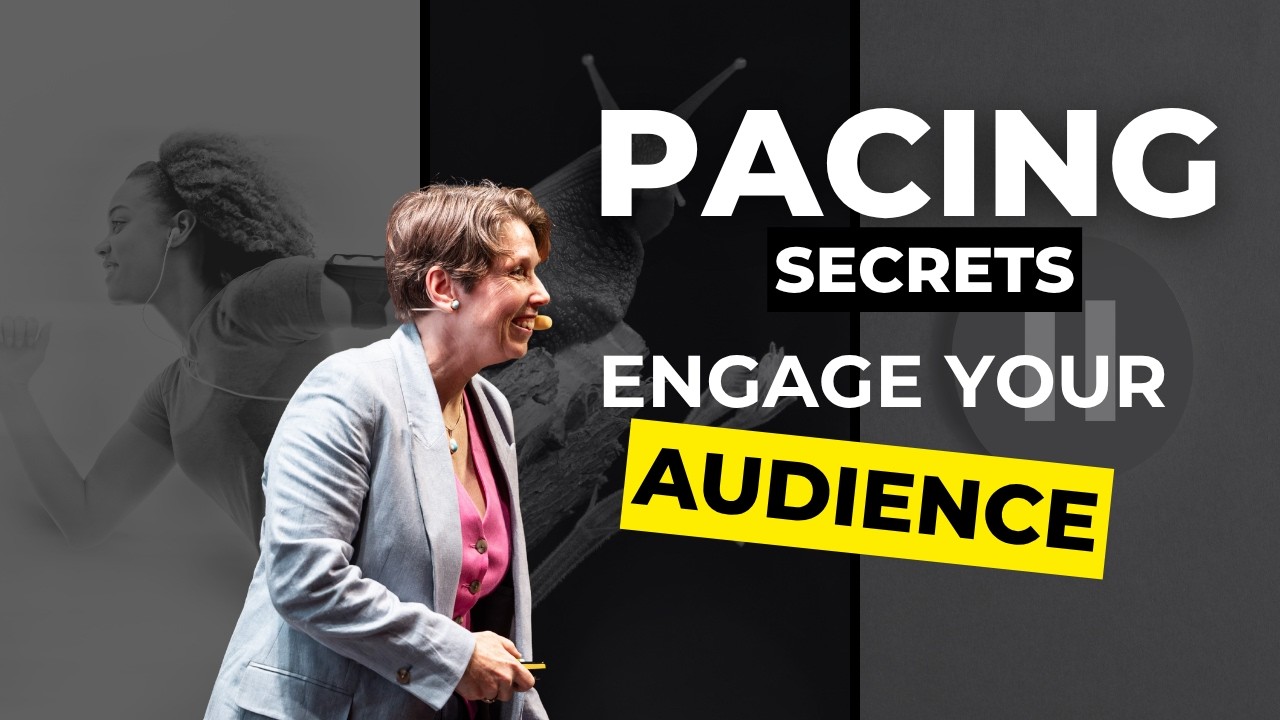
Sarah Archer breaks down four pacing modes for speakers: cruise for conversational flow, accelerate for energy, slow for emphasis, and land for key moments plus pauses. Marking these rhythms onto your script signals what matters and makes you more memorable.
Chapters
Have you ever been in the audience when the speaker starts talking and within 30 seconds you're like, am I at a cattle auction or is this a keynote? Because they're going at the speed of an auctioneer who's drunk 3 Red Bulls and had 5 espressos, and you're like, I'm sure this is interesting, but I just don't know what any of it is. You're still mulling over question 1 and they're on slide 7. Or the other extreme, where the speaker talks so slowly that you start questioning your life choices and you're like, I've aged 3 years since they started that sentence and they still haven't got to the end. This is what we're talking about today, the mastery of pace, because it is one of the big 4: pace, pitch, pause and volume, and it's so important in terms of keeping an audience engaged, understanding, and making you memorable or not, for the right reasons or not. So here's the problem that I see sometimes, and the first thing to say is that this can be a content problem. At the start. If, if you've got too much content and you're trying to fit a 2-hour talk into a 45-minute keynote because you can't discern what the audience needs to hear versus what you feel that you've got to share with them, then that isn't necessarily a pacing problem, that's a content problem. So let's assume that you have got the right amount of content that enables you to deliver your talk without needing to, you know, do it at 5 million miles an hour. Here's some of the problems I see, assuming that content is okay. First of all, having a delivery that's too slow or too flat is gonna make you and your talk sound dull. We want to have contrast, and if there's no contrast or you just take ages to get anywhere, then your audience is going to switch off. Secondly, if you're too fast in your delivery, then you are going to lose your audience. They're not going to be able to keep up with, you know, where you are, and they need processing time, they need you know, time to reflect, and if you've just gone on without waiting for them or giving them that time, then you will lose them. And in either of these scenarios, the outcome not only is that you're going to lose your audience who will just run out of patience with you, but you will also undermine your authority and your message. So we don't want to do that. We want to get the pace of our talk right, okay? And I don't think this is something that many people actually speak about. You know, they'll say, don't go too fast, don't, you know, don't go too slow, or slow down, but they won't give you the nuances of pace that maybe will help you understand how important it is and also give you the tools to be able to deliver that talk in a way that makes you stand out from from other speakers. Okay, so what are the possibilities? That is one of them, that you become more memorable. If you can have the pace of your talk keep your audience engaged, keep them leaning in, yeah, give them the space to learn those big points and consider those big points, you're onto a winner. You will have a more engaged audience. You will come across with more authority, your message will land with more impact, and you are likely going to end up getting more speaking gigs and referrals on the back of that. So, let's cover the principles of pace. Great speakers don't just talk slowly, they talk deliberately, okay, with intention. That's why it's so difficult to chuck a talk together lastminute.com and be able to deliver it to your full potential if you haven't, you know, choreographed some of these performance things into the delivery, and that's what makes the difference between starting speakers and, you know, speakers who are earning multiple thousands per gig. So, great speakers' talk delivery deliberately. That's the first principle. Second, authority comes from variation, from taking your audience on this journey. As I often say, you are like the conductor of an orchestra, and your job is to keep the audience on that journey, taking them up to the highs, the lows, and all sorts of stuff, um, as you know, as the conductor of the orchestra. So the other principle is that it's about rhythm. It's not just about slowing down. So there is a musicality to our voice that we want to bring out and use it as a really powerful tool, as I said, to take the audience on that journey. So let's talk about, you know, actually how do we do this? How do we consider pace? So there are 4 modes Of pace that I wanna share with you today. First of all, we have cruise control. Like, this is normal conversational speed, and we wanna be using this when we're explaining or we're in narrative flow in a story as we move through our talk. So, that's cruise control. Then we've got accelerate. Uh, this is slightly faster, And we want to use this pace when we're building energy and getting that excitement, something's coming, or we're moving through detail. We want to have a level of detail in our stories, in our talk, or in our, you know, what we're sharing around data and so on, but we can afford to be slightly faster, especially if the data is up on the slide as well. Although keep that to a minimum. Then we've got the third mode, which is slow, and this is where we are landing important ideas and emotional moments, okay? This is, you know, this is where that choreography comes in. If you have a one-paced talk, you're never going to get that contrast that you need to take your audience on that emotional journey. Within your stories. Our last one is land. This is a combo of slow and pause, and this is where you have a key insight or you want to land one of those memorable lines that ends up being quoted on X, if you still use that platform, I don't personally, or Instagram or wherever else, or LinkedIn, That's where you want to be using slow and pause. And then the last thing is, uh, using slow and pause also works when you have a piece of comedy to deliver. We always want to slightly slow down as we're heading to the punchline and pause before the punchline, and that's why we call it comedy timing.
Okay?
So let me see if I can give you some examples of that, those 4 paces in action. So I'm just going to use a sentence which is, I had a big surprise yesterday. Okay, so let's do it in cruise. I had a big surprise yesterday. In accelerate. I had a big surprise yesterday. In slow. I had a big surprise yesterday. And in land. I had a big surprise yesterday. So I don't know if that gives you some sense of it. It's sometimes hard when it's out of context, but those are the 3— sorry, 4 different paces that we're aiming to use. Okay? So, have a practice with those. I ran this training in my Skills Lab, and the difference it made to the feel of the words, it was amazing. And what was really interesting is that especially when it comes to slow and land, there is a feeling of discomfort that will come with that, and like, it's I call it the authority, um, uncomfortable zone, because it will feel unusual if you're not used to doing it, um, but you've kind of got to move through it and trust that the pace will work when you want to make that important point. Now, you just heard me slow down a little bit there and And land. You've got to have that confidence and commitment to the pace and the point that you're making to be able to land it and finish it strong. We don't want to tail off, we don't want soft landings, we want that energy and authority to come through in the pace that we're choosing For those points. Okay, so you've got the 4 modes. I've given you an example of it in action, and you've probably heard me use these things in this podcast anyway, because I will be shifting, as you've heard me, through cruise, through accelerate, through slow, to land and pause all the way through this episode. Now, once we've got those 4 modes, what do we do next? So, once we have our talk, and you can practice this with just an excerpt of your talk, I want you to map the rhythm into your talk script. So, looking at where should I be accelerating, where do I need to build energy, excitement, anticipation, where do I need to move through the detail More quickly. Where do I need to slow down? What do I need people to consider, to reflect on? You know, if I'm asking a question, I might be slowing down so they can absorb that. I might use the land at the end of that as well to give them that space. And that's the next thing we need to look at: Where do I want to land? Where are the key things that I want my audience? To take on board, to understand this has weight and this has impact for me. You are consistently communicating and signaling to your audience about the importance of the content you're sharing via the pace that you choose to deliver it in, okay? So have a go at that. First of all, practice those different modes. Say the same sentence and try out the different speeds, or even, you know, use a passage and maybe vary within the passage, and you'll see you can switch between modes quite quickly. If you are using slow around an— slow in land around an emotional point, this is something that I'll need to do a separate episode on, but it keeps coming up when I'm working with my speakers, is that they will try and slow down and pretend, you know, have that pretence of the emotion. If you can feel the emotion before you, you know, if you can get yourself into the space of where you were when that thing happened, as long as enough time has passed that you're not gonna Um, get upset if it's something, you know, that was, um, traumatic. As long as you're going to be okay to do that, I want you to feel the emotion because it's emotion first. And if that comes through, like if you feel excitement, it will come through. You know, I get excited sharing this stuff and you can hear it in my voice. If I was delivering something where I'd felt, you know, frustrated or sad or angry or worried or disappointed, I want to be feeling that first and then sharing it, and that emotion will actually influence your pace subconsciously anyway. But so we've got the cruise control, the different paces. I want you to practice those and have fun trying those out and see what happens in a meeting if you start to use that land, or in a talk, in you know use that land technique, that land mode. And see how it feels to you and to your audience. And then also to map the rhythm onto your talk. So here's your takeaways, big takeaways. Pace isn't about speed, it's about emphasis. And you are signaling to your audience through your pace what emotions they should be feeling, what energy they should, you know, what they should be feeling in terms of energy. You can bring them to you, push them away, all sorts of things with pace. It's such powerful tool that I want you to practice, play with, and master so that you can become that high-fee keynote speaker, that leader who is able to hold your employees in the palm of their hand at a town hall meeting, or when you're leading change. You know, these are such powerful tools for you to use. Great, hope that was useful. As ever, if you get value from the podcast, do subscribe. You can do that if you're watching on YouTube, you can do that, you know, press the bell button below. If you've got any questions or comments, love to hear those, pop them below. If you're listening to us on a podcast, on Apple Podcasts, Spotify, Amazon, you can subscribe there as well, and I'd love it if you could leave a rating. Or review, and you can do that over at ratethispodcast.com/tsc if you're listening to the podcast, uh, or wherever you're listening. And obviously, if you're on YouTube, you know, leaving a comment and subscribing, recommending it to people would be smashing. And I want to thank you for your attention. It's been brilliant being with you. As I say, I hope you got value. I will see you next time. Until then, you know what I'm gonna say. Don't forget to go out, grab your life by the nuts, and get pacing. Bye-bye.
It's a nightmare. You're an expert with so much to say, but now that you've been booked to speak, you're struggling to know exactly what to talk about. You want a talk that engages the audience and wins you new clients without you losing your personality or anyone feeling pitched to. But what happens when you sit down to create that talk is that you end up staring at a blank page for ages, or worse, surrounded by hundreds of sticky notes with content that you could include.
With so much material, you just don't know where to start or finish.
Don't worry, because many experts like you face exactly the same challenge, and that's why I created the Blank Page to Stage Guide. In just 50 minutes, this breakthrough resource is going to help you identify the big idea of your message, make it relatable for the audience that you're speaking to, and convey it all in a way that gets the audience inspired and on board with your idea. And it works even if you have tons of material or you're subject feels less than exciting. If you want to cut through swathes of content and get a talk that you're excited to share, your audience loves, and wins you new clients, then grab your Blank Page to Stage guide from saraharcher.co.uk/newguide-tsc. Oh, I forgot to say, it's completely free.
Enjoy!
More from Sarah




The Skill That Helps You Connect With Any Audience with Michelle Mills-Porter




What Moderating World Leaders Taught Me About Great Communication with Xenia Wickett


