[Quick Tip] Does Your Idea have Enough Impact? - 302
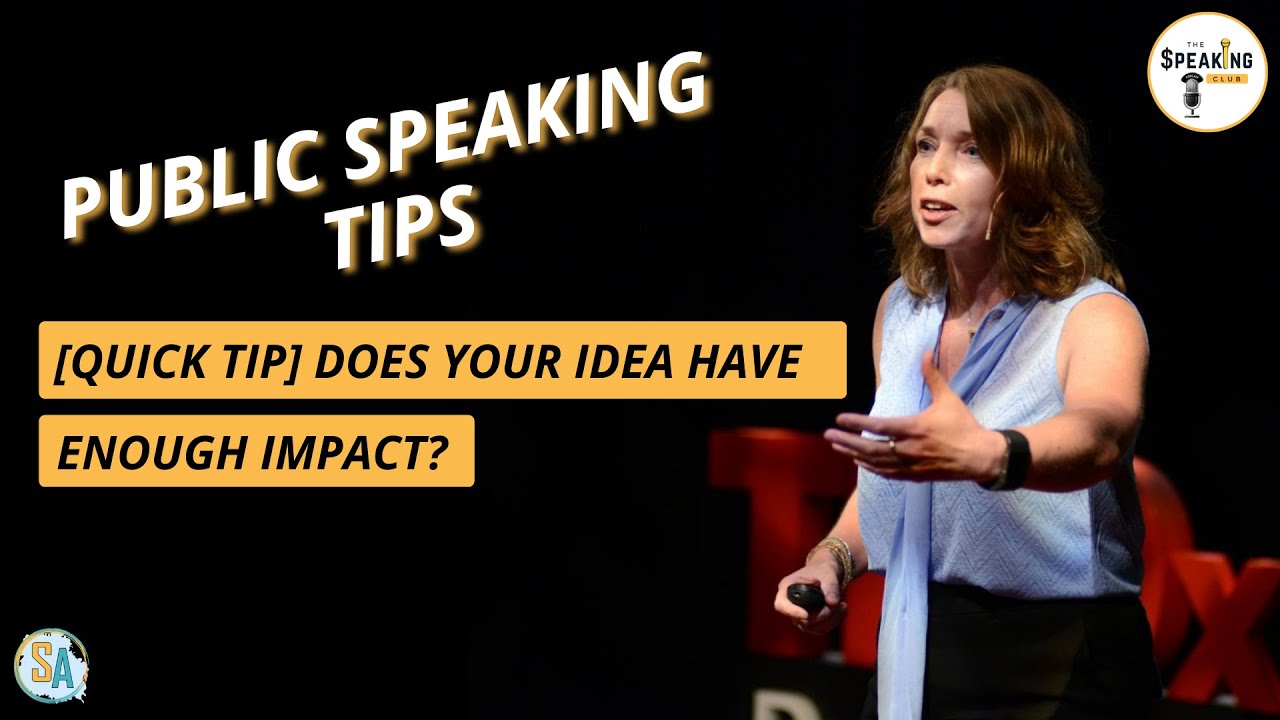
Sarah Archer explains why a speaker's core idea must be emotionally resonant and memorable. She uses Nicola S. Morgan, a Channel swimmer, whose talk centered on "unfinished business" as an example of high-impact messaging. Archer outlines a process: generate many titles, push past the obvious, test concepts with others, and use tools like ChatGPT to refine your idea.
Chapters
Think of these quick tip episodes like a cold water swim. In just a few minutes, you can get some amazing benefits to support you on your speaking journey. And bonus, the only thing that's getting wet here is your appetite to try this stuff out. And if you have a question you want me to answer about anything related to speaking, storytelling, pitching, performance, or humour, then DM me on Instagram, LinkedIn, or Twitter. Hey, welcome to the Speaking Club Podcast. It's great to have you watching or listening to the show. I want to open this show with this: people won't remember what you said, they won't remember what you did, but they will never forget how you made them feel. feel. That is a quote from Maya Angelou. You've probably heard it before, it's well used, potentially overused, but it's so appropriate for what I want to share with you today because as speakers it's likely that our audience won't remember your name, they will probably forget what you said, the exact words, but they will remember how your message made them feel. And that's whether it was positive or negative. We want them to have a positive feeling from your message. We want it to affect them in a powerful way, and in order for your message to do that, what matters is the idea that is at the heart of it and how you communicate that idea to them. A couple of weeks ago, I was watching a speaking competition. And it was the semi-final I was watching, and I remember hearing one of the speakers, and as soon as they finished their talk, I knew that was the person that was going to win the competition. Now, they were all being judged on the same criteria: how engaged they made the audience feel, how well they used the space and the props, how bookable they, their talk was, they were. But they all pretty much ticked those boxes, but there was this one speaker who had the edge over the others because her idea was so powerful. Let me give, give you more of what she said. So, her name was Nicola S. Morgan. She's done a TEDx, and I will link To that in the show notes so you can have a look for yourself. But essentially, what she shared was this. She was a Channel swimmer, and the first time that she swam the Channel, she failed. She had to get hauled out of the water, she had to be rescued. And when she got put on the boat, she was obviously feeling really down. But the captain of the boat said to her, don't see this as failure, see this as unfinished business. And she built her talk around that idea, and I was just like, that idea is so powerful, it's really sticky, it lingers with you like a song you can't forget, it's universally like Appealing, and it just, you feel it in your core. It was really powerful. And she did get through to the final, and then true enough, eventually won the competition. And that's the thing that I want to talk to you about today, is your idea. How does your idea measure up to that? Does it linger? Does it make people feel stuff in their core? Is it universally appealing? Does it show people new possibilities or reframe the way that they see their life? And if it doesn't, then you've got some work to do because this is where we want to get to. As speakers with our talks. And I know what you might be thinking, oh, that sounds like a big, big menu of things to check off, Sarah, and it is, it is a lot, but if you get this right, if your idea is so impactful and so powerful that people can't get it out of their head, that they remember it, it is gonna open doors for you, as long as you've got the other stuff as well, we want the whole package, but if this idea resonates like that, makes people feel emotions, makes people shift the way they see their lives, they see the world, they see themselves, then that is gonna give you a massive return on the energy and investment and commitment to get your idea into that shape. And that is the thing, like, some speakers will have this idea come to them gift-wrapped just like that, like Nicola did. I mean, it was, you know, it's a, it was a gift what he said to her, and it clearly had an impact on her life because she went and did another swim and she achieved her goal. And she's sharing that with other people now and, and educators and children and all that good stuff. So maybe you've already got it, it's there and it's fully formed, but maybe not. Maybe you need to work on your idea to get it to that place, and it will take you energy and time and thoughtful, you know, creating it using your imagination. It will— you will be able to get there, I promise you, but you will have to maybe work at it if it's not already been given to you on a plate. And that's, you know, one of the things that you might be struggling with is actually getting it to there. So I wanted to give you a few tips. To help you get it into that place. So first of all, one of the things that really helps you find the gold sometimes is tapping into your intuition. And the way that you do that is going beyond the obvious. Like when I work with people and we're talking about talk titles or how they open their talk, I want them to do 20 ideas. And then go beyond that, because it's after the obvious ones that your intuition kicks in, that you start getting things that you hadn't even considered before, looking at it from a different perspective. It'll— you'll get the gold if you keep going, but most people stop at obvious. Okay, so keep going. Maybe do 50 ideas, 100. Do it one day, come back to it the next. Your mind will be working on the issue as well. In the background, in the shower, in the car, you know, listening to other stuff. Maybe you'll get inspiration from a book that you read or a podcast that you listen to. Something will click. So, you have to have some patience not to grab the first thing. And then maybe when you have a few ideas that feel like they might work, that they'll connect with your audience where they are, give them this powerful, you know, new way of seeing things, test them out on people. That's a great thing to do, get some feedback. Another tip you can do is use ChatGPT. Now, you— I love ChatGPT as a sounding board, as a— as an idea generator, you know, maybe doing your stuff and then doing— letting ChatGPT have a go and then smashing those ideas together. So, ChatGPT won't have the answer, I promise you, because it won't be you. Won't have your voice, won't, you know, have that sort of spark of creativity, imagination, and intuition that you will have, but it might be a great prompt. It might just give you a way in to see things in a different way because this is one of the biggest obstacles that people have to getting this idea that lingers, that has impact, is our expert mindset because sometimes we get stuck in seeing our thing from our perspective We can't see beyond that. We can't look at it in, you know, 360, see the problem from the perspective of our audience to be able to present it to them in a way that is, uh, you know, powerful, um, that they feel it at their core. You've got to strip back that expert mindset in this and try and see things with fresh eyes, potentially, to get to where you need to. And it, you know, perhaps this is something that you need to get some external help with because we can get stuck in that, in that mindset, and sometimes we need someone else to come and unlock that big idea and get us to see things in new ways. That's one of the reasons why I created the Blank Page to Stage Guide that you can pick up for free is because people struggle to see that big idea. You're welcome to grab that. It might help you see things from a new perspective. But this is absolutely something that I want you to give time to, give thought to, let your imagination, you know, run loose on to come up with this powerful sticky idea that lingers. Because if you can get it, I promise you, you know, it will open many doors. It will make your talk more memorable. It'll help you in other ways too, in terms of building your talk around it. Building your messaging and posts and, you know, marketing messaging around it. It will help you if you've got a TEDx talk and you've got an idea that's so powerful, it will help you get, you know, more views on your TEDx video. It will be so worth it. So, please, please have a go, and there is help, as I say, with the Blank Page to Stage guide that you can pick up. I've done that for you. But you can probably get there on your own as well. Good. Well, I hope that's been useful. I hope that's given you some ideas. What's your powerful impact idea that lingers? Have you got it already? Do you need to do some work? Smashing. Well, look, thanks again for listening, watching the show. If you like it, please subscribe, leave a comment below. If you're listening on a podcast audio, then do leave a rating or review, and you can do that over at thispodcast.com/tsc. I'd really be grateful if you would take a couple of minutes to do that. Well, that's all from me for this episode. You know what I'm gonna say next. Until next time, what I want you to do is to go out, grab your life by the nuts, and get cracking. Bye-bye. It's a nightmare. You're an expert with so much to say, but now that you've been booked to speak, you're struggling to know exactly what to talk about. You want a talk that engages the audience and wins you new clients without you losing your personality or anyone feeling pitched to. But what happens when you sit down to create that talk is that you end up staring at a blank page for ages, or worse, surrounded by hundreds of sticky notes with content that you could include. With so much material, you just don't know where to start or finish. Don't worry, because many experts like you face exactly the same challenge, and that's why I created the Blank Page to Stage Guide. In just 50 minutes, this breakthrough resource is going to help you you, identify the big idea of your message, make it relatable for the audience that you're speaking to, and convey it all in a way that gets the audience inspired and on board with your idea. And it works even if you have tons of material or your subject feels less than exciting. If you want to cut through swathes of content and get a talk that you're excited to share, your audience loves, And wins you new clients, then grab your Blank Page to Stage guide from saraharcher.co.uk/newguide-tsc. Oh, I forgot to say, it's completely free. Enjoy!
More from Sarah




The Skill That Helps You Connect With Any Audience with Michelle Mills-Porter




What Moderating World Leaders Taught Me About Great Communication with Xenia Wickett


