[Quick Tip] Judging 55 Speakers: The Good, The Bad and The Ugly - 320
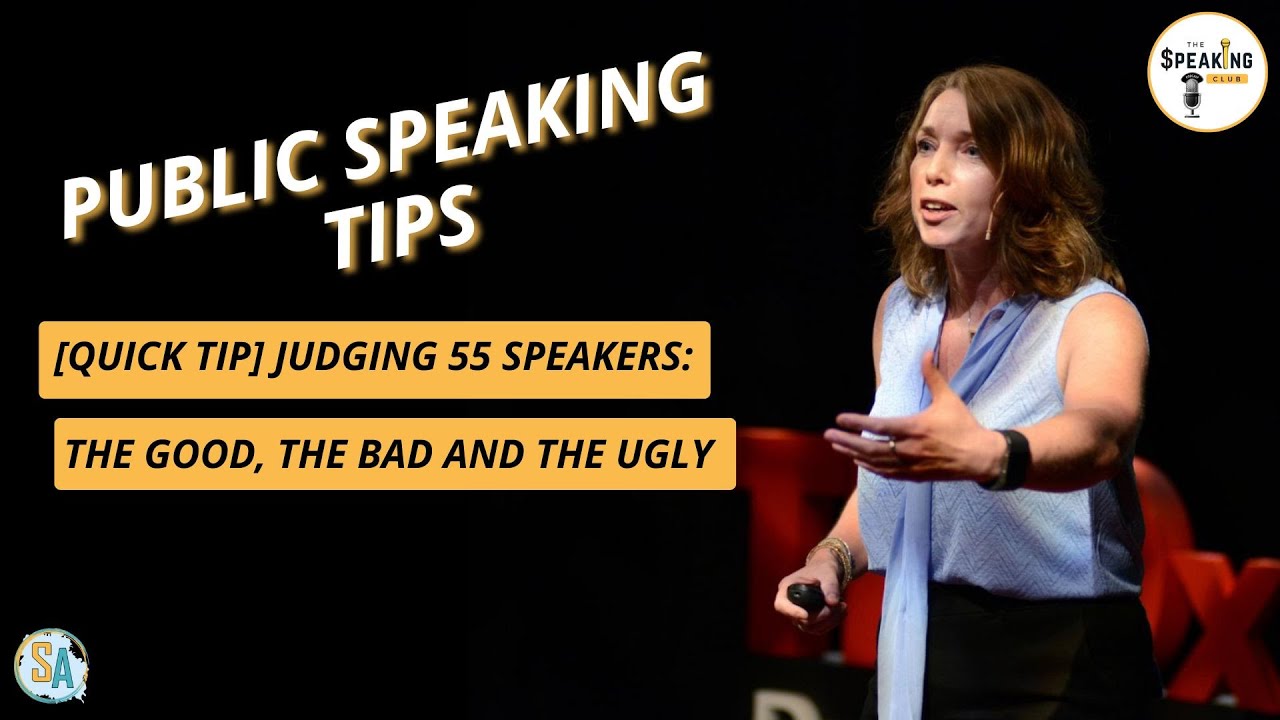
Sarah Archer judged 55 entries for the Speaker Awards and breaks down what worked and what didn't. The best speakers used characterization, dialogue, and metaphors; the worst had no narrative arc, submitted the wrong format, or pitched products. She covers stage presence, vocal variety, and why slow pacing and monotone delivery kill even good stories.
Chapters
Think of these Quick Tip episodes like a cold water swim. In just a few minutes, you can get some amazing benefits to support you on your speaking journey. And bonus, the only thing that's getting wet here is your appetite to try this stuff out. And if you have a question you want me to answer about anything related to speaking, storytelling, pitching, performance, or humour, then DM me on Instagram, LinkedIn, or Twitter @SarahArcher15. Hello and welcome to episode 300 Welcome to episode 120 of the Speaking Club podcast. How are you? I tell the truth, I'm recovering from something that happened this morning. Um, what basically what happened was I went down to get the bin out from the garden and I felt like John Travolta on Grease. My summer dreams have been ripped at the seams because my paddleboard Exploded. I'm not gonna lie, my eyes began to wella wella up before I pulled myself together, thought about what else was going on in the world, and realised I was experiencing what people call a first-world problem. Anyways, enough of my paddleboarding exploits, or lack thereof, as it turns out. Let's get on with the show and talk about other people's dreams, perhaps your dreams of winning an award for your speaking. Okay, so this year I got asked to be a judge for the Speaker Awards again, which I was chuffed about, and I was this year judging Best Storyteller and Best TEDx Speaker, and this always creates a bit of excitement in me as well as a bit of trepidation because judging these awards takes a lot of energy, and time, and especially this year because, get this, there were 55 entries. Yes, 55 entries across the 2 categories, and I'm not gonna lie, by the end of the judging session, I had square eyes, and I'm sure I wore out the carpet between, uh, my laptop and the kettle, but I loved it at the same time because it was an absolute treat to see so many speakers from all walks of life, coaches, consultants, Olympians, adventurers, you name it, they were all in these awards. And the— whilst the topics that they spoke on varied wildly, and the quality varied too, what didn't vary was the criteria that I had to judge on. So, I was looking firstly at content. Was it well structured? Was it engaging? And did it have a clear message? And then delivery. Did they have stage presence? Was there good vocal variety? Did they use body language in performance? That was the sort of key criteria I was judging on. But obviously, when you are judging people and they're ticking the same boxes, there are things that make the difference either way. And this is what I want to share with you. I want to give you the inside track, the big scoop. On the good, the bad, and the ugly from those entries. Think of this as your unofficial guide of what to copy, what to absolutely avoid if you want to do a cracking talk or enter some speaking awards yourselves. Okay? Okay, let's kick off with the good, or rather the great, to be fair. Here's some things that made people stand out for me. First of all, characterisation and dialogue. The top scorers for me didn't just tell a story, they performed it, they brought it to life, they became the characters, and this was just using simple gestures, changing posture or voice, and suddenly I wasn't looking at a speaker, I wasn't watching a speaker, I was in the scene with them. And it doesn't take going to drama school, although some speakers do take acting lessons or improv lessons or comedy lessons, um, because they do help, but it does take some intentional movement and vocal play and a lot of rehearsal. You know, you can absolutely do this yourself, you can role-play with someone else, you can see, you can watch things, for inspiration. Um, but this is something you can absolutely do and it will make all the difference. Okay. Next thing, powerful metaphors. You've heard me talk about this tons on this podcast. The fastest way to get your audience to feel and understand is to relate your message to something they already know about, something that's concrete for them. One metaphor can unlock 1,000 light bulb moments. But you have to fully transpose it. You can't just sort of half-ass the metaphor. You've got to fully, you know, connect it to what they— what you're— the point you're trying to make to what they know and bring it to life, okay? So, that's something to bear in mind. Use metaphors, but commit to them. Okay, next thing, storytelling with relevance, and this is kind of similar in a way. This really stood out again. There were some people that just told their tale of woe or their tale of triumph, but they didn't show what it meant for the audience. So, you wanna be saying, here's my story and here's what it means for you. And a lot of speakers don't do that. And you've always gotta be understanding that your audience wants to know what's in it for them. So what? What does that mean for me? And you've got to do that job. So fully commit and transpose your story into their lives or into their organisations or whatever. Makes a big difference, has a big impact. Okay, next thing, stage presence. Now, this doesn't mean swaggering about the stage or having jazz hands, right? The best presenters were confident, natural and completely themselves. And yes, this only happens after a lot of rehearsal. I'm working with a TEDx speaker at the moment, she's doing the talk this week, and it— she's done amazing, committed to being in the rehearsal studio with me week in, week out. It's something that people get in my Green Room programme, you get a weekly rehearsal slot with me, She's been there every week. She's turned up. She's felt the fear because doing rehearsal can be confronting, as I've probably mentioned before, because there is that fear of failure. If you've just written the talk, you've got your script, you've got the content, you're like, oh, I've got the talk. But what it feels like going backwards when you go into the rehearsal studio. But this is where like the magic happens truly. And she's committed. She's gone through that arc. Until she knows it so well, she's able to bring it to life and with her personality and authentically, and it's just really, really good. So, work on that. Go through the arc of, like, learning it, getting comfortable with it, making it completely your own, letting go of the script and just being you, so you can be present with the audience. Okay, so there are the good or the great. Now let's shift on to the bad. Hmm. Okay, here's the first one, the adult child, as I'm calling it. And this is all about making sure that there is congruence in the character that you're portraying. There were some entries where someone, for example, was portraying a 5-year-old and was using language that no 5-year-old would ever Use like subconscious fear response, and if you do that, the audience is going to go, "What? I don't know any five-year-old that would be talking about their subconscious unless they were some gifted special child." And and what it does—I'm going to use an acting term here—is break the fourth wall. When you go to the theater, if an if if an actor calls out to the audience, they break the fourth wall, and that breaks the connection, it breaks the magic of that moment, and it will distract your audience. So, make sure that the language that you're using is age-appropriate, context-appropriate, etc., for the character you're playing, or you will risk pulling the audience out of the moment. Okay, next one, the audiobook reader. This one is something I see a lot with authors. It's where they kind of— it comes from the place of expecting their book to seamlessly translate into a talk, which it doesn't, unfortunately. And I saw things like, the dappled sunlight caressed my cheek as I waited for the handsome stranger to come through the door. Suddenly, there was a chilling feeling as I heard a creak. Like, you don't need to be giving a ton of detail. You just need, in a talk, to give enough for the audience to get the context, to put themselves in the place. A couple of details, specific details, and then move on with the story. You're not writing a novel, you're giving a talk. Completely different ball game. Okay, macro versus micro storytelling is the next There were some entries where it felt like they were cramming their whole life story into a 5-minute video, and it doesn't work, especially for this type of thing. So, my advice is to choose one powerful anecdote, to zoom in, a vignette if you like, and then pull the micro-message out of it. If you try and cover too much ground, you won't have the emotional connection. You just won't have the same impact. Less is more when it comes to emotional connection. We go in and then we extrapolate out. Okay? Next one, the kids' TV presenter. Oh, I just— I was a program when I was young called Play Days, I think it was. And I loved it, but they were so big, like they're completely joyful, enthusiastic energy, and this over-enthusiastic syrupy delivery can make the audience feel like you're reading them The Gruffalo if you do it when you're on stage or in a speaker award video, whatever. We want you to speak to us, with us, not down to us, okay? So please be careful of that. Do not become a kids' TV presenter when you're on stage or Or indeed doing a video, right? Smashing. Okay, next one, the tortoise pace. Oh my goodness. There were some awards that only felt right at 1.5x speed on playback. Slow talking might feel dramatic to you, but on the receiving end, it is like watching paint dry at 0.5x speed. Pacing matters, and again, this is something that you need to practice. Don't make your audience reach for the speed controls, and certainly again live, it's right to have a dramatic pause occasionally, especially when you want the audience to do something like go into their memory for a specific question or you're signposting something important is coming, but generally do not talk at a super slow speed or you will again lose your audience. Okay, next one, the one-note pony. Monotone delivery equals nap time for your audience. Again, this is something, it's a speaking skill. We're not all born with being able to vary the pitch and tone of our voice, the pace, the speed, and so on. But it's a skill that we can learn. So, yes, maybe some people have a more naturally melodic voice, but you can absolutely learn this and, and be able to train your voice to do this stuff. And if you want to be a great speaker, if you want to win awards, then it's something you're just going to have to do. Okay? If your voice never changes, as it was in some of the entries, it means that you either don't know your story well enough, or you're so focused on getting it right that your personality is missing in action, or you do just have a monotone voice. And the truth is, your voice is a tool in this job as a speaker, and you've got to sharpen it. Okey-doke. So that's all the bad. Now we're coming to the ugly. It's not a long list, but it is important. Dun dun dun! Some entries, and I say this with as much love as I can generate, in the storytelling category particularly, there was no story. There was just ranting. Long-winded opinions with no narrative arc thread. Remember, telling is not storytelling, okay? You just got to be mindful of this. And even people that kind of did have a little bit of story, it was just like— it was like a lecture. And we don't want to lecture our audience, right? We want to bring them with us on the journey. Um, so you please be mindful that you are actually sharing a story. And if you want some help with storytelling, you know where I am. It's my bag. But, you know, you can do this on your own. You just gotta think, what, what do I find? Watch stories, read stories, get some basics of storytelling. Okay? Now, these entries, they were 5-minute videos. And for, for some of the categories, Uh, some people just submitted their showreel. Now, I love a good speaker reel. It is an important tool and asset for you to have as a speaker, but for the love of microphones, do not enter it into a storytelling category. Read the brief, okay? Don't just flash in your speaker reel. Just no good. Unless the only reason that you could do that and get away with it is if the story was It is the same story and you were using your speaker reel to show it from different, different talks that you've done. But even so, I think, you know, stick to the brief is the message here. And the last one, the last ugly, please do not try and sell me your book or anything else in your speaker entry. I know this sounds unbelievable, but people did this. Top marks for confidence, but really, that was a big turn-off. So, there you go. The good, the bad, and the ugly, and my behind-the-scenes judge's report. So, I think the takeaways here are big ones, really. Read the brief. Make sure that if you're telling a story, or sharing a story, I should say, rather than telling a story, that you are bringing it to life, that there is actually a story there, that you're not treating it like a novel. Make sure you bring things to life with your, the whole of your being, and bring your personality into it. Do not sell anything, big one, and don't take, you know, judges for granted, their attention for granted. Okay, so if you are creating a talk, entering an award, or just wanna level up your storytelling, I hope that this has helped you. Giving you a peek behind the curtain, if you like, and some ideas to borrow or importantly some to bin. And remember, it is not about being perfect. It is about being yourself, your authentic self, but also putting the audience first, thinking about the message that you wanna share with them, what journey you need to take them on in order to land that message. So that's it from me. Thanks for joining me. As always, if you found this episode useful, Share it with someone who needs a nudge towards great in their speaking, and I really appreciate you taking the time to join me, and I look forward to being with you next time. In the meantime, keep sharing your stories. If you do get value from the show, please consider subscribing if you're watching on YouTube. Also, leave a comment; that'd be amazing. If you're listening to the podcast anywhere else. Leave a rating or review wherever you're listening, and you can do that also at ratethispodcast.com/tsc. And yeah, all that's left for me to say is have a wonderful week. I'm off to find someone to fix my paddleboard. Until next time, don't you forget to go out, grab your life by the nuts, and get cracking. Bye-bye. It's a nightmare. You're an expert with so much to say, but now that you've been booked to speak, you're struggling to know exactly what to talk about. You want a talk that engages the audience and wins you new clients without you losing your personality or anyone feeling pitched to. But what happens when you sit down to create that talk is that you end up staring at a blank page for ages, or worse, surrounded by hundreds of sticky notes with content that you could include. With so much material, you just don't know where to start or finish. Don't worry, because many experts like you face exactly the same challenge, and that's why I created the Blank Page to Stage Guide. In just 15 minutes, this breakthrough resource is going to help you identify the big idea of your message, make it relatable for the audience that you're speaking to, and convey it all in a way that gets the audience inspired and on board with your idea. And it works even if you have tons of material or your subject feels less than exciting. If you want to cut through swathes of content and get a talk that you're excited to share, your audience loves, and wins you new clients, then grab your Blank Page to Stage Guide from saraharcher.co.uk/newguide-tsc. Oh, I forgot to say, it's completely free. Enjoy!
More from Sarah




The Skill That Helps You Connect With Any Audience with Michelle Mills-Porter




What Moderating World Leaders Taught Me About Great Communication with Xenia Wickett


