Style That Speaks: How to Dress for Impact on Stage with Kay Korsh - 318
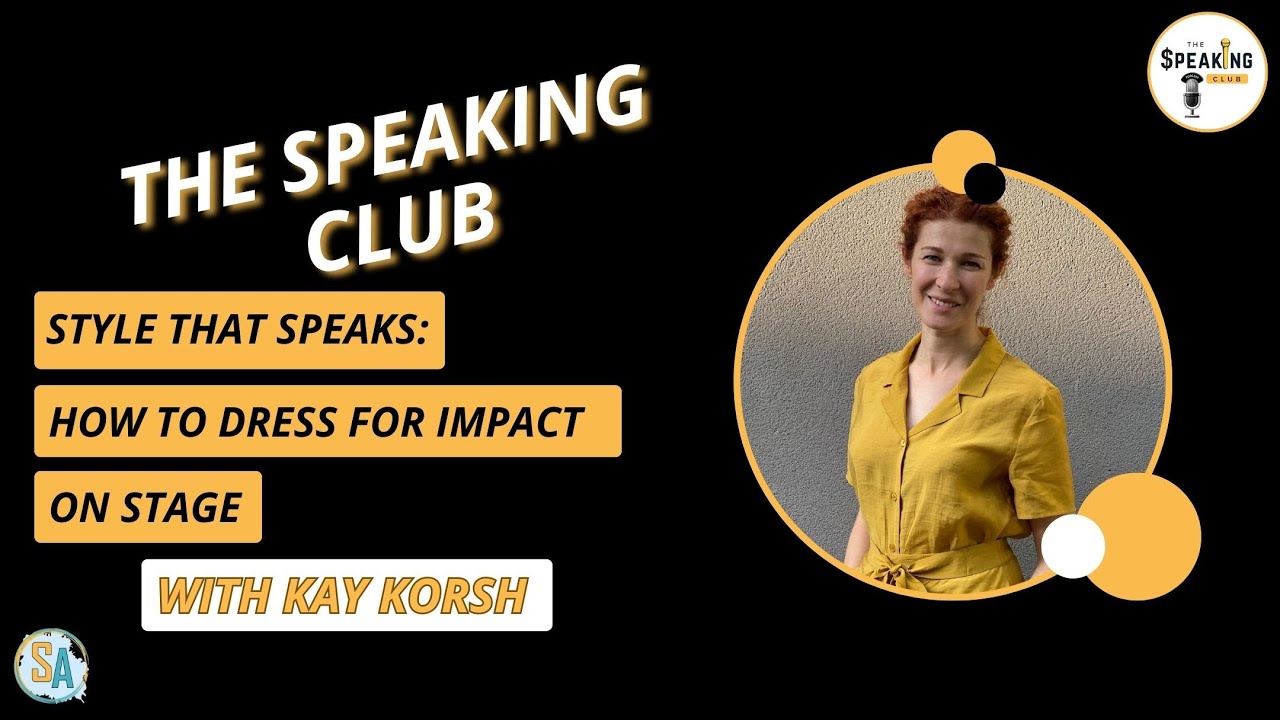
In episode 318 of The Speaking Club Podcast, host Sarah Archer welcomes professional stylist Kay Korsch to discuss how speakers can use clothing as a strategic tool to enhance their stage presence. The conversation begins with a quote from Oscar de la Renta about style being personal, setting the premise that authentic appearance supports authentic messaging. Kay explains the difference between designers (who create new garments) and stylists (who curate existing pieces), and shares her journey from Soviet‑born fashion enthusiast to celebrity stylist for brands like Prada, Tom Ford, and Burberry, before pivoting to work with speakers during COVID‑19. She outlines a systematic process for speakers: start with personal comfort and authenticity, then align the look with the audience’s expectations and the speaker’s message. Practical advice covers fit and tailoring (ensuring correct sleeve, trouser, and jacket lengths), avoiding wardrobe mishaps (unraveling ribbons, loose props), using color strategically (matching brand hues, complementary tones, and skin tone), and being cautious with accessories and hairstyles. Kay emphasizes the value of a decluttered, well‑organized wardrobe for mental clarity, suggests incremental wardrobe edits, and recommends travel‑friendly fabrics and handheld steamers to keep clothes crisp on the road. Cost‑effective strategies include re‑mixing existing pieces, using visual boards (e.g., Canva) for inspiration, and testing outfits on camera. She shares client transformation stories that illustrate how a tailored style can differentiate a speaker in a niche and win business. The episode concludes with Kay’s personal reflections on overcoming perfectionism, recommended books, business advice, and how listeners can access her free resources (color quiz, FAQ guide) and connect via LinkedIn. Throughout, the focus remains on actionable, authentic styling that supports a speaker’s message without becoming a distraction.
Chapters
Hello, you are watching and listening to Sarah Archer and episode 318 of The Speaking Club Podcast, and I want to open this show with a quote from designer, fashion designer Oscar de la Renta. He was the first designer from the Dominican Republic to achieve international fame, and he styled celebrities, first ladies, and royalty. And this is what he had to say. Fashion is about dressing according to what's fashionable. Style is more about being yourself. I started this podcast for 2 reasons, because I want to help people recognize the power of stories and humor in speaking, and because I believe it's your message that counts, not the number of ums and ahs you use. There are some organizations that want to create robots, They want you to sacrifice your personality in order to speak perfectly. I want to let you know that you can be yourself and a sensational speaker. So if you want to be a speaker that connects and engages authentically through stories, a speaker that gives value as well as a great performance, then welcome home. Hey, welcome to the show. It's great to be back with you.
I hope you're well.
I hope you're having a brilliant start to the year. Things are very strange everywhere, but we keep on going, and we get out there sharing our message, transforming people's lives, getting on stage, and I hope that you are moving forward in your speaking journey. I love that quote from Oscar de la Renta, style is about being yourself, and that, you know, that's what I'm all about, being your authentic self on stage, bringing your authentic personality and your unique stories to inspire people, move people, get people into action, and, uh, and also, you know, making some moolah for yourself while you're doing that. Although the people that I work with, first and foremost, they're mission-driven. Probably you are too. Anyway, one of the things that I emphasize with the people that I work with on their signature talk is that when it comes to speaking, you are the writer, the director, the producer, and the performer, and you are putting on a production for your audience. And if we continue with that metaphor, you're also responsible for costume and styling, which is also a critical element of your speaking. I mean, there are the fundamentals of making sure that you are comfortable And you feel able to fully express yourself when you're speaking, but also you need to consider how you want to express yourself and how that aligns with your message. Now, this is something that I am not equipped to help you with. Fashion and style, not my bag, but I've brought someone onto the show today who is eminently qualified. To get you looking fantastic and feeling fantastic on stage, and that is Kay Korsch. Now Kay has worked with fashion royalty— think Prada, Tom Ford, Burberry— and now she brings that style savvy to professionals and speakers who want to show up with more confidence, more authenticity, and have a whole lot more impact. And through her company Mind Over Fashion, Kay helps people discover their true style so they feel like themselves, only elevated, and they use their wardrobe as a secret weapon to connect with their audience. So if you have ever stood in front of your mirror or wardrobe wondering whether to go polished pro or quirky creative, or you've walked on stage and realised halfway through your talk that your waistband's digging into your tummy, this is the episode for you. Let's dive in and discover how your clothes can speak just as loudly as your words with the fabulous Kay Korsch. Welcome to The Speaking Club, Kay Korsch.
Thank you very much for having me, Sarah.
It's an absolute pleasure. Uh, yeah, I'm— this is going to be a popular episode, I think, because, uh, who Who doesn't want to look good and connect with their audience on stage? So let me start by— let's fill in some background.
I want to ask you, what got you started as a stylist?
Well, I've been interested in fashion ever since I remember, which is weird because nobody else in my family is into fashion or creative at all. I grew up in Soviet Union and So I always wanted to be a stylist, even before I kind of understood the difference between a stylist and a designer. Do you know the difference between the two? Because it can be a bit subtle.
I think it would be useful if you made that distinction for, well, for me and for other people listening, maybe.
So designers are people who invent new designs, new clothes, maybe using different fabrics and silhouettes. And stylists take all of the clothes which have already been made and combine it together and then apply it. They either, I guess, specialize in just putting outfits together on models or working with real people or different brands. So there are different things stylists can do, but it's ultimately just combining existing clothes together.
Cool.
So I always knew that I wanted to be a stylist, not a designer.
How did you get into it? Is it something that's easy to get into, or is it— was it a challenge?
I wouldn't say it's easy because it's one of those industries which are really oversubscribed. Because as you said, this episode is going to be interesting for people because fashion and style is something which is exciting and creative and obviously draws people in. So a lot of people, for various reasons, want to work in fashion. And so there is high demand for people to work in fashion, but I guess not as much space. And I guess I always was quite clear. I always loved all the things which I've been doing, but it has been developing throughout my career. And for the biggest chunk of that career, I worked with celebrities and luxury brands a lot in magazines, dressing celebrities. And then when COVID started, I decided to pivot and started working with speakers. And I kind of first dipped my toes into it, trying to gauge how I'm going to like it or not. And I guess I was— one of the things was that I was a bit worried if it's going to be as creative as working with celebrities. And I always loved the adrenaline of working with celebrities and on shoots and all of that excitement. And I wasn't sure if I will find as much creativity in what I do now, but actually there are a few bits to the way my business is structured now which are more creative than what it used to be. So that's quite interesting. I absolutely love it and, yeah, really enjoy doing this now.
And is it as glamorous as we might perceive it to be when you're working with the magazines and the celebrities and the luxury brands? Is it glamorous or is it a slog?
I would say yes and no. It's definitely glamorous because you get to go to all the parties and fashion shows and, you know, meet all of these exciting people. who then when you talk to other people about that, they're like, oh, wow, you know so-and-so? You worked with so-and-so? But obviously there is the other side of things, which I guess you do more when you're just starting out. So when I was starting out and was more assisting, I would drag the suitcases around with clothes. And then you do less of that, and then you don't do that because you have assistants who do that for you. But there is also this thing about, ah, this expensive shoe is lost, or, you know, this necklace is lost, what a disaster, and stuff like this. Which, uh, or things like, um, I, um, just things maybe you might not agree as a person, uh, and as the, the way you see things. So for example, I also used to work on commercial projects, and there was one project where we had everything pre-agreed, pre-confirmed with the brand. It was with the company who the shoot was for, and it was in a different country, and everything was kind of taken from the UK to the location. And then when on the day of the shoot, we were kind of going through everything and then the person, the representative of the company wasn't sure about the shoes even though they were pre-confirmed.
Oh no.
So we had to send somebody to drive like 100 miles to get a different pair of shoes, which was probably about, I don't know, €400 for a pair of shoes. And they weren't very different. And when you, when you are in a situation like this, you think, hmm, is it really worth it? So, you know, there were situations like this which I wouldn't call, um, glamorous. I would call that it's a bit unnecessary.
Yeah, absolutely. And now it'd be remiss of me to not ask who, and I guess fame is subjective anyway, but who would you say is the most famous person that you've styled?
One of the most favorite and famous is probably Elizabeth Debicki, who was in The Crown as Diana, and she's just amazing. And yeah, it was exciting and interesting, but I've been quite lucky, I would say. I think that I mentioned her because that's kind of maybe my personal preference, but everybody really who I worked with, I've been very lucky. They've all been lovely and fun to work with. So yeah, it was fantastic.
Brilliant. And I guess, so we established you've worked with actors and you've worked with celebrities. How does styling for speakers differ from working with those people in the entertainment industry?
I think I chose working with speakers exactly for the reason of them being most similar, because they're also exposed to people and to cameras, and that you need to get their look as close to perfect as possible because they're just scrutinized. And you can see on video all the, oh, I thought it looked perfect, but actually it doesn't. So all of those things are the same. There is a lot of similarity. Obviously, I think celebrities, because they're used to being recognized, they have a bit— and I think what I found interesting working with, being in the environment, in the room with the celebrities, that they would quite often what's the word, kind of try to change the subject and bring attention onto you rather than attention onto them because they're probably so used to people asking them questions, they want to avoid that. I remember this with Ben Whishaw. He's really, really lovely to work with. It was so interesting how he immediately As soon as I kind of started speaking to him, he diverted this attention onto me and started asking me about Ukraine and, you know, like everything. And I think I can understand why. So with speakers, I think they're probably more chill about this. They don't— it's not— they're not in the place where everybody is kind of trying to get them and find out about them.
But the speakers want you to ask questions about them.
Yeah, no, that's true. But they're all really interesting people.
Yeah, yeah, no, absolutely, absolutely. Cool. Okay, so I guess one of the other things may be that when the— I don't know if this is correct, but it's a perception that I have— is that actors and celebrities are often playing a part for the, the photo shoot potentially, and also presenting an image for the brand, whereas speakers are wanting to bring their authentic selves and personality to the stage. And I wondered if you could share how you think speakers can get the balance right between, you know, bringing their authentic self and personality to the stage while still meeting the expectations of the event and the audience? Because there sometimes may feel a bit of incongruence there, or, you know, a pull to be something other than yourself.
I always go through the same process with everybody who I work with, and that process always starts with what the speaker, what the person is comfortable with and where they would feel most authentic. And that comfort represents itself in both physical and emotional state.
Mm-hmm.
So we kind of go through questions on how to identify what they actually like, to just bringing it into their consciousness. And only after that process, we turn to the audience and we think how to make sure that their look is aligned with their messaging and how to make sure that what the audience is thinking is the same as what they want the audience to think, rather than something completely different. Because if the audience thinks about something else, they're going to be distracted, so they won't be able to listen. And I guess this is kind of the answer to your question. You always start with yourself to make sure that you do feel comfortable and authentic. And then you're trying to marry the two. So you're trying to meet somewhere in the middle. And when I work with somebody, it's me and the speaker and the audience. All of those things have to meet somewhere in the place where all of us are happy with the outcome. Because initially the audience doesn't know, or the people who are seeing your brand, clients who are seeing your brand online, you being the face of your brand, they don't know what they're going to see. So you can create the story. So you are in control of Making sure that you are happy with this and they are going to understand what you're talking about. Essentially, I am pulling— when I'm working with people, I'm pulling all of those images out of my head as a computer. Okay, what do you like? What do you want the audience to see? These are the ways to achieve that, and we are finding that place.
Excellent. Yeah, I can't imagine, like, for, for me, having to go on stage and wear heels would not only be uncomfortable for me, but could lead to a terrible accident in front of you. So I get that whole being comfortable, but balancing it. I like the way that you start with the, the, the speaker first. I think that's important. And you're also a speaker. So for your own, you know, when you go on stage, how, what's your sort of process? What do you, you know, how does it work for you as a speaker? What are you comfortable with? And then how do you want the audience perceive you? And I guess being a stylist, maybe there's an additional bit of pressure there. I don't know. How does it work for you?
First, I freak out because I think everybody's gonna think I need to look perfect. I would say I've really discovered my own style when I started teaching people, because before I started what I'm doing now, I never had to explain which way things work. Why do these colors work? Why do these shapes work? So over the period of now what has been, I think, 5 years, I developed all of those materials and I learned how to explain this to people. But along the way, I was obviously questioning it for myself as well and understanding what my body type is and things like that. And so now, because I'm in a really good place where I know what works, my wardrobe really consists of the things which work. And with being on stage, I guess one of the main things is to— like, the immediate things, like, are your trousers too creased? Which—
Yeah.
Like, I sometimes I'm like, oh, it's really annoying because these trousers are cut for flats. So I sometimes wear flats and sometimes Block heels, not too high. But the length of the trouser needs to be the right length. So I need to have enough types of trousers which both don't crease and work with the specific length of the shoe. And then obviously, if I remember speaking in that place, in that outfit, or I have the recording of that— talk maybe, and if I am planning to record it, I need to wear something else. And then for that audience, so all of those questions. So essentially the questions which I would be solving for other people, I have to solve for myself.
It's sounding quite complex, isn't it now?
Yeah, it's, uh, it is complex. Yes.
So what are some of the— I mean, you've alluded to a few there in terms of trouser length and marrying that with the right type of heel, but what are some of the big mistakes that you see speakers making in their stage outfits?
Well, this is the easiest to avoid and the— and a big mistake. Basically, if the clothes don't fit you properly, you might come across as sloppy. If you come across as sloppy, it will undermine your credibility. And this is something which is so easily avoided. So every time somebody buys something, trousers or a jacket, they need to check for the length of the sleeve and the length of the trousers or the length of the dress. I guess that depends on your height. If you're wearing a dress, sometimes it might be a bit too long. So just to make sure that it doesn't look overwhelming and things like that, that the waist is in the right place. And all of these things are very easily avoided. So I always recommend for people to have a seamstress or a tailor which they can trust.
Okay.
And then once they buy something, check for themselves. They can— it's pretty easy to learn. This is one of the things I teach in my program as well, how to understand what the length of the item needs to be. And then if that's not correct, also not to disregard it, because if everything else about the, um, the item which you are buying is correct, kind of learning how to assess it and understand, is this actually really good and the only thing which needs to happen is the length, then I would always encourage to still go for that item. If it's great on the hips, great on the waist, you just need to adjust the length, you take it to the tailor or a seamstress afterwards and adjust it. And the same with the jacket, for example, something like the Shoulders are difficult to adjust. So if it's a structured jacket and the shoulders seem too wide or too narrow, then it's not right. Maybe you need to try a different size. But then if it needs to be adjusted on the chest or the sleeve, that's a much easier alteration based on certain things. If you know about it, It then becomes much easier to shop and also making sure that it looks good on stage.
Cool. So that's the first one, make sure the clothes fit. What other ones have you seen, the big faux pas?
Well, in terms of practicalities, another thing which is kind of in this, in the same realm as what I was just talking about, if something gets undone, for example, you've got a blouse which has a ribbon on it and the ribbon gets undone, people then look at that, or maybe not even consciously, maybe they don't realize what is wrong, but it kind of distracts them. Or there was a case which somebody told me about of a speaker who had a prop in his pocket and then the prop came out of the pocket, but with the prop, the lining came out as well. And then everybody was looking at the lining instead of listening to him. So things like that. So I always encourage people to practice in the full-length mirror or recording themselves full length with the whole talk as they, you know, how do they move on stage, how do they move with their hands to make sure that the outfit works.
That's really useful. And I think that, that tip about, you know, if it's just the— if it's something that's easily altered, then go for it.
Because I think—
I don't think we use Taylor's enough, or you don't think to. You kind of, well, it doesn't fit, so I'll just put it away. But that's a really, really useful tip. And I guess the next question sort of leads on from, from that in terms of, you mentioned sort of structured jackets and things like that. What advice do you have for speakers who are unsure about how to begin developing their signature style?
It's actually the same system as what I described. So first they answer those questions. Do I— am I somebody who is moving around on stage and is expressive? In which case, do I need maybe something looser or something with the stretch? Do I have sensitive skin, so therefore I need to wear natural fibers? Or do I hate ironing things? And I travel a lot, so I need to buy fabrics which don't crease as much. So first you can, and then also on emotional side of things, I guess some people are fine. Like, how do you find the balance of kind of exposing more skin, less skin? That depends. It depends on the personality, but also on where you speak, right? Like which country you speak in, what audience you speak to. And I wouldn't say, oh, you shouldn't wear miniskirts, or I wouldn't say you have to completely cover yourself because I worked with very different people and sometimes I can give my feedback, but they are very determined to do it like they— this is how they feel comfortable. And it's always about finding that balance. Right? So you first think about that. And also, I guess another thing which I normally talk about when it comes to emotional comfort is, I think, because as speakers we are constantly told that we need to be memorable, we need to stand out. But for some people, they don't like clothes very much, or they don't like standing out very much in terms of the way they look. And they always say, It's okay. You don't have to wear bright clothes necessarily. You can choose what you are comfortable with because there are different ways of how you can stand out. For example, to take Steve Jobs, who was always wearing the same thing, people would remember him for that, but he made it super easy for himself. He probably had a row of 20 turtlenecks and 20 pairs of jeans which were exactly identical, right? And it's great. He's a fantastic example of somebody who did that. So I feel like when I tell people that, they almost feel relieved if they can recognize themselves in that. And then that helps you to move forward and then think about the audience. And then what is the train of thought your audience has when they see you?
Hmm.
So you write down the keywords. Are you— which subject do you talk about? Are you in— are you a futurist? Do you talk about AI? If you talk about AI, you definitely need to make sure that you look up to date, because if you look out of date, people might feel again, either consciously or subconsciously, that your ideas are out of date. How can you be sure about talking about AI? and future technologies if you look like you're from the past, essentially. Does that answer your question?
Yeah, it's a great answer.
There's some stuff there again that I hadn't even considered that are really, really useful for people to, to be thinking about and being aware of. And I think the whole sort of thing that's coming across to me is around don't let your outfit be a distraction from your, from, you know, the message that you've got to share. So, it's gotta support and complement and also make it easy for you to, to deliver it, but not for it to be a distraction. And it, it reminds me of when I used to do stand-up comedy, and as a woman doing stand-up comedy, you had to be super careful around how you dressed. Because in fact most stand-up comedians who are female tend to dress down because what you wear on stage as a comic can be a distraction from your material in terms of especially, you know, women are saying, looking at you, and men are evaluating. So I don't know, it, it's something that female comics always sort of, um, considered, and I think it, it's the same but almost to an—
to another level as a speaker.
So yeah, some brilliant tips there, Kay. Thank you so much for sharing those. One of the things that I saw, um, in terms of— I think it might have been testimonial or on your, on your site— you talk about helping clients move from feeling like someone else to finding their unique style. And I wondered if you could share a story or a real-life example of, of where that's happened, you know, a good example of that.
Well, a really good example is when— I won't name the person, although she probably wouldn't mind. But, uh, um, when we worked on her style, she then secured, like, her biggest client. And the feedback from the client was that the reason why they chose her is because she stood out amongst everybody else in her niche. So when they— before they met her for a call or anything, they just picked her based on the pictures. Because she looked really authentic in a sales area. So she teaches people how to sell without kind of being cheesy.
Yeah.
And probably again, if we think about— and you know this exercise, it's really, really good for everybody who is listening now to do this with their own niche. If you are, for example, if you are, say, a person who teaches how to sell, what is the immediate? You tell me now, what's the immediate? What would that person look like?
The perception might be that they are, um, yeah, very, uh, flamboyant, uh, very loud colors, um, sharp. I don't know, like, you know, stylish, that sort of thing, I think would probably pop into my mind.
Exactly. This is exactly it. So it's normally confident in a suit.
Yeah.
Kind of flamboyant because of the confidence. They're flamboyant because of the confidence. They're wearing a suit. She, on the other hand, because she also teaches specifically how to sell mindfully and not to be cheesy, we dressed her in something which she was comfortable in. No heels, natural fabrics. kind of more coming from it from the perspective of mindfulness and meditation, all of this kind of stuff. So she looked very different to all of the other people in that niche. She immediately stood out and she secured that gig.
Wow, that's great.
I mean, when I hear stories like this, it's even, it's incredible for me to hear them because It's always, you know, the perception of style is kind of quite surface, right? That it's not really that deep. It can't deeply change things. But with the stories which my clients share with me, it appears that it's actually not. It's very, yeah, it's very deep.
That's really cool.
That's such a big transformation in terms of, and like that, Standing out, but standing out in a way that's authentically you. That's, that really is a great thing. So I've had my colors done, and I know that it can play a significant role in fashion in terms of what we pick and how it, you know, complements us and suits us. Is there a way for speakers to use color strategically to enhance their presence and impact on stage? We might have covered it a little bit, but just, I thought I'd ask and check in with you.
With quite a few things within style, sometimes doing them wrong or applying them wrong can do more harm than not doing that at all. For example, with colors. Yes, so a lot of people ask me this, should I use my brand colors in my wardrobe? And that's a really good question because as a speaker you want to be memorable and that's just another hook for the audience to remember you by if you're wearing your brand color. But there are a couple of things to consider here. One of them is if you, for example, if your brand color is green, what kind of green is it? Because there are loads of greens out there. There's a turquoise, a mint green, olive green, khaki green. Dark, light, and so on. If you are wearing a different hue, people are not going to make this connection. If you start mixing different greens in the outfit, that is definitely not going to work because they're going to clash together. You need to learn how to find complementary colors. And I actually have a free resource on that which I can share with you. Maybe you can put it in the show notes. But so that's the first thing about just making sure that people I'm going to make that connection. And then another thing is, does that work with your complexion? If it doesn't work with your complexion, you're gonna look drained. That's not great for, for you because it's important for a speaker to look radiant for the videos and all of this. And, um, actually a third thing is what I see, one of the things which bugs me especially is when people start overusing the color. And for example, you know, if your brand color is purple and then you just wear purple shirts all the time, that becomes a bit too like a costume. So it's always good to have that balance where you come across as somebody who knows what they're doing and you are confident enough to juggle with those ideas in the same way as when you're on stage speaking and you have, you know, in your bag of tricks, ah, something with the tech is happening, this is what I'm going to do now because I'm confident and I can just like take it out of my hat and, you know, use the tricks. In the same way with style, you want to come across as kind of off the cuff rather than too stylized.
Yeah, yeah, I get you.
So it's good to know a variety of colors which work and then kind of bring them all together.
Yeah, that's that. Yeah, and you don't want to go on stage looking like a clown or like someone's been sick all over you just so that you stand out, for sure.
Excellent.
Okay, and then How important are accessories in styling an outfit for, you know, for stage as a speaker?
And accessories is another subject which is kind of the same. I would rather you didn't use any accessories than used the wrong ones. Yeah, this is where I talk about being current and being out of date because that can really show If you're wearing accessories in a way which is out of date, like outdated, then it's going to spoil your whole look. So essentially, accessories can either make it or break it when it comes to your outfit. And there are certain rules in terms of jewelry, what kind of jewelry is current, what isn't, and what works, what doesn't.
Oh my goodness, I'm getting more nervous about this.
Am I scaring you by the minute?
Oh, I'm thinking in my head, what kept going through my head is like timeless pieces. Is there such a thing that we can have timeless pieces? Because now I'm like, oh my goodness, I think I might have to chuck out half. Not that I like wear loads of accessories, but I don't want people going, oh, she's so like 1970s or whatever.
Well, I cover it a lot in my free content, but the jewelry, I definitely did a few posts on that. So, and that's the same Applies the same thing to footwear. So footwear, I would say footwear, jewelry, hairstyle, makeup, these are the— so the additions to your actual clothes is what is gonna either make it more stylish or less stylish, I guess.
Oh my goodness, now we're getting into hairstyles. That's, uh, I just got my hair all cut.
Okay.
And I've been telling people that, uh, that when I FaceTimed my mother, she just went, oh no. Oh God, who knows? I could have finished my speaking career. But, uh, anyway, so—
No, I don't think it's— I mean, I, I should be the one saying how important it is, but I don't think it's gonna finish— Lancaster isn't gonna finish a career. Oh dear.
I tell you what, we'll definitely put links to your freebies, uh, in the show notes so people can check out the stuff in more detail, because it, it does sound certainly more complicated than I considered, as I said. But they, you know, and it's— there's a lot too, you know. I did— they, they do say clothes— the expression clothes maketh the man is an old expression, but it— I think it has a lot of impact. And I think people are scared And also we tend to live in the past. Maybe women, I don't know, maybe men equally as much as women, you know, either we hang on to something we thought looked good once that doesn't look good anymore and all of that sort of stuff, which leads me to my next question, which is around decluttering your wardrobe. Um, I know that you have a view on this, but I wanted to ask, how can simplifying your wardrobe impact a speaker's confidence and decision-making?
For everybody, I would say making sure that in your wardrobe you only have stuff which you wear currently and it's organized, it immediately frees up the space in your brain. And who doesn't need more space in their brain? I mean, everybody does, right? That's what we're after. So it's, it's really, really helpful and It feels like an overwhelming task, and probably the majority of people don't keep their wardrobes in shape. And the things I kind of recommend, first of all, is just pulling out between 1 and 3 things and kind of putting them on and just assessing if they work or not. And you can just do 1 thing a day. So something where it's not A massive task on your to-do list, but just more of an ongoing thing. That's how I do it. I wouldn't say like my wardrobe is not perfectly organized, but there is some— there's definitely order to it. And I don't have much space, and that's another thing. So I live in a 3-bed terraced house. It's not very big, so my wardrobe is actually quite small. And definitely making sure that, you know, if somebody goes in kind of just thinking immediately, okay, is there anything which I actually haven't worn for ages? Why did I not— why have I not worn it? Is there a specific reason? Does it need to be altered, or is it just not gonna work? And sometimes it's really frustrating because sometimes we would buy, especially if you don't know a lot about what works, what doesn't, We would buy something and we would never wear it. It still has the tags on and we're like, I can't get rid of it. It still has the tag on. But then it just sits there for years and years and you never wear it. So kind of going over that feeling of, I can't get rid of it because I've never even worn it and it's been bought fairly recently, to just go, okay, you know what? I'm going to cut my losses. Maybe I can sell it or donate it, but just moving on and making sure that the stuff in there is actually the stuff which works and which brings you joy.
The 2 words that are coming into my mind as you're talking are precision and intention, and I think You know, as you say, we can be almost like, um, you know, not misled, not— we tend to sometimes focus on the wrong things, the price of something if it's in a sale, or great advertising, or, you know, I saw a TV program with someone in a suit that I thought, oh, that looks smashing, you know, I think I'll get one like that, without even thinking like, Is that gonna suit me? She's like an ironing board and I am not like an ironing board. Probably not gonna work. But that, that idea of being focused and precise and intentional about what we're wearing rather than just buying for the sake of buying, I think that's what's coming across to me.
Yes, and I always encourage people, as one of the exercises about finding your unique style, is to look for inspiration of people. So, you know, for women it would be look for somebody of a similar shape whose style you like. It doesn't have to necessarily be a speaker, but a person whose style you like. And then you try to dissect, okay, what do they actually wear? What's the formula? How do they actually repeat that formula? Do they wear things which are fitted on the waist, or do they wear Is it tops and bottoms or is it primarily dresses? You know, kind of trying to dissect those people's style and making boards. As you know, the majority of speakers would generally use Canva for their LinkedIn, maybe content or something. So you can use Canva to create visual boards with that inspiration. And the same applies to male speakers. They can if they are tall, they would look for somebody who is tall, whose style they like. And, you know, or if they are shorter, then look for somebody who, you know, like different, uh, different shapes looking for similar type body.
That's a really good tip, actually. Not, not looking at the, the sort of the models or whatever and thinking that's gonna work.
Oh yeah, no, that is, uh, you know, I worked with models It's— they're like aliens. It's completely different breed.
Yeah, the exception rather than the rule, basically.
Yeah, definitely.
Cool. And so we've talked about, um, you know, prices and wardrobes and stuff like that. I guess, you know, especially when people are starting out, they may be on a budget. What are some of the cost-effective ways to elevate your professional appearance?
Well, a lot of people I worked with, they didn't even have to buy much stuff. Sometimes just seeing what they already have and then adding a couple of things to it can make the whole difference. Having the right pair of trousers which fits you well, plus, you know, or again, a top to complement the bottom. So whatever it is for that person. And one thing which I see and hear over and over again, when I go through people's wardrobes and they— we always find combinations which they didn't think of. So with their existing clothes, but we just come up with new combinations or maybe just changing a little bit. For example, I was doing a wardrobe edit with a new client a few days ago and she had this amazing dress which already had the belt kind of with the dress, the belt came with the dress.
Yeah.
But it was just a bit too flimsy. So we used a different belt, which she already owned, but a more substantial, thicker leather belt. And it just had a completely different look. And all of a sudden it worked. And we paired it with different footwear from what she was thinking of, again, from her existing wardrobe. It always makes people so happy Because they think, oh, I would never have— I would never be able to come up with this myself. And, you know, and it just looks completely different. So you can do this exercise by yourself. Basically, you need to— well, either with taking pictures by yourself with maybe a tripod. I would encourage you not to hold your phone because you need to see how things hang on you when your arms are down. So either putting the camera on in a way where you can take pictures or putting it on a tripod and then taking pictures of the outfits which you've got and trying to come up with things which you haven't tried before. Just combining it with different things. For example, taking one pair of trousers and then putting all of your tops with those trousers and then different top with different trousers, you know. So just kind of trying to brainstorm different ideas. And then once you have all these pictures, look at them either on the screen or print them out and try to gauge why does this look worse than this. What's the neckline here? What's the shoulder line here? What are the sleeves like? Is it tucked in? Is it out? All of those things. And again, actually also trying things tucked in or out, that can also— so how do you wear those specific things?
Great stuff, great stuff. Cool. And, and then I think the final question before we head into the standard questions is this one. I think you mentioned close to the start of the conversation about creased trousers, and I wondered, for speakers that are traveling quite a bit, what tips have you got for maintaining, maintaining that polished look on the road?
So either buying the fabrics which don't crease or crease less, and there are loads of them now. You know, some brands would call it travel tailoring. Um, yeah, different, uh, names of the fabrics, but it would normally be a synthetic mix rather than natural fibers. Obviously, if it's linen, it's gonna crease. And by the way, that's not to say that you can't wear linen. Actually, linen can be different. For example, with the person, with the woman speaker who I was talking about in the example, a lot of the stuff which we got for her was linen, but it was heavier linen, so it didn't actually crease as much. And then the second thing what I use and I take with me always when I travel is a handheld steamer. So having— rather than using an ironing board, it can be faster and easier. It does depend on the fabric, but generally handheld steamer is quite a good investment if you have to travel a lot.
Excellent, that's really helpful. Well, look, thank you so much for everything you've shared so far, and we're going to come back and talk about where people can find you and how they can work with you in a little bit. But I have some questions first. And the first question is this one. What's the best thing that speaking has done for you?
Exposure, definitely. Yeah, just exposing myself, growing my audience. That's brilliant. Yeah.
Excellent. And do you enjoy speaking?
Well, that is the second part of it, and we probably don't have much time for this, but I, just so you understand, I was somebody who was so terrified of speaking. As in, you know, if you put a phone camera at me, I would freeze and not be able to speak at all. And going from that, I first started speaking virtually and running masterclasses and workshops, and then I started speaking in person. in real life, which actually was very recent, maybe, I don't know, maybe a bit over a year ago.
Wow.
And I have discovered that I love it. I never thought I would, but I think feeling that energy and kind of feeling that people enjoy what they hear and find it useful and insightful, that, yeah, I Honestly, I can say every time I go on stage, I really enjoy it.
There's, there's not a buzz like that sort of energy exchange when you're on stage and you can see the effect that your message is having on people. And, uh, yeah, I often find that the people who are most nervous and then break through that and step on stage, you can't get them off it after that. They're just like, yes, I want to do more. But I'm really pleased that you have had that same experience. Okay. Question number 2.
Um, what's the book that's had most impact on your life and why?
Um, a couple of different books. One is, uh, um, The Gifts of Imperfection by Brené Brown.
Oh, okay.
Amazing. Uh, you know, I am a perfectionist, trying not to be. Absolutely brilliant book. Um, The second one is Chatter. I'm trying to remember the author now. Um, I will not remember now, but it's called Chatter and it's about the voice in our head. Excellent book. It's just been a while. That's me talking about it, so I forgot the author, but I can find that out for you.
Yeah, we can find it and put it in the show notes. And why is that something that you've struggled with, Kay, in the past?
Yes, 100%. I think, well, I also have been on a journey working with the therapist as well on overcoming. So the therapist, her kind of specialist area is in self-compassion. And so I worked a lot on myself in that way. So to learn to be compassionate towards myself and That was absolutely transformational to my whole life, to my business life and personal life, without a doubt. Where was I? With the chatter, I think now it used to be that I would go in loops of going over and over again about a certain thing which happened and beating myself up for this. To now kind of I still have the cycles, but they're just much shorter, much smaller. Yeah, cycles. And I actually took the book Chata. I took a couple of things from that book, which I now teach my clients and people in my program about you know the way they look, how to overcome that because obviously we tend to kind of generalize and catastrophize. I just look bad and everything. So how to break From that.
Yes, I think there's such a lot of negative self-talk around image that it's probably a really, really important aspect of what you do with people. I didn't realise that, but that's, that's great. Oh, thank you for sharing that. That's, uh, that's really brilliant. Okay, what's the best bit of business advice you've had and why?
I can't pick one. I work with amazing people. I have now 2 business coaches and it's just really incredible. I'm trying to think of one piece of advice. I think letting go. I think people tend to spend time kind of doing one thing and then it comes out that they invest, you know, for example, if somebody invests lots of money in their showreel, And their website, and then they don't really see the return on that. So kind of maybe seeing beyond that, and rather than trying to make it perfect. Yeah, that's it. I think it comes from the place of all of or the majority of business owners being perfectionists. So overcoming that and just doing it. This is good enough for now, and I need to concentrate on different things and trying to think about things which will bring you revenue fastest, I guess. Or in the SMART, I guess it's about fastest, but also there's like a longer-term game.
Yeah, that makes absolute sense. I think that's it, you know, definitely done. I struggle with this. The 2 things I remember is done is better than none and go for B- because otherwise things just sit and not getting done. So yeah, that's really, really useful. Okay, last question, Kay. If you could have one mentor, they can be alive or dead, fictional or non-fictional, who would you choose and why?
Oh, that's tough as well. Um, there are people obviously who I would say probably it would be a business mentor rather than I mean, in terms of like life mentor, Brené Brown definitely comes to mind. But in terms of business mentor, I did spend quite a bit of time in the community of Stu McLaren.
Oh, yeah.
Yeah, heard of him. And I think he's fantastic. It's just that his business is now so big that I would have to, you know, to be a VIP and to be closer to him. It just wasn't something which I decided to do. I would probably benefit, although saying that, people who I do work with give me value, incredible value every single time. And I will actually name them. One is called Josh Peck and another one is Simona Vincenzo.
Wow.
And both of them are just— I just absolutely love them and they just you know, incredible addition, and I owe my success to them for sure.
Brilliant.
I think you're underselling yourself a little bit there, but that's okay. Well, listen, Kate, once again, thank you so much for being, um, open and also vulnerable and sharing about you as well as all of the brilliant tips that you've shared around styling yourself for success on stage. Where can people find out more about you? Where's the best place to go?
I would say the best place is to connect with me on LinkedIn, which would be if you put in Kay Korsch— K-A-Y is my first name, second name is K-O-R-S-H— into LinkedIn and connect with me and just drop me a DM and say that you heard me on Sarah's podcast. I would love to have a conversation.
Cool. Excellent. And then also, we'll put some links in the show notes to some of the free resources that you mentioned as well. I think one of them was—
yeah, one is the colour quiz. I have another one which is 10 things, like 10 kind of most common questions speakers ask and kind of the overview of How to make you look better.
Brilliant. Well, that's amazing. We'll put that in. If there's one thing that you would like to leave people with, Kay, to end this conversation, what would that be?
Uh, in danger of being too profound, uh, uh, be kind to yourself. Let's go with that.
I love that. I love that. And, and I think this is such an important message for this area, uh, for people. So yeah, that's brilliant. Thank you again, Kate. It's been lovely speaking to you and getting to know you a bit better. I look forward to meeting you in person sometime this year. I'm sure it'll happen. And yeah, you look after yourself.
Thank you. And likewise, thank you so much for having me.
You're welcome.
Oh my goodness, I learnt a ton from that interview. And the funniest thing was that shortly after doing the interview, because, you know, I do the intros and outros at a separate time, I saw a post from Kay on LinkedIn about the best thing to wear when you are online doing a virtual presentation, and she said, don't wear V-necks, and what am I wearing in that interview?
A V-neck. Anyway, as I said, I'm not qualified to help you with this stuff, but Kay is.
I, as I say, I got loads of tips there. I don't know why I didn't think so much about the alteration stuff, like find something that fits you well and get it altered so that it works in, in every aspect of the tailoring. So, I never thought about that, and there's the colour stuff, so much to sort of think about and integrate into my own approach to styling on stage, and I hope that you got a ton from it too. And if you did get some inspiration, some aha moments, then do go and say hello to Kay, over on LinkedIn, uh, check out her styling guides and resources which we'll put in the show notes, and yeah, hopefully it'll help you feel more confident and kick ass when you next step on stage to speak. So, I want to say thank you so much for watching and listening again to the show. It's great to have you give me your time. I know there's so much choice out there, so it really does mean a lot. And if you're a regular watcher or listener and you haven't yet subscribed, then do that, just to subscribe to the YouTube channel. And if you fancy leaving a comment or a quote about what did resonate with you in this episode on the YouTube comments, then go ahead, that would be amazing. And then if you're listening to the show on a podcast, then do leave a rating or review, and you can do that over at ratethispodcast.com. /TSC, and an honest rating or review would be fantastic. And also you can do that on the podcast app or place that you're listening to it, whether it's Spotify, Amazon, whatever. But thank you so much again for joining me. Hope you got, uh, stuff from this episode, and I will catch you next time. But in the meantime, you know what I'm gonna say. Don't forget to go out, grab your life by the nuts, and get cracking. Bye-bye. It's a nightmare. You're an expert with so much to say, but now that you've been booked to speak, you're struggling to know exactly what to talk about. You want a talk that engages the audience and wins you new clients without you losing your personality or any feeling pitched to. But what happens when you sit down to create that talk is that you end up staring at a blank page for ages, or worse, surrounded by hundreds of sticky notes with content that you could include. With so much material, you just don't know where to start or finish. Don't worry, because many experts like you face exactly the same challenge, and that's why I created the Blank Page to Stage Guide. In just 50 minutes, this breakthrough resource is going to help you identify the big idea of your message, make it relatable for the audience that you're speaking to, and convey it all in a way that gets the audience inspired and on board with your idea. And it works even if you have tons of material or your subject feels less than exciting. If you want to cut through swathes of content and get a talk that you're excited to share, your audience loves, and wins you new clients, then grab your Blank Page to Stage guide from saraharcher.co.uk/newguide-tsc. Oh, I forgot to say, it's completely free.
Enjoy!
More from Sarah




The Skill That Helps You Connect With Any Audience with Michelle Mills-Porter




What Moderating World Leaders Taught Me About Great Communication with Xenia Wickett


