The Hidden ROI Most Speakers Are Missing After Events
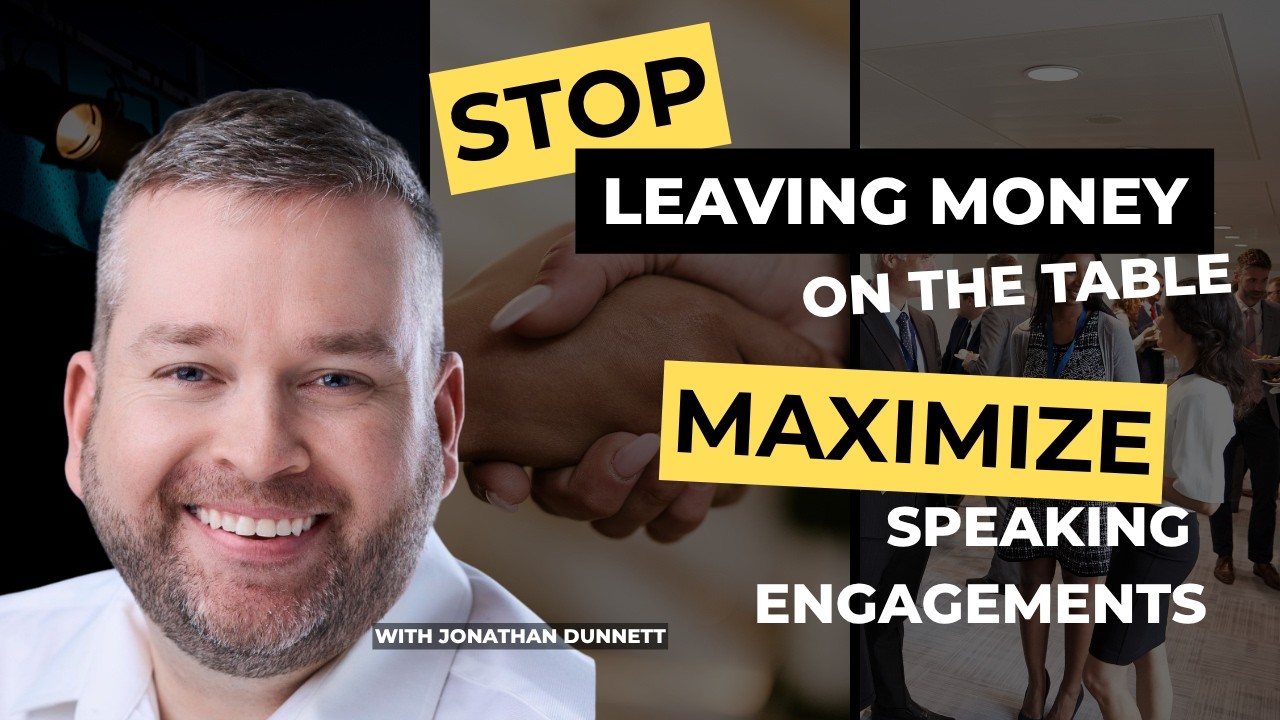
In this episode of The Speaking Club, host Sarah Archer interviews Jonathan Dunnett, a strategist who helps speakers turn event appearances into systematic business‑development engines. The conversation begins with Jonathan’s background in research and intelligence gathering, which later informed his work with speakers. He explains why relying on serendipity – the chance “lucky” conversations that happen on stage or in the green room – cannot be scaled, and why speakers need a deliberate, data‑driven approach before, during, and after an event. They discuss how to identify the right people in the audience, prioritize high‑value targets, and create low‑friction touchpoints such as pre‑event coffee meetings, VIP meet‑ups, or post‑event follow‑ups. Jonathan shares a painful case study of a speaker who had 500 ideal attendees but only generated eight leads, illustrating the cost of an unstructured plan. The duo contrasts the practices of companies that treat events as strategic pipelines with those that simply “show up and hope.” They explore the long‑tail nature of sales after speaking engagements, the importance of building trust, and the role of consistent, differentiated branding across the web. AI and search are highlighted as both a threat (homogenized positioning) and an opportunity (using AI‑indexed content to answer buyer‑journey questions). Jonathan outlines a 30‑day ROI‑maximization checklist: define business goals, map the attendee list, schedule concrete meetings, and document the plan to reduce mental friction. Throughout, the emphasis is on intentional relationship building, asking great questions, and maintaining authenticity rather than being pushy. The episode ends with practical resources (Jonathan’s website, newsletter) and a plug for Sarah’s upcoming “Stagecraft to Showreel” program.
Chapters
A lot of speakers rely on their time on stage at an event to create leads and opportunities, and if you're a fab speaker, that might be enough. But what use are you making of your time off stage? Maybe you're in the green room chatting to other speakers, meeting new speakers. Maybe you've had some great conversations with a few members of the audience, or you might have even got some photos and some footage that will help with your showreel, and then you left. But my guest today believes that too many speakers are leaving a ton of opportunities on the table at speaking events. Jonathan Dunnett works with speakers to help them leverage their network and events strategically so that they fill their calendar up, and one of his big ideas that really resonated with me was you can't scale serendipity. In other words, if you're relying on luck to generate opportunities from your speaking, you're probably missing out on a ton of value. So in this conversation, we're going to explore how speakers can be far more intentional about networking, relationship building, and business development before, during, and after the event, and we're also going to talk about how to identify the right people in the room, how to avoid wasting your time on conversations that don't go anywhere, and why the real value of an event often happens long after you've left the venue. So, if you're using speaking to grow your business, get clients, or generate opportunities, this episode is gonna give you a ton of ideas and value. Let's head on over. Welcome to The Speaking Club, Jonathan Dunnett.
Thank you, Sarah. Good to be here.
Excellent. I'm really looking forward to our conversation. It's something we haven't really talked about before, and I know it's going to be valuable for speakers who are listening. But before we get into the nuts and bolts of what you do, let's quickly understand how you came to do what you do today, um, and where you started off.
Yeah, so my career journey has been really kind of vast and varied. Um, what I currently do now, really, I kind of fell into it around 2008. And so I, I had a professor at the time I was doing my undergrad in business, and he came to me and said, hey, we have a client that wants some research done. And like every, you know, university student said, uh, Well, does it pay? And so I— he said yes. And so I took that opportunity, and it was a really interesting initial foray into a career now that's spanned 18+ years. And it was building in aerospace and defense. And so that was my first project, was really in around the aerospace and defense industry, specifically around UAVs. And so that was a fascinating kind of way, and I had a natural knack and an acumen for it.
What's a UAV?
A UAV is an unmanned aerial vehicle.
Oh, cool. Okay.
Yeah. And so, yeah, it was a really interesting initial introduction. And again, I just found I had a really good knack for being able to do research and think from like a systems-level perspective. understand information, ask the right questions, and then do synthesis to say, having said all that, what does it mean? What does it matter? And, you know, make recommendations to the client.
Yeah, because that's quite important, the so what of everything, because there's people that are really good at data analysis and all, but sometimes not so good at doing the so what of it. And so if you've got both those sides Uh, it makes you a valuable commodity. So, so then, so you're doing that, and then how did you come to do what we're going to talk about today, which is relating to speakers?
I mean, in terms of the speaker side of things, it's been an interesting journey, and I had some kind of serendipitous experiences that I had along the way. So as an example, I was involved with TEDx locally here in 2013, and I was on the organizing committee for that. with no, you know, understanding that that would be relevant and useful in the future. But I don't know if you find the same, Sarah, but I find oftentimes for myself, my past experiences, even if they weren't necessarily planned out in a particular path, often I'm able to draw on them.
Hmm.
And so last fall, I was having a conversation with a gentleman who had written some books, had been successful, written a new book, and it was about the legal sector. And he didn't really understand the legal sector. And some of my past experience, I worked with AmLaw 100 and 200 firms. So these are the big global law firms that you, you probably have some in your backyard. And so I had really good context on that industry. And so I was able to share some of that context, and I just started asking questions. And at the time, I was reexamining what I was doing, looking at my focus. And the more questions I asked him, because he was lamenting, you know, I've got these books, but I can't get keynote opportunities. And I said, well, tell me about that. And so as he spoke, I was like, oh, well, that's really interesting. I could help with that. I could help with that. I could help with that. And so much of my past experience really meshed very well with what he was talking about. And so subsequent to that, I started doing more interviews with people that were doing speaking and keynotes and that kind of thing. And it's amazing, Sarah, structurally, you know, so many questions around business growth are, are the same. It's just a different context.
Yeah.
And so, um, it's been really interesting to kind of see and validate that. And just fundamentally, at the end of the day, I love helping people. You know, they're here today and they want to go there tomorrow, and I love helping them Excellent.
And it's interesting that you use the word serendipitous in your context, you know, of where you've come from. Now, you also talk about the idea of serendipity in relation to the fact that you can't scale it.
Yeah.
And I wondered if you could expand on what you mean by that and why This is such a big issue for speakers?
Yeah, good question. And so I think for a lot of us, I mean, you, you would have experienced this in your career. I know I have. You have these moments of serendipity, whether it's like my TEDx example, or you meet someone in a certain way, or you meet someone who introduces you to someone. You know, there's all these kind of serendipitous moments that you could never have orchestrated or planned. But the inherent problem is with a lot of those is there's just no scalability to them. You can't repeat that. You can't say, how did I get to that person who might, you know, might have been an accident, who then introduced me to this CEO or this board member or whatever it might be? It's really hard to repeat that. And so I think what's missing a lot of time is really focused intention and attention in terms of building something that is more scalable. And oftentimes that comes from having very sharp focus in terms of what am I really trying to achieve, who are those right people that I want to connect with. And it's not just speakers. I mean, you look at anybody for the vast majority of the business landscape out there, a lot of people They just kind of float through and, you know, they pick up these interesting people along the way, which is fine. But unless you're really deliberate in terms of your relationship building strategy, you can just end up in this place that it's, you know, a little, a little wishy-washy and you may not be achieving the results that you want to achieve.
Interesting. And we'll unpack that a little bit more, I think, as we go along. And I think it's something I've seen I think I've seen you applying the principles that you talk to people about yourself, certainly in the way that we ended up connecting. So it'll be— I think it's obviously working. One of the things I wanted to get you to share about was the story of the speaker who had 500 ideal customers in the room, but came away with just 8 leads. And I wondered what you believe should have happened differently in that scenario?
So this is a painful story. When I was speaking with this speaker, we were talking about their business and their challenges and that sort of thing. And they talked about this story of, well, I've, you know, I had 500 people, very, very niche industry. So it doesn't mean they're— this is a local gathering. These are people coming in from all over the world. They strategically took the opportunity to speak for free. That's not their norm. But again, 500 ideal customers in the room. So, I was very excited. I said, so like, tell me, what did you do? What did you— must have reached out and got, you know, built kind of a multi-day plan around this, set up B2Bs with people so that you could connect, you know, build relationships, that kind of thing.
Yeah.
And I said, what did you do? And they said, well, I got up and spoke. And so in doing the math, you know, the 8 leads, that netted out, you know, excuse me, maybe a couple hundred thousand dollars worth of potential opportunity in the near term.
Hmm.
But that means there were 492 other people sitting in that room. that may not ever be your customer. And so just even from, from a strategic perspective, if had they been more deliberate in terms of, you know, doing something the day before, day of, day after, people naturally, especially if they're traveling anyway, they need to eat lunch, they need to have breakfast, they need to have coffee.
Yeah.
And so there's very low friction opportunities where They could have reached out and said, hey, you know, I'm going to be speaking at this conference. I know that you're coming in. Could we grab a coffee? Could we grab a lunch? You could do it as not just necessarily one-to-one, but bring some scalability to it. Have 5 to 6 people with you. That's, that's a group size where it's still tenable in terms of you're still having conversations with everyone.
Mm-hmm.
But it's not you trying to yell down to the person When you have 20 people at the table. Just to land the plane on this, what was painful for me was really just even average close rates. This person probably should have had about 40 leads coming out of that opportunity.
Yeah. Yeah.
And so again, you do the math, there's millions of dollars of lifetime value. But the difference was they got up and spoke. And hope for the best versus actually building a deliberate plan.
And what's interesting, what's occurring to me, because you're firing off ideas in my brain around this, is that potentially you as a speaker could add value to the event organizer by proposing that they offer some sort of meet the speaker before or after Uh, so that they believe that they're getting value. They could even ticket it a little bit, the, the event organizer, for, for, I don't know, make it a slightly more VIP experience, um, or limited experience, and you've got to book on, which always makes things seem more sexy. But yeah, so there's lots of opportunities, and you're right, I don't think speakers consider those things, or it does not even enter. Maybe there's some who are really switched on and it does, but for majority probably like, I'm gonna get there, I'm gonna get there early, talk to the other speakers, get on stage, maybe hang around for afterwards for a little to talk to people. Um, but yeah, there's— then they're leaving a lot on the table with that, with that approach. Okay, cool. So—
And just even if you think about that from like an energy and effort perspective, if you've already traveled, you've already done the hard part, right? So what is the opportunity to really compound rather than just getting back on the plane and going home and, you know, going back and reading a book. Maximize that time that you have.
Yeah. Interesting. Now, I guess there may be some resistance to this from speakers listening. You know, that they, a lot of them rely on being charismatic, on working the room afterwards. You know, beyond what we've talked about, why isn't that enough, do you think?
The problem is even the most charismatic people, and I love charismatic people, right? We all do because we are naturally drawn to them. They have amazing energy, which is great. But if we go back to my example of the 500, if you don't understand who's in that room and who matters for your business, There's no way you're going to work that entire room.
Yeah.
Right. And not everyone that matters for your business is going to be the super extrovert that's going to rush down to the stage and say, oh my gosh, I've read your book, I followed all your podcasts, I love you, love everything you're doing, let's get you in next month. You know, that's, that's not everybody's wiring. There are going to be CHROs that are sitting in the room going, yeah, we've got that event in about 6 months. But if you don't know who that CHRO is, yeah, you know, you've got maybe a big global company where they're going to pay you $50,000, $100,000, $150,000, $200,000 to come in and speak, but you don't know who they are.
Yeah.
You can be as charismatic as you want and you've likely missed that opportunity unless they come and approach you.
Cool. So in terms of the sort of systems and strategies that you're talking about here, I think from what I've understood from when we've talked previously that you've trained hundreds of companies in leveraging and maximizing event attendance. What are those businesses doing events that speakers should be copying? And I'm thinking about before, you know, they even get there, whilst they're there, we've talked about a few things, and then afterwards on the plane or whatever, what should they be doing?
Yeah. So I'll differentiate. There's 2 types of companies. There's companies that use events well, and there's companies that don't use them well. Unfortunately, a lot of companies tend to fall into the not using them well. component, and it's everything that you might imagine.
Yeah.
So these are companies that say, all right, I'm going to trade show X, which is the largest in my industry. I go there because everybody goes. Now, before that, one of the things that a lot of people make as a mistake is just assuming that trade show X is the right place to go. It might be completely wrong for you.
Right.
Right, so there's this— sometimes if you've been in the industry forever, you just go to these shows, you, you do the same thing, rinse repeat, maybe get a little bit of business. The question is always, number one, is this the right event? Is this genuinely a good opportunity based on whatever your business goals are? That's always key. The businesses that do this better They are the ones, and I've seen examples of the plans and strategies of large global companies in some cases, and I'm not suggesting this is what speakers should do, by the way, because you just don't have enough time or resources to do this, but a large global company, hundreds of pages of strategy to say at day 1, this event, this time, we're going to approach this person and ask this question.
Wow. Okay.
Very, very detailed. And some of that work, of course, is set up before because you're actually setting up to say, we're going to meet this person at this given time and ask this question or this series of questions. Now, of course, for speakers, that's, you know, you don't have time to build a plan that's hundreds of pages, nor should you, because most events are not appropriate for that. But even if you say, I'm going to— back to our example with 500— had we built a plan around, okay, I'm going to get up and speak, I'm speaking for an hour, 500 people. Number one, figure out who's going to be there. Who are those 500 people? Some of them are probably not going to matter, but this is a very niche industry, so probably most of them matter. So then how do you prioritize who is kind of, you know, top on your hit list? Who can you reach out to before to make sure that you have an opportunity during the actual event to connect with? So like you were saying about the VIP event as an example, maybe you have a book signing, maybe you have a book reading. Like there's, to your earlier point, there's all these things that we can do to kind of activate and elevate the experience. The other thing too is 500 people, it's not likely even the best networkers. If you drop a power networker in that situation and say, here's your plan, execute it, the likelihood of you getting to all 500, very, very low.
Yeah.
However, there's a customer journey and we also, we always forget about that, right? And I see this with companies too. when they're going to events. This goes back to the ones that aren't maybe doing it so well. They assume, I can show up and I'm going to get a purchase order.
Yeah.
Like, okay, you know, if you sell a pen, sure, you might get a purchase order for 500 pens. But most people don't sell pens. And the speaking business especially is a high-trust, high-risk environment as well.
Mm-hmm.
So if an event planner is going to put you on a stage, and I know, Sarah, you've been on many stages, there's a lot of trust required for me to say, I'm Jonathan Dunnett, the event planner. I'm going to trust you, Sarah, to go up and, you know, execute on everything that we want you to do, do a great job, and I will by extension look good through this. The other side of that is you perform poorly.
Yeah.
Then it reflects back on me. So that's where the risk comes in. Yeah. But just, just to sum up, it's such an opportunity for speakers to be more deliberate. And it doesn't, again, mean that you have to have hundreds of pages. But even if you deliberately say, I want to accomplish these 10 things at this event, You are better than 95% of people who are just standing there and winging it.
That's so true. And I think something that I found out maybe 2, 3 years ago is this concept of a long tail conversion. So there was actually research done at a particular conference that showed that only about 15%, let's say there, you know, 100% of people 15% of people bought within the next 90 days, if they bought at all.
Right.
Which meant that 85% of people were buying over 18 months, maybe 2, you know, there's that long tail. And so, this is where you have to build those relationships. So, even if you see this as the start of the journey, you know, rather than the end of the, you know, I'm in there, I'm going to get a deal, you know, whatever. That's, that's got to be, you know, you've got to go in with that perspective, I think. Is it— do you— have you found that with people that you've been working with?
Absolutely. And again, it's such— speaking is such a high-trust exercise. Uh, like, Sarah, I'm not going to cut you a check for $50,000 or $100,000 unless I really trust that you can deliver. There's a few, you know, exceptions to that where I had a friend of mine who works in marketing, and he was working at a large global firm, and they wanted to bring in this celebrity to speak. Well-known athlete, you know, and they had— they were planning out this full-day event. There was one event that was— or excuse me, one speaker that was about a $30,000 speaker, CEO of a small company, you know, was doing well, growing, all of that. The athlete ended up costing them something like $300,000 for the keynote, plus the private jet, plus, you know, the Ritz-Carlton, what— so very expensive proposition. The experience for people, terrible. And meanwhile, that $30,000 speaker blew the socks off everybody in the crowd. And so— You know, I think it's really interesting in some cases how we assume that, you know, just because someone is a celebrity or has lots behind them that they're going to be a great speaker. And that's not always the case.
No. And what I found recently, and I'm going to do a whole show on this, is that often there are people who have huge stories, but I think sometimes they rely on the story too much and they're actually really bad storytellers and speakers. And, you know, you can't, even if you've got an amazing story or you've got an amazing background, if you want to be a speaker that gets rebooked, you have to do more than just share the information. You've got to, you know, think about that audience. Otherwise, you know, maybe they don't care, that person. There's like 300 grand in their pocket. I only need to do this once and I don't need to worry about being booked. But otherwise, if you're trying to make a career out of speaking, you absolutely have to do more than turn up, tell your story, you know, and rely on the information landing. You've got to absolutely engage that audience. Anyway, so just, just, uh, it's right at the front of my mind at the moment, actually. Yeah.
And I think that's That's critically important, and there's really those 2 key factors. So exactly as you mentioned, number one, you have to activate the crowd and be a great speaker, great— be a great storyteller. And going back to your earlier point on long-tail conversions, if you don't build those relationships intentionally, you're absolutely right. I mean, again, it's a high-trust thing. It's not like you're selling ice cream. Ice cream is an impulse buy. Pens are an impulse buy. You are selling something that you are going to be brought in. I'm going to trust you to help my company or my large event be successful. And so that relationship with the event planners, with the people that are going to hire you, is critical. So I think you have to have both. You have to be able to be an amazing performer, which I know that's part of the work that you do, which is amazing. And then as well, really develop those relationships and be intentional, especially over the long term.
Yeah, absolutely. Now, there may be some people who are worrying about being too transactional in this, um, with this approach. And I don't think that's what you're proposing in terms of the way to have these conversations or, you you know, touchpoints with people. Am I right in that this isn't a transactional thing?
Correct. So what I promote is the antithesis of, of transaction. Like, because you, you have this experience, Sarah, I know I do, where you hear the ding, you know, whether it's an SMS or an email or a LinkedIn message, and you see That name, and you, you already know. You're like, oh yes, it's Graham. He wants something. You already may know what it is, but you know this is what Graham does every month, 2, 6, 12 months, whatever. The only time they come around is when they want something. And so I think especially in kind kind of an, an AI and information overload world in which we're living, having genuine connections, genuine rapport, um, you know, understanding the person on the other side and being genuinely interested in who they are, that is such a difference maker versus, you know, Graham when he pops around.
Definitely. So how does all of this come back to your background in intelligence gathering and research. Um, can you share how it all sort of comes together, Jonathan, in terms of what speakers should be doing around this type of thing?
Yeah, so for speakers, I think a lot of times, again, going back to the folks that are charismatic, If you're charismatic and engaging, that's a great basis typically, but not always in terms of gathering the insights that you need to grow your business. And for the introverts that are listening or watching and the ambiverts that are listening and watching, the good news is oftentimes introverts and ambiverts are actually better at this because people are not overwhelmed in some cases by them.
Hmm.
You know, if you— I've watched introverts especially who are very quiet, very, you know, reserved, go and be able to have meaningful conversations. And again, that comes back to the connection and being genuine part. When you're talking with people and they are disarmed by you, you can ask them questions that somebody else would never ask.
Mm-hmm.
And they'll just go, oh, well, Here's the answer, or I think it's this, or you should talk to Charlie. And so in terms of what insights and intelligence that speakers can gather, there's a few fundamental things that really matter. So number one, if you're thinking about, as an example, let's say you want to do a talk at Google, that whole series that they have. Let's say that that's really a priority for you. We then need to apply and understand, well, how do I do that? So how would I gather those insights to be able to do that? You could potentially just write somebody a cold email. You find somebody on LinkedIn that says, you know, talk organizer at Talks for Google. Great. That could be one path. But if you knock on that path too— on that door rather— too early, it might just be Oh, Sarah, this Sarah Archer sent me this cold email this time, and I, I don't know, uh, maybe, maybe we shouldn't have her, right? Cold emails, in terms of going back to your point about being transactional, a cold email is kind of the bottom of the barrel. It should be your last play on, like, if you have no other choice, a cold message, fine.
Yeah.
But there's typically other strategies that you can use. But again, let's stick with the example and say we want to do this. Okay, first thing, there's always somebody else who has done this before.
Yes.
So that's the first thing that I'm going to think of. So if I'm in your shoes, Sarah, and I wanna do a talk at Google, I'm gonna go back and look at the however many they've done, hundreds of these, and go, are there any names here that I recognize? Anybody that I know? So that's going to be step 1. Let's say, uh, there are no people in the list that I recognize. Then second thing that I'm going to do is look at the locality. So maybe you, as an example, see that there's, you know, 10 or 20 people who are based in London. You go, okay, I have a network in London, so let me go in at LinkedIn and see who those second-degree connections are.
Yeah.
And then reach out to my second-degree connections, say, I know you're connected with so-and-so, um, I'm interested in speaking about their talk at Google that they did. Would you be able to introduce me? You get the introduction, you have the conversation, say, tell me about your journey. How did you get to that? So without guessing, without sending a cold email— and this is just one path, I mean, there's a lot of different pathways But we can gather those insights to understand, and especially if we validate that, you know, 3, 4 conversations, then we can say, oh, okay, these are the commonalities that exist. If I want to do a talk at Google, I need to do this, I need to do this. These are probably the key people to start building relationships with.
Yeah.
And then, you know, that it'll create that opportunity. Another quick example would be, as an example, Speaker reels are a big business. If I want to know who puts out a good speaker reel, I can go and watch them, but I'm only seeing the end product. I'm not seeing necessarily what that process was like. I'm not seeing if they were good to work with. I don't know maybe the initial quality of material that they had versus the output. I, I saw an example recently where a speaker asked me to take a quick look at their reel. And I illuminated to the speaker, I said, your editor doesn't know how to make audio changes because there was all this background noise that was just a bit ugly in terms of the video and it was really detracting from it. And I said, you know, you can just EQ that to get rid of that background noise, right? Like your editor knows that. And they didn't. Those are the sorts of examples where If you're looking for insights about people, about choosing vendors, that sort of thing, there's so many different insights, but it all comes back to what am I trying to accomplish? What are the stages that I want to get? What resources and help do I need along the way?
Yeah.
And a lot of the time it's really about validating, right?
Yeah.
It's saying, I think this person is good at what they do. They've sold me, but I want to double-check and make sure that They are what they seem to be.
Yeah. Yeah. And that's what event planners and bookers will be doing with you as a speaker, right? Is doing that validation. Is there any way, any tips you've got on that side of things as well? Or, and this might not be in your sweet spot, but, you know, once you're making those connections and people are obviously gonna be checking you out, How do you make sure that you're, you know, anything that you've got to share around that in terms of, you know, making sure your positioning is the right positioning?
So I'll go back to a couple of quick thoughts that I had. First is in terms of if I'm being validated as a speaker by an event planner, the number one thing that you can do, and you alluded to this earlier, is have, you know, have a great performance but also be easy to work with.
Yeah, yeah, right.
How many speakers— and I mean, speakers are people— you meet speakers, you meet people that they're just difficult to deal with. They're demanding, they have very specific requirements that are maybe a little bit over the top. You know, they, they come in and they're expected to be put up on a pedestal, and, and it's like This is a local event. I don't know what you're used to, but so I think being accustomed to just being good with people, again, building meaningful relationships, treating people well, and being easy to do business with, one. And then to your point, in terms of the positioning side, the biggest thing that I'll really speak to is, especially in an AI search world, I ran an AI audit, um, over the last couple days for a speaker. Speaker's doing well, doing a lot of the right things, and yet one of the biggest things that's holding them back currently is the fact that they are not, uh, consistently positioned across the web in terms of who they are, right? So if you look at their footprint, they have 5, 6, 7 different identities Keynote speaker, author, coach, workshop facilitator. And we see this pretty often, right? Because a lot of keynote speakers, they do other things, multiple things, which is okay. But what's really important is that you have to tell that whatever the story is that you're going to use on positioning, it has to be clear and it has to be consistent. And just to drill in on clear and particularly from an AI search lens, I think a lot of speakers are doing themselves disservice right now by basically looking exactly like a million other people.
Yeah.
How many, how many wellness and health speakers do we know? How many people are talking about even, even though it seems niche, perimenopause?
Yeah.
We've seen like an explosion of people pop up in that space.
Mm-hmm.
Um, you know, uh, the nervous system. There are so many people like, and these seem to be really niche topics, but then if you present yourself in exactly the same way as others who are looking for the same stages, you're really doing yourself a disservice. And so what I would say to people is on a positioning perspective, you really need to not just use the LLM output. But really go through that cathartic exercise to get to an identity that you feel good about and that you can then consistently deploy across the web so that you can be found and you're visible for that.
This is a really good point. So definitely AI search is, is becoming a bigger thing and we can talk more about that in a, in a second. But I think the other side of this is the homogenization of you know, positioning one-sheets, you know, profiles, and also people that are using AI for creating their keynotes. And the thing that is going to get you booked is being different and standing out differently. And I'm not saying don't use AI to help you research or you know, bounce ideas off of because I think it's a great tool. But if you are, you know, handing over your identity to AI, then you are definitely just gonna fall into the, the bucket of everyone else because everyone else is doing the same thing. So you've got to find a way to bring that personality through. And even if you use— like, I mean, I use you know, ChatGPT and Claude and stuff, and they do get to learn, you know, the way that you are and the way that you speak. But even so, they still homogenize stuff. So I don't know if you, if you find the same thing.
Yeah, I mean, absolutely. And I think this is the thing where you run into the, the conflict between off-the-shelf models that are not specifically trained. There are different models that are out there where, from a content perspective, if you were looking to have something trained specifically on you, then, you know, you can build that, or you can take an off-the-shelf and modify it, and it's kind of a halfway between. But, um, you know, one famous example is Marshall Goldsmith. Marshall Goldsmith, who's one of the world's best executive coaches, he's kind of a legend in the field. And what he did was he went and created a bot. It's called Marshall— I think it's marshallgoldsmith.ai, I think is the URL. And so he has all of his books, articles, everything. It's trained specifically on his voice.
Mm-hmm.
And you can basically go and say, Marshall, tell me about, and if it's something based in his experience, the bot will actually answer it. Tim Ferriss has done the same thing as well.
Interesting.
There are some different examples where you can get some tools, and this is not necessarily my area of expertise, but you can really train the models. Most people are not going to do that necessarily. They may not be in a position to do that, and that's entirely fine. But I think to your point, Yeah, if you're using the same models as everyone else and you say I'm a health and wellness speaker, you're going to sound like every other health and wellness speaker. And so I think it's really pivotal. Like, I use LLMs every day in my work. I think they're amazing tools, but you can't let that abdicate your thinking and your creativity.
No, no, you have to— it's, it's an assistant that is helping you. You still have to be in control, question, challenge, and make sure that your identity, your personality, everything that makes you unique and bookable is going to come through as well. So yeah, cool. So is there anything else that you— because I know you've been looking at AI search— is there anything else that you think speakers should be paying attention to around this that we haven't covered, Jonathan?
Yeah, so we talked about the identity piece, which is really, really important, and that having that consistent position that AI can understand. And, and Sarah, I think we had chatted about this the other day when if you have someone where if you have another person that has your name, so I have a— there's another Jonathan Dunnett who's actually a, like a He's an athlete.
Oh.
He does like parasailing or something like that. I've not met him. I probably should. But so in search, I know that oftentimes I need to make sure that my stuff is being positioned and it's always a work in progress, right? It's not something where you can go, okay, well, that's done, that's sorted. And, you know, never do I have to look at this again. It's not true. But so the identity piece is really important. I think the other big opportunity that I see is particularly for speakers at all levels of the journey. So whether you're starting out, whether you're established, but you're trying to still grow, or even if you're at sort of the top tier, I think one of the mistakes that people make is they forget about creating content that answers and responds to the customer journey in a way that you want to be positioned.
Hmm.
So as an example, let's say that, um, I am a speaker and I'm focused on wellness. As an example, let's say I'm doing, you know, $25,000 to $30,000 per, uh, per speech right now. But, you know, I, I still want to grow. There's people ahead of me in the journey. There's people that are more well-known. One of the big opportunities in terms of AI search is taking the questions that you're getting innately from your customers, as well as identifying what those position— what those questions are that maybe you're not thinking of in AI search, and then answering those questions through your content. And specifically, the where LLMs are indexing The responses to those questions is in written content. Gemini might be a little bit of a different bird, and I can't answer this definitively. So Google— excuse me, YouTube does a wonderful job of pulling transcripts. So when this is uploaded to YouTube, YouTube will be able to understand that. How that rolls back into Google, how that rolls back into Gemini. I suspect there's probably some horse trading that happens, which is good. But bigger picture, if we talk about ChatGPT, if we talk about Perplexity, if we talk about Claude or any other model that you're using, the, the key to this is to make sure that you have your, your content documented and those answers documented.
Yeah.
And also to make sure that your site is actually accessible. So one of the things when I was doing that audit the other day, what was interesting was one of the books was actually the, the web page for the book for some reason was set to noindex, which means it's completely not accessible to AI search. It's not accessible to Google. So the only way that somebody's going to get to that site is if they go to another site that has the link And then they end up there. And so customer journey that aligns with the questions that your buyers have, huge opportunity. Because even what I'm seeing too is there are people that audit that I did, this is a person that should be showing up, they're not showing up.
Yeah.
I've done this audit on other people that like big names and sold hundreds of thousands, if not millions of dollars of books. Not showing up for the queries that they should. I think we're at a really interesting gold rush moment for AI search.
Interesting. So we can't really afford to bury our heads in the sand, uh, because if we don't pay attention to this, um, the other people that are, are gonna get ahead of the game because they're being found, basically. So, right.
have the short-term sort of, you know, you popped up. And these models are very dynamic as well. So they have, uh, kind of larger training sets that they go through periodically. But it's amazing, just even from my own experience, getting content to pop up fairly rapidly, sometimes in days and weeks that can happen. Um, the other thing too is As, as you continue to do more of the right things, that compounds over time as well.
Yeah.
And so it's not just the immediate opportunity, but it's how, how you build kind of your, your defensible mountain that point to you as the expert versus someone else.
Brilliant. Yeah, that's great. Okay, cool. So last question before we shift into the standard questions that I ask all the guests. If a speaker's got an event coming up in 30 days and wants to maximize the ROI, what should they do first?
If you've got 30 days, you still have time. That's the good news. So number one is you're going to think about what are your business goals? What do you, what are you trying to achieve? Number one, big picture. Then how does this event help you with those specific goals? Who's going to be in the room? What information and insights do they have? What relationships can you build to, you know, identify suppliers or identify customers or understand how procurement happens? Back to our Google example.
Yeah.
What are the— what's the opportunity? Then you're going to document those different things that you want to have happen. And before the show, you can actually operationalize this. So if you say, day 1, I want to meet with Sarah for coffee at this location, I want to discuss the following with Sarah. Wonderful. We've just removed all the stress of getting on the ground going, oh, I think I'm supposed to meet with Sarah. What am I supposed to ask her again?
Yeah.
Right. We're going to remove the stress. We're going to remove some of that mental fatigue because events can be very draining. And so If I can line up my coffee with Sarah, my prospect meeting, my insights about the speaker reel that I want to identify, maybe there's a particular company that I want to understand how they do procurement, whatever it is, there are people at those shows that have either done it or they have the information or they have the network that knows. So really creating a list and I have a free free resource as well if people are looking for kind of a one-pager. It's very simple, but it's meant to be. That's available on my website, jonathandunnit.com. And just build, build a simple plan, even if it feels overwhelming. Start with simple.
Yeah.
Right? Just remove some of the friction for yourself. And yeah, and what you'll notice is over time, As you start to kind of— it's a muscle. Once you develop and understand this more methodically, then you're going to be able to build. You might say, I'm gonna do 5 things this event. Next one, you might say, I'll do 7.
Yeah.
And 10. And then before you know it, you're an absolute machine executing because, you know, you can go to an event that before you would've only been able to do 5 things and you're doing 40 or 50. While still creating meaningful connection, building meaningful relationships. And it's just, it's such a better way to maximize event opportunities because once an event is gone, it's gone. You can't get it back.
Yeah, and I think it's easy to forget as well that there is a cachet of you being the speaker on the stage, that you actually doing some of this stuff Is gonna possibly create some super fans, you know. So it's not just— so it's, it's you make the most of the opportunity of you being, you know, one of the, the people that, that they're coming to see, and they will actually likely feel really grateful that you're, you're having a conversation with them. I think don't make assumptions about what people are going to think. Is a key thing here. You know, if you're going in with the right intentions, even though, you know, there is a long-term game here in terms of growing business, it doesn't have to be— it can be human to human. And, you know, you, you don't make assumptions about what people are going to think. Because if often when I talk to my speaker clients about this, even just reaching out to people, they will make assumptions and put all of their sort of ego, you know, negative thoughts onto that person. And if you switch it around and say, but if you were that person reaching out, what would you respond? What would you think? And they go, oh, I'll just say, yeah, this, that, and the other. I said, well, there you go then. But like, I don't know if you get that type of resistance coming through.
Yeah, I mean, the whole psychology of how we understand people— I mean, I have a whole, uh, framework called the Pyramid of Understanding, which is really about, you know, developing an understanding of who this person is. But you're exactly right. When we make snap judgments, oftentimes those are based on our own biases, our own thoughts, our own narratives that we've constructed. And it's just not a healthy way of doing business because exactly as you say, like, you put the shoe on the other foot, it can change things. One of the, one of the examples, one of my favorite stories actually, that as you were sharing that, that came to mind for me was I had a former colleague of mine who used to sell cars and he worked at a Chevy dealership. And there was this guy that came walking onto the lot and all the salespeople are gathered around and said, yeah, there's a tire kicker, you know, look at that, look at this guy, right? So anyway, former colleague goes out and starts chatting with him. And about 5 or 10 minutes, he comes in and he's got a huge smile on his face. They're like, what? What do you— you know, he's just a tire kicker. He's like, he bought that Corvette.
Nice.
Brand new Corvette. The gentleman was having his Porsche down the road serviced at the other dealership, and he walked over and was looking at a new, uh, a new sports car to go along with his Porsche. So you can't— you can't assume. And, uh, even another lady that I used to work with— I used to work in a furniture store years ago— same exact thing. The lady was the owner of the store, took this other lady through and showed her a bunch of stuff, and she just thought, this is probably, you know, tire kicker. Not really serious. And she got to the end and said, so was there anything that I showed you that, that you liked and, and you'd like to take home? And she's thinking, you know, maybe I'll sell her a rocking chair or something. And she said, I'll take it all. What?
Nice.
$10,000 worth of merchandise. But exactly to your point, when we assume about people, we sometimes miss an opportunity.
Thank you so much for sharing all of this stuff. And I know we're going to, you've got some resources for people and we're going to, I'm going to come back to that in a little bit after we've done our next set of questions. The first question that I have to ask you, which I ask everyone, is what's the best thing that speaking has done for you?
So, I mean, I'm not a speaker. However, in terms of what the best thing is that speaking's done for me is I've been able to connect with amazing people from all over the world that are doing this, all kinds of interesting people. You and I didn't know each other before. You know, my clients that I'm meeting, I didn't know many of them. Some of them I had innately, you know, built relationships and rapport through my network over the years. But that, I would say that's the best part is just meeting great people. And I love to work with people that are doing meaningful work and really having a positive impact in the world. And so I think that's really the gift.
Brilliant. And I know you've said, Jonathan, that you're not a speaker, but I can't imagine that throughout your life and career you haven't at some point been speaking in front of an audience of some size or description. Has there been a time where things didn't go to plan, where you were like, oh, I wanna forget about that? Can you share about that?
Sure. How long do you have? So, to your point, I do, I carve out and just specifically say I'm not a speaker because I'm not. I don't do keynotes and that kind of thing. It's not what I enjoy. It's not my passion. I love training. I love having conversations like this as an example. So, have I had things when, you know, training didn't go well? Um, I, I gave the, the valedictory address at my university when I graduated. That's, that's probably a good example, I would say. So not necessarily that it didn't go to plan. However, and I'm sure you've had this experience, when someone gets up before you and gives the most amazing keynote or address. And then you're thinking, what am I doing here? Should I, should I rewrite everything that I wrote? And, and that was the internal conversation that I was having with myself 5 minutes before I was to get up and, and to give the address. And, um, anyway, I, I stuck with it, um, but it was just really interesting in terms of, you know, it still reasonably went to plan with the exception of people didn't always get the jokes, which that's okay, you know, they don't always land. But I still had fun. But yeah, definitely, you know, some of the crowd was a little disconnected at points. But the other quick example that comes to mind too is I used to be a teacher. And so things always go wrong.
Yeah.
When you're addressing a crowd, things don't necessarily land. And I had I was being evaluated once and I had somebody coming in and my lesson had flopped and I had 30 minutes to change rooms because I had to change to another classroom and move everything with me. And I was doing a lesson, a science lesson on compounds. And so I had chosen for some reason to give 16-year-olds sugar. What ended up happening was everything was going along fine until I moved the pop or the soda. I'm not sure what we call it in the UK, but the Coke and the Pepsi to the second floor. Cart going back and forth jostled it a little bit. Anyway, I went to open it, all down the front of me.
Wow.
I'm covered in Pepsi, I have 5 minutes before I'm being evaluated. The lady walks in and says, hey, how are things going? Meanwhile, the lesson before has entirely flopped. So I'm rejigging the lesson in my mind of how am I going to make this successful? Covered in pop-its. Oh, things are great. Went down to the bathroom, dried myself off as best could be, mentally thinking, okay, I've got 2 minutes. How can I rejig this entire lesson plan and make it work? It worked, but, you know, that moment was tough.
Excellent. Yeah, it's— we do sometimes sort of sabotage ourselves in the way that we think about things. But it sounds like in that example, you pulled it out of the bag. So it's a nice one. Nice one.
Thankfully, you know, again, I mean, much like your background, things don't always go to plan. when you're on the stage. And so it's, what do you do next?
Yeah, exactly, exactly that. And I think, I think the other thing to say is, just as a side note, is that when things don't go to plan, don't fall apart because the audience doesn't know that things haven't gone to plan. So you can normally pull it back as long as you don't panic and go into, you know, Fight, flight, freeze, whatever, and shut down. But yeah, so that's cool. That's— thank you for sharing that, because I think it's important to hear these examples so that, you know, no one, I think, escapes unscathed from speaking in front of an audience. Something has always happened. So, but we carry on. Um, next question. What's the book that's had most impact on your life and why?
How to Win Friends and Influence People.
Dale Carnegie.
Yeah, Dale Carnegie. And I mean, for me, for, for people that are unfamiliar, that book is really about connection fundamentally. And it's about understanding, how do I ask great questions? You don't necessarily have to be— we've talked about charismatic people throughout this, this podcast. You don't have to be the charismatic talker that's regaling everyone with with stories upon stories. But if you can ask great questions, people assume that you're a great conversationalist. And I think just even from my own experience, I know that it's been a muscle for me. I've had to grow it. I've had to be very purposeful. And, you know, much like speaking and storytelling, the more you do it, the more you exercise, the more you hone your craft, the better you get. And so Dale Carnegie definitely, you know, You know, despite the fact that that book, I think it's now like 100 years old, there's still such tenets that still hold well today. And I think that's highly reflective of human behavior and human nature. We love to be asked about ourselves in a meaningful way and to have connection created.
Cool. How old were you when you got that book or read it? What made it— made you grab that book?
I was in an airport. And I don't know definitively what made me grab that book, but I, I think I read maybe the, the back cover and went, okay, I've got a, you know, a multi-hour flight. I think I was in my early 20s when I grabbed it.
Cool. And, and, and you still use those things every, every day. It's one of those classics, isn't it? That, yeah, doesn't, like you say, doesn't get old.
Yeah.
Okay. What's the best bit of business advice that you've had and why?
Best bit of business advice. I mean, I've gotten so many pearls and gems from people over the years. I would say that the big thing, and this is from a, you know, an amalgamation of numerous people, but believe in yourself, get outside advice and perspective, and keep going and continue to hone and refine your craft. It's never done, and which is fine. And I know you're an entrepreneur too, so you probably, you know, you live this, but just continue to persist. There are going to be days when it doesn't feel good. There's going to be days when you just want to stay in bed. Keep going because you don't know exactly, you know, it's like that little cartoon of people giving up and then, you know, the gem is just on the other side, you're almost there. And so that's the key is just keep going, keep persisting. It doesn't mean that you can't pivot, but be true to yourself and continue to press forward.
Sage advice, that keeping going, and because, you know, it's easy to give up. But like you say, you know, there's the story from Napoleon Hill's book, I think, about the guy who literally was a few feet from gold when they, when they gave up. So, good, good story. Okay. Last question. If you could have one mentor and they could be alive or dead, fictional or non-fictional, who would you choose and why?
Wow. It's such a tough question, Sarah, because, you know, for myself, I tend to draw so much inspiration from different people in my journey. I will say, and maybe this is not a definitive answer, but I did have the opportunity— I mentioned Marshall Goldsmith earlier.
Yeah.
I had the opportunity last year to meet and connect with him in a small group setting. Even those few minutes when, you know, he looked at me and was coaching me for all of, you know, 1 to 2 minutes was really, you know, transformational. And the experience and the rigor that you knew was behind those questions was really significant. I mean, he has coached some of the top CEOs in the world. And so, That was an amazing moment for me. Um, I look at people like John Maxwell as an example, where I've had the opportunity to hear him speak.
Mm-hmm.
Um, and I, I have people in my network that are well connected with him and speak very highly. So there are, there are these people out there that just are sage and they're, they're great at what they do. And so I have a hard time naming one, uh, but I'll, I'll just say that I'm, I'm so incredibly fortunate to have, you know, so many amazing people that give me these pearls and gems every day. And I definitely draw from that. Cool.
Now, it wouldn't be— I wouldn't be walking the talk and always thinking from the audience's perspective if I didn't ask the question. You don't have to share, but I've got to ask the question. What question did you ask Marshall Goldsmith? And what did he say back? So in a nutshell.
Yeah, I didn't actually ask him a question, but he kind of led the session. And there was a question about, um, effectively, you are Sarah Archer and you are the best in the world at— and for me, I'm very much a process thinker. I, I don't tend to do things on the fly. I have instincts, but particularly for something that requires, you know, a good answer, I want to have what I feel is a good answer. And so, you know, he's asking me this question and he asked all of the group that question as well. And I was like, I'm Jonathan Dunnett and I'm the best in the world at— you know, I just kind of froze because I didn't, again, have a good answer.
Yeah.
He, you know, poked and prodded a little from a few different angles, and then he mercifully let me off the hook because he could see I wasn't there in that moment. I didn't have a definitive answer. But I think that's a wonderful question actually for your audience to consider.
Yeah.
I am insert name and I'm the best in the world at— and coming back to the positioning conversation that we were having earlier, That's such a great kind of frame to put things in, in terms of if you are trying to present yourself as authentically you, as an ex— a true expert, not just a health and wellness speaker, but yeah, really drill in like, what does that mean? Why, why uniquely you? Yeah, that's a wonderful opportunity, I think, for your audience.
And when you reflected, what answer did you come up with?
I'm still working on it.
I shouldn't have put you on the spot there. I had to ask. I had to ask.
For me, at the end of the day, what I've always been great at is asking great questions, setting context, and helping people to really, within that, to make more effective decisions. The psychology of decision-making is so fascinating, and we all run into these challenges where It's hard to see the forest through the trees.
Yeah, yeah.
And yet sometimes when we have, even if we have the right information and insights in front of us that very clearly lay out, you know, the, the so what, as you said earlier, that give us, okay, this is the most likely path forward that makes sense. Our own wiring sometimes gets in the way. Like you talked about our biases earlier. Or people just have friction, they get stuck. They have these narratives. Maybe they had people growing up that told them, you're not good enough.
Hmm.
You don't know, you're stupid. You don't know anything. How could you be a CEO? How could you be a keynote speaker? And that's where people get stuck is they just let these narratives run wild. And meanwhile, if you already know the answer, The best, the best thing that I would say is this. There was a lady, Deanna Guardiella, I think her name was, in MIT, wrote this piece a few years ago, and I think it's a brilliant piece of wisdom. She framed— this was about your internal critic or your inner critic, but it's so useful for decision-making. Say, what would your best friend say?
Mm-hmm.
That allows you the space to mentally divorce if you're stuck.
Yeah.
To then take an objective third-party perspective and look down at the decision and go, they would tell me the thing that I already know most of the time, right?
Yeah.
So I think that's, that's the, um, to, to answer Marshall's question, that's really what I'm good at is, you know, helping people understand, build the context, Make effective decisions and get out of the way.
Love that. I love that. Yeah. And the quality of the questions is going to influence the answer you get. So, it's all about the right— asking the right questions. So, that's a superpower of yours. And you just put me in mind, just to sort of drive home that best friend, a guy, a golf psychologist called Bob Rotella, who basically with the top 100% of athletes, top 100 athletes, they're all the same in skills, but it's all the mental game that makes the difference between the winners and the losers. And he's, he's a golf psychologist to some of the top ones. And one of the things that he said, which always stuck with me because I was so frustrated with my golf game, was, on the golf course, be your own best friend.
Yeah.
And that just made such a difference. It's such a simple thing, but when you're going around and you're about to have a go at yourself, 'Cause of the shot you just hit. You're like, no, what, how can I be my own best friend to myself? And so, I think it applies in a lot of ways. Really good piece of advice that you gave there. Smashing. Okay. Thanks so much, Jonathan, for sharing all of that brilliant insight and also tips around how you can leverage and maximise the speaking opportunities that you have to 10x maybe the speaking opportunities that you could get. From, you know, making the most of these opportunities, the gigs that you've got already. If people want to find out more about you, possibly to work with you, get some of those quality questions, where's the best place for them to go?
Yeah, so best spot is jonathandunnott.com. You can find me there, and I've got, you know, my various social. I'm more active on LinkedIn as well, so either of those channels. There's a contact page on my website as well if people want to reach out for something specific. And I do have a free newsletter as well, where I share a lot about what we discussed here today as well. So if that's valuable, more than happy to help people in their journey. And again, I, I love connecting with good people. And so if, if that's you, and you're looking to make more impact, I'd love to connect and chat with you.
Smashing. Well, thanks again for coming on the show. And best of luck with what you're up to, uh, helping speakers get more gigs and get more business.
Thank you, Sarah. Appreciate the opportunity.
One of the things that I really enjoyed about this conversation is that Jonathan isn't talking about being more pushy. No one wants that. You don't, the audience doesn't, people you're meeting at events don't want that. What he's talking about is being more intentional. And I think that a lot of speakers secretly hope that speaking itself will do all the heavy lifting for them, that the right people will magically find them, that opportunities will just somehow appear. And don't get me wrong, occasionally they do, but if there's one thing that I took away from, from this interview, is that speakers who consistently generate business from events aren't necessarily the best speakers in the room. They're often the most prepared. They're often really focused on who they want to meet. They'll— they know why they're there and they have a plan for what happens next. So perhaps the question to reflect on is this: Are you attending events or are you working events? It's no point in turning up, as Jonathan said, and like not getting the full value out of your time there. So, if you enjoyed this conversation, if you've got stuff out of it, make sure you go and find Jonathan on LinkedIn, let him know, you know, check out his stuff. Also, come find me, love to interact with you. I'm on LinkedIn a lot, Instagram too. And I just want to say, if you are looking to maximize the opportunities that you get when you are on stage, then it might be worth checking out an event that I've got coming up this September called Stagecraft to Showreel, and this is going to be working with me live across 2 days to get your talk absolutely on point. We'll be working on stagecraft, we'll be working on voice, on choreography, on storytelling, on humour, all of the stuff that's going to bring your talk to life, and we'll be applying all that stuff to your signature talk. Then on day 2, we're gonna get a professional filmmaker videographer in to film the best bits of your talk, the ones that are really going to be impactful to share on your showreel and so on. So do check that out, that's saraharcher.co.uk/ stagecraft. Okay, last thing for me to do is say thanks so much for listening or watching the show. If you're on YouTube and you haven't yet subscribed, uh, then amazing, hit the little bell thing and subscribe. And if you have a comment to share about the show, I'd love to hear it. Let me know if you— any of these tips are useful, if you're going to use them, which ones you're going to use. If you're listening on podcast, then hit the subscribe button too. And also, if you could leave a rating or review, that would be amazeballs. You can do that where you are listening or at ratethispodcast.com/tsc. Really is amazing for you to do that. It's great to get the show reaching more people, and the more that you subscribe and comment, it will reach other people who might get some value from this message too. Excellent. Well, time for me to hit the road. Not literally, I'm sitting in a chair, but anyway, you know what I mean. Until next time, don't forget to go out, grab your life by the nuts, and get cracking. Bye-bye. It's a nightmare. You're an expert with so much to say, but now that you've been booked to speak, you're struggling to know exactly what to talk about. You want a talk, that engages the audience and wins you new clients without you losing your personality or anyone feeling pitched to. But what happens when you sit down to create that talk is that you end up staring at a blank page for ages, or worse, surrounded by hundreds of sticky notes with content that you could include. With so much material, you just don't know where to start or finish. Don't worry, worry, because many experts like you face exactly the same challenge, and that's why I created the Blank Page to Stage Guide. In just 50 minutes, this breakthrough resource is going to help you identify the big idea of your message, make it relatable for the audience that you're speaking to, and convey it all in a way that gets the audience inspired and on board with your idea. And it works even if you have tons of material or your subject feels less than exciting. If you want to cut through swathes of content and get a talk that you're excited to share, your audience loves, and wins you new clients, then grab your Blank Page to Stage guide from saraharcher.co.uk/newguide-tsc. Oh, I forgot to say, It's completely free. Enjoy!
More from Sarah




The Skill That Helps You Connect With Any Audience with Michelle Mills-Porter




What Moderating World Leaders Taught Me About Great Communication with Xenia Wickett


