The Positioning Problem With Your Speaking Fee
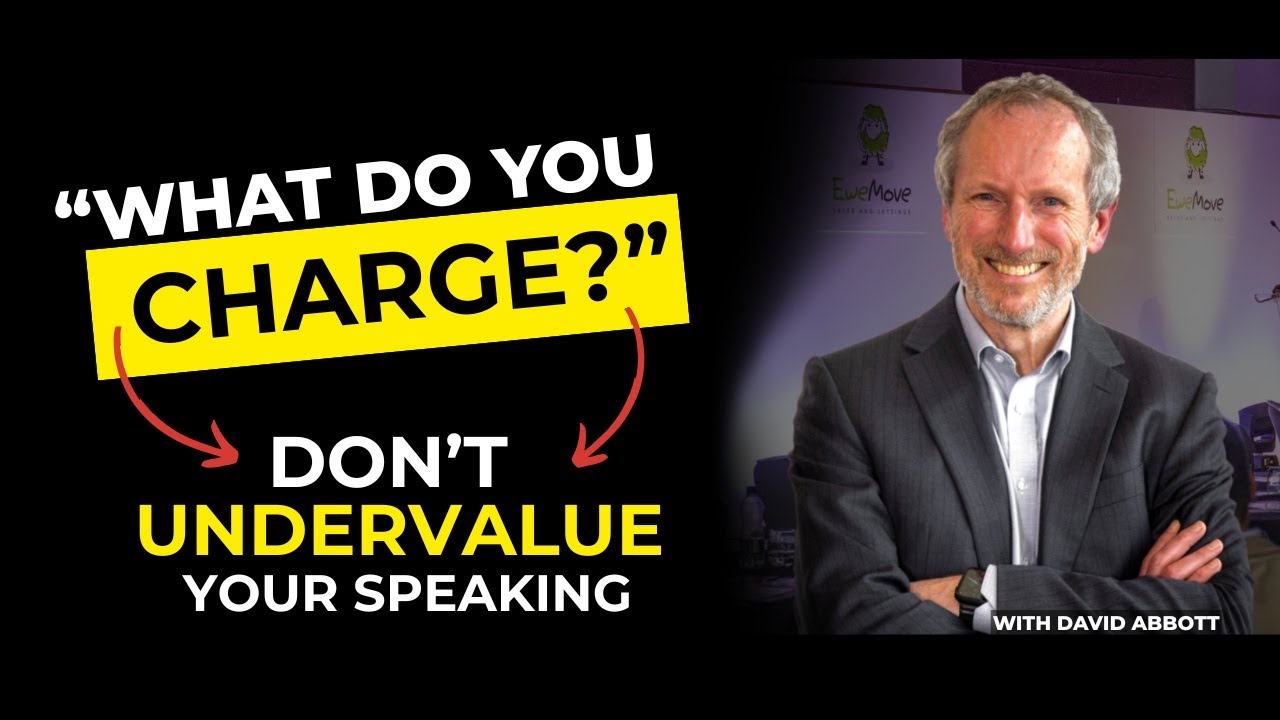
Pricing specialist David Abbott explains why speakers undercharge: most pricing problems are actually communication problems. He shares tactics like anchoring (highest price first), precise numbers, and testing higher fees regularly, emphasizing that emotion and perceived value matter more than logic.
Chapters
If you've ever found yourself lowering your speaking fee or hesitating when someone asks you, what do you charge? Or wondering whether you are actually charging what you are worth, then this episode is gonna be a doozy for you. Because pricing isn't just about numbers, it's about confidence, positioning, and also how clearly you can articulate the value that you bring. And my guest today, David Abbott, is someone who spent years helping businesses and speakers get this right. He's a pricing expert, he is a professional speaker, and he's the creator of the brilliantly named Platypus Pricing Process, which we will definitely be getting into. And in this conversation, we are going to be exploring why most pricing problems are actually communication problems, the psychology behind what people are really buying, and how speakers can stop undercharging without feeling like they're pushing or overpricing themselves. So, if you want to be better at charging what you're worth and getting paid for the value that you create, you'll want to listen to this. this one. Without further ado, let's dive in. Welcome to the Speaking Club, David Abbott.
Thanks very much, Sarah. Lovely to be with you, and hello, everybody out there.
Yeah, it's great to have you on the show.
Lovely to be here.
I was fortunate enough to see you in action live just a week ago, so I already know the answers to some of the questions that I'm going to ask you. But I'm excited for the audience to get those golden nuggets that I got last week. So let's get cracking. First question I wanted to ask you, David, is how did you shift from being an engineer to becoming a pricing specialist?
Sounds like it must have been a long journey, doesn't it? There's a bit of a gap in between the two. I really enjoyed being an engineer. It's great if you're interested in that kind of thing. I was an electronics design engineer. It's like being a crossword enthusiast and you're paid to do crosswords all day. It's fab. But there are a couple of things as I progressed through my career, there are a couple of issues. One is it's fantastic being an engineer. Managing engineers is a pain in the backside. But the other thing is, I'd receive a specification for something that somebody wanted. In the days when I was designing integrated circuits, you know, it'd be a spec for an integrated circuit. So I'd go away, I'd design the thing, get it manufactured, and at the end of it, you've got this black thing with legs on it, and you pass that back, and that goes into a product, and it goes out into the marketplace. So there's somebody out there figuring out what the trends in the marketplace are, what customers really need, what problems could be solved, and coming up with ideas. And then from that, approaching me with that spec, I do my bit in the middle. Then they go off and they learn shit and they promote it and they decide on the price for it. And, you know, they do all the rest of it. There's a whole great big commercial process and I'm responsible for one little slice in the middle. And I was just interested in the broader picture. So I made a move from product design into product marketing, which is very much around the trend forecasting and, you know, what are the appropriate technologies to use. And then from that into marketing communications, then did a marketing qualification, then senior roles in marketing. And pricing is one of the elements of marketing. People used to talk about the 4 Ps of marketing. It's 7 these days, but the 4 Ps, the classical ones were product, price, place, and promotion. And you can find books galore on product, place, and promotion, not many on price. So it seemed like there was a bit of a gap and here I am.
You filled that gap.
Yeah.
Now you've developed what you call the Platypus Pricing Process.
Yes.
How did that quirky name come about? And what's the big idea behind it?
I would love to say that it stands for something, you know, P is for profit and L is for, I don't know, whatever. Nothing like as clever as that. When I first developed the content and started speaking about it, it was just called The Psychology of Pricing. And there's a huge amount of detail that goes into a pricing process. There's all sorts of different stages. One bit of it is how do we communicate a price effectively? And that's the psychology bit. That's the interesting bit that audiences like to listen to, you know, because we're all very quirky and it's a lot of fun finding out just how weird we are. But the psychology of pricing is a little bit boring. And when I first joined the PSA, you know, we had a number of conversations around this with people within the region that I was part of and the mastermind groups I went along to. And I remember people talking about other speakers. There's somebody who'd written the book Why Nobody Ever Washes a Rental Car, and I've never read the book, but I didn't— I may have got a word or two wrong in the title, but it's going to be close. It's memorable, and it kind of says something as well. You know, you can see why nobody washes a rental car. They don't own it. You know, you can kind of guess what the message might be behind it. And I was just trying to find something that had that kind of sticky memorable kind of name. And it was literally in a meeting, we were just talking about things and the bit of alliteration just suddenly came out of nowhere. How to price your— we were talking about a whole bunch of things and Platypus was just suddenly there. So there's no science behind it. There's no clever acronym or anything like that. Since then, so what was that? I don't know. 2012, something like that. Since then, I've had occasionally a little bit of pushback from an audience where they'll say, oh yeah, great topic and all the rest of it, but it's a serious subject, pricing, and the platypus is a little bit lighthearted. You could drop that. No possible way, because the number of people that have got in touch with me and said, oh, I heard you 5 years ago, they couldn't remember your name, but I Googled Platypus and Pricing and there you were. You know, the beauty of something like that is it is sticky. It's memorable. If you become known as the Platypus Pricing Guy or whatever, it's a fantastic handle. So, it's staying.
Yeah, no, it's brilliant. And I think having seen it in action, the concept of a platypus, you know, the awkwardness of this, the sort of one-offness of it, it really works well with the theme of your talk and your sort of idea behind everything. One thing that I just wanted to just go back on in terms of your engineering background, you know, and this process and all of that, do you find that having had that background, it means that you're approaching this subject from a slightly different angle? Or have you sort of really discarded that engineering stuff?
Well, it's a fundamental part of me and I know. And you've got to untangle cause and effect, you know. It's— I don't think it's engineering that necessarily made me what I— the kind of person I am that's highly driven by data. And, you know, in the color profiles, I'm a very high blue. The reason I went into engineering in the first place will have been because, you know, huge affinity for numbers, science, 3 maths A-levels, you know. It's— that's the kind of person that I I am. So I like data, I like research. When I am presenting, you saw this on the slides, if there's some academic research that backs up the particular concept that I'm talking about, I'll quote the research. If someone wants to go and read it, fill your boots, you know, because I find all of this incredibly interesting. So it's just, we're all We all have fundamental characteristics, don't we? And that's just part of me. It's, I like numbers, data, and evidence.
Excellent. And I mean, the interesting thing though, you know, you've got that affinity for numbers. Most people will think that pricing is all about numbers and data, but actually it's the antithesis of that. It's more about psychology. So why do you think it is that emotion is more powerful than logic when it comes to price and buying decisions?
Emotion's more powerful than logic in almost every single thing that we do. You hear people, I'm going to butcher the saying, but something along the lines of, you can't argue somebody into a position using logic where whatever their current position is, they didn't arrive at using logic. Almost nobody arrives at their existing positions about the world or the positions about a particular thing that's in the media or whatever because of logic. They arrive at them because of a whole bunch of things. It's all of your experiences up until that point, all of the stories that you've you've told yourself and experienced, all of the stories around the particular thing that you're listening to right now, how those stories are delivered. Well, we're storytelling animals and it's stories that communicate points. So when I do talk about the platypus, although I'm a numbers guy and I do like the research, as you saw, I don't say, right, and here is this paper. If you look at chart number 4 on the— I'll take, you know, look at the data trends. Yeah, there's None of that. It's, you know, we tell some stories around pricing, you know, so I'll tell some stories about organizations I've worked with or things that I've seen out in the marketplace, whatever they are, that bring the thing to life.
Yes.
And that's how we connect with each other. It's through those stories, isn't it? So, and it's the only way, you know, professional speakers tend to be professional storytellers. And that's something that you know something about as well.
I mean, if we ever doubted the fact that we're driven more by emotion than logic, we only need to see what's happening in the wider world to see that played out, unfortunately. But anyway, well, leaving that aside, but to do that, there's definitely something that's on display right now.
Yeah.
One of the things that you've said and came across in your talk was that most pricing problems are really value communication problems. I wondered if you could elaborate on that, what you mean by it, and also how people can start fixing that.
Over the past, oh, I don't know, 10, 12 years, I've been speaking to a lot of CEO groups. And if people aren't familiar with what a CEO group is, the biggest in the UK is something called Vistage. And a CEO group, there's 12 to 14, 16 founders, MDs, CEOs of an organization. They meet once a month, business speaker in the morning, and in the afternoon, if there's an issue at work, they bring it to the table and they get the help of everybody else. When I'm talking to a CEO group, I have a look at all of the websites for all of the members there because I create bespoke examples of the content that I'm going to deliver to bring it to life. And I've spoken to around about, um, well, typically about 20 a year. So if you do 12 years times 20 a year times 15 in a, in a group, I, I'm not going to try and do that now, you know, but it's in the thousands. That's how many websites I've looked at to create those bespoke examples. And I would say that 95% of those websites talk about how long we've been in business, when we were founded, you know, the awards that we've won, the things that we do, the incredible machinery that we've got. You know, we've got 5-axis something or others that allows you to do this, that, or the other. Very few websites talk about the outcome that you're going to get when you work with us, the value that we are going to deliver. And that's the key thing that every single customer, clients, whatever you want to call them, is looking for. They don't really care about how you're going to do something. They care about the difference it's going to make to them. And most organizations could do a better job of defending the price that they go to market with, or actually increasing their price if they clearly communicate the value. Remember, things that I say every single time to every single audience is, It's not the customer's job to work out for themselves what value they're going to get from you. It's your job to clearly communicate that value. And given that the vast majority of websites that I look at don't do a good job of doing that, if you do a good job, you will stand out. And I know I'm talking about websites and focusing on that because that's the public-facing bit of the organization that I can actually look at. But anytime I've worked with a client, The rest of their marketing materials tends to be very similar, you know, their pitch decks, their brochures, whatever it is that they send out. Even, I did some work with a distributor. I'm not going to say what the product was because they're the largest in their field. And if I named the product, it would be instantly obvious who it was. But I spoke to the senior sales team before I basically did the same session that you've seen, the Platypus Pricing.
Mm-hmm.
And I asked them, why do people buy from you? And they said, well, you know, we've got the biggest range in the marketplace. We carry almost everything ex-stock. We've got fantastic processes so we can deliver it the next day. It's really high-quality stuff. We back it up with fantastic technical support. We do this. You know, a great big long list. They didn't mention price. And then I got hold of their marketing materials and every single thing was lowest price, sale, from, you know, all of their marketing materials was about, we're cheaper than somebody else. And none of the communication was about that this is just how good we are to justify the price that we want to charge in the marketplace.
Yeah.
And that's not an uncommon gap. So, you know, I really do focus on value simply because in my experience, so many companies are really, really poor At understanding what value means for the customer, and then communicating the way in which they're going to deliver that value.
That's really interesting. I think what's coming to my mind is that it feels now, in the current sort of economic business climate, with all the uncertainty, that people are facing in all different aspects of, of, you know, life at the moment, that there is a hesitancy in making some decisions, some buying decisions.
Yeah.
And that can result in the temptation to look at making things cheaper, more affordable, so that it becomes easier. cycle, you think that it will be easier for people to make a decision if the price is cheaper, given everything that's going on at the moment. How would you, would you say that's true or would you argue against that and focus back on value?
There are elements of truth in it, obviously. And in some particular markets, it's more true than others. So for example, In every corporate role that I've ever been in, if there's ever a downturn in the market and the company feels it needs to tighten its belt, all training courses stop and the marketing budget suddenly gets smaller because they feel like they're discretionary spends, you know, within an organization. So it is the case. that industries face tough times, depending on what's going on in the world and what's happening in your marketplace and what the competition are doing and a whole bunch of different factors. The issue that I have is that for most organizations, the one tool that they think they've got in their toolbox is price. So if things ever start to get a little bit difficult, right, okay, well, we need to start dropping our prices, undercut everybody else. protect our market share, or we'll protect our revenue while the market is actually declining, or whatever it might be. But they're ignoring that everybody else in the marketplace is looking at them and thinking along the same lines. And you're rapidly getting into that race to the bottom. And I would rather try and find ways to focus on the brand and what the brand means for the for customers. I'll come back to the brand just in a moment. Now, this is more of a marketing issue, but really focus on communicating the value. If you can justify the price that you want to charge, then let everything else go down. It's not true that all customers always go for the cheapest price in the marketplace. You only have to think of our own buying habits. You know, how many people own an Apple iPhone? There are cheaper phones in the market that do everything that an iPhone does. Even if you're bought into the whole Apple ecosystem and they all talk to each other. I had an iPhone for many years while I was still on Windows PCs and didn't have an iPad. And it was the only Apple product I had. I still had an iPhone. Now, there are lots of people like that. But there's something about the value, the ease of use, the the box it came in. You think, if you've got an iPhone, I remember there was a thrill down my spine when I got the phone home and I picked up the lid of the box, the whole box came with me, and then the bottom slowly floated. I think I did the box 3 or 4 times before I took the phone out. You know, we're much more complicated. We think that Every customer out there is a really simple decision-making machine. If you meet the spec, then whatever the lowest price is, that's always going to get the business. And then we personally, we make much more complicated and sophisticated decisions. The thing about brand was during COVID a lot of companies stopped spending money in response marketing where Pay-per-click, that kind of stuff where for whatever, perhaps if you're selling online, that's fine. You can still do it through the post. But if you're trying to drive people to a physical location and they're not allowed in the shop anymore, then you can, well, you can save all of that money or you could spend some of your marketing money on other things. There are quite a few analyses after COVID, you know, a year or two after COVID to look at What had happened during those years. And it looked like those companies who invested in their brand, so in building the brand perception, the understanding of the brand, the value of the brand in the marketplace, that not only drove sales during the period around about the same levels as the response marketing used to do, but it actually built market share coming out of COVID And it's just illustrating that we want the comfort. There are a lot of psychological things going on. You know, if you buy something with a brand on it that you know and trust, there's an element of less risk or an element of self-esteem. Or from a business perspective, you know, nobody ever got fired for buying IBM.
Yeah.
There's an element of Things are tough. I could save a little bit of money, and if the production line stops because of my decision, I will lose a bucketload of money trying to get the damn thing going again. My job's on the line. Or I could go back to the premium supplier that I've used all of these years and know for absolute certain that that line's not going to break down and everything's going to be absolutely fine. And price actually communicates something about what to expect.
Mm-hmm.
So if you do have a quality product and you push the price down, you're actually communicating that maybe it's not such a good quality after all.
Interesting. What's another thing?
Actually, Mia, you're just reminding me, there's a client that I did some work with. This is an electrical wholesaler, and they had grown from £10 million turnover making £1 million profit to £20 million turnover making £200,000 profit. So they've gone from 10% operating profit to 1% operating profit. And it was because they got discount happy. They were chasing growth. And the only tool that they had in the toolbox was, we'll drop our price. If we've got the lowest price, we'll get the sales. Well, they got the sales, but at a vastly reduced profit. So Yeah, they're making a million pounds, you know, and now they're making £200,000. In what way is that success?
Yeah, and they're probably having to work harder to get more sales.
Twice as hard. They've gone from £10 million to £20 million. They're working twice as hard for less money. In what universe does that make any sense?
No, that's really interesting. And I think, um, that whole— I mean, we're back to the, the, the Psychology again, like status drives so many buying decisions in all sorts of different ways. And whether you're trying to protect your status or flaunt your status or whatever it is, you're absolutely right. That's so interesting. Okay. So for setting prices then, you talk about the platypus.
Yeah.
In terms of setting prices, most businesses still price based on cost or competitor benchmarking.
Yeah.
talking about value, you know, how, what is the smarter way for them to approach pricing?
There are, we're getting into the technical side of pricing now and quite away from the psychology behind it. But there are a number of tools that you can use. In certain circumstances, it's possible to figure out what value you are delivering. And then there's all sorts of research that suggests that people are in general, prepared to pay somewhere between 5% to 20% of the value that they receive. So if you're doing something and you know that it's going to create £100,000 worth of value for somebody, then a fee of between 5% to 20%, somewhere in that range, that's quite a big range, but I'll come back to some other tools. But there's a, in theory, if they're If you're going to generate £100,000 for them and if you charge £90,000, they're still getting £10,000 extra. In theory, if they were purely logical, they'd still be happy with that. In reality, they think that you're taking the mickey and they'd rather not do it at all than give you £90,000 and they only get, you know, all sorts of human factors that come into play. But somewhere between 5% up to 20%. feels fair to people. So that's one aspect, trying to understand from a monetary point of view. And money isn't the only way that we compute value. Value means many things to us, but money is just one of them. The other is there are a whole bunch of tools that you can use, things like Geber-Granger or Beckett, de Groot, Marshak. There are tools that you can use to establish people's willingness to pay. And I'm not going to go into the detail of them. There are Wikipedia pages on all of them. There are willingness-to-pay tools in the marketplace that you could employ. And that then involves a little bit of research and asking people what they would be prepared to pay in certain circumstances. And then thirdly, there's a tool that I use with pretty well every single client, which is a comparative value tool. So this tries to figure out how do people perceive your value versus your competition's value. And then you can plot that on a horizontal axis where you've got 100% is you're doing everything that particular customer or client can possibly imagine perfectly. So there are tools that allow you to compute the value. So you work out as a percentage of that, the maximum possible value that you could deliver, where might you be and where might the competition be? And then if you've got some idea of the fee you charge versus the fee that they charge, then you can do a scatter plot. You can see, and you can see where you sit relative to everybody else, not just in terms of, oh, you know, there's a range of prices out in the marketplace, which is what you said. You're absolutely right. Most organizations, it's either cost plus, add all of our costs together, stick a margin on, or we'll just have a look and see what are the prices in the marketplace. And it feels like we're at the premium end, so we'll price towards the top, or it feels like we've got got some cost efficiency, so we'll price towards the bottom. By doing the scatter chart, you can see exactly where you fit compared to everybody else, and then you can make specific decisions. Well, I'm actually delivering quite a lot of value. I'm going to deliberately price up here, and it might be higher than anybody else's price in the marketplace, but I think I'm delivering more value than anybody else in the market. So you get that picture, and it's a better way of making a pricing decision. than just either finger in the air or, oh, let's just copy what everybody else is doing.
Yeah.
Somebody somewhere in the mists of time worked this out perfectly. And since then, we've all been copying each other. And, you know, so somebody once, once upon a time, they got it right. No, they didn't. You know, 30 years ago when somebody invented this process, whatever it is, or also somebody did that. And since then, everybody's just been copying it, you know.
That's really interesting. The next thing that I want to get onto is some of maybe the strategic things, like you talk about making prices stickier. Can you say what you mean by that and how you can increase the chances of people saying yes without discounting?
And this very much comes into the psychology behind Yeah. How we make a pricing decision. And by that, I mean, you know, the client, how does the client decide, yeah, that's a fair price to pay, I'm happy to pay that price, or whatever. So, there are a number of things that we can do. One is presenting more than one price. If we only present one price to somebody, then the only option that they've got is to compare that with anything they bought in the past, or alternatives they can buy from other people, or other things that they could spend the money on, or If you present 3 options, then subconsciously it feels more like they're in control. They've got some choice. Now they can choose between these 3, and they think less about the other options out there. And I do not want anybody to think that I, okay, that's your product. I'm going to find a way to take some cost out and take some cost out. We'll create 3 options that way. It's by adding value and adding value. You know, so you've got a good, can you find a better and a best?
Yeah.
So that's one way of doing it. Another way is something called a pricing anchor. And the pricing anchor is just a way of planting a number in somebody's head that means that any numbers after that feel more reasonable. And the simplest way of doing that is if you've got 3 prices, start with the highest price first. And if you want to see this in action, Watch the celebrity strictly, not strictly bake-off. You know, so and the the celebrity one, it's it's a charity thing. So it's stand up for cancer, and they you know they'll they'll do a bake, and they they all walk out into the garden, and they they're going to break for the ads. And when they come back from the ads, the judges are going to have a look at the bakes, and you know somebody might get the. The handshake. But immediately before the ads, there's a little piece to camera where they talk about somebody in their family having cancer and the importance of giving. And then was the donation page. And the donation page reads, to donate £40, £30, £20, £10, text 40, 30, 20, 10. And it's in that order because when you hear 40 first, that becomes the reference. Against which everything else then gets compared. Well, 40 is quite a lot. Oh, 30 is not too bad. You know, oh yeah, I could afford 30. If you started 20, 30, 40, 10, 20, 30, 40, then people anchor on the 10. Oh yeah, I could afford a bit more than that. I'll do 20.
Hmm.
So the first number that people encounter becomes that reference point, that internal reference against which everything else then get compared. And a third tip would be to make your numbers slightly precise. So, there are a lot of people who, I don't know, let's say you provide a service, a law firm. Let's say you're a law firm, you've had a look at your others, somebody wants to have a look at their terms and conditions, they're getting into a new lease for something, and you're going to go through all of this, and you know how long it's going to take roughly. Because you've done it many times before and you know what your hourly rate is. And the lawyer hourly rates tend to be £450, £475, £500. Yeah, they tend to go up in £25 multiples. So you think, well, I charge £500 an hour. I think this is about 10 hours worth of work. Okay, that's £5,000. But £5,000, that really does sound like you've just done the finger in the air thing. It sounds— You're inviting people get into a negotiation with you. If instead your hourly rate was 513 and it wasn't 10 hours, you actually look at it, well, it's going to be close to 10, but actually I think it's going to be more like 10.5 or 11 or whatever. You multiply more precise numbers together and you quote the precise number, then it feels like there's some science behind it. And in the example I've just quoted, there genuinely is a bit more science behind it, but it feels like There's more science behind it, and the customer is less likely to negotiate.
Yeah.
That's one aspect where there's a negotiation element. But even where it's just a price on a page and you either pay it or you don't, there are a few psychological things going on there. The 99 pence thing, that's called charm pricing. So if you knock a penny off and it changes the first digit, so you go £10, you knock a penny off and it becomes £9.99. Or better still, £20, you knock a penny off and it becomes £19.99. That first digit changes from a 2 to to a 1, it feels like it's less expensive because mentally we put it in the 20s bucket or the 10s bucket. There's only a penny difference, but it feels like there's a bigger difference. That's one factor. But the whole precision thing, if it's not £20, if it's £21.32, again, A, it feels like there's a reason, but B, again, there's a chunk of psychological research around this. Precise numbers just feel smaller to our brains than round numbers do. So it's entirely possible that if you did exercises with different people to try and get them to estimate or describe the size of £21.32 versus, versus other people describing the size of 20, it's highly likely that the people describing the £21.32 will describe it as a smaller number than the 20. Because to our brains, precise numbers just feel smaller. So there's 3 tips there that should be able to help anybody with their pricing. 3 options, start with the highest price first, and try and make your prices precise. Really simple stuff.
Yeah, excellent. That's brilliant. Thank you for sharing those. Those are really, really cool. Now, I wanted to turn to speaking a little more now. Now, you are a speaker, and I wondered, In your own speaking journey, how did you decide on your fee and what was the biggest mistake that you made early on?
One thing I'm not is I'm not a walking encyclopedia of prices. The number of people that come up to me and say, oh, I've got this problem, I'm launching this new service, you know, what price should I charge it? I haven't a clue, yeah. And there are a whole load of ways in which we can figure out what the right price should be. But I'm not walking around with every possible price in the universe stuck in my head. And as a consequence, I had the same challenges that other people have when I first started. Plus, when you're yet to be well established, when you don't have the testimonials, you don't have a speaker show that people can look at, it's evident that you've You don't have the same pedigree that other people might have. It's difficult to charge quite as much. You can't just decide, right, I'm going to be a professional speaker and then tomorrow I'm charging £10,000 for a keynote. You know, it doesn't work like that. So I did some work. I tried to find out what was going on in the marketplace. I looked at the value that I was delivering and based on that came up with some early prices, which I backed off a little bit on because confidence. I'm as human as anybody else, and because I was yet to be established. But what I've been doing consistently is testing higher prices, pushing higher prices, trying different things. And the fees that I'm charging now are very, very different to where I started. So my advice would be to anybody setting out as a speaker or anybody in a similar circumstance, you know, where you're providing a service of some kind, Okay, be tentative at the beginning unless you are signing up people for life, because once you've agreed the price, it's very hard to come back and change it, you know.
Yeah.
But assuming that, you know, it's per gig or per activity, whatever it is, you might start off a little bit tentative, but keep testing. Do not stop testing higher prices. Keep trying a higher price all the time. And eventually you should reach a point where you are losing opportunities and it's clear that you are losing them because of price.
Yeah.
There was a client that was in one of my audiences. This is one of the CEO groups. And the chair just asked a warm-up question. He asked everybody, when was the last time you increased your prices and how much by? And there are a couple of people who did this every year and they followed inflation. There were a couple of people who hadn't done it for 3 or 4 years and they looked a little bit sheepish about it. They got to one person, they were a firm of architects, and the guy said, well, I think it on average is probably about every 9 months. And I said, well, what do you mean though, roughly on average, and why 9 months? He said, well, we measure our win-loss ratio, and if we start to win more opportunities than the limit that we've set, our prices go up. So we aim to lose a third of the opportunities that come into the business.
Okay.
You know, the 70% that we win, that keeps us completely busy. And if we start, if it starts to go up too much, you know, if the work that's coming in, you know, what we don't want to do is go and recruit another person and then recruit another person and suddenly there's a downturn and then You know, what we do is we just put our prices up, you know, and bring the demand back down to an acceptable level. I thought, brilliant, absolutely fantastic. So, they're monitoring that key metric and continuously pushing their prices.
God, that's really interesting. Yeah, that's really clever actually. So, it's good. And I think that's probably, people don't pay enough attention to those numbers. To be able to do that.
I just, a quick anecdote. I know there was somebody, sadly she's not with us now, but somebody in the speaking industry, this is 10 years ago I think, told me that she'd tripled her prices overnight. The number of inquiries did go down, but they didn't go down to a third, or the number of actual engagements, they didn't go down to a third of what they'd previously been. So she ended up working less hard and at the same time making more money. But what most organizations, if you go back to what we were saying earlier about discounting in order to win volume, you know, do you really want to work harder to make less or less, do less work and make more? I think it's a pretty easy decision.
Yeah, absolutely. Absolutely. Now I'm going to put you on the spot here.
Okay.
And it'd be interesting to get your take on it. Now, you and I were in the same meeting last week when this came up, where a speaker had been booked by a company, and the company told her that she was half the price than all of the other speakers who had been put forward for the gig, and all of the other speakers were men. And so, she fed this, and they said, we wanted to book you not because of your price, but because of the value that you are gonna deliver to our audience, and we wanted to let you know. So, she fed that back to the booker, the agency booker, who was also a woman, and the agency booker said to her, I can't increase your prices. in parity because it will price you out of the market. Have you got any tips or view on that? It's really, I know it's a thorny question, but I just wanted to get your take on that.
There are a few things there that I'd like to know a little bit more. Yeah. So was the bureau saying, I can't increase your price as a female speaker compared to the male speakers. Because if that was the message, and that wasn't said on the day, you know. It wasn't, yeah. If that was the message, I would have a really— this close to International Women's Day as well, I would have a really big issue, really big issue with that. Because it shouldn't matter, it shouldn't matter anything about who you are or whatever. It's the value that you're delivering to the audience. That's what we should be paid for. No, it's as simple as that. I would end up shopping around for a different bureau, I think, to work with. Certainly, I'd go back to the company and try and find a bit more information on the other people who had quoted and what else they'd been quoted in the past, you know, because presumably this isn't the first time they've held a conference or whatever it was. Because it may be that the speaker bureau's perception of what the market price was is incorrect. Or it might even be that this particular company, they're in a specific market sector where they do expect to pay more. And the speaker bureau person, they're right about the market in general, but they're wrong about this particular industry. And she needs to update her data, you know, for the future. So there's no single answer, but there are a few things I'd like to understand more before— I would certainly, I will be tempted to be going back to that, the speaker booker and saying, I understand, okay, you don't want to double my prices, but let's stick another £1,000 on right now, minimum. Let's see how that goes, you know.
Yeah, exactly.
Yeah.
Well, that I didn't, as I say, I put you on the spot, but I think there's some really interesting questions that you've raised in terms of context around this.
But yes, good.
Okay. Another speaking question, one that's come up with my clients, and I have a view on this, but I wanted to check in with you as you are the expert. In terms of online versus in-person gigs, there has been a tendency for speakers to discount online gigs versus in-person. Have you got a view on whether that is right or wrong?
I don't think there's an absolute answer to that, a right or wrong. I know what I think about it, which is you're paying me for the value that's going to be delivered. So if I'm running a session, if I'm running a keynote and I'm delivering it 45 minutes online versus 45 minutes on the stage, I'm going to charge the same because you're getting the same value either way. The— if it's in person, I'm forgoing some of my time because there's travel time involved. You know, you're going to pay me for the travel and the hotel. So in person actually costs me more to deliver. I ought to be charging more, and I guess that's wherever it comes from. Or for virtual, you charge less because you don't have that travel time, you can fit more in. But that's starting to say that what we're really charging for is our time.
Mm-hmm.
One of the things that I point out is there are 3 fundamental things that we tend to sell. One is our inputs. So if lawyers are charged, you know, if you are £200 an hour and something's 2 hours, then it's 400 quid. If it's 3 hours, it's 600 quid. You know, all you're charging for is your time. And in a way, by saying that it'll be less for virtual because they don't have all the traveling and that kind of stuff, you know, we're basically saying it's not the value that we're going to deliver, it's the time involved.
Yeah.
So companies, they either charge for their inputs, which is typically time, or if they're materials, cost-plus charge, pricing is just charging for inputs. Or you charge for your outputs. You basically say that what I deliver is the same as anybody else. It's almost fungible. There's a market price and it doesn't matter who you go to within the market price, you're going to get the same value. You pay the same price. I'm much more focused on, well, the whole value conversation that we've already had. What are the outcomes that you're going to get? You know, how are things going to be different and better for you as a consequence of the work that we do together? You know, genuinely, what value am I going to deliver? And that's what I think we should be paid for. And if it's— if I'm being paid for the value, then I don't care whether it's online, via séance, you know, however.
Yeah.
You— we could, we could do it using the Ouija board. I don't care. Um, it's the same price. Yeah.
If you could, if you could do that, you'd be earning a fortune. Excellent. Thanks, David.
I'm going to be the first speaker who comes back from the dead and their fee is completely unchanged.
I love that. I love that. Okay. Um, so penultimate question before we get into the standard ones. Let's say a speaker does want to raise their fees and maybe we've covered this and reposition their brand. What would you advise them to do to make that work?
I don't want to destroy anybody's business. So if somebody's out there, for example, and they're charging £1,000 for a genuine conference keynote in the UK, that would be at the very, very, very cheap end of it. You know, that would be communicating, I don't think I'm very good, you know, but maybe take a chance on me. I'm not going to say to a person like that, right, okay, you need to be £5,000. That's the average. You you know, multiply by 5 overnight. 'Cause the danger then is, you know, particularly if you're starting out, you're keen for any work to come in, you know, you don't wanna lose it all. I would say continually push your prices. So each time a new opportunity comes in, stick another 10% on, 'cause 10% compounds quite quickly, you know?
Mm-hmm.
So if over the next year or so, or 18 months, there are 10 opportunities. And every time you increase by 10%, 10%, 10%. I've got the calculator with me, but that's, you know, you've gone from 1,000 to multiples of thousands, you know, quite quickly. So do it in a testable methodology where you're not betting the whole of your business on, you know, hey, now I'm £5,000 now and I'm sitting here waiting for the work to come in and Phone's not ringing, you know. I don't want to do that to anybody. And it's exactly what I've done. I didn't spend a year or two at a lower price, think, right, okay, I've nailed it now. I've now got a book. I've now got a showreel. I know I can deliver it. Okay, right. I'm going to go from this price to that price tomorrow.
Yeah.
No, I went from up to there and then up to there. And then I have had some, a few years ago, I did a 40% price increase overnight because I was thinking, you know, this is working, it's taking a long time. And actually, I actually, you know, looking at where I am now, I don't think I'm increasing my prices fast enough. Right, catch up, 40%. And everything, there was a little bit of a dip and then it all came back. So as busy as I, I was 2 or 3 years ago, but charging 40% more.
Yeah. Interesting. Although, using your own logic, perhaps it should have been 41.25% or something like that.
Just— I know, that has occurred to me as well. And the reason I didn't do that is because all of my prices were already precise. And if the 40% had meant that any price ended up in a 5 or a 0, after I'd applied the increase, I'd have just added another pound on. So, it was either 30% or it was 30% plus £1. I love it.
So, to wrap things up before we go into the standard questions, if our listeners only took away one pricing principle from this conversation, what do you think it should be and why?
It's the fundamental one, as I said earlier. It's not the customer's job to work out what value they're going to get from you. It's your job to clearly communicate that value and to give them a little bit more flesh around that. When I'm working with a client, the way that I approach that is this. There's a guy called Peter Drucker who wrote a paper called Marketing Myopia. And in it, you know, he said nobody wants to buy a quarter-inch drill bit. What they want is a quarter-inch hole in the wall. But nobody really wants a quarter-inch hole. He was making the distinction between features and benefits. But nobody wants a quarter-inch hole in the wall. What they want is a quarter-inch fixing. But nobody really wants that. What they want is a picture hook or a shelf. But nobody really wants that. What they want is to make the room beautiful or to improve the space utilization in the room. So a methodology to try and figure out what value you are genuinely delivering is to try and think through what are the criteria that somebody is going to choose my product, my service, my work, whatever it is. What are the criteria that are in their head that they're going to use to decide between me and an alternative solution? So if it's a speaker for a conference, it might be your reputation in the marketplace, the responsiveness, how quickly you get back to them, your social media presence so that you can promote the event. There might be a list of criteria. But that's just the how, they're just the features. So for each one of those, keep asking, well, why do they care about that? Well, why did they care about that? Why do they— keep asking that until you've reached something that you think, ah, that's the real fundamental value. What I generally find with clients when I do this is there might be 10 criteria that we list. When we do that drill down, it always ends up with maybe 2, maybe 3. Fundamental pieces of value. So they become the core message. Why do you want to book me? Why am I worth £5,000? Because I'm going to get you repeat bookings next year. I'm going to get you the highest customer satisfaction scores that this conference has ever had. Maybe blur the 2 things. How am I going to do that? I'm going to— and then it's those first criteria things, just by delivering those things exceptionally well. But we start with those fundamental value bits. So that's the methodology. If people struggle, oh, I don't really— I find it hard to put into words exactly what the value is, you know, that's one way of approaching it. But absolutely fundamentally communicate your value.
Smashing. Thank you so much. You've shared such valuable advice today and guidance for people on this issue of pricing, which I know can really get people stuck and procrastinating and stop them from moving forward. So it's a real benefit to have you on the show. So that's brilliant.
Absolutely.
Now, before we point people to where they can book you to speak, book you to consult with their organisation or work with you, I wanna ask you a few Questions. First question is this: what's the best thing that speaking has done for you?
I think the community. I've never yet met a speaker who has chronic stage fright and is somehow gritting their teeth and going through it anyway. All of us, there's an element of, we enjoy being in front of people. All of us, I think we enjoy the making a difference to people's lives. You know, everything that we do, it's impacting somebody somewhere somehow. You know, there's a phrase, you know, when we stand on this stage, we change lives. So all of those things are part of why we do what we do. And that's part of why I enjoy being a speaker. But I think some of the best things are the people I've met. The Professional Speaking Association particularly is a fabulous community, really, really nice people. I relish the times when we have an opportunity to get together and talk to each other over a few pints and a few more. It's fabulous.
Good.
Okay. And I should say, not just in the UK, worldwide. I went and spoke in South Africa 3 years ago in April. And one of the ladies that I met over there, Joanita, I still had a WhatsApp with her just last week. You know, we're continuously in touch. There's a guy called Martin, I can't pronounce his surname properly, Laskolnik, Austrian. But Martin, really, really nice guy. Spoke to him this morning. You know, so it's the people I've met in the States, they're just, as a group, genuinely really, really nice people. It's a joy to spend time with and build these relationships from these communities. Brilliant.
Thank you for sharing that. And I think that is, you know, that is something that it can feel quite lonely as a speaker sometimes. So finding a community of like-minded speakers can be really beneficial to you. You know, from a wellbeing perspective, but also from a business perspective because you get to share ideas and tactics and all that good stuff.
I could not have progressed even a tenth of as far as I've come without the PSA. All the generosity of advice and suggestions and, you know, chances to try things out and get feedback, you know, talking to, watching other people do things, you know, the whole It's a fabulous community. Brilliant.
Thank you for sharing that. And next question is around a time when you have spoken and it didn't go quite to plan, and you're like, I don't want to think about that. Has that happened to you, David?
Just 10 days ago. So, I said I create bespoke examples when I'm talking to the CEO groups. And I cover 6 pricing concepts. One of them is value. So the value bit, I pick one, maybe 2 of the companies where they've got a website, which might be very pretty, you know, it might function very well, but it talks a lot about we and when we were established, and it does all the things I was talking about earlier. So I'll pick that. I'll show, you know, look, you know, I'll even then paste all of the content into a slide and highlight the number of times we talk about we and us and our versus how many times we talk about you. And then I'll create a new webpage with a little bit of help from ChatGPT. You know, I'll create a new webpage based on their existing website that just focuses on the value communication. And I must have done that a few hundred times. And every single time, the person from that company, they've got their camera out and, you know, they're taking photos of the new content. talking to my web developer first thing in the morning until 10 days ago. The guy took real umbrage and he felt like he'd been ambushed. Oh, it created a real issue. I got terrible scores. This is a Vistage session. Vistage scores matter because other chairs book you based on those scores. I've written an email to apologize to him. Because it's not meant to be an ambush. It's meant to be, you know, I've just picked one out of, uh, yeah, I could have picked almost anybody. I've picked one out, but here's how it could be done better. But he didn't think so, you know. So, so yeah, I, it's fresh in my mind because the scars are still forming.
Would that, will that make you change how you approach that going forward, having had that experience?
I have, yeah, because the It's not so much that I used him, it's that I used him without talking to him first. So 2 hours ago, I've got another gig tomorrow morning. I figured out who it is that I'm going to be using 2 hours ago. I spoke to the 2 companies whose websites I'm going to, you know, do the same thing with. And they were, oh yeah, great, fantastic, fabulous. But—
Yeah.
And that's the reaction I've had 99 times previously, but I want to avoid that 100th time. I don't want that to happen again. Oh, you know, I've been doing this for 16 years. I've had 100 of these and still—
Yeah, yeah. It's really interesting though, but we're always, as speakers, we're always learning and evolving and creating our content and approach to make things better. So that we can make the difference to the audience. But yeah, it's just—
Can I reflect that back on you specifically? Because you came to my region, you did a session in the afternoon on storytelling. And this particular session that didn't work well, it wasn't 10 days ago, it must be 3 weeks ago, 3, 4 weeks ago actually. So this, how to price your platypus is my main thing and I've done it 300, 400 times. I've got a new version, How to Value Your Platypus, which is focused on how do you choose the price in the first place and how do you communicate value. It's really focused on that bit. And I found a couple of Vistage groups who were prepared to be test subjects. So didn't charge, just went along. In return for me coming and doing it, they gave me feedback. I improved on the back of that. I then Then I was comfortable. I had something and it worked. Try, you know, did it with a few more people, rolled it out. And I've done, I don't know, 4 or 5 CEO groups. This one 3, 4 weeks ago was the first Vistage group and it bombed, you know, partly because of the reasons I've just explained, but it bombed. But it got me thinking about just why, why was it not clicking? And I came along to your storytelling session. And you were talking about the structure of the story and, you know, how you put things together. And it wasn't a direct thing that you said, but what you said just generated something in my head. It was like a light bulb going off, an epiphany. And I went back, I spent a day restructuring and rebuilding the content. It's all the same content, but now told in a more story-like manner. My scores with the Wonderbond were 2 or 3 out of 5. I did it again for a different group of the same chairman, 10 days after that first session. The scores were 4.82 out of 5 and things like that. So, you know, big thank you to you, but we are continuously learning.
Yeah.
You know, and you said, like I say, 60 years of experience and you said something and it really triggered something in my head. Like I say, an epiphany.
Oh, good. I'm glad I made a difference to you when I spoke that time, which is exactly what you were talking about. Thank you for the feedback. I appreciate that, David. Cool. Right. Last few questions. What's the book that's had most impact on your life and why?
From a fiction point of view, probably Lord of the Rings. And it's partly what got me into science fiction, fantasy, and And there was a period in my teens when it was my Christmas book. Every single year, out came Lord of the Rings. I read the thing cover to cover again. Yeah. So from a fiction point of view, probably that one. And that's probably the fiction book I've read more than any other. From a nonfiction book, Thinking Fast and Slow, Daniel Kahneman.
Yeah.
Which is just a fabulous insight into how Inside our heads, it feels like we are completely logical and reasonable, you know, and sensible. And every decision that we take is fundamentally grounded in logic. And in reality, we're just this complex mess of these hidden shortcuts that we rationalize after the event. And yeah, really, really interesting insight. into humans. And that's not just from a pricing point of view. Marketing, fundamentally marketing is about trying to influence other humans to do things. The better we understand how we tick, the more effective a marketer you can be.
Absolutely.
In fact, people, anybody listening to this, the absolute best podcast in the world is Sarah Archer's, clearly. The second best podcast in the world is something called Nudge, Phil Agnew. And what he does, it's half an hour once a week, and he talks about the psychology behind some marketing thing. You know, he talks about the paper, the research, and how it's applied. And there's a fabulous back catalog. If you have anything to do with marketing, sales, influencing, anything whatsoever, that podcast should be on your list.
Brilliant. Well, I'll give that a listen as well. So I'll put a link in the show notes to the books and that podcast for people to go and check it out. Smashing. All right, penultimate question. What's the best bit of business advice you've had and why?
I think this relates back to being a high blue as well. There was a I recall when I had a senior role in an organization called Premier Pharma, I was running one of the brands, a company called CPC, and I reported into the Europe, Asia, and Pacific, EA, PAC, whatever it was, CEO. So basically, there's a CEO in America and there's a CEO the rest of the world. And we had a meeting about something and there were 3 or 4 of us, we got together. And before he let us start, he made us really focus on exactly what's the question that we're trying to answer. And that's the number of times we go into something and we just dive straight in. Oh, solution. Oh, I think I've heard what it is. Right. Okay. This is what we should be doing. And he made us all take a step back and get absolute clarity on what genuinely is the issue and what is the question that we're trying to answer. And only then did we start to work on it. And that is so powerful. I mentioned Vistage. I was actually a member of the equivalent of Vistage, something called ACE, the Academy for Chief Executives, for 10 years. Vistage bought it, it's now rolled into Vistage. And the issue session that I talked about in the afternoon, the number of times somebody would bring an issue along and then we'd go around the table asking questions. And then once everybody uncovered all the background, And they could give advice. The number of times the advice from somebody was, that's not the issue. The issue is really this. You know, because they'd listened to everything and they'd heard and seen something and said, you know, you're looking at this the wrong way. That's not the problem you're trying to solve. It's really this. And that is such an important thing.
Yeah, absolutely.
Really be clear about what it is that you're trying to work on, solve, answer, whatever it might be.
Yeah, there is definitely a correlation between the quality of the questions and the quality of the solution.
100%.
Okay. Last question. If you could have one mentor, David, and they can be alive or dead, fictional or non-fictional, who would you choose and why?
It's a bit of a weird one. And he is still alive, but it might be Billy Connolly.
Cool.
And it's because I'm glad there's at least one Billy Connolly in the world. I remember decades ago, he was doing the world tour things. You know, he started off the world tour of Glasgow, then he did the world tour of Scotland, I think it was. This one was the world tour of Australia. And he was telling that one story where he'd he decided finally he was going to get his nipple pierced. And he went into wherever it was and they did the job. And after the guy had done the job, he looked at Billy Connolly and he said, now there's one less of them and there's one more of us. And I'm glad there's one more of him, or there's at least one of him in the world. Because every time I've ever watched him, he has a joyful life and a sideways way of looking at everything. And I don't want to be him, but having somebody like that as a mentor who can show you the different way, the off-route way of just thinking about things.
Yeah.
And finding the joy in it all. Because every single thing that he did, he just seemed to get that. Biggest, you know, buzz out of. I think that, yeah, I think that that would be, it would be great to have somebody like that helping and guiding you.
I think that's brilliant. I don't think we've ever had Billy Connolly as an answer, but I can absolutely see why you would be suggesting him. He's, yeah, definitely one of a kind, and it's a shame there's not more like him, like you said.
Excellent.
Well, look, David, thank you so much again for sharing All of the experience and, you know, the years that you've put into this to get to this point and to share that knowledge with us and give us some really tactical, practical tips and tools to increase our prices and not fall into some of those traps that tend to sabotage people. Really, really appreciate it.
Ah, with pleasure.
Good. And if people want to come find you, where's the best place for them to go?
My website's the easiest thing, and it's www.davidabbottspeaker.com. No hyphens. David Abbott Speaker, 2 Bs, 2 Ts.
Brilliant. And I can absolutely recommend David as a speaker. Now, I'm probably the worst person to watch speakers because I'm, you know, you kind of dissect things, but you absolutely, you know, captivated me, and it was really, really useful. Really good stuff. So, highly recommend. Good. Well, Thanks so much, David. You look after yourself and thanks for coming on the show.
Oh, it's been a total pleasure. Loved it.
There was a lot in there, a tonne of value, and David always brings the goods. I've seen him speak, as I said, in the show, and yeah, he delivers every time. So, I'm absolutely chuffed that we were able to tap into his brilliance on the Speaking Club. Now, there's a few things that really stood out for me. First of all, This idea that pricing isn't a numbers problem, it's a value communication problem. And this is something that I see all the time in terms of speakers positioning their message and packaging their message in a way that really clearly and quickly articulates the value that they're going to bring to whoever is booking them. Because if people don't understand the value, the price is always gonna feel too high. Second, the reminder that confidence in your pricing doesn't come from picking the right number. It comes from being clear about who you deliver for and what you deliver. And finally, this is a big one for speakers. Discounting isn't a strategy. It might feel like a quick win, but over time it chips away at your positioning and your business. And I also love those psychological tips around, you know, packages and number endings that are also going to be really useful to tap into that psychology of buying that people have. So, if you have been sitting on your pricing or second-guessing it or undercharging, maybe this is your nudge to revisit it. And, you know, if you enjoyed the episode, then go and check out David's website, his work. He's also got a book, The Platypus Pricing Process, and I'll pop all the links to those things in the show notes for you. And if you know another speaker or business owner who needs to hear this, send it their way. Also, if you've got value, go and Say hi to David on LinkedIn. I'm sure he will appreciate that too. So, until next time, firstly, I want to say thanks so much for watching or listening to the show. We understand your time is precious. Hope you got a tonne of value, you thought it was worth the investment today. And if you did, and you are listening to the show for the first time, maybe subscribe so that you get these nuggets every time we publish an episode. If you're on YouTube, subscribe. Leave a comment would be brilliant. Let us know what you thought. If you've got any questions that you might want David to respond to, bung them in the comments. And if you are listening on a podcast, then it'd be amazing if you could leave a rating or review. You can do that where you're listening or super easy, take a couple of seconds, or more like, I guess, 60, go to ratethispodcast.com. And that would be amazing if you could take the time to do that if you've enjoyed the show. So, all that's left for me to say is thank you again for watching and listening. It's been amazing to be with you again. And don't forget, until next time, to go out, grab your life by the nuts, and get cracking.
Bye-bye.
It's a nightmare. You're an expert with so much to say, but now that you've been booked to speak, you're struggling to know exactly what to talk about. You want a talk that engages the audience and wins you new clients without you losing your personality or anyone feeling pitched to. But what happens when you sit down to create that talk is that you end up staring at a blank page for ages, or worse, surrounded by hundreds of sticky notes with content that you could include. With so much material, you just don't know where to start or finish. Don't worry, because many experts like you face exactly the same challenge, and that's why I created the Blank Page to Stage Guide. In just 15 minutes, this breakthrough resource is going to help you identify the big idea of your message, Make it relatable for the audience that you're speaking to, and convey it all in a way that gets the audience inspired and on board with your idea. And it works even if you have tons of material or your subject feels less than exciting. If you want to cut through swathes of content and get a talk that you're excited to share, your audience loves, and wins you new clients, then grab your your Blank Page to Stage guide from saraharcher.co.uk/newguide-tsc. Oh, I forgot to say, it's completely free.
Enjoy!
More from Sarah




The Skill That Helps You Connect With Any Audience with Michelle Mills-Porter




What Moderating World Leaders Taught Me About Great Communication with Xenia Wickett


