The Speaking Strategy You Can't Learn from any Programme with Jenny Carrell
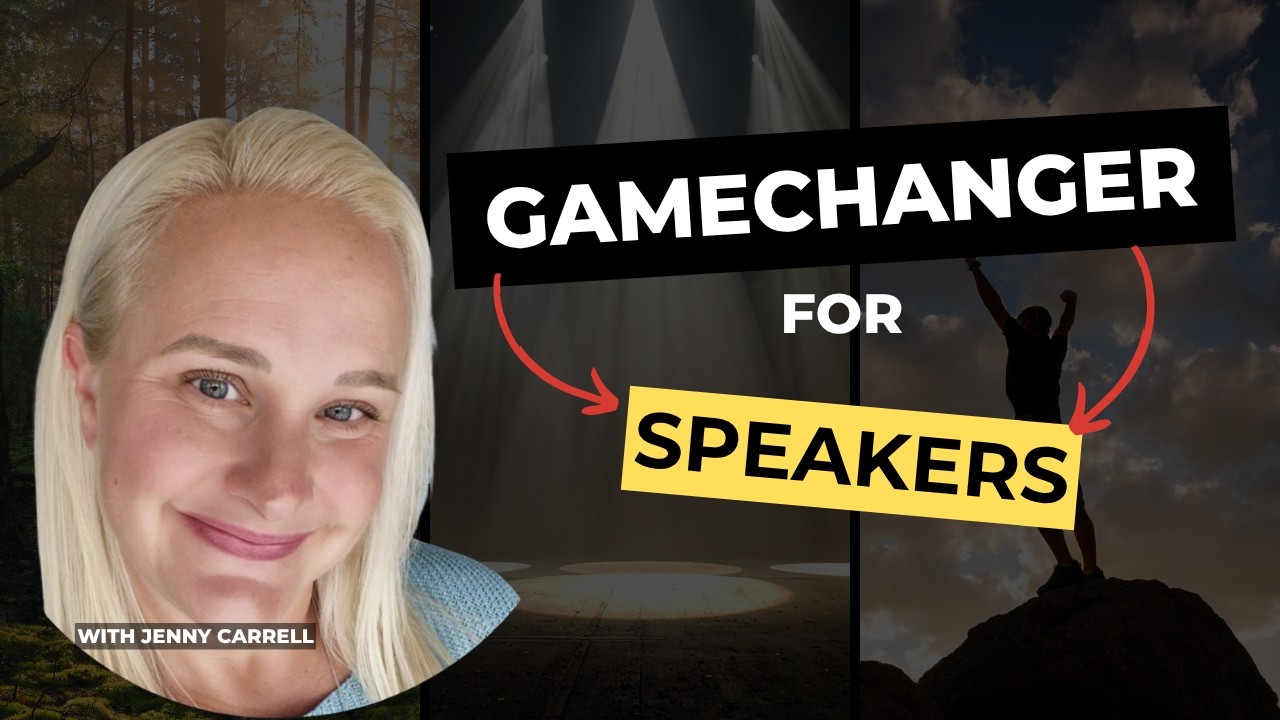
Jenny Correll teaches speakers how to use intuition and nervous-system regulation to build their speaking careers. She uses techniques like flipping the script to manage your inner critic, and recommends choosing speaking opportunities based on what feels aligned rather than chasing every opportunity. Her core advice: go with the flow and let your subconscious guide your strategic decisions.
Chapters
You can learn structure from a program, delivery from a program, presence from a program, but most speakers have done all the programs and yet there are so many who aren't where they want to be. So what's the thing that separates the successful speakers, the ones that get booked, get paid, from the ones that are still stuck doing free gigs or low-fee gigs? Well, I think it's probably the one thing you can't learn from a program, and most speakers don't even know that they've already got it. I'm Sarah Archer, and this is The Speaking Club Podcast, designed to help you become the highlight of any event you speak at and land more gigs. Now today we're talking about that missing ingredient, but I've got a question for you. Have you ever had one of those moments where something felt really right, or maybe really wrong, and you couldn't put your finger on why? There was no spreadsheet to prove it, it wasn't logical, it was just a feeling or this quiet voice telling you what to do. Now you might call that intuition or gut instinct, or experience talking. But however you position it, this is something that most of us have felt at one time or another. Now, the big questions are this though: should you trust that feeling or that quiet voice? And second, what role should intuition, if we call it that, play in our speaking businesses? Our careers and the opportunities that we choose to pursue. Now, my guest today is a lady called Jenny Correll. She's an intuition coach, and she helps people strengthen their inner guidance and understand how it connects with the opportunities that they create in their lives. In this conversation, we are going to explore everything from intuition and manifestation to self-belief, visibility, and why some speakers seem to attract opportunities while others keep hitting roadblock after roadblock. So whether you are a skeptic or you're already a convert, one thing I'm going to promise you is that you're going to find this conversation fascinating. And it just might be the game changer that you've been looking for. Right, let's head over to my chat with Jenny Correll. Just wanted to give you a quick heads up that we had a couple of technical issues in recording this interview, which meant that the audio isn't at the high quality we would normally expect. And also, one of the cameras failed partway through. Maybe it was Mercury in retrograde. If you know, you know. Other than that, it's an amazing interview. Know you're gonna love it.
Let's head over right now. Welcome to the Speaking Club, in person, Jenny Correll!
Thank you, I'm very excited to be here! So am I!
We've not done a live interview like this, for video as well. We've done it on audio, but not video.
Yeah.
And we've never done it in a space called the Magic Room.
Yeah, it's where all the magic happens. Exactly!
So I'm proper excited about this. This is gonna be great. So the first thing that I wanted to ask you was, before you became an intuition coach, what did you believe about intuition? Were you like a skeptic or were you open to it?
So if I'm completely honest, I'd heard of the word intuition, but I hadn't actually got a clue what it was, what it meant, how to use it. And I guess for most of my life, and this is probably why I became an intuition coach, is I didn't listen to my intuition, and I did everything but listen to it, and it didn't take me down the best route. So I had no idea what intuition was. The only thing I can remember is that people would say to me quite a few times, including a chief exec when I was an HR manager, Jenny, you have got this amazing inner wisdom. And I was able to feel into situations and know things without kind of any logical explanation. But at the time I hadn't got a clue what I was doing. I just thought it was normal. So, so yeah, I wasn't really even a skeptic. I just didn't know what I was doing. I was completely disconnected from it, but I obviously was using it at times.
Yeah, it's interesting. And maybe that because it was work and not you personally, yeah, you didn't have all of the baggage, yeah, around stuff That we do for ourselves that enabled it to come through potentially.
Yeah, and I think sometimes when you're doing— I'd say we play different roles, don't we, sometimes in life. And the Jenny, or the version of Jenny at work, was a very different, say, personality than the version of Jenny at home in her home life. So I'd created a character that potentially was more connected and more tapped in than I was at home.
Interesting.
So we really were wearing masks.
At that point, yeah, at that point, absolutely. Interesting.
Which leads me to the next question, which is, many people arrive in this space doing this type of work because something has happened in their life that sort of leads them there. What happened in your life? How did you end up doing this, which is very different to HR?
Very, very different to a HR manager, absolutely. Although looking back in my life and say in my professional sense, and even maybe in my personal life, I was using the skill set or what I would call the zone of genius that I use now with my clients. But my life was most, most of the time not in a state of okay. So I've just turned 40, and for 36 years of my life, I really was very disconnected to who I was.
Hmm.
I was literally running in what we call survival mode. I had experienced quite complex trauma in childhood. And it was literally running my reality. Every decision, every kind of behavior and action I took was based on, based on fear, as opposed to what I would say is a thriving state where your nervous system is in regulation and you're able to take a chance on yourself and learn to trust yourself and your intuition. So I feel like that was kind of research for all of the stuff now that I teach. And what I teach is through lived So I always like to say to my clients, I haven't always been like this. I've not always been so tapped in and honestly, you know, living my best life every single day. It's not to say life doesn't throw curveballs at you, but you kind of learn to respond to life as opposed to react, and that's where things get kind of magical, as I would say.
Mm-hmm.
Um, but yeah, for 36 years, completely checked out, and most of the time when I wasn't following my intuition, I had some big things happen to me. I think the The thing that kind of started moving me into this work happened around 24, 25, and I wasn't listening to my intuition. I was in the Dominican Republic, and this is probably one of the biggest crisis points that pushed me into the journey onto where you see me today. And I was sitting at the side of the road, and I heard a voice saying, there's going to be an accident in a minute. And I can remember my whole body was dreading. It was like there was going to be something that was going to happen. And obviously I didn't have any information. Is there going to be an accident? And within about 30 seconds of me feeling this dread feeling and hearing there's going to be an accident in a minute, a car came off the road and ran me over. Oh my God! So that is what happens when you don't listen to your intuition. It had to get so loud for me because I was not listening to my intuition my whole life up to this point. And then that pushed me back to the UK, and I slowly began to kind of Rebuild my life and then become the version that you see today. It took me another about 10, 12 years to do that, but it's definitely one of those moments or crisis moments that is kind of fundamental when I look back in getting me to where I am today. Very different version when I think back. I wouldn't even recognize that version now, but I'm grateful for her too.
So this was at the age of 24?
That was at 24, 25.
So was that the first time you'd heard Something like that, or had you heard it previously?
I've heard it a number of times, this voice, and it started— I guess the first memory of this voice, and it comes in your own voice, I want to say that it's not some kind of weird spooky voice, it's your own voice, it's a voice that just pops into your head without any kind of prior thought. Another sort of big trauma that I had was when I was 8 years old, I was in a fatal car accident, and we were coming off this dual carriageway. From my understanding, the driver had gone to sleep at the wheel and there was obviously just us children in the car. And I heard a voice and it said, hold— because I didn't have a seatbelt, I was in an old car that didn't have a seatbelt and I was in the middle. And this voice— and this is actually, it was a slightly different voice, it was an older woman's voice, but now I recognize it as my own, like my voice now, but as a child I didn't recognize it. And it said, Jenny, hold on to the 2 seats in front and brace yourself. And that was the reason I didn't go through the windscreen when we crashed, because I got myself into the brace position. So you did it? I did it. I went straight down. I could hear everyone screaming, and I was the only one not screaming. I kept really calm, and I held those 2 seats. And that voice calmed me right down, because, you know, 8 years old, knowing— not fully knowing what was about to happen, but I knew something was seriously wrong. And that voice, it was so calm, it just said— and it used my name— it said, Jenny, hold on to the 2 seats in front and get in the brace position. And that was the reason I didn't go through the windscreen.
Oh my goodness.
So obviously something was looking out for me.
Yeah.
And so you use the words complex trauma. I mean, I don't know if— I mean, I don't want to go into the details, but in terms of what that means, if people don't understand what those words mean, does that mean a series of different things happen to contribute to a You know, different sets of things, or—
Yeah, I mean, for me, I experienced— I'm quite open about this because I want people to know that you can go from one state to another state if you have the knowledge and understanding of how to do it and how to implement it. So I was physically, emotionally, and sexually abused as a child, and it was something that I was so disconnected from most of my life, but I hadn't realized it was actually running my reality. So it was complex in the sense it was very intertwined, intertwined, very confusing for a child to even get your head around that kind of stuff, let alone obviously that fatal car accident. That was just another thing to add to the, to the, to the bow, shall we say.
Yeah.
So it wasn't until, as I say, 36, where I had my 2 children and I started to step more into awareness and go, surely life isn't like this, because I was in survival survival the whole time. And I'm not surprised when I was running from things that were happening or from the past, you know. Um, and that got me into this, this thought process of what happens if I try something different? What happens if I ask for guidance? What happens if I look for help? Um, and that literally opened up within about 3 days of me setting that intention, and I was guided to the right people at the right time. And then really the rest is history. So this has been really a 4-year journey up to this point. And I, as I say, I don't tend to recognize even the version of me, say, a year ago. So growth happens very quickly when you start stepping into awareness. And I realized I was not my past. It was an experience, and I learned from it, and it created a version of me today that's able to tap into help people, help my clients in a very kind of, I would say, deep level, because I have some understanding of what they've gone through. But I also don't regret any of my experiences, which might sound a bit strange, you know, if people have been bad to you or hurt you. I don't regret any of it, and that took me a while to get to that point, so I'm not saying that's just easy straight away, but I started using my experiences as lessons for growth.
Yeah, but you must—
I mean, to have that background and to be able to, on the surface, maintain a normal existence, like HR manager job, family, get married and all that, That must have been a struggle, which is, I guess you got to the point of saying, I can't— was it, I can't do this anymore?
Well, it took its toll. I think I was very good at fitting and moulding myself into the version that people would want to see. Does that make sense? So I was the biggest people pleaser on the planet. I was living my life for everyone but myself and their expectations, even to— and I'm sure my mum won't mind me mentioning mentioning this, but I became an HR manager because she was an HR manager and she told me I'd be a good HR manager.
Ah.
And I was a good HR manager. There isn't, you know, I had a lovely time, worked for a local charity for homelessness in Worthing, and I had a wonderful time as an HR manager, but I wasn't aligned to it. And I, I started to recognise that all my decisions in life up to a certain point were based on other people's expectations of me. And things really did start to shift when I put myself first. That's when life really started to move in a completely different direction.
And since— I mean, we've had a couple of examples of where the voice has come through, and one time you followed it, and when you were older you were just like, let the cart hit you, basically.
Yeah.
But have there been times since you've been more aware that intuition has taken you to places that logic never could?
Oh my goodness. I mean, I would not even be sitting here with you today, um, if I was just listening to my logic. So if, if I— well, a version of me, say, 4 years ago wouldn't be doing this right now.
Mm-hmm.
So I think along this journey, the more I stepped into awareness, the more I kind of realized that intuition is really like an internal guidance system.
Mm-hmm.
It's a very highly intelligent system, and we're all born with it. And it's not around thinking through life, it's around feeling through life. So we are very programmed very early on to disconnect from feelings in our body. Most likely a reason for that, because you're kept in more of a controlled state. So when you start what I would call stepping into awareness, and you start stepping back into, I'm gonna now feel into my reality and feel what feels exciting and a little bit scary—
Mm-hmm. Best combination.
Fear and excitement. Excitement is your intuition going, this is the way, this is alignment. And then the fear is just your brain safety mechanism saying, or ego, whatever you want to call it, I haven't got the information for that version of Jenny that's going to be talking to Sarah on the podcast today. It will do everything to try and self-sabotage that. But when you're in awareness, you push through it. So I think there's that. I think my clients always say this to me because I say there's a book, isn't there? Feel the fear and do it anyway. So, and I was doing that, you know, for years ago without having any of this information. It was something that I just started picking up. Oh, well, this is working, and, you know, and this is exciting. And I think one of— because obviously we're on a speaking podcast here— I did my first public event in March, and this was at quite a big spiritual event in Worthing, and it was on manifestation and the science behind manifestation, because I'm really interested in bridging that gap between science and spirituality.
Yeah.
it really gives, it kind of broadens the scope for people to really understand what's going on. 'Cause some people go, oh, it's a bit woo-woo.
Yeah.
But actually now there's science that backs this up. We've got quantum physics, we've got neuroscience. And I mentioned this in my talk, that there was a version of me a year before that event that had gone to the same event, and I had looked at these speakers on the stage, and I heard this voice go, you can't do that, you'd never do that. And I just remember thinking, I think I will do that. And it took me another 6 months to actually get the courage to follow that excited energy, because my whole brain and all of my kind of ego was going, don't be so silly, Jenny, no one's going to turn up, no one's going to listen to you. And I remember being on a walk on the school run and this voice came in and it said, message— and her name's Debbie, she runs the event— message Debbie and say you'd like to do a talk. And I didn't know what the talk was going to be on. So there I was on the school run messaging Debbie and she said, that's great, Jenny, I'll book you in. Okay, so then obviously I felt the fear because I'm like, oh my God, what have I just signed up for?
Yeah.
And when we get to the event, so fast forward 6 months, I had— I'd done a lot of preparation for it, but, um, I can remember being up on the stage and there were people that were even sitting on the floor because they ran out of seats. And I remember thinking, oh my God, Jenny, you have manifested this down to a T, because I would, I was visualizing it. I wanted to make sure that it was, the room was packed, even to the point where the, you know, the feedback from people was exactly the things that I had actually been saying that they were going to feed back to me. And I think that's a real good example of manifestation. You have the idea, but you do have to take action on it, and you have to move through that fear state. But when you do that, what you do is you're teaching your nervous system system, that it's safe to do so. So then, um, the next thing I applied for was a TEDx talk, you know, and that's when you came into my reality. So, you know, it's that kind of thing. When you start following your intuition and you move through the fear, it opens up to all these opportunities that were always there and available to you, but you would never have even taken the chance on yourself.
What's really interesting that's coming through for me is how easy we find it, and we don't judge it, to listen to the voice that says negative things to us.
Yeah.
And that, you know, we'll listen to that. That voice doesn't, you know, we don't generate that voice. The thoughts come through.
Yeah.
But when it comes to intuition, which is still the same thing, it's a voice in our head sending messages to us, suddenly that's—
We're sceptical.
We're sceptical and it's rude. So why Is it— do you think we're so willing and, you know, to accept one side of the coin but not the other? Or why is it so hard to hear that one? Yeah, this one's so loud.
Because I think when we're children, schooling system, society, all of it, we're very much programmed— and I'm sure a lot of people can recognize this— to go through the inner critic, is what we call it. Inner critic. So it's a narrative, and it's your brain It's a brain safety mechanism. Your brain isn't designed to help you follow your dreams. Absolutely not. Its job is to keep you safe. So if there's a version of Jenny that wants to do a talk in front of all these people, and my brain has never got the information that that's safe, it's going to bring in the voice and it's going to say, don't do it, you're going to be laughed off stage. All of those, that kind of narrative. But I learned not to listen to that voice.
Mm-hmm.
And I call it a technique that I kind of created for myself, really. but now I teach. It's called flipping the script. So I trained myself to talk to myself as if I'm like, I'm an inner coach or my best friend, biggest cheerleader.
Yeah.
So when that voice comes in, I now pay attention. Oh, here comes— and it's just the brain. I just go, it's your safety mechanism, thanks for that. I even call it a bit like my human. I'm like, thanks for that. And then this other voice would come in going, Jenny, I'm so proud of you. You're going to be absolutely amazing, and what you're going to deliver is exactly what those people need to hear. And I think with intuition as well, it isn't just that voice in your head, it's the feeling you get.
Mm.
So we are so used to obviously hearing that voice, and that voice, that inner critic, is very deeply programmed by the age of 35. So it does take a while for you to unprogram yourself. You're not going to get it, you know, amazing straight away. It takes practice, it takes consistency. And this is backed with science. We're creating new neural pathways in the brain, reprogramming that subconscious mind. Um, but intuition is, is a feeling. And I think when it comes to decision-making, if we're thinking about being more decisive and moving into things that are more aligned to us and our journey, we all know the right decision, don't we? So when something comes in, you know what to do.
Mm-hmm.
And normally intuition isn't going to feel comfortable. So it's going to be, I know this decision, but this uncomfortable energy is going to come in. So I always like to say, you, you know the decision, that, that's the intuition part. Anything after that is you negotiating with fear.
Yeah.
So you're not really worrying about the decision itself, you're worrying about what's going to happen to you, what kind of— what— who are you going to be after that decision's made and you follow through? Are you still going to have the same friends? Are your family going to to you. And I had to go through all of this. I had to lose people, had to reframe relationships with family members because I recognized that I no longer was aligned to that version. And as I started to follow my intuition, all this amazing stuff started coming in. But it did rock the boat for the life that I had once lived. And, and that's hard. I always say that's hard, but you always know the right decision. And it's normally the one that feels uncomfortable.
Yeah, definitely. I think it's really interesting. So I, I've done a lot of studying around this, Eckhart Tolle and stuff like that, and, and the ego, this critic or whatever. There's— I've worked with speakers in the past and they have this visceral fear. And when you dig down, not that I worry about necessarily going to the past, to sort out the future. But so often it's been a case that they've been at school, they've been called on to stand up in front of the class, and they've mispronounced a word or something's happened and everyone's laughed at them and they felt shame and embarrassment.
Yeah.
And that point onwards, the ego has stepped in because it doesn't— there's 2 things: it's protecting you from that shame Yeah. But also, the other thing that I feel about the ego is that if we recognize that we have choice about whether to listen to it or not, there is this concept of ego death. It wants— it doesn't want to lose power over us. And so we get to the point where, you know, I call mine Arnold, and I'm like, well, you know, it's not all the time because Because it does still have a power, but when you recognise it, yep, and you recognise that you have choice, yes, and you go, thanks very much, but actually, yeah, thanks for the information, but I'm gonna move forward. Yeah, and I think so, so that's the thing, and we don't recognise how much power those things that have happened to us— no matter, like, it's a tiny thing, yeah, but at that age it's such a huge thing, and it just steps in and said, that's never happening Yeah, I'm never gonna let that happen to you again. Yeah, therefore as an adult when you've got this huge opportunity, yeah, we're not gonna do it.
We're gonna self-sabotage. So yeah, yeah, that's, that's really, really interesting. I think, and I think the more that you teach your nervous system or your ego that, okay, now we have the information because we have moved through it and we haven't died. Yeah, because that's what it's using, it's scanning the situation for the risk and it's like, oh, okay, you could possibly feel those emotions, in theory you could die. That's basically what it's coming down to. I also like to remind myself when ego comes up, or the brain, however we want to call it, and say, actually, we do— and I don't call it failure, but you do have to make mistakes in life. So otherwise, how are you ever going to grow from stuff? Yeah. You're not gonna— when you're all successful, that's great, but it's not going to propel you forward to the next level. You're gonna have to get really uncomfortable, and most people on the planet aren't really ready for that. So if you're already on that journey and you're doing it, I think give yourself a pat a pat on the back, because that's where real growth happens, when you're willing to get uncomfortable and trust yourself to pick yourself up again, because you are going to have disappointments in life.
Yeah.
But what I worked out is a technique, and I call it, as I say, my inner coach or inner cheerleader, that every time I put myself up for something and say I don't get it, of course I feel a bit of disappointment, but I'm like, Jenny, I'm, I'm so proud. I talk to myself using my name. It's called distant self-talk. Jenny, I'm so I'm so proud of you, you know, you've done so amazing, and, and let's get excited for the next opportunity. And I'm not joking, it normally comes in in the next few days, and then I get all excited again. So it's really following the excitement energy and learning how to focus your energy in a new direction when perhaps it hasn't gone the way you wanted it to go.
Yeah.
So does that kind of make sense? Yeah, definitely.
And I think for speakers, there will be a lot of rejection.
Yes.
And we'll talk about that. So, you know, but a no is just one step forward to a yes.
Yes.
So, yeah, okay, how— we might have covered this, but how in your mind are manifest— first of all, how would you define intuition? And then how would you say that intuition and manifestation are different?
Okay, so intuition for me would be your inner guidance system. It's kind of like your own personal GPS, and it's very specific for you. It's very different to anyone else's intuition. It's the most intelligent system that we have, and as I say, it's very underused.
Mm-hmm.
So it's your internal compass. It's, it's, it's, it's able to give you information around a situation where sometimes you don't have the logical information to hand. So we've all had those times where you just don't know why you don't like this person. for example. We've all had this, haven't we, where you're like, you almost try and force yourself. I'm getting this real niggle, and it normally sits around what we say the solar plexus, which is kind of the stomach area. This is one of your energy points of the body, and you get this kind of niggle there, your gut feeling, and you're like, I really, I'm not sure, everyone's loving this person and I'm not. And what's happening there is your body, it reads what we call the electromagnetic field. I think it's around 1,000 times faster than the brain. So they've done experiments where the information is received from the body and it takes about 15 seconds for the brain to catch up. So you're already getting a lot of information from what we would call the field, which we could call it the quantum field, the universe. And obviously we get trained not to use this information. We get trained to use the brain, which is lagging a lot behind. And so when we have ignored those kinds of feelings around people or situations, normally it shows up a bit later on. You're like, I knew I had that, you know, that feeling about them. Why didn't I trust my gut on it? So that's your intuition. So that's actually giving you, um, an idea of who's safe, who's not, what opportunities are aligned, what opportunity is not. So we really want to start teaching ourselves to feel before we think. So always feel through life rather than think. We need the thinking part though. The thinking part is Say we have information around somebody who our body is telling us is not safe, we're getting the niggle feeling, we then need the logical thinking part to go, okay, what's my exit strategy? So we do need both parts, but we've got it round the wrong way, most of us at the moment, including myself. Um, manifestation is, is really the result of your intuition or you not following it. So intuition is like, I guess, the GPS and manifestation would be the journey or the outcome. So you're manifesting your life 24/7. Most of the time people are doing this about 95% unconsciously, and we would do this through the subconscious programming. And your intuition is really— you know when you're not moving in the right direction, it's not going to feel comfortable. Most people, I would say, try to ignore that, and they would try to fix their life. They'd fix the external reality or try to control people or situations, as opposed to going, what signal am I sending out? Because I'm actually just having it mirrored back to me. So manifestation is the result of you either following your intuition or you're not. Depending on what you're manifesting would probably give you a clear idea. So if you're manifesting things where you're constantly, um, feeling chaotic or unsafe, um, then you're not in alignment. If you're manifesting with ease where it's like, I really want to put out to the universe, I want to be on Sarah Archer's podcast, and then she comes and knocks on my magic room door, you know, that means you're in alignment because it just flows to you easily. But you have to follow your intuition to get to more alignment, to get that kind of stuff to come in. So they do go hand in hand, but they are separate, if that makes sense.
Yeah, absolutely. And what's really interesting, you said, you know, we're cut off from it, and I, and I was thinking about all the times where people say things like, oh, don't be so emotional, or society wants us to be cut off from our feelings a lot of the time. They're— they— we're not encouraged to feel things.
Yeah.
And often when bad things have happened to us, you know, avoidance is a huge thing. So feelings, you know, we tend to not really think about when we're feeling joy or happiness You know, it just kind of happens. And again, we're often able to tap into the negative emotions much more easily, so we don't go there. Is that something you've seen with people struggling because we're conditioned not to feel?
All the time. And that was my whole reality before. Um, so we are so primed to live in survival mode. So we train our bodies in childhood, and it's not the child's fault. Um, we're running on subconscious mind from about 0 to 7 years old. So the subconscious mind can only accept information, it can't reject it. And your brain is, is around a theta brainwave state, so you're literally being hypnotized as a child with programming from your parents, their belief systems, society, schooling system. And most people aren't in awareness of this until they step into adulthood and they get to, like me at 36, you know, after being run over and having a life of absolute chaos going, I'm a bit exhausted now, is there another way?
Yeah.
And recognising, yes, there is another way, but it means you're going to have to make different choices. You're going to have to decide to make changes, because if you don't change, you're not going to see a change in your external life. But we are so primed to live in survival mode, so most of our— most of us, you know, our bodies recognise we're kind of running from a big saber-toothed tiger. So when we have our nervous systems in dysregulation because we're prime to be killed, and that's what the body is recognizing this information as. With stress at work, you know, toxic relationships, we're always running from that saber-tooth. We're not going to have our nervous systems lovely and calm and open to then move more into alignment, trust our intuition, and, you know, create a life that we truly desire, more conscious life. So it's, it's a journey moving out of that because we are so prime to be in that. And could we say that's right? No, it's not. But, you know, I think there's more people now stepping into awareness that recognize how precious our children are and how precious the brain is at that stage, to start implementing, um, more sort of thrive-based belief systems like, you are enough, I'm so proud of you, I love you, and, and all of this stuff. But I always encourage parents in particular it's great if you say this to your children, but make sure you say it to yourself because the children are picking up on a signal as well. So it's not just conscious, you want to go subconscious.
Yeah.
And also, you can't be controlled once you step out of survival state. When you're in survival state, you're not thinking as you would in a, say, a thrive state. You aren't going to take the opportunities that are going to propel you forward. I mean, I had a conversation with someone this week and they just go, Jenny, I just want to remain stuck. Absolutely fine if you want to remain stuck, you know, I'm quite happy to plod along. And I said, that's absolutely fine, I'm not judging at that point. I guarantee at some point they will because it's going to get more and more uncomfortable, um, or, you know, have like a crisis moment like me. But we don't want to get to the crisis point. We want to start recognizing that we're running on this kind of programming, and the more awareness we step into it, more we come of question our belief systems, question our thoughts— it's called metacognition— that is when you're going to start following a life that's truly aligned to you. And that's where the magic— the magic just starts turning up with the opportunities and people.
Yeah.
And who doesn't want to live a life of joyment, you know, joy, abundance, you know, contentment?
Yeah.
It's possible because I've lived the other state and now I live this state. But I'm not saying life's always perfect, and I'm always very honest about that. I still have things happen happened to me, and I just come from a very different perspective than I would before. I would go, what the— what's the information I need to process here? But you're completely right, we are so programmed not to feel. Yeah, because if you feel, you're going to be moving out of what we would call a kind of fear-based narrative.
Interesting. One of the things, and I'm just going to bring it up because we're— I want to share this for people listening as speakers. So I, I have a lot of resistance often from speakers who want to get audiences into action but don't want to feel manipulative in terms of their audiences, in terms of tapping into the pain beneath the surface of the problem that people have. One of the things that I share with speakers is a story about a guy goes into a petrol station and and he's queuing up to pay for his petrol and he hears this awful, awful groaning noise. And he gets to the front of the queue to pay and he says, what's that noise? It's terrible, it's like horrible. And the guy says, oh, don't worry about that, it's just our dog, he's lying on a nail. When it gets painful enough, he'll move. And this is the same thing for people, and in a sense, as a speaker, Part of your job is to, in a sense, either through your own story, to amplify the pain.
Yeah.
So that people recognise there is pain there, to bring it into focus, and also to show the other side of the coin, like you have.
Yeah.
I don't know, like, and people resist that, but sometimes people need you to show them.
And I think our jobs as speakers or whoever we are, whatever job we're doing, in, in the sense is— and I find this really inspiring— one, through people's own story of transformation, to show one, it is possible to other people, because it is. But also, I've learned you are going to trigger people.
Yeah.
And so through your own kind of transformational journey and sharing your story, you're not always going to be met with everyone cheerleading you on. Quite the opposite. It. And actually, if you're— if everyone likes you, it's a clear indication you're not what we call in authenticity, and you're not sharing an authentic message. Because you are meant to trigger people as part of the process. And actually, it's a little gift you're giving to them. They will not see you as a gift. They will see you as a threat. Because what you're doing is you're showing to them there is this other way. But when we have deep programs running us and we're living in what we call victim state. Anyone not living in a victim state is going to feel threatening to their ego, the brain. Oh my goodness, we don't have that information. Yeah, it's fine for her but not for us. And that, that's all it is. So it's starting to learn not to take it personally.
Right.
Um, but I do feel like when people— you inspire people, it is sharing your story and it's going, yeah, I was in this pain and I'm also honest about it that I still feel pain. It's not like you're ever going to From that human level, actually intuition and this kind of work that I teach is very much embodying you more into being a human and having a human experience, which means we've got all these emotions. We're emotional beings. Why aren't we able to process them and feel them? Because we've been trained to think they're unsafe, but they're not. Yeah, they're our guidance.
Yeah, actually your compass for life.
Exactly.
Yeah, well, I mean, you've shared a few of these, but I'm just curious I'm curious, what's— and it may be you or it may be someone else— what's your most extraordinary manifestation story?
I'm only giggling because we had the conversation before we got on, uh, yeah, on the podcast. But so when you turned up, I explained this room, which is called the Magic Room. It was named by the builder who built it. Did not exist like 2 and a half years ago. So I had started moving into more of this kind of work. And I used to have to kick my family out of the house when clients would come and I was, you know, attracting more and more clients. And I can remember just going, I just need a space. I need, you know, I want a space where it's separate from the house and where we're sitting here, it used to be a garage and a big workman's shed and I had no money for it. Like, yeah, I could have, you know, saved up, it would have taken me a long time to save up for the money because it wasn't a cheap build. Um, and I think it was around 4 months of me kind of visualizing, and obviously I was doing the work and I was, you know, really picturing myself in this room, even to the point where we've got peppermint walls and up here— probably your viewers can't see— but a starlight ceiling and silver carpets. And so for about 4 months, I was getting really excited by this idea, not having any money for it. And then I found out I was in someone's will they had passed away. And, and I can remember my family going, oh, you're just gonna get some jewelry. And I just knew, intuition again, knew that there was going to be a large amount of money coming so I could build this room. Didn't have a name for it at that point. And, but I knew they had a partner, husband, so I knew obviously if until they passed there would be no inheritance. And then this voice came in and said, he will die in 2 months, and he did. And it's very sad, it's not something that I'd wish on anyone. Um, but again, it was that inner knowing. Um, and they weren't close, I don't know them personally as such, they're family but distant family kind of thing. And, um, and yeah, the money turned up and the build started within about, you know, 4 months of that happening. And then this, as I say, this building's probably had about 500 people in it within about 2 years of work. So it's, it's amazing. Um, and I remember being in the room waiting for the very first client, crying my eyes out, almost like touching the walls, going, how was it here and now it's in what we call the physical realm, the third-dimensional state? And that was literally moving in alignment, which means your thoughts and your actions and behaviors are all moving in the same direction. In other words, showing up for me, starting to step into my authentic version, starting to imagine what it would feel like to be in this room, picturing people that I would be training with no idea how that was going to happen. And then it all just started to come in.
Yeah, it's brilliant. It's brilliant. I think this is one of the— probably one of the most maybe not underutilized or under, um, spoken about tools in manifestation is your imagination.
It's the most untapped resource in business. So, I mean, talk about business energetics. So what's happening when you're imagining— and you remember that children get told not to daydream, so as I say, you're very programmed really early on to not tap into this. So from a kind of science perspective, when we're in the imagination and when we're starting to think about things in the imagination, we're actually tapping into what we call the quantum field, which is the energy around us that we can't physically see with the eyes, but we're constantly interacting with it. And it's, it's called the field of force. It's limitless possibilities. So if you— if your speakers out there, if they have a desire to do, say, like a TED Talk in America, and they're really like, oh my goodness, that's what I would really want to do, that means there's already a version of them that's already doing it. And what we're doing with manifestation is we're not chasing opportunity, we're aligning to them. So we're having to align to a version of us that's already doing it. So that's the first part. If you've got a desire for anything, it means it's possible.
Yeah.
Otherwise you wouldn't have a desire for it. And we access the quantum field through the imagination. And what we want to do is we want to start picturing what was it— what's it going to feel like. And I do this all the time, actually. I picture what it's going to feel like to stand on a stage, and I even feel the warmth of the lights hit my face, and I can actually feel it. This is called visualization, where we're using imagination And we're using an emotional state. And what we're doing there is— do you remember when I mentioned the subconscious mind? It can only accept information, it can't reject it. What this subconscious mind and the brain is now rewiring to is, I'm already in that situation. So then you're going to start making decisions based on that future state. It's easier to do this. It's almost like you're priming yourself for this, this wonderful future that has yet to manifest in what we call the third-dimensional reality. You are that powerful. You are able to create it. Does that kind of make sense? So the imagination is literally starting to think, and you want to get into visualization where you feel the emotions of what that would feel like to have whatever it is you're seeking or you're desiring. But get excited, because if you have the desire, it means there's a version of you that already has it.
Yeah, absolutely. I think, I think what people don't realize realize is that they are already using imagination.
Yeah.
But they're using it in a way that it's fear-based. So when they think about themselves going onto a stage, they are imagining the negative stuff.
Yeah.
And it— again, you can either choose to use this tool in, in harness of what you want, Or in for what you don't want.
Yeah.
And I think this, again, it's making that choice to use it for what you do want.
Yeah. And I think that's the thing, you have a choice.
Yeah.
Do you want to create more of what you don't want, or do you want to create more of what you do want? And that's where awareness steps in. Listen to what you're saying to yourself. Your thoughts are creating your reality.
Yeah.
Your thoughts are creating the signal, they're creating the emotional state which is bringing in your life, mirroring you and your internal state. So, and, and that's where people have to recognize it's going to take effort because you're going to have to get conscious.
Yeah.
And conscious awareness does take effort because you're so programmed to be unconscious.
Yeah.
But it really does work, and it's a bit like a muscle, you know. The more you practice at it, the more you get really good at it, and the more that voice— that unless you're hitting a new limit of exposure, for example, visibility, that's when it might trigger. But most of the time you're like, Jenny, you've got it! You're absolutely amazing! Oh, you're going to be— I can't wait to see what you're going to create today. And that is how I— I know that sounds— that can sound really weird if you're not used to it, because a version of me before certainly wouldn't have talked to myself like that. But when I decided to talk to myself like that, my reality changed within 3 days, very, very quickly. And I've not looked back. It's so powerful.
It's really interesting how we— like, back to that whole— we accept the negative without Yeah, but we can't— yeah, that's the same feeling towards the positive, you know.
You can change it. So this is where the practice, the consistency— there's no point just dipping your toe in. This is recreating neuropathways, so, or creating a sort of new neuropathways so that when you're— so the energy that— and you're an energetic being— when your energy is coming through the brain, it's now going through the neuropathway of Jenny is an amazing speaker, for example.
Yeah.
And what happens is you start to get this, what I'd call, integration feeling of just an inner knowing. So there's like no doubt in your mind, and that's when you can't be affected from external factors. So I'm not ever doing something for validation from somebody else. That's a powerful state to be. I validate myself, I approve of myself. You really become free.
Yeah.
You're not scared of making mistakes because it's just a learning experience. So you can train it and you can create these neuropathways where unless you're hitting a new threshold of where your ego would be like, ooh, we haven't done that bit, it might come in then. And it gets quite quiet though. You're just like, thank you, off you go, and then you carry on. But at the beginning, you are going to be fighting against that voice a lot of the time. And if you're not, it means you're not doing the work.
Yeah.
Because otherwise it would just be plodding along. You know, just running your show, and you're now the— worked out I'm the director of my reality, so I'm going to take control. Yeah, it's a bit like captain taking control of the ship with an actual destination. I'm going to do this, I'm going to be talking around the world. Yeah, so how am I going to show up to do that?
So one of the things that a lot of speakers, um, kind of get obsessed with is like strategy and, you know, where— how should I position myself for You know, getting really clear on the message or the topic, how can intuition help them in this space? You know, is it— can they tap into that, and should they tap into it to make those sorts of decisions?
Absolutely. I mean, for me, intuition first. So I mean, even in business, I've never had a business plan. I just follow my intuition, and we do, you know, quantum leaping and things like that, which is a good different story. But so when a speaker is deciding what message they want to convey, what talk they want to do, I would highly recommend them to train themselves to get used to feeling the feelings around what does this message feel like to me, what does this venue feel like to me, is there a niggle feeling or is there excitement mixed with fear, which is the best bit. I wouldn't ever, for me, have a— it kind of defines your strategy. but I would always go intuition first. So you need the both parts, but for me intuition would be the guiding post. So, um, and it's not going to make sense most of the time. It's not going to make sense. Um, and you'll know if it's the right talk or the right message for you because— I know that sounds a bit corny, but coming from the heart, if you're passionate about this message you want to share, you're going to feel excited. Your energetics are going— you're going to glow. You're going to become magnetic, and that's what the audience are tapping into.
Mm-hmm.
Then they're gonna hear the message. You could be talking about black is white, you know, it doesn't matter. They're there, they've got your— you've got the full attention because they're feeling on an energetic level. But to do that, you're gonna have to trust yourself in sometimes going down a path which logically doesn't make sense, but you will feel into it and go, yes, this feels more exciting than this opportunity. If you have 2 opportunities that feel the same, you can't really go in the wrong direction. So if that comes in and you're like, well, there's this talk or this talk, or there's this message and this— I'm actually— and I had this actually with my March talk. I had 2 topics. I was like, oh, they both feel just as exciting. Well, I'll do this one first and I'm going to do this one next year, and I'm already excited for that. So it's just following that excited energy.
Yeah, it's really interesting because what I see sometimes is a lot of speakers being driven by By external factors, and then they jump on the bandwagon to something and, and then wonder why things aren't working.
That would be a kind of indication of a speaker— and let's say it's a human being at the end of the day— but a person who's more in a scarcity mindset, so running on fear-based narratives. Because if you're not running on that state and you've got a nice calm nervous system, you're not seeking validation from anyone or anything, you're following what What's your zone of genius? What kind of message you want to serve? How am I going to serve others more? That would be the kind of line that I would say, not what validation am I going to get, what credentials am I going to get after my name or whatever. It's how am I going to serve others best? And that's— that state's a very different state to seeking the validation and chasing trends.
Yeah.
Because the most— I say this, but the most successful people in history are the ones that don't follow the trends. Yeah, they're the free thinkers, they're the ones living in authenticity, and they're the ones that are a bit like Marmite— you either like it or you don't. Yeah, but you're only interested in reaching the people that do like it. The others, fine, they'll go somewhere else. It's none of our business. Yeah, but it takes courage to do that.
Absolutely. I love that. Do you think someone could manifest an opportunity that they're not ready for?
Yes, absolutely. So there's opportunities everywhere, and And that idea of being ready, what does that mean? Like, so there are so many people out there that I, I mean, I work, I've worked with quite a few of them, and now they have moved into what they're meant, well, not meant to be doing, but more aligned to them, where they're like, I've got this dream journey and I want to do this. And I always say to people, if money's no object, what would you actually be doing right now? Oh, well, I've always wanted to do this, but I need to do this first and this, and I'm, you know, I need to get this qualification and all of that, and they've already talked themselves out of it.
Yeah.
So, you know, and I had to go through this too, and I didn't have any versions of Jenny telling me, go, keep going, keep going. And this is what I love to do for people because it's really helped me being my own cheerleader. I can cheerlead others on. But yeah, it's, it's to that point where I sign up for stuff which I'll be like, yes, great opportunity! And then, you know, I'll crap myself after because I'm like, I'll figure it out, I'll figure it out. But like, I get so excited. It's— you actually, do you know what it is? I think it's you learn to trust yourself. When you trust yourself to be able to cope with any situation that arises, you're free and you become unstoppable. So that's what I advise people to do, start learning how to trust yourself. One of the things I would do is never let myself down. If I say I'm going to do a certain thing on a certain day, I will do it. I will not let myself down ever. And that helped build that self-trust, trusting myself with my inner knowing, my inner voice, learning to trust the intuition, built on that kind of muscle. But yeah, absolutely, you're never going to fit— if you feel ready for something, then you've outgrown it.
Yeah, yeah, yeah.
And how— that's not exciting. No, it's like, that's not going to give you the buzz, is it? No, it's not.
And I think that that's also something important that you just said about having integrity.
Yeah.
Because effectively that's what you're talking about. Like, I've heard, you know, before, our word— that's the thing that I said, but I recognize our word is the only thing that we have really. When we're born, when we leave, like, that's the thing.
Yeah.
And we so often will take— we'll cheat ourselves or con ourselves and not be impeccable with our word, with ourselves, and put other people above us.
Absolutely.
And that's the wrong way to be. So that, I guess, that's the first really important building block, is be impeccable with your word, with yourself.
With yourself. Don't let yourself down. Do not self-abandon. Stop people pleasing. Try people pleasing yourself. Yeah, you're going to lose people, you're going to lose situations, you're going to lose things in life, but you need to clear that out to then step into why you're truly here. And I always believe that people have a gift And if you've got a gift on this plane of duality, so we've got, you know, sadness, happiness, it means there's people ready to receive it. But you've got to stop pleasing others because otherwise you're just living your life for other people's expectations of you, and I don't think they're particularly pleased with you anyway. No, absolutely not, absolutely not.
Okay, cool. Um, I guess we, again, we might have touched on this A big thing about speaking, a part of the equation to getting booked, is about being visible, because if you're not visible, people won't know you're there, you know, to be booked.
How much of being able to be visible starts with seeing ourselves?
It's 100%. So how manifestation works, how we create our reality, or how we create life is based on our self-concept. So it's how we feel about ourselves, um, and most people are not aware of how they feel about themselves. Because if you remember your subconscious mind, which was programmed back in childhood, you've most likely been programmed with the belief of you're not enough, you could be undeserving of love, I shouldn't be seen, I shouldn't be heard. So you've got all of this running your show, basically.
Mm-hmm.
So it's about really starting to get into awareness Until you see yourself, others are not going to see you, or they will see you in the way you see yourself, which most likely is unconsciously.
Yeah.
So, um, it is fundamental if you want to have any change in your external reality, it starts with the internal program. And I call it a program, but what we're doing is, it's a bit like a computer program. Awareness is the first part. You start stepping into awareness of your thoughts. What am I saying to myself? You start changing the thought processes, become your internal coach, your best friend, your cheerleader, whatever role you're seeking out here to validate yourself with, you give it to yourself. That is then going to start programming the subconscious mind with a new emotional state of, say, joy, abundance, gratitude. And now you're living from a brand new frequency. And I mean, I love Dr. Joe Dispenza for this, but he says your personality creates your personal reality.
Oh, nice.
you are hiding away in, uh, in unconscious programming, you're never going to be able to sustain a life of being visible. Like, if you want to be visible worldwide, the first person you need to see is yourself, because you are actually mirroring to other people how you see yourself. So if you want people to mirror back to you, gosh, you're amazing, I love you, you know, you're inspiring, you've got to inspire yourself first.
Yeah, yeah.
It all starts with the internal dialogue, the internal frequency. Um, so yeah, that would be my advice. Get to know thyself. It comes actually way past even believing. First of all, you believe in yourself, then you know yourself, and that's a very different standpoint.
Yeah, absolutely. That's brilliant. What do you think is the biggest misconception around intuition that people have?
Probably that it's woo-woo, or it's something that's, you know, for certain people. And there's a lot of that with obviously spiritual development as well. So I like to say that it's not an exclusive club. We are actually all born with intuition, and it can be scientifically proven now. Happens a lot with the microbiome. And I'm not a scientist, but around the gut and then the connection to the brain and all of this stuff. But we are energetic beings and we live in an energetic environment. And when we start tapping into our— in that really intelligent system and start recognizing we are way more powerful than we ever thought we were, this is where life starts to shift, and it happens very quickly. Um, but it is accessible to everyone. Everyone's born with it, and, um, just some people are better at tuning in than others because they've practiced at it.
Yeah.
So it's learning how to practice tuning in. It's getting a bit like a muscle. You go to the gym and if you look at the weights, that's not going to do much, is it? Well done for going to the gym in the first place, but you've got to— now next, now you've got to start lifting the weights. So now you started working out, okay, Jenny said you've got to start feeling into life. Start practicing with opportunities that come in. Practice with your messages, you know, what stories you're going to be telling in your talks. Practice on your relationships.
Yeah.
But yeah, sometimes you're going to start feeling it maybe isn't in alignment, as we would call it, as before. But it's really around learning how to practice how to feel and then trusting yourself to make that decision and being able to cope with whatever aftermath comes from making that decision.
That's brilliant. And I think what's really interesting as well with people, you go back to what you said about people having that, you know, it's woo-woo, it's this, it's that, and it brought me in mind of a story about Henry Ford. I don't know if you've heard this story where he wanted to have an engine, a certain type, I can't remember all the details, and his engineers kept telling him it's not possible, and he said, make it happen. Yeah, make it. And he must have been listening to his intuition because all the logical evidence was saying this is not possible. Yeah. And he said, I know it's possible, just make it happen.
Yeah.
So it happens with the biggest business people, like you probably, Elon Musk, yeah, whatever you think Yeah, you still listen to his intuition.
I think, I think, I mean, that's a really good example of Henry Ford, and I highly recommend listeners or watchers to read the book Napoleon Hill, Think and Grow Rich. Yeah, exactly, yeah. Because I love that. So this is when you have the inner knowing and you've got your external reality, you've got your friends, and you've— and this has happened to me in my own business, by the way, when I first started. started to move into it, and you have everyone telling you in their kind, because they're running it through their own belief system, it's not you, it's their own, you know, limited belief system. Oh, oh, you know, you're going and you're not going to have a, you know, a safe income coming through as an HR manager, and what do you mean you're going to go and start your own business and all of this? Well, it worked out pretty well for me, and it still is working out pretty well for me, and then they kind of start paying attention.
Yeah.
But at first, this is where it's going to take courage for to follow your intuition. Not everyone is going to be a supporter of the decisions you make, but you're not here to please everyone. You're here to please yourself.
Yeah.
Get a little bit selfish in that respect, because— and I always say I'm a recovering people pleaser, but it's worked a treat. Now you're going to encourage people, you're going to attract in people who are going to be the supporters. But it is a lonely process at first. That's why I say it's a bit challenging at first, because you're not going to have— if it's shown to you straight away, but you have got to consistently show up for yourself every single day, and that takes courage. But when you do start getting the stuff come in, you'll be like, okay, it does work. And then you kind of build on it, just keep building and building like a muscle, and then there's almost like no convincing, and then it becomes a knowing.
Yeah.
So yeah, I guarantee every successful person in business or in their life has been following their intuition most of the way. Yeah, most successful entrepreneurs never have a business plan. Yeah, and I thought that was interesting. I've never had a business plan. Yeah, and new opportunities come in and it's sometimes it puts you in a different direction and you're like, uh, you know, when I first started my business I wanted to be a world-renowned psychic medium. Now I want to be doing this work and, you know, spreading the message of how we create our reality consciously but from more of a science perspective. Interesting.
Now we've covered a lot of ground, but if we had to, if you had to sort of summarise for speakers out there that are thinking, I would love to be on this stage, and but have kind of, you know, not, not given themselves the credit that they can get there, what are the 3 steps that they could take to manifest this dream gig happening?
Okay, so first things first, they need to get really clear on what they want, because the universe or your life is just mirroring to you, and it loves you unconditionally. So if you're a bit hesitant of actually what you want, the universe is going to give you more confusion.
Yeah.
So first we'll get really clear. What, what is it that I, you know, who do I want to serve? What message do I want to get across? What do the stages look like? Are they all massive stages? Are we on a TV screen? You know, and I always say think big. You know, the universe isn't on a budget here, so start thinking big. You are literally on So you want to get really clear on what you want. Second is you want to start embodying that version of you now, and it's a bit like a TV screen. So if you're on channel 1 and you're where you currently are, and say channel 8— I was like number 8 for abundance— but 8 is, um, you, you know, speaking in TED Talks all around the world, for example. You're not chasing that. What you're doing is you're going to tune in the frequency of that version you that already has it. So do you remember when I mentioned about great time to do it is at night, just before sleep? Start to visualize what does it feel like to get onto that stage? What does it feel like to feel the lights, the warmth of the lights on your skin? What does it look like? What's the floor like as you walk on? I can still see it because I do this all the time, every time. And feeling the body, start feeling what emotions are attached there. Okay, so we've got joy, we've got excited, you know, abundant energy. We're living our best lives. And what you want to do is you want to start thinking and acting and behaving like that version already in the present state. And this is where that Henry Ford comes in. It's not going to show up straight away. You're going to be doing it and you'll be like, well, it's not showing up. I haven't been invited to my TED Talk yet. But the universe has things going on in the background you can't possibly imagine, so it's configuring things around. So you want to start acting and thinking like that version. So does that version self-sabotage? Are they talking to themselves in a negative way? No, they're probably not. If they're on a TED Talk in America, they're living their best life, they've made it. So you have to act as if you are that version. Um, and then the third point would be, uh, the action part. Mm-hmm. So a bit like when we've got the law of attraction, you've got the action part. You can't just do the visualization and just sit there, because you remember you've got to act like it. So you're gonna say yes to those opportunities that could be your stepping stones.
Yeah.
Um, respond to emails that could be an opportunity in disguise. Anything that feels in alignment, and that's where you're gonna get the excited energy with a teensy bit of fear, is going to be a yes. And get used to saying no to anything not in alignment, which can be hard if you're used to following trends and you're seeing all these other people being successful doing it. It doesn't mean that you are not going to be successful. Don't compare yourself to others. Biggest killer of joy. You're on your own timeline, so don't look at what anyone else is doing. You just only have to focus on you and also have fun.
Yeah.
Have fun along the journey, because when you get there, if you're not having fun along the journey, you're a bit like, well, what's the point? So what is the point? So yeah, have fun, explore, get curious, be playful like a child. The universe loves that energy.
Yeah, I think— thank you for sharing that. And there's just one point that I just wanted to check in with you on. A lot of people get hung up on how things are going to happen, and they're trying to control how the universe delivers the thing that they want.
Yeah.
But that, I think, from my understanding, is one of the biggest ways of sabotaging that dream coming through. Is that—
Absolutely. I mean, it's hilarious when I look back at the examples that's happened to me where my ego, should we call it that, ego is being attached to a certain outcome. I want it to go this way, and I now recognize that part of myself. It's what it's doing is it's seeking the validation from what we call external reality, and it normally gets taken away from me. But what I've learned is when it has got taken away from me, the more that's happened, because, you know, it was in alignment in the sense it's aligned to where I want to go, But I've got attached to that, it's got to be this way, the most amazing things come in its place. So if you find that this thing that you're kind of seeking, this very specific outcome, that would be an indication that you're attached to it. And it's really hard not to get attached to stuff, but just start recognising and start programming yourself to say what's coming in its place is better.
Yeah.
So that just helped me detach from that, and it It works a treat actually, but it takes practice again, and it's in awareness that that's what's going on. You're not, you're not doing it to self-sabotage, it's just your brain's going, oh yes, well I can kind of work out I've got the safety systems in place for that talk, but maybe not that talk. So that's what it does.
So our job is literally to focus on the destination, to imagine being that person, that version of ourselves, And then to take action that is aligned with it.
Yeah.
But not to tell the universe exactly what to do.
No, that's where the brain comes in. So you want to— you don't want to know how you're going to get to it. That's a bit of— your brain will figure it out eventually with intuition and all of that. But you just want to have some kind of idea of a destination and what is it that it's going to look like and feel like. Feeling is the most important part for the signal. But yeah, and then let go. I think it's a bit like when you order something off Amazon, you know, you put your order in, you don't sit there tracking it, and then all of a sudden it turns up on the porch. So you've surrendered, you've let go. So that part is, is really crucial in manifestation.
Definitely. Cool. Well, listen, thank you so much for sharing all of that stuff. Now I'm going to talk about where people can find out more about you, uh, work with you, book you to speak in a little bit. But first I have some questions to ask you.
Okay.
The first question I always ask guests is, what's the best thing that speaking has done for you?
I think it's given me the confidence to share my story, yeah, and my, and my voice, and it's the impact that I've seen it's had on others. So there was a very different version that would have kept quite small at first, obviously people-pleasing, and the more I've been able to speak out and the more that I've been able to share my message on whatever platform, whether it's a podcast, whether that's on stage, whether that's here in the magic room, it has been phenomenal how my life has changed. And I feel that the power of sharing our story, um, through voice is one of the most fundamental things for connection.
And the other thing that I ask, you know, is, is have there been a time where, as a speaker, and it could be in your career or, or afterwards here in this new career, that things haven't gone to plan when you've spoken, and you're like, oh my God, I want to forget all about that, that it ever happened. Has that happened to you?
Yes, but it's strange, as I wouldn't— I would reframe it. So, um, I guess when I did my first public speaking talk, um, in March, um, that obviously was the biggest audience in the sense of when I was talking about manifestation. And I can remember that I, at the start, I, I didn't mumble my words, but I had lost Fred, I guess.
Yeah.
And in that moment I can remember going, Jenny, it's okay, no one actually knows what you're about to say next, and I brought myself back into, say, more of a calm state. But what I didn't do after that talk is focus on it. I literally was paying attention to how I felt, how I was so proud of myself, and that most people don't even have the courage to get up on stage, so you're doing pretty well, Jenny. And I use my name, as you see, a lot. Because it helps with the programming.
Yeah, and I think that's actually exactly the opposite to what most people do, which is all that they will do on the way home is go over and over and over the bit that didn't go quite right.
And most people haven't even noticed, and if they have, they'll probably go, well, brave soul for getting up there, and, you know, they're probably sitting there in awe of you that you're actually on the stage, because they wouldn't do it themselves. Most people aren't happy to get up on stage, I've worked that out, so I Give yourself a pat on the back whether you make a mistake or not. Yeah, you know, it's a very small part, and also we learn from it, don't we? Exactly that.
Cool. Next question, this might be a hard one, I don't know. What's the book that's had most impact on your life and why?
Oh, that's a hard question because I've read so many. It's funny because the one over there is The Let Them Theory by Mel Robbins, and obviously that is, you know, a very well-known book now, now. Um, but I, I think with that book, when I was reading it, um, I was like, I'm already doing a lot of this stuff.
Yeah.
I just didn't have a name for it. And so for me, it was almost like a validation that actually, Jenny, you are doing this correctly, you know, and you are helping people, and you have been transformational for this reason. So I think that's— I just heard that, I hear a lot, obviously, um, thought-provoking book. But there's been so many. Think and Grow Rich, Napoleon Hill, Brilliant, absolutely brilliant. And most people would say The Secret. I do love Rhonda Byrne's, but I also love Bob Proctor. So now I'm going on, but Bob Proctor, amazing when he talks about paradigms and how we create our sort of, you know, internal state, external reality. And I always mention Dr. Joe Dispenza, great one for people to look at.
Yeah, well, so what is there a specific book?
There is, I think it's because— yes, it's called Become Supernatural. But he's got lots on YouTube as well. Interesting.
So we'll try and link to— we'll certainly link to Napoleon Hill, to Mel Robbins' Let Them, Let Them.
What specifically in Mel Robbins' book was it that, that you resonated with most?
I think through my journey and being one of the biggest people pleasers on the planet before, I found it really hard when I started to lose people and friends that potentially I'd had for a long time, but also family members I had to reframe relationships with, and that really hurt. I'm not gonna lie, that's one of the most challenging things of this journey, of when you sort of transform and you sort of move more into authenticity. People aren't going to necessarily like the new version just because they haven't got the information for it.
Mm-hmm.
And, um, when I read that book, there were parts of me that went, oh, okay, others are feeling it too, and it's a normal stage to go through. So it kind of helped me, I guess, move through some of those challenges. But I will say it's never easy. No, we're primed for connection and it's going to hit safety mechanisms if we have people moving away or you're now excluded from friendship groups and you haven't done anything wrong, or, you know, or people character assassinate you. So all this stuff is a normal part of it, but it hurts.
Yeah.
And it was nice to have it validated by Mel Robbins, that it's actually like a normal process and actually Means you're on the right track. Yeah, yeah, yeah. Not everyone's gonna like you, and that's a good thing. If you've got everyone— I remember saying, oh, I get on with everyone. Yeah, I wasn't in authenticity. Now I piss people off. I love that, I love that.
Okay, what's the best bit of business advice you've had and why?
Oh, hang on, let me have a think about that. I literally, I hear so much go with the flow, which is what we're talking about here. Go with the flow. Don't attach to to how it should be. And I go back to that thing where I mentioned that when I first started, I wanted to be this— I'd actually watched this guy called Tyler Henry, and I was like, oh my God, I want to be a world-renowned medium, psychic medium. And then it shifted, and it's like that part of me doesn't get excited at all anymore. The part of me that teaches people how to tap into the subconscious mind, reprogram to live a life of, you know, what they truly desire, that's exciting.
Yeah.
So It's so strange along the journey how things can shift, and if I was completely attached to that, then I probably wouldn't be where I am sitting here talking to you today.
Yeah.
And having this fun experience.
That's really interesting as well, and I think sometimes though, people, if they don't let go, like, they feel trapped because they think, oh, I've invested so much in this road, this path, that is that— have I wasted all of that if I shift into something else?
Yeah, especially if you've spent money on certain, you know, development courses and things like that. And I spent money on a speech coach prior to knowing you.
Yeah.
And, you know, I was spending money without having any prior— you know, I'd never done a public speaking event and I'm already spending money on a speech coach. And, you know, this, this is where the journey gets fun. When you go into a flow state, you kind of act on the most exciting energy at the time. I don't know if I'm going to be doing this in 2 years or even a year's time. I might be doing something completely different. As long as I'm having fun and as long as I'm living with authenticity and going through that excited energy, that's what's keeping me moving, is the excitement. So if something starts to feel a bit boring and not so exciting, there's this part— takes courage to let it go. Absolutely, it takes courage. There'll be fear-based thinking, oh, but that's part of my services, What happens if I'm now closing off to money? It's funny, the more I've done that and the more I've actually stopped working with certain clients, which again feels difficult, but they're just not in alignment with how I've evolved, um, nothing wrong with them, for example, it's just the change in vibration, that more stuff's come in, more of this exciting stuff's come in. But it's, it's learned, you have to practice at it. Yeah, definitely, definitely.
That's really helpful.
Okay, last question. If you could have one They can be alive or dead, fictional or non-fictional.
Who would you choose and why?
Oh my god, there's so many amazing people. I think I'm just gonna go with Dr. Joe Dispenza. Dr. Joe Dispenza for me was transformational. He is sharing information with that for me is if people have this understanding, and it— you don't have— it's not woo-woo because he's based in science. He never actually talks about it being a woo-woo thing, but it, you know, you could class some of it as— but it is so transformational if you are open to making change. Um, and he helped me shift, and we call it quantum leaping. I've not met him obviously in person, and a lot of your mentors sometimes times you're not going to have one-to-one access to them. I listen to what I call the greats, the mentors— Bob Proctor, Dr. Joe Dispenza, Mel Robbins talking about all her wonderful stuff— on the school run. You know, I go for a walk, I have them in my ear, because you're not always at first, you know, it might show up at some point, going to have access to them face to face. So that's where you have to start choosing, how am I going to surround myself with people Who know, or a little bit more further along the journey? How am I going to learn from them if I don't have them in the physical just yet? Yeah, if that makes sense. So yeah, Dr. Joe Dispenza, I think like again, I was already doing a lot of what he teaches, but it was having him come in and then it opened up to even more understanding. So it excelled me, I guess.
Yeah, excellent. So you haven't met him yet?
Yes, I would say yes. Yeah, absolutely.
Well, listen, thank you so much, uh, Thank you for answering all those questions, sharing everything, and hopefully showing people another path to sort of living their dream life and, you know, speaking career. Yeah. If people want to find out more about you, to work with you, to book you to speak or whatever, where's the best place for them to go?
So I've got a website, theintuitivepath.co.uk, and also on Instagram, again, The Intuitive Path, and Facebook, The Intuitive Path. So just Google The Intuitive Path and I'm sure I'll pop up.
And you are also on LinkedIn?
I am on LinkedIn, yes, I am on LinkedIn. I need to update that, I'll be honest, I need to update it.
Yeah, so they can— all of those options are available?
All of those options, yeah. Excellent.
Well, thank you so much again. Is there anything that you think, you feel, that you need to say in order to call this interview complete?
No, I just want to say thank you. Thank you for the opportunity. Again, you were manifested into my life and I feel utterly privileged. to be on your podcast, and I hope the information shared today helps people.
I'm sure it will. Thanks so much, Jenny.
Thank you.
Cool.
I absolutely love that interview. This is an area that I am super interested in, and I genuinely do believe that it's something that can make the difference between being successful or being stuck. And one of the things that I really appreciated, uh, about this conversation with Jenny is that she didn't position intuition as the opposite of strategy. Instead, she invited us to think about where strategy ends and something else might begin. And as speakers, we're encouraged to analyze everything: the niche, the message, the market, the next opportunity. And all of that matters, don't get me wrong, but perhaps There's also value in paying attention to the quieter signals that we get. You know, the, the things that we feel as well as the things that we think. And there are opportunities that energize us rather than drain us, and that energy can be such a big signal that we are moving in the right direction. There are moments that feel more aligned and less forced, and these are the things that maybe we should be paying more attention to. So whether you think, you know, of it as intuition or accumulated wisdom or simply knowing yourself better, I think these types of feelings and, you know, voice that we might hear, that quiet voice, that inner voice are worth listening to, because sometimes the biggest obstacle to the opportunities that we want to get isn't what's happening around us, it's the story that we've quietly accepted about ourselves. So maybe that's the question to leave you with on, you know, this episode. Where in your speaking business Have you been listening to fear when you could have been listening to yourself? So there you go. I hope that you found that useful, valuable. Maybe it's got you thinking differently about stuff. And if it has, do go and find Jenny. I know she's on Instagram. Go and check out her website and let her know if anything particularly resonated with you.
All of the links are in the show notes.
And let me know what you thought. I'm over at LinkedIn, you can find me there. I'm also on Instagram. Uh, if you're watching on YouTube, bung a comment, let me know what you think about this episode. Uh, skeptics are still welcome, but I'm sure you're still going to find value in what Jenny was sharing today. So that's it from me. Thanks so much for paying attention, giving us your time, and it's been an absolute pleasure as always. I will see you next time, but until then, you know what I'm gonna say. Go out, grab your life by the nuts, and get cracking. Bye-bye. It's a nightmare. You're an expert with so much to say, but now that you've been booked to speak, you're struggling to know exactly what to talk about. You want a talk that engages the audience and wins you new clients without you losing your personality or anyone feeling pitched to. But what happens when you sit down to create that talk is that you end up staring at a blank page for ages, or worse, surrounded by hundreds of sticky notes with content that you could include. With so much material, you just don't know where to start or finish. But don't worry, because many experts like you face exactly the same challenge, and that's why I created the Blank Page to Stage Guide. In just 50 minutes, this breakthrough resource is going to help you identify the big idea of your message, make it relatable for the audience that you're speaking to, and convey it all in a way that gets the audience inspired and on board with your idea. And it works even if you have tons of material or your subject feels less than exciting. If you want to cut through swathes of content and get a talk that you're excited to share, your audience loves, and wins you new clients, then grab your Blank Page to Stage guide from saraharcher.co.uk/newguide-tsc. Oh, I forgot What have you got to say?
It's completely free. Enjoy!
More from Sarah




The Skill That Helps You Connect With Any Audience with Michelle Mills-Porter




What Moderating World Leaders Taught Me About Great Communication with Xenia Wickett


