Unlocking the Cheat Code to Better Health and Performance with Margie Chavasse
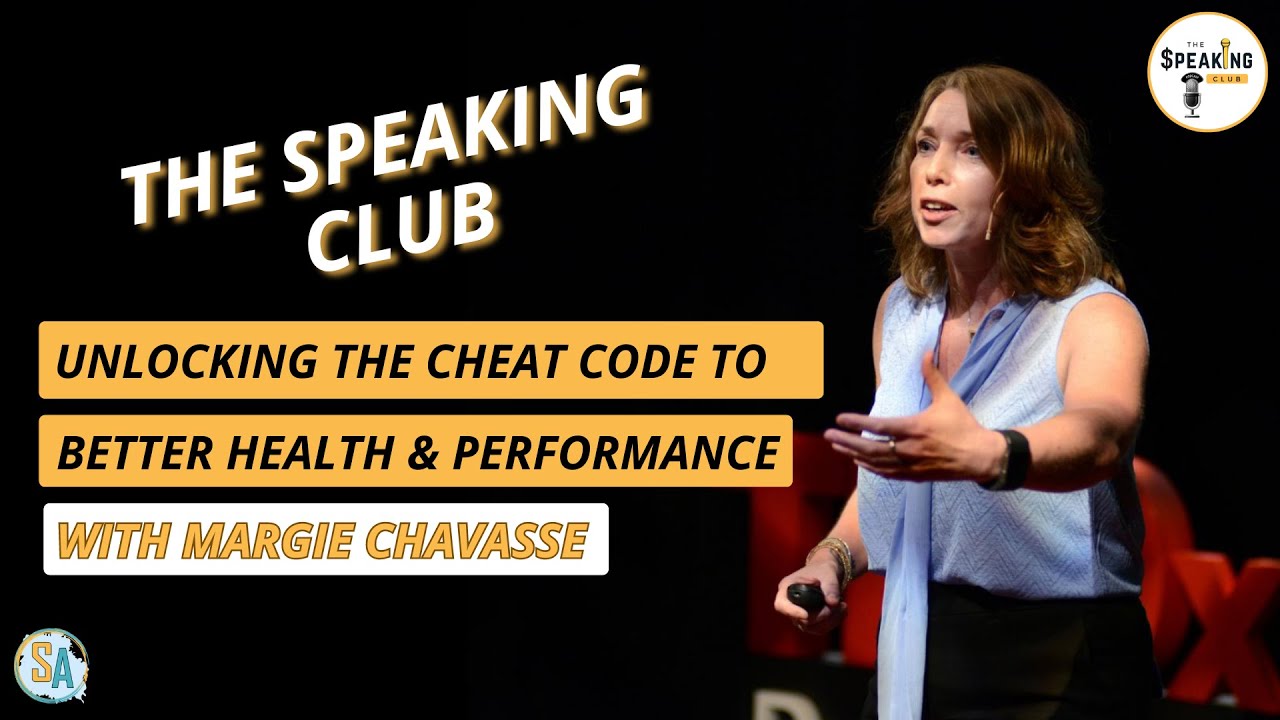
Margie Chavasse, a kinesiologist, uses muscle-testing to read the body's signals and identify imbalances. She explains how gut health affects speaking performance: leaky gut and inflammation cause bloating and brain fog. Most clients see results within three sessions.
Chapters
Hello, you're listening and watching Sarah Archer, and this is episode 296 of The Speaking Club podcast. And I'd like to open this show with a quote from Hippocrates: All disease starts in the gut. I started this podcast for 2 reasons: because I want to help people recognise the power of stories and humour in speaking, And because I believe it's your message that counts, not the number of ums and ahs you use. There are some organisations that want to create robot speakers. They want you to sacrifice your personality in order to speak perfectly. I want to let you know that you can be yourself and a sensational speaker. So if you want to be a speaker that connects and engages authentically through stories, a speaker that gives value as well as a great performance, Then welcome home. Hey, welcome to the show. I hope you're well. Hope you're getting out there and getting speaking, and I'm very well, and actually, this is what this show is about. It's about wellness, 'cause I want you to imagine this scenario, right? You've been booked to speak, or you've got an important presentation, or you turn up to go business networking, and as you get there, you start to feel uncomfortable. Maybe your stomach is playing up, or or you're feeling foggy in the brain and you can't even blame it on a decent night out the day before. It's just that it happens and often it happens at some of the most inconvenient times when you need to be on point but you don't know why it happens and although you've been to the doctor maybe you haven't got any answers or they've given you some pills and the pills aren't having any impact so instead of feeling energized and ready to step into that space and wow your audience or having a great conversation conversation with someone, you end up feeling uncomfortable. Maybe you're even, like, embarrassed, or, you know, you're worried about forgetting something important and delivering a subpar performance as a result. I've had stuff like that happen to me before, and I've hated not feeling on top of my game. I've hated that feeling of discomfort that stopped me being fully present With my audience, and I couldn't find a solution despite going to conventional medicine for help. I was told it was a general thing, IBS, and they couldn't help me. And so I was kind of just putting up with things until a friend referred me to a lady called Margie Shavaz. I see. Margie is a holistic health practitioner. And she uses something called kinesiology, which we're going to explore here. And I think it's got 2 different meanings depending on where you are in the world. So we're going to unpick what that exactly is. And she's also going to give you some tips for staying healthy, which might be a game changer for you, for your health, and also for your performance as a speaker. Okay, that's enough from me. Let's head over to the interview. Welcome to the Speaking Club, Margie Chivas.
Hi, thank you very much, Sarah. It's absolutely brilliant to be here.
It's going to be a fun interview because you are full of life and energy and funny. So, I'm really looking forward to this. Now, the first question that I'm going to ask you Is, is something that I, I was surprised when you told me this, um, which was that you used to be director of finance. And it sort of doesn't— it, it kind of not knowing you at that point versus what you do now, it was kind of a mismatch in terms of our assumptions. Not always good to make assumptions, but our assumptions about someone who might be in that type of role. Uh, but you made a switch. from Director of Finance to Kinesiologist, and I wondered if you could tell me why and how that happened.
Sarah, it's such a good question. Um, so I became an accountant in the first place because I really didn't know what to do after university, and I just wandered along in that for, for, for many a long year. Um, and then I became a mother, well, quite a long time ago now. Um, and my— when my youngest one was very small, she became covered in eczema. And I thought, that doesn't look too good. So I had this sort of mathsy brain. I also did engineering at university, very logical about things, needs to know the reason why. Went to the doctor, went to the hospital, went to the pediatrician, went to all these people, and they couldn't actually tell me why my daughter had this problem, which just got incredibly bad. And so I thought, well, hang on a minute, there must be a reason. And I, you know, I love the fact you're giving me some creams which may help, but do you know, they— I know they have long-term damaging effects, the hydrocortisone cream, for instance, that they wanted me to put on her. And I thought, this is a 1-and-a-half-year-old, and I, I don't want to This isn't what I want to do. I had no idea what to do because I had never heard or been really to alternative practitioners for anything. But my back was so up against that wall and I couldn't stand the thought of my little daughter scratching herself to red nightly.
And where was this on her body? Was it all over? Was it just an area? What impact was it having?
Yeah, it started on one little patch on her leg, and I watched over the next 2 weeks as it spread everywhere. Actually, I don't think it did her face, but it was on all the creases where you might expect eczema, but it covered everything. So the whole of her arm was covered, and she would scratch herself like this. I had to put socks on her hands at night and, and put Sellotape around them. Other brands are available. So that her little Nails couldn't scratch her skin. And I had to change her sheets daily because they were such a mess. And it was just— well, for your child, well, for my children, I'd do absolutely anything for them. So, so I thought that I'm, I'm not going down the route that the doctors say is the only route, and I've just got to suck it up. I'm going to look for something else. And I looked here and there and I turned under rocks. And, you know, you know, if you were in a park and you've got a million leaves underneath them and you know under one of them is a million pounds, you would keep going.
Yeah.
And I knew there must be an answer. And so I kept going and eventually I found somebody who could help me. He was a 4-hour drive away. And I was, you know, I tried all these other things and I thought, well, to hell with that. I'm just going to bundle her into the car and go 4 hours to see this man for an hour and then drive 4 hours back. The other 2 children, oh, God knows what I did with those. I think I probably locked them in a cupboard with the dog, but I don't know, but I can't remember. And I drove to the other side of the country, saw this man, and he told me what was causing the problem. But on top of that, he also gave me a list of supplements I needed to give her to start repairing her. And so that's what we did. And I had to send him food sheets of everything that was passing her lips every week. I had to send these off in the pigeon post, and then he would, he would write me a letter back. And he, and I would then find out what I needed to, how I needed to modify her diet. But, you know, she got better. She got better. And this man, I didn't have a clue what he, what kind of practitioner he was. I just knew I was grasping and looking under every single leaf I could. And he was what I now call kinesiologist. So I think in those days they call it something a little bit different. But bearing in mind my daughter, this is now 30 years ago that we were doing this. And it, it just transformed our life because up to that point, seeing her like that was obviously very, very stressful.
Mm-hmm.
2 other smalls, and it meant that I was giving the other one more attention than them.
Mm-hmm.
And so they were losing out a little bit as well. And, and I was forever like, like a, Like a bow wire, you know, far too highly strung and short of temper and all of that kind of stuff. So it transformed my life. So I then thought, well, one day I want to be able to do this.
Nice.
You then have to go on quite a long way. You know, we've now got Emily Better and the effect of that transformation for her. becomes folklore in your own family, and you forget how grim it was in the, in the heat of the moment.
Mm-hmm.
And then years later, I had a recurring issue, and the doctor said, well, Mrs. Shabazz, don't worry, you can just keep going with it until you reach the menopause. And I was in my 30s at the time, and I thought, do you know, So, so I thought, well, should I try one of these things that Emily tried before and, and go and see if I can find a suitable person, which I did, who got rid of the problem I had. And so I thought, hmm, that's interesting. So I was then taking my own children, uh, the, the other 2 as well with things to see kinesiologists and alternative practitioners. The whole thing about alternative practitioner thing, once you've gone through that door and tried it, And found it— find it works, it's a lot less scary to do the next time around. And so now I was becoming quite accustomed to it.
Yeah.
My husband, perhaps a little less so until he had an issue, and then that wasn't going, and the doctor said, oh, come in for an operation. And I was thinking, okay, okay, now fine if that's what you want to do, but Can you just give this a chance and give it— go and see the person I go and see? And so he did, and he— it transformed his problem. And, um, he wrote her a letter, you know, going in the post with a stamp on the envelope. And she then found out, said, I get letters like this, it's lovely.
Uh, what, like a thank you letter?
Yeah, yeah, wrote her a thank you letter. I mean, so he didn't ever go to hospital to have this, this thing sorted on his gut because he didn't need to. There was another way of doing it rather than intrusive. And so that's kind of like what I like doing now is trying to stop people from getting into that situation. But I'm going ahead of myself. So it was— it took me— Sarah, I cannot believe it. But it took me 20 years to get round to actually deciding that perhaps I could do this too. I mean, we tried it, we knew it worked.
Yeah.
Could I get round to actually plucking up the courage to do it? No. So, so there's some various, various things moved in our lives, not least that the children were kind of getting to the end of school and stuff. And so there was the opportunity for me to go and do some qualifications and learn more about how these people did this seeming magic. And so that's what I did. So, so, and then I was still doing the finance at the same time as doing the kinesiology. And that— they are so completely different.
Yes.
So that was a bit of a mind-bending thing. And yeah, eventually I plucked up the courage to Park the, park the finance. I was getting burnt out from it anyway. So, and start doing this.
Fabulous. And you haven't looked back. Now, I know that we, you, you were a bit reluctant to answer this question, I know, but I'm asking it anyway because I think it's important. Could you kind of give an explanation Or analogy, whichever way you want to do it, of what kinesiology actually is. Could you explain what it is?
Well, I wish I had got my magic wand. I think my, I think it's probably in a box over there, but I, I won't get it out right now. But, but actually, if you think about, um, kinesiology is really a bit like a biohack, um, for your body's messages. So it's, it's, if you like, it's, it's got this, um, your body's got this secret language going on. And the kinesiology is like the translator app. So it will help you understand what's going on in your body. So your, your body, in your, in your mind, you've got a conscious and a subconscious. In your body, you've got a conscious and a subconscious.
Yeah.
And your conscious is right there. You're using it right now, but your subconscious is also whirring around. And your subconscious is like the Encyclopedia Britannica. It knows everything about you. And it's got it all recorded. And if you, if you could access that, then you know what the answers are. So your body knows what the problem is. And if you let it, your body will also tell you what the answer is. But how the hell do you get into your subconscious to be able to do that? And perhaps people who meditate really very successfully can do that, but I certainly wouldn't be able to. So, but kinesiology is like having that key into your subconscious. And a lot of the signals can get messed up. So your, your body doesn't really know quite what, what works and what doesn't. It's like having, um, a bad reception on your, on your phone.
Yeah.
You know, sometimes you go into dodgy places on the train, say, and you don't get a good signal.
Yeah.
Um, and then the good signal comes back again. But kinesiology will help you get that good signal and help you understand what's really going on in there. Um, it's not magic, but using it is pretty awesome. It's absolutely awesome. When I've had, um, I have some grandchildren, one has got a rash on the back of her leg. And so my daughter phoned me up and said, Mom, what do I do? And you go, oh my goodness, what do we do? And so then I just, I was able to, to use the kinesiology and go, well, This is what we need to do. We need to stop having these things for a little while because they're irritating it. We need to start repairing using the, these supplements. And then those 2 things will help the, the body recover because the body— this is also a real, a real key point is the body wants to be healthy.
Mm-hmm.
You've got to give it the tools to be healthy. And it will do the best it can in the circumstances it finds itself in. So if you aren't looking after it, it will still do its damnedest for you. You know, it wants you to be healthy. But if you can give it more of the good stuff that it wants, Mm-hmm. then you've got this rose which will Blossom and be fragrant and lovely.
I love that. I love that explanation. It does feel like magic. Now, you and I have worked together, and which sort of is, is gonna lead me into my next, next sort of question, because I for years had, you know, my stomach would swell up, it would bloat, bloat, and, and I would go to the doctors and They couldn't really diagnose what it was. They thought it was IBS or, uh, whatever. And they gave me some, some, um, tablets to take, which didn't actually do anything. And I kept trying to find out, is it coffee? Is it this? Is it that? And though I couldn't find any sort of co— I couldn't find the link or the cause of it. And then you and I, uh, had a session and you did this magic. Oh, you don't think it's magic, but then we, you know what our bodies, the way our bodies work is essentially magic as well. If we, you know, if you think about it. But you did your, your stuff and, and it's, it's been cleared up and it's, you know, it's, it's gone. But that used to really disrupt my life. You know, I would be going to, um, a network meeting, let's say, and if your stomach swells up, you'll feel uncomfortable. I felt uncomfortable. I felt like my, if I was wearing trousers, they would be cutting in. And if I was, you know, I felt like I was you know, doing a presentation, it would just, I'd be worried about it showing. And so I wouldn't be, you know, my body language might be off. So it's just like, certainly that's what I experienced. But what, and I was putting up with it because I couldn't get an answer and no one, and there seemed to be like you said, for your daughter, a brick wall. And so, um, what do you find that people are putting up with that could be affecting their performance and quality of life because they're small enough that it's not life-threatening. It's not like a broken leg or, or something more, you know, that is going to threaten your life, but it affects your quality of life. What sort of things do you come across?
Definitely, definitely. Well, gut is probably— masses starts basically in the gut, but by the time people get to me, it might have gone somewhere else as well. Um, so, so your gut issues, um, are quite common really. And people don't know what to do with them. And, and you're quite right. People can, you can be, you're not ill, but you're, well, you're, but you're not well.
Yeah.
Yeah. Um, and, um, it's like that gray area where you don't want to be. So the, the issues might be, um, gut is as I say, really common, aches and pains. So, so if you've had, if you've had a gut issue for, for years, say, and you've ignored it, Hmm. then sometimes that can, that can appear to, to resolve itself sufficiently. But the pain, but something might have escaped from there and gone somewhere else. So if people get achy wrists or they get achy shoulder, yeah, which one's my right? Particularly on the right shoulder. And yeah, referred aches all over the place. They, those are very common. Those are very common that people just put up with and they say, oh yes, I'm probably getting osteopenia. You know, my bones are getting older or, oh, it's just old age. But these things kind of creep up on you as age does. does. Now, we can't do anything about age, but we can do something about this, this creep.
Mm-hmm.
And that's just get it and pull it back. And then you're, you're starting at a lower place and it might creep up again, but, but you want to pull it back down. So, so aches, a foggy brain, foggy brain. Lots of people have foggy brain and that can be Oh, it can be all sorts of things. But again, the brain and the gut are very interconnected. There's this thing called the blood-brain barrier here. So things aren't supposed to go— the textbooks will tell you that things get to the blood-brain barrier and then the pathogenic stuff, the stuff you don't want in the brain, can't get in, can't Go up here.
That's fine.
Okay, so you're like 2 separate bits. Well, that's not, that's not really what happens, and it's acknowledged that that's not what happens. Um, so things can cross that blood-brain barrier, and if you're not well, so particularly if your gut hasn't been well, then, um, that becomes permeable. So if you think about having a sieve in your kitchen, you might have a sieve strainer for your tea, and it's got very, very little holes. So that's what it should be like, let's say. And then you've got another one which you might, um, which is for bigger things like peas or your potatoes when you're draining those, or the colander even, um, and that those holes get bigger and bigger. And that's what happens for the blood-brain barrier. So it can become permeable, and that can happen for your gut lining too. So the— so the— where little tiny things should be able to cross from the gut into the blood, it gets extended and bigger things can.
Right.
And then guess what your body sees? It doesn't see, oh, if that had hung— that, that is good stuff for us. It goes, that is a molecule which is Too big. It's a pathogen. In goes your immunity. It tries to get rid of it. It makes inflammation. It makes you feel rubbish. Your, your, it sends stuff up to your brain, makes you feel really foggy. And you, you get ill. But you don't realize it until, until you get to that stage, possibly. So those, those kind of things I might see.
Interesting. And I think, because I, you know, we, I love, this is an issue that I sort of wrestle with because effectively conventional medicine hasn't been around for that long. Traditional, or what we might call alternative medicine, uh, today has been around for eons, like, and yet it's almost treated as new age when actually some of this stuff is older But let's put what you just said in, in a more conventional, sorry, conventional medical context. So for instance, if we have a problem with a back, then we might get referred pain in our leg.
Yes.
So this concept of, of referred pain is something that we may well come across. And, and I think there is conventional medicine also talks about leaky joints and leaky joints. Guts. So, uh, that's something that, that is out there. But I don't think people really appreciate that this stuff is sort of going on. And again, it doesn't have to be, um, it's, if it's not, it doesn't feel like a major thing, but it's something that is building up and affecting our whole body. Where it could have been, you know, it could have been sorted out in the gut. And then when you talked about, um, you know, stopping doing some things and taking things, stuff to repair the damage, is that the damage that you're talking about? Is that repairable where those holes in membrane, let's say membrane, I don't know if that's the right word, membranes or whatever. Is it possible to repair those and take them back to what they should be? Or is that once the damage is done, it's done?
On the whole, it is reversible. So with Emily, for instance, my little one, it was reversible. So let's, let's go. I, there are little bits of things which aren't necessarily so reversible, but So, but you've got to then, you've got to then also realize that these things have escaped out of the gut where they should be. So they're causing damage somewhere else. So it's not just repairing the gut integrity. It's, it's dialing down the toxins that have gone elsewhere. And the reason she came out in a rash was because she was was because when you're trying to get rid of toxins and bad stuff, your intestines are the major way. Your pee through your kidneys is a significant way. Your lungs have huge surface area and they're an important way. So hence people with bad breath or something like that. And your skin has got meters of surface area, and that is one of the ways of getting rid of the toxins. So if you are getting, um, poor skin integrity, you've got to think about not necessarily what's going on the outside, but what your skin is telling you about what is coming from the inside.
Gosh.
But it's more than just the, what's in the gut. You've got to understand that this stuff has already leaked out.
Yeah.
And you've got to work out how to get rid of that as well.
Oh, that's really interesting because it really shifts the way you look at things. It's, it's fascinating. And I mean, why do you think that it takes us so long to come and get help from Someone like you?
A number of reasons. One is fear, because what I do is not mainstream. And so 99% of people don't want to go outside the mainstream. And it's when you've got more people going outside the mainstream, and they're coming back with good reports, that the rest of the tribe might go, Well, I'll give it a go. Second major thing is that in the UK, the NHS is free at the point of use. And if you've got a chronic condition and you're on repeat prescriptions, those will also be free. And I'm afraid if you come to me, it's going to— there is a cost implication. The difference is, though, you pays your money and takes your choice, don't you? You, you Stick with the free at the point of use and you just manage the symptoms, which are apparently not recoverable, or you go alternative and you think, I might be able to get my quality of life back.
Hmm.
And, and I suppose for me, when Emily was just such a small little tot, She has a lot of life to be led. And so therefore, I was willing to do anything so that she wouldn't be penalized with her health for the rest of her life. And if I was 90, I might think, you know, I'll just stick with this. So it all depends where you are on the spectrum and, and probably how much you value yourself.
It's interesting. I think, I think there's some myths though, that also get in the way? And we've touched on one of them already, which is around aging. Are there some other myths that you come across that stop people, that just make them fall into the acceptance rather than action camp?
Okay, so with the myths, I mean, aging is a really big one of them. And I think also it's your other cohort who perhaps have got degenerative conditions and, and they're going, Well, I've lived with it for 20 years. So you've actually got to be quite, quite tough in, in being true to yourself, knowing that actually there is an alternative. And I, I think that takes a lot of courage to do. So yeah, those kind of, those kind of myths. It's other people's belief systems as well being imposed On you. In fact, I had, I would say one of the, my belief systems before I went alternative was from my parents, which was, oh, doctors always know best. And, and no, no, no, none of this woo-woo stuff, you know. So I had to get myself over that. But once you're over it, give it a go. And then you can talk to other people from a point of power of knowing actually what it's about. Other people's belief systems doesn't have to be yours.
Yeah, that's really true. I think the other thing that might get in the way is this perception you've mentioned that certainly in the UK, you know, conventional medicine is low cost or no cost. Um, and that there might be, you know, there could be, you know, years of having alternative treatments. And I think that's a, that's a myth that's wrong, isn't it? Because I mean, your own experience is that pretty much You know, within a few sessions your daughter was sorted and presumably yourself and your husband as well. On average, how long does it take to get something resolved with a kinesiologist?
Um, doing what I do, I would say generally people work with me for 3 sessions and, um, rarely they need more sessions. It depends what they, what, what their symptoms are and where they are, but For a lot of things, they're resolvable really relatively fast. The trick, the trick is knowing what really the body is saying. And then once that, once you've got that talking, you've got the answers really. And they can resolve quite quickly.
And, and just, I mean, I just want to ask you this before we get onto, uh, some other questions, uh, around, um, what people might do to prevent it themselves and your speaking. But when you first got trained in this, because for me it feels like you are tapping into, you know, my energy, and you're not even Like we were, we were over Zoom and this worked. Like, how did you, when that, when you were first able to do that, how did it feel? Was it difficult to do? Was, I'm just curious about, you know, that, that sort of feeling for you of being able to, to tap into someone's energy. Can you feel it in yourself?
I can, but it didn't start off like that. So when I was, when I was training, like, it's like doing anything, the more you do it, the easier or the, the more natural it becomes.
Mm-hmm.
And when I was first doing it, the muscle response testing would be physical. So we'd be in a, a big room testing each other. And the muscle response testing, you can test a number of different muscles. But let me just show you, I might, I, I might push gently down on your arm. Your arm would be straight, but it doesn't work on Zoom. My arm's out there then. So I, I ask you to match my pressure and you would match my pressure because it's easy. I'm putting a little bit on, you're just, you're just matching it so that the arm's not going anywhere. But then if I then challenge you with something which isn't good for you, let's say this wasn't good for you and you put this against you.
Mm-hmm.
And at the same time, I pushed your arm, you would say, oh, you're using more pressure. And I go, no, I'm not. But your arm goes weak.
Mm.
You— and the reason what's happening is that your, um, your body goes, ah, that's a threat. Now what do I do? It, it can't work out the fact that you're not actually taking it in or whatever, but they— it Your brain is going, it's a threat. I've got to protect you from this. Do I protect you from that or do I keep the arm strong? And at that, just that little instant, it goes weak.
Mm-hmm.
Okay. So I then know that this is a problem. And, and that's, if you like, is the premise. So then that you build on that with masses of, of, um, of stuff and ways of doing things. But then when COVID came along and you go, oh, I can't get people here, I can't, I can't have a clinic or anything to see people. So what are we going to do? And another kinesiology friend of mine said, well, I've been taught this way that you can do it over the internet. So I learned then About, well, I already knew that energy, energy, going back to my engineering and my physics type stuff. If you go back to Einstein, energy really isn't constrained by time and space.
No.
And, and we, we know this, but we don't really understand it. I mean, a few people might, but I'm not one of them. But I do, I do know that energy I can feel somebody else's energy miles away. So if I'm concentrating on you, I can feel your energy. Now, obviously, I don't go around feeling people's energy all the time when I'm walking down the street because I'd be exhausted all the time. But, but it's, it's something which I have Um, I have sort of worked on developing my senses towards it. So I, I honestly, 10 years ago, I wouldn't have thought I would be doing what I'm doing now. Because whilst I was going to kinesiologists for years before that, I didn't think that it was a power that I might have. But it's just As I say, it's repeating doing what I do so much that I, it's, it's now second nature to me.
That's fabulous. Fabulous. It, it really does feel like magic. So let's talk now. Thank you for sharing that. Um, based on your experience, what are the 3 most important things people can do to maintain their health?
I think probably the top one is actually being in touch with your body. And, and as I've just said, it's, it's taken me years of doing what I do to get better and better and better at it. But actually, when you are consuming something or you are near something which isn't good for you, Your body knows it. And just try and, try and tap into that yourself. I'll go off on one. I was taking the dog for a walk yesterday and we were going, we had a, we were in a field with some sheep and she's very good at staying to heel, which is absolutely fine. But there was an electric fence around the side of it and she was not wanting to walk to heel. She wanted to walk further away. And then I twigged it was because of the electromagnetic coming off the fence was making her feel really uncomfortable. And so she was further in the middle of the field. And we, we all have that sensitivity that, that the dog was showing at that point. We just don't realize it. We mindlessly go through our days and we will grab something to eat for lunch. We're not thinking about whether it's serving us. And then you find you're falling asleep in the afternoon and you can't really quite work out why. Well, perhaps it's something to do with what you're eating. So it's, it's not— I'm not saying go on a restricted diet or anything like that. I'm just saying, saying be mindful, be mindful about what you're, um, what you're consuming, and your body will tell you whether or not it's good for you. I get people who say, well, the doctor says it's fine to eat anything, but I don't eat tomatoes because I know they make me feel a bit rubbish. Okay, Well, good on you for actually having worked that one out. So that would, that would probably be number one. Um, and that's something people can work at for the rest of their lives. Um, another one is talking about, um, the methods of excreting stuff you don't need. So the major one where you want most of the stuff to go is down the poop channel.
Okay.
You don't want it escaping. You don't want it going out through your lungs. You don't really want it going through your kidneys because they're very delicate. Now, the kidneys, going again off on one, are the one thing which at the moment science is saying cannot be reversed. If you do kidney damage, you can't reverse it. Yet we put all that concentration through in our pee, and it can do damage. So you want that really ideally to be going down the poo channel, which can take multiple times more toxins. Okay, so, um, so it's making sure you're— you are going to the loo regularly.
Regularly.
Yeah. Um, and again, this is a funny one. People say, oh yeah, yeah, I'm absolutely fine. Yeah, once a day, it's fine. But actually, their transit time can be Much longer than they think it is. So the time it takes for something to go in here, go wiggly wiggly all through the system, get digested by all the enzymes in there, and then the rubbish come out at the far end can be much longer than you think. So if you're not sure, well, actually it's just one of those lovely little tests you can do for yourself. And it's right the time of year is go and get a thing of sweet corn, eat some sweet corn. Having not eaten sweet corn for a while. Then you can all email me and tell me how long it took before you saw it. So that gives you an idea because, because it should only be 24, 48 hours, but it can be days for some people.
Yeah.
So that's a really important one. Um, and then body movement is a really important one. So one of your ways You're— you are but a selection of cells, okay? And they're all stuck together in a very lovely way, but they are just individual cells, and each cell is doing something. It's, it's creating energy so that you can smile, so that you can lift your hands. All these little cells are doing their bit, and like a car, they have exhaust. So they, they do their little chemical reaction. in your cell using the little mitochondria in there, and then the waste comes out through the cell wall and it goes into stuff called lymph. Now lymph is the clear liquid you have between all the cells, and it starts off as a little, little tributary, and it joins up and it becomes a little bit of a stream and then a river, and then eventually it goes all the way back and feeds back into your blood system. So But it doesn't have a pump like the blood. Okay, so the only way it moves from the tips of your fingers or the bottoms of your feet is because of the muscle movement that you— so if you're, you know, even if you're sitting in a, a chair a lot for work, just get up and do a star jump. And if everybody thinks you're mad, well, who cares? You're getting your lymph moving. I like that. Or dance around the kitchen.
I, I do understand that because when I go out for a run, sometimes it is, it definitely gets the body, it definitely gets that stuff moving, uh, a lot more quickly, uh, than other times. Cool. Okay.
And there can be masses of toxins in there and you, you don't want the toxins in there. You want them out.
Interesting. I love the way you, you, you talk about things, and you're very good at using analogies in making things understandable. And I think that for someone like you in the space that you're in, with all of the barriers to overcome in terms of messaging and, and marketing and so on and reaching people, um, how have you adapted the way that you communicate in terms of You know, your marketing and also your speaking to, to make this message reach the people who need it?
Um, well, I, I met you networking, I think, many, many years ago now. Um, so networking is obviously talking to lots of people and, and doing presentations if people want me to do presentations. I'm actually running a webinar next week, which, uh, well, on the 11th of September. Wednesday the 11th of September, 12:30 UK time. And that is to talk about gut health and how to revive it. Because I've said about keeping the poo moving or whatever, but there are about a third, apparently, apparently a third of the UK population have irritable bowels. Um, which is, uh, doctor— well, it's called IBS, irritable bowel syndrome. Syndrome is also like a trash can. So it's something where, um, anybody, the, the medical profession don't really know what's causing it. So we'll, we'll, we'll put it in this bucket. And I have got a number of things which aren't, um, just about reducing inflammatory foods, but might actually help people understand what is happening in their bodies. And if you know that— I, I'm one of these people, if I know why things work, then I'm far more likely to do it the right way. Do you know what I mean?
Yes.
So my, my, what I want to do is to educate people so that they can take control of themselves. And then of course, if they need further help, they can go and find some further help. But there are things one can do oneself. And, and my podcast next week, I hope I'd love people to come along and to, um, have some ideas. It's only 30 minutes. And anybody who registers will also get a recording.
Excellent. Excellent. So that's, so, so basically you're taking, you're creating your own platforms now to get this message out there. And one of the things that, as I mentioned, you do really well is storytelling. I've seen posts from you on LinkedIn and other platforms where you're, you're, you're not sort of going direct for the, the sort of technical medical stuff, but using these stories and these analogies to make the connection for people. Is that something that you've had to work on to do that? Or is it something that's come naturally to you?
Well, I'm not a doctor, so I would fall over myself if I started talking in really highfalutin Latin names. And yeah, I suppose I have worked at that, Sarah. But yeah, the more you like everything else, the more you do it, the easier it becomes.
Absolutely. Absolutely. That's brilliant. And, and in terms of speaking, where is that fitting besides the webinar? Do you find that speaking is one of the best ways that you do reach people?
I don't know that I've quite found my groove on that one yet, but, you know, I'm very happy to— well, you can see I'm rabbiting on here. So also I'm happy to talk. Yeah, you are.
And you've got a great talk for people to— like, hopefully people will get on the webinar and see Um, how valuable this stuff is, but it's, uh, it's important that you get this message out there so that people just aren't putting up with stuff anymore. And there's a real opportunity for them to, to change the quality of their life and increase their performance and, you know, and, um, just make things easier for themselves in a way. So yeah, well, brilliant. Look, thank you for sharing all of that stuff. Now, before I let you go, I have some standard questions to ask you.
Okay.
First question is, what's the best thing that speaking has done for you?
What's the best thing that speaking has done for me? Well, it's improved my confidence and it, it makes it easier for me to come through with my message and actually, yeah, clarify in my head, which can, well, we've gone off on so many asides, you can see this, my head goes off Like a firework of all these different things, and it's made it better. Thank you very much, Sarah. You're such a good teacher.
And have you in the past, when maybe it was in the corporate world, because obviously I'm sure you had to give presentations in the corporate world or elsewhere, have you had a gig or speaking presentation that went wrong and you're like, oh no, I never want to do that again? Has that happened to you?
Uh, yeah, probably.
You literally wiped it from your memory.
Yes, yes. I used to have to get on the microphone at 7:30 in the morning when I was, um, in stockbroking, um, and talk about companies which I had been and visited, um, and say whether actually the, the salesman should be Buying, selling, what what they should be doing with this thing.
Oh yeah, I never knew that you did that.
Yeah, it was nerve-wracking, nerve-wracking. I mean, this is so long ago, back in the eighties, but we'd have the Japanese office online as well because they'd still be up at that time. Oh, they would. Yeah, they'd still be up. There'd still be part of their day.
Yeah. So, Marky on Wall Street. Blimey! I never knew that you did that.
No, only the City of London, darling.
Gordon Gekko of kinesiology. Excellent. Right. Next question. What's the book that's had most impact on your life and why?
I can't remember the name of the book, but it has a bit in there which is you can control yourself. You can't control other people. And it had the most enormous impact on me for Bringing up my children and, and understanding you can't push somebody into doing something, can you? You can control how you react and how you behave. I'm sorry, I'll have to look it up and tell you what the book was.
Yeah, yeah, do.
It's a real classic.
We'll put it in. It wasn't How to Win Friends and Influence People? That's normal.
No, I love that. That's beside my bed, waiting, waiting for a reread. A reread.
Reread. Okay. Yeah. I wonder what it was. We'll have to, you'll have to let me know and we'll put it in the, in the show notes, that one.
I'd say The Habits of Highly Effective People.
Ah, Stephen Covey. Right. Brilliant. Cool. Excellent. We will put that in the show notes. It is a classic indeed. Excellent. And you can see how it's reflected in the way that you approach things today as well. And that is, that's, it's such an important message because it does stop us from doing things and, and also getting hung up on things that we can't, we can't absolutely have any impact on in terms of other people. Thank you for sharing that. Right. Next question. What's the best bit of business advice you've had and why?
I think my best bit of business advice is to do something you enjoy doing, but But funnily enough, that's come to me quite late on.
Mm-hmm.
Um, and I, you know, I did all the accountancy stuff and then all of that. And did I really enjoy it? I look back on it and go, why did you spend so long doing that? But anyway, never mind. Um, yeah. And then actually getting around to doing what I do now, which is Well, it is a little bit of fairy magic, really. It's lovely.
It's amazing, amazing. Brilliant stuff. And the last question is this one. If you can have any mentor, and they can be alive or dead, fictional or nonfictional, who would you choose and why?
I would choose Oh, and I can't think of it. The chap who trained Warren Buffett.
The chap who trained Warren Buffett?
Yeah, he— Warren Buffett used to work for him, and he— again, I've got the, I've got the book on my shelf. Benjamin Graham. Yeah, I'd love to know what he thinks of today's Amazing.
So what did— how did you find out about him and why did he— why did it resonate so much with you?
Um, because, well, it's nothing to do with kinesiology. It's, um, because he had a system for investing in companies and seeing value. And then he kind of stuck to it. And then Warren Buffett has continued that. And he wrote this seminal work back in the 1920s, '30s, something like that, probably. And somebody told me about it, but I just, I just remember kind of rather falling in love with him. But I just thought that was wonderful. Yeah, it was a good book. Otherwise, if it's not that, I'd love to meet, I'm not sure if he's still alive, Jack Canfield, Chicken Soup for the Soul.
Chicken Soup. I don't know if he is, but he would be another good one.
You're right. Yeah. Yeah.
Yeah.
Because it's so, um, so nurturing and see, yeah, probably that one's a better one. The, um, Just the way he sees things and stopping being— for me, it was stopping— helped stop me being so rigid about this is right and this is wrong.
Right.
You know, and, and being able to see the bigger picture and appreciate other people's points of view better.
Brilliant. Brilliant. That's, that's really, uh, I haven't had Jack Canfield come up on the show before, so that's Really good to have someone different. And Benjamin Graham, I will look him up. I don't know anything about him, so I will find out. My curiosity has been piqued. I will find out more about him. So listen, Margie, thank you so much for coming on to the show. I will put some details in the show notes about how people can jump onto the webinar next week. Where's the best place for them to go? To find out more about that though, and yourself, or to connect with you, where should, where should they go?
Uh, to connect with me, they can always connect with me on, um, LinkedIn. It's the only social media I do. I have a website which is nrgholistichealth.com. Um, so they can go to that. I don't think I've got a landing page for the Webinar on it. I've just come back from 3 months of sailing, Sarah, and I have not been doing masses of work while I'm away. So it's been good.
I love that. I love that. And if people can—
sorry, sorry—
see some of your sailing exploits on LinkedIn on some of your posts as well. No worries. We'll put the link for people in the show notes to NRG and to you your profile on LinkedIn. And yeah, thank you again for sharing all of that stuff and helping people to stop putting up with, you know, lower quality of life than they should have and are entitled to have.
Thank you so much, Sarah, for interviewing me and for this. It's been, it's always such a joy to have a chat with you.
Likewise, Margie. Likewise. Take care. I will see you soon.
All right, take care. Bye.
So I hope you got some, uh, real value from that interview, some maybe some new insights, some new perspectives on the body, on how it works, how you can, um, get some indicators from your body about what might be happening, what might not be good for you, what you should be doing, um, perhaps things that you haven't considered before, because I know I don't know about you, but I so often in my head that I'm not connected to my body and, and I miss some of those signals that I should be paying attention to. So if you did get value, do let Margie know. Hop over onto LinkedIn and say hello to her. And there is her gut health webinar that's coming up next week, which you can also hop onto the link she mentioned. Uh, is in the show notes and you can go and register for that and spend some time with Margie, who, as you can see, is a ball of energy, full of fun, and like really a funny person as well as having all of this great information to share with you. So that's all that's left for me to say. If you are a regular watcher to the YouTube channel, please do, um, leave a comment if you've got anything that you wanna share. If you're not subscribed to the channel, please hit subscribe. Uh, there's some more stuff coming your way. If you're listening to the show, um, and you're not subscribed to the podcast, then do, uh, subscribe on wherever you're listening, whether that's Apple Podcasts, Spotify, Amazon, or your podcast app. And I'd be so grateful again if you could leave a rating or review for the show. It helps other people find it. And yeah, it's just nice to know what you think about What we're— what I'm saying, what we're doing, and so on. So, that's it. Until next time, you know what I'm gonna say. Go out, grab your speaking, your life by the nuts, and get cracking. Bye-bye. If you want to discover how to create a killer pitch that makes you or your business stand out from the crowd, then you'll want to grab your copy of my book Straight to the Top. It will help you clarify your USP, your business story, who your target market is, and what will make them buy. You'll discover how to get the edge on the competition and position your offer for success. You'll also get proven elevator and investor pitch frameworks to use for maximum impact. To get the book for free plus lots of extra bonuses— you just pay shipping and handling— go to standoutpitch.com today.
More from Sarah




The Skill That Helps You Connect With Any Audience with Michelle Mills-Porter




What Moderating World Leaders Taught Me About Great Communication with Xenia Wickett


