Why You Are Shackled by Self-Doubt and How to Break Free - 300
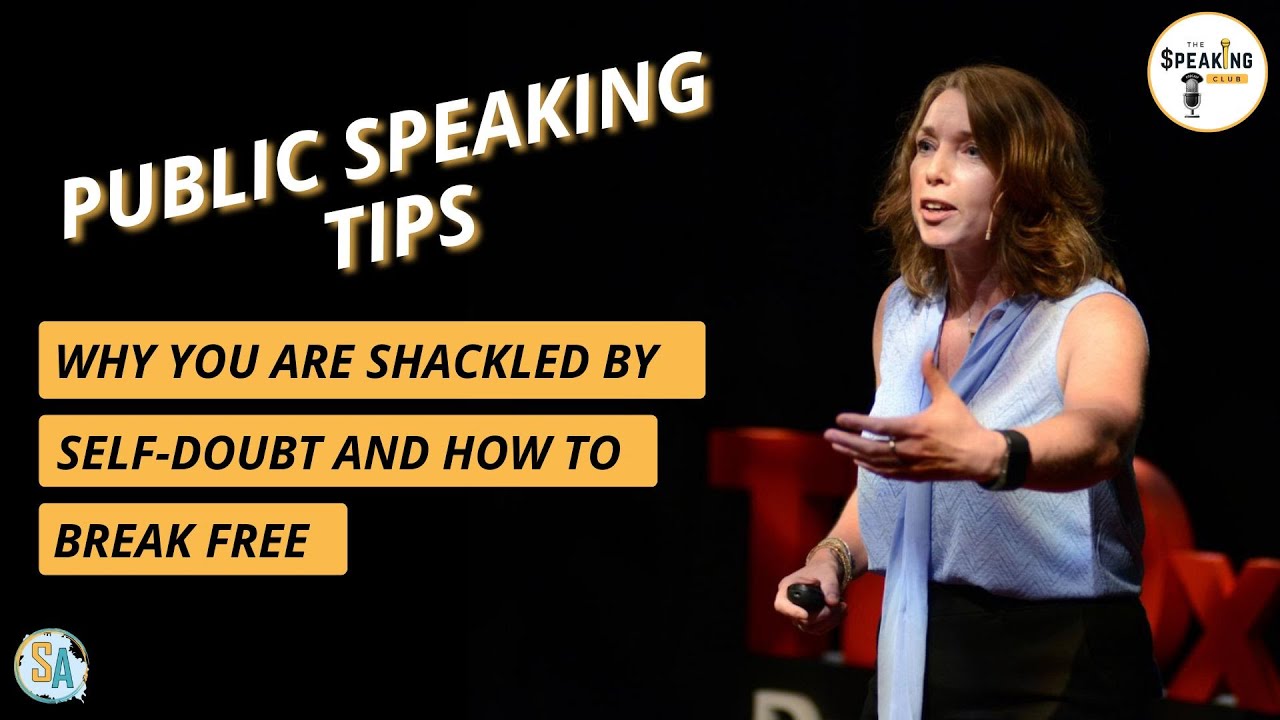
Sarah Archer explains how self-doubt hijacks your imagination and creates worst-case scenarios in meetings and presentations. She traces it to the ego's "pain-body" and offers mental tools like visualization and reframing confidence as commitment. Practical fixes: tell stories, maintain eye contact, rehearse, and focus on serving your message instead of yourself.
Chapters
Hello, you are listening and watching Sarah Archer and episode 300 of The Speaking Club Podcast, and I want to open this show with a quote from the one and only William Shakespeare.
Our doubts are traitors and cause us to miss the good we oft might win By fearing to attempt.
I started this podcast for 2 reasons: because I want to help people recognize the power of stories and humor in speaking, and because I believe it's your message that counts, not the number of ums and ahs you use. There are some organizations that want to create robot speakers. They want you to sacrifice your personality in order to speak perfectly. I want to let you know that you can be yourself and a sensational speaker. So, if you want to be a speaker that connects and engages authentically through stories, a speaker that gives value as well as a great performance, then welcome home.
Hey, episode 300!
Do you know what?
It's been a pleasure and a slog to get here, but I am so glad that I stuck I started the Speaking Club nearly 7 years ago now, and I, I had actually planned another topic for this show, but then I got an email from a listener called Justin, and it kind of changed what I was thinking of. The subject for that email was Gratitude and Hello, and Justin opened with, I am writing to say hello And to thank you for your heartfelt podcast. I have lots of positive feedback for you below. That's always nice to hear. More on that in a bit. But after a brief introduction to himself and what he'd been up to, Justin asked for help with a problem that he's experiencing when he speaks, and he experiences it when it's in meetings, and on stage. So here's what he wrote. On show number 284, you asked listeners to send you a problem that they are wrestling with. The problem that I wrestle with is that I find myself muting my authenticity and passion for things in certain settings. I will look down at the table, avoiding eye contact, trail off with without finishing my thought, and I won't finish articulating what I have to say. There are a variety of fears at play: previous failures, awareness of my privilege as a white male, and always having more interest in what others have to say than believing that my point has worth. I would like to learn different methods you've seen speakers use to overcome their self-doubt while Not becoming condescending or know-it-all-y. I need to move past this learned habit so that I can share stories and inspire hope for positive learning and growth. So from what Justin said and, and what he told me about himself in the email, I know that he is experienced and accomplished in the field that he's in, and he has a big idea that he wants to share, um, but it's a struggle to find the confidence in certain situations to convey that message. And that is what I'm seeing more and more of. And I work with both men and women, and truth be told, I've encountered this issue, issues of self-doubt, more commonly with women Before, but that's changing. There are more men, and particularly white men, who are second-guessing whether they should share their message because of what they are, and I think that is wrong. No one should feel that their idea has less merit because of what they are. And, and don't misunderstand me here, I am not saying that we shouldn't address the imbalances that exist. Having been the victim of misogyny myself in the past and knowing that most events still have predominantly white male speakers, there are definitely things that we need to do to level the field. However, I am an advocate for a society that values the idea And the person equally, regardless of what group they belong to. And I just wanted to make that point first of all. So it's showing up equally, kind of, in the people, in what I'm seeing. So how does it show up? Well, it shows up in the content that people share and how they share it, and it will end up undermining their authority, their authenticity, and the credibility of the message in the eyes of the audience, and it also surfaces in the way that people approach gig outreach, so, you know, reaching out to get gigs, because I think, from what I've seen, people are making assumptions that is forcing them to almost, like, barricade the door before they've even tried opening it, and that's also bad. Fortunately, I able to help deal with this issue for the people that I work with, but I think I can help you and I can help Justin too. And that's why in this show I am going to be sharing some of the ideas of why I think that this is showing up, based on my experience of working with many, many speakers, and I want to give you some new perspectives to try on and And also some tools that might help to free you from those shackles of self-doubt because I want you to be bold, I want you to be audacious and I want you to be confident— I'm going to change that word in a little bit though—
in sharing your message because there's a better word we can use.
I'm going to show you that. So in answering Justin's question, I want to start with my take on why this is happening at a sort of, uh, conceptual level, if you like. So the first thing that I want to talk about is the battle between the ego, your ego, and the self, yourself. And so for me, I want to make this distinction between those two. For years, I thought my ego was me, literally until I was about 40. And I went on a course, and through that course I learned that I could make a distinction between the two, and it was an important distinction, that the voice in my head wasn't me, it was my ego, and I could ignore it if I chose to.
And I—
you might have heard me talk about this in the past— I called my ego Arnold. And I, you know, I was talking to my mum on holiday about her ego. We had some interesting chats. I've just been away with her for 2 weeks and we called her ego Karen. Apologies to any Arnolds or Karens out there.
It's not nothing against you.
It's just, that's why, you know, we came up with the names because it turns out my mum has been beating herself up for years. And she, I don't know how much of it she took on board, to be honest, but she seemed to take some stuff on board and she started talking about what Karen was saying to her. And she was telling Karen to shut up. So making that distinction between the voice in the head and, and you, that you that I think is the self, is an important one because they have different roles. The ego is something that has evolved with us, um, it originated from that fight or flight to keep us safe. And I know this may sound That the ego's got a role to play, right? But essentially, the ego is kind of like Venom. I don't know if you've seen the film Venom or read the comic book, but essentially there's this guy, this journalist called Eddie Brock, and, uh, he has this alien parasite that takes over his body and literally comes out of him. And its job is going to keep Eddie alive in order for itself to survive. And also makes Eddie do some things that are not necessarily in line with what he wants for his life.
And I think the ego is a bit similar to Venom in some ways.
You know, it kind of preys upon us. It has power over us, but only in the future and the past.
Eckhart Tolle—
I don't know if you've read his book The Power of Now— but he calls, um, the ego— I, well, I've interpreted it this way— as the pain body. So it gets power from the past and the future, and that's why in the present it doesn't have any power over us. So, but even just understanding that that voice in the head is not you, it's your ego, is one thing. And then there's the self. For me, myself is the, the higher self, if you like, the, the thing that, that sort of gives me, um, my purpose. Um, and my inspiration, and it, it was linked to my intuition. And there's this battle between the self and the ego, and so often we let our ego win. And the ego is comfortable with you in the box that you're in. As I said, it's kind of like a parasite. It wants to keep you safe, and it doesn't like change. It doesn't like you growing. It doesn't like you getting out of your comfort zone because it perceives that as a risk to, to itself, to the ego and, and you. So it'll— anytime that we want to step out of our comfort zone, you'll find that voice coming up, those self-doubts coming up, uh, also making meaning of things. We'll talk about that in a bit more in a second. And but interestingly, I was talking to a speaker recently, one of my clients, and he was talking about how Friends and family, when he started out as an entrepreneur, thought he was mad.
And as I shared with him, friends and family kind of like us to stay in the box that they put us in as well.
And it can happen in organizations too. You get labeled, you get put in a box, and they can't see beyond the box that you're in, which is why sometimes you have to move out to move up. Anyway, being aware of that is It's not that they don't support you. It's just that you changing threatens their, you know, their own view of the world, their perspective, because you were there. And if you're stepping out of that, what does it mean for their world? What does it mean for them? Anyway, that's an aside. So there's this battle, and most of the time, the imagination, our imagination, which is such a powerful, powerful tool. if we harness it in the right way, is co-opted by the ego, and we use our imagination to go to the worst-case scenario, to imagine if we say things, what other people are going to think, and so on, and it slows us down or stops us completely. But what we need to understand is that we need to use our imagination in service of the self, and a way to do that is through visualization. Now, I know Justin said, You started doing visualisation, but this is something, you know, sometimes people don't do it in the right way. Visualising things going perfectly, visualising the ideal outcome, you know, before you've got to talk, you know, visualise it going well. This is the thing, it's got to be going well. There's no point visualising and things go wrong, but we, by using visualisation, we are harnessing our imagination in service of ourself, Rather than having the ego co-opt it to cause anxiety, worry, stress, and actually potentially stop us from doing what we want. So that's the first thing in terms of the mind, is being aware of the ego and the self and the battle that's going on. Then the other thing is, I've touched on this, our beliefs and assumptions. So one thing that we human beings are absolutely brilliant at is making meaning of things. And it's a good— like, it's a shortcut for us, you know. That's how, you know, we make assumptions, um, we try and understand things so that we can then make a shortcut of it. But my feeling is that we should be aiming to live a meaningless life. And that sounds awful, doesn't it? Because everyone wants you to have a meaningful life. I'm saying have a meaningless life, because the moment you stop attributing meaning to things that people say, to things that they do, um, it sets you free because we make things mean stuff that is not true, but that affects the way that we behave. Like, if we're in the— in speaking and someone in the audience looks bored or is, is, you know, looking away or something like that, we make it mean stuff about ourself. This is the key thing: we make it mean stuff about us. And I've known speakers in the past that have misread things. It's affected their behaviour on stage and their performance, and, you know, it's, it's something we mustn't do. You know, we've got to focus on ourselves and what we are doing and not worrying about what other people might be thinking about us, um, what, you know, making it what they're, you know, behaving or expressing mean about us. Unless they outright say something, you know, please try and avoid attributing meaning to things because it is a waste of your energy and takes your power away. So that's the other thing. Don't make assumptions. Um, just, you know, that's different to planning. And I'm gonna talk about that in a minute, making assumptions and planning for things, for preempting what people are thinking so that you can respond are 2 different things. So we don't want to do that because it feeds the ego and stops us. So what we want to do in terms of that preempting is thinking, if I say this as a speaker or in a meeting, what are the likely things that people might think about in response to this? And planning for that is a good thing because it means you're prepared If something comes up, it's like when I was doing stand-up comedy, you wouldn't ever ask a question as a comic unless you planned out every single different version of the answer that they could give. Because if you're trying to make a joke out of it, then you know you've got to be prepared. You can't just ask a question and then like you know it's hard to do things off the cuff. So planning in speaking context, whether it's you know say one to one, a meeting, or your talk is a sensible thing to do and doesn't mean that you're feeding that ego. You're just being prepared. Okay. So that's the mind, the battle with the ego. We need to harness our imagination and we need to try and aim to avoid assumptions and making meaning of things. Now, how does self-doubt show up in relation to the actual speaking itself, like the content and the delivery? Well, first, in regards to the content, If you are letting self-doubts own you, then you will attempt to qualify yourself in the opening of your talk instead of being provocative, instead of trying to get attention, instead of trying to hook your audience in. You will stand there and prove to the audience why you should be speaking, and that is boring as hell. And as I often say, you've heard me say this before, you shouldn't share who you are until you've made people care who you are. You know, they will not give you their engagement or attention if you just stand there and say how wonderful you are because they don't care. All right.
And that's only for you.
That's not for them. Okay. That's to ease your, your doubts. The other thing that you'll do is you'll lean into facts and statistics and data rather than sharing stories. That's also a bad thing. And also you will downplay your insights and your opinions. For fear of being judged. This is how it can show up even just in the content, right? And then in terms of the delivery, then basically you will cling to the script when you know the material because you're afraid to let go. That's how it can happen. All the slides, you'll have the script on the slides in really dense bullets because you're afraid to let go. How else? You're going to likely rush through things instead of, instead of taking your time, instead of using silence, instead of owning the stage and leading the audience through the material in the right way. And also I've seen it show up as someone trying to be a speaker.
You've got this idea of what a speaker should be, what they should say, doing that hand thing.
I know some people do it. For me it's a turn-off. I'm not keen on that, um, 'Cause it just feels most of the questions that people ask when they do that thing are really, in my sense, in my opinion, inane, if that makes sense. Anyway, that's just my opinion. It's not something I encourage speakers to do. Anyway, so you'll try and be a speaker instead of being authentic and showing your personality and your passion. So that's the, that's the ways that it could show up. And/or you won't even get started at all. I see lots of speakers who will get their talk together, like the script, the talk, you know, the content, and that will give them some sense of satisfaction. I've got my talk, but they don't ever book a place.
They don't.
They shy away from the rehearsal and they will avoid getting on stage, and that has got to do with ego and self-doubt. So that's not good. We don't want that. So the big question is, having set all that up as the why and the sort of how it shows up, what can you do to overcome these doubts?
I want to start with tackling the mind. First thing we need to do is investigate the beliefs behind the doubts and the behaviours, and as you may have heard me say before, Behind every objection is a belief. Behind every belief is a story. And so when we're looking at our own beliefs that are getting in our way, we need to identify the story behind those as well, because we have the power to dismantle our own negative beliefs that are holding us back in the same way that I teach you to do that for the objections of your audience. So Justin, the guy who wrote the email to me with this problem, had done some level of investigation and he said, uh, there are a variety of fears at play: previous failures, awareness of my privilege as a white male, and always being more interested in what others have to say than believing my point has worth. Okay, so that's what he said was kind of behind— he thinks is behind his doubts. So here I want you, Justin, and you, audience, to look at the beliefs around— well, particularly Justin here— around previous failures and to investigate and explore what you mean by that. What failures are you talking about? Write them down, examine them. First of all, did the failure lead to anything better? Could it have been a gift instead of a failure? What did you learn from that failure as well? Like, is, you know, that feedback is a gift. Where does this failure sit in relation to your achievements? When you actually analyze it, is there one failure in a whole list of achievements? And as usual, this is what we human beings do. We're blowing up that one failure and forgetting all the other successes that we've had, because that's the way we're wired. A question that I want to ask you is this: isn't not playing full out because of that fear of failing Certain failure. If we don't do something, we've definitely failed.
We haven't even—
we failed to get started. We failed to speak up. We failed to show up. So that's something that I want you to ask yourself. So do that work, examine what you mean by that, and see reality What, you know, what exists there, because sometimes in our minds, in the shadows of our minds, things seem more powerful, more real than they actually are when we put them on paper. So that's the first thing. Then Justin mentioned his awareness of his privilege as a white male, and this is a belief, and behind that belief is another story. And I want to ask you, Justin, what story are you telling yourself about you and the people in the room when this shows up for you? Again, don't get me wrong here. I always say that, and I think I mentioned this before, that you want to plan for what people think. Like when you're a speaker, if you say something, people are going to have thoughts in response to the thing that you say, and you want to be thinking about what thoughts that are going to come up for them, so you can preempt and tackle those thoughts if they need to be dealt with. So, if you are anticipating people having a belief about you that's not an assumption that has no evidence to back it up, right, then it has no substance to it, then plan what you might say around it to preempt that concern or issue that they might have. So in this instance, it feels like you're making the assumption, Justin, that the people in the room will dismiss what you say because you are a white man saying it. And how can you see this from other perspectives? So first of all, is that genuinely true? Do you know for sure that this is going to happen? This is what I call an imagined fear. Like I said, this is our ego using our imagination to paralyze us, and it isn't a proper assessment of the situation. So it's based on us assuming, making meaning, you know, and all of that other good stuff. So I don't want you to shy away from sharing this message But do have a think about what they are likely to think if you do make your point, and then plan how you will address those things that come up. And also consider what evidence that you have for that thing coming up beyond your own, you know, imagined fear, as I say. Now, finally, you said that you are interested in hearing what other people say, You're more interested in hearing what other people say than believing in that your point has worth. Now, this is an interesting thing because you've positioned this as a positive. You're interested in what other people say, and that is— that's good, but it's not good if it's at the expense of something valuable that you have to share that could positively impact people in the room, or the business, or the organization, or the audience. So, in that sense, you being more interested in what other people have to say is not a positive thing.
It's a—
it's an actual—
it's an excuse for not sharing your point.
You know, it's sort of being a victim of the fear and the self-doubt. So, I'm just quite— I'm challenging you.
It's a positive except when it's not.
And Is it an excuse? I just want you to consider that. I don't know, we haven't met, I'm responding to what you put in your email, I'm responding to what I see with other people that I work with, and I'm just challenging whether that is a real thing or something that is an assumption or, you know, an excuse. Okay, so the other question to consider objectively before you contemplate sharing something is, does this actually have value? Will it benefit the room or the audience for me to share this? Is this in service for the message that I want to get across, or is this something that would— is something I want to say for the sake of it? And if you analyze that and you believe that it does have value, then you Objectively make that assessment, and then the answer is yes, you share it with confidence.
Okay?
So if you believe it's valuable, and you can take that like a little assessment. Am I saying this for this reason, or am I saying it because it actually is going to move the conversation forward? It has value, and so on. If the answer is yes, then say it. The second tip I want to share here. Because you were particularly worried about not coming across as patronizing or salesy. So, the thing that I want to say here is this. Right? You can't tell anyone anything. I've said it many times before. You cannot tell people stuff. Not if you want them to listen, not if you want them to change.
If you want them to transform, you have to show them, lead them to see it for themselves.
And if that's what you're doing, and usually this happens through a story, if you're doing that, then you can't be— you can't be patronizing, you can't be know-it-all-y, because you're literally sharing an example and a story for them to be able to see it for themselves. So that's what I want to say for you. Stories are the least patronizing way that you can get people to say things, and if you try and tell them, it doesn't work anyway. So I'm not suggesting, by the way, that you're in a meeting and you want to get a point across and you launch into some elaborate story that takes 10 minutes to, to share. But what I'm suggesting is that you share an example or an anecdote that supports the point that you want to make, and then can also overcome resistance, and then make the point. I just want to share an example with you of this that happened at another organization. And then cement it with the point. Okay, so if you understand that your job is to show people, not tell them, and you have given consideration to where they are, what they think, then there is little chance, as I said, of you coming across as condescending or a know-it-all. So I want to put that worry to rest for you. Now, what also has an impact on all of this is how you deliver the point. This is where authenticity and passion combined with voice and body language play a part. The first thing we want to make sure is that you are unreasonably excited about your content and your talk. If you love the content, it will make you so much more inspired to share it. It kind of like is an override switch for the self-doubt. And I've seen this so many times before. People can't wait to get on stage and share it, and when they get great results from the content that they're sharing, then it makes them want to get on stage again. It's so powerful. So make sure that you are unreasonably excited about your content. And if you find it difficult to create that content yourself, then work with someone, someone like me, someone else, or work with a buddy to sound things out and check in. Now, the other thing that I wanted to say here is that there needs to be congruence in all aspects of your delivery, in what you say and in what you—
how you say it.
And that is in relation to eye contact, because if you make a point and you fail to make eye contact, which you said, there's a disconnect there that will undermine your message and also damage the trust that the audience has in you, you know, because if you can't make eye contact, then there's a lack of belief or something shifty going on. That's what people will feel. So, you need to not do that, right? If you're making a point, you keep your body language open, keep smiling, smile, make eye contact. This is all about building a relationship with your audience, building rapport with your audience. Standing tall, using silence to gain the attention of the room, and sharing with commitment, all of that will make sure that your message lands in the right way, in the way that you want it to. And here's something that I want to say. I said at the top of this episode that I was looking to replace the word confidence, and what I want you to do is to replace the word Confidence with the word commitment. This is a key thing, right? You know, so often I hear people say, I'm not ready to do a talk in front of a big audience, and I say, it's not a question of being ready, it's a question of being committed to starting the journey. And commitment is a huge deal in any aspect of speaking, in tackling self-doubt. Uh, let's If we replace that word, confidence with commitment, then we say, I'm committed to getting this message across. I am committed to showing up. One of the other big issues that I see, and I've mentioned it many a time before, is, and it's a source of a lot of self-doubt in speaking, is making it about you. It is not about you. You are speaking, you're sharing your personality and passion in service of the message and the audience. You are the vessel for the message. It is not about you. Um, and once you recognize that, it, it, it should feel like a big release. It doesn't matter what people think about you.
That's not the issue.
You want them to focus on the message.
So, and the other thing to say is you can't control what people think about you. You know, you can control how you show up and perform. And if you show up committed and play full out and commit to the delivery, then that's a huge, powerful thing for you to be able to do. And to be honest, why does it matter what people think about you?
So, I remember, I think it was the same course that I learned about Arnold, being told once that if you don't worry about what people think about you, then that makes you the most powerful person in the whole world. And I'm not saying that you shouldn't care about other people, you should, that's good, and most of the people I work with, most of the people that listen and watch this, this podcast, are no doubt people who care about helping other people. But what I am saying to you is don't worry about what other people think about you because again you're putting yourself in front of the message and as I always say, when people are thinking negatively about you, it's because you're triggering something in them. Perhaps they're jealous, perhaps you're, you know, as I say, you're out of the box that they put you in and that is causing them to have some sort of crisis. But don't worry about what other people think about you. You can't change it. You've just got to be you, and people will come into your life and go out of your life, and you won't have everyone in the audience agreeing with you or liking you, but you will find your tribe if you are authentic, if you are passionate, if you share your personality. They will find you, but you'll never get there and be that fully self-expressed speaker that you want to be, that will be doing the type of talks that will get you referrals and more gigs and so on, if you let yourself be confined, be limited, because you're worrying about what other people think of you. Now, what are the takeaways for you?
Here we go.
First of all, spend some time sitting with your doubts and your fears and try and get to the bottom of them. Find the belief and then the story behind it. Look at it, see if you can find a different story that trumps that. Is there one failure in 100 successes that'll show you that, you know, that's not something to take into account? And acknowledge that your ego is trying to keep you safe, but show it who is in control. Then take back control of your imagination. Harness your imagination in service of yourself. Use visualization to see things going the right way. Replace the word confident with the word committed and commit to being the vessel for the message and doing whatever it takes to be in service of that message for your audience. So commit, play full out, go all in. That's what I'm saying to you.
Next one, uh, don't make it about you.
As I've been waffling on about just before this, let go worrying what other people think about you. In doing that, you give your power and authority and authenticity away. Understand that you are showing rather than telling your audience, which should negate any concern about coming across as patronizing because you won't. You're showing them, you're guiding them, you're leading them. To see it for themselves. Practice sharing your message, iterating it, getting it easier for you to deliver and easier for your audience to understand. The better, the more we share, the better the quality of our idea becomes, so, you know, be sharing it as much as you can before you get on stage. Develop your talk content, last one now, Develop your talk content so that you're unreasonably excited to get on stage and share that message, or get on the podcast and share that message, or get on the webinar, share that message, the YouTube video, and share that message. Cool. So the final thing I wanted to share with you about Justin's email was, was this. I'm gonna, I'm gonna read it out. And having said, don't worry about what other people think. Or rely on external validation, I have to say that Justin's words just before I hit the 300th episode were absolutely lovely to receive. He said, Feedback for you, your shows are a ray of sunshine coming through the leaves of the forest. I hear your laughter and kindness in my earbuds as I'm running on the trails surrounded by ferns and waterfalls. I feel inspired to write down some of the gems you share and moved by the quotes you include. One of these things that I notice is how close I feel to you as a listener. Perhaps connected is the right word. You have the ability to disarm my defenses, and then you sneak in the side, uh, door with an especially poignant point. Thank you for the kindness and insight that you pour into these episodes. It's clearly a labor of love. That was smashing to receive, I gotta say. So, um, they made my day. And I think probably, um, knowing that it's helping people, the Speaking Club is helping people, couldn't make me happier. So thank you for reaching out and taking the time to share that with me, Justin. Really appreciate it. And to you as well, I want to say thank you, whether you've just started watching or listening to the show, or you've been with me since the start. I want to say thank you, a heartfelt thank you to you for listening and choosing the show. It really means the world to me. Before I end the show today, I wanted to share something we are introducing from this episode onwards, which is a way for you to support the Speaking Club and also get exclusive content, exclusive contact, and access to an exclusive community, uh, where you will be getting, um, interaction with myself and more surprises by supporting our Patreon. We haven't done this before, but we thought the time was right— 300th episode, to introduce our Patreon. It will start at $5 a month, and you can check it all out at the link in the show notes. Well, that is it from me for this episode. Thank you to Justin for posing that question. I hope that you got some help towards solving that issue for yourself. And also, I know this is not an issue that Justin is experiencing alone. I know there are so many people feeling the same way, having those doubts about their ability to speak and connect and get their message across, and I hope that this has given you a way forward and through that obstacle. Well, if you are a regular listener for the show, that's great. If you have just started, why not subscribe to the podcast, to the YouTube channel, Take a look at the Patreon, as I said, and if you enjoy the show, please do leave a rating or review over at ratethispodcast.com/tsc. And if you take a photo of your review, um, we will send you over an e-copy of that book, Cracking Speech, Mate: How to Use Humour to Make Yourself an Amazing Speaker.
Well, that's it from me. I want to say until next time, don't forget to go out, grab your life by the nuts, and get cracking.
Bye-bye.
It's a nightmare.
You're an expert with so much to say, but now that you've been booked to speak, you're struggling to know exactly what to talk about.
You want a talk that engages engages the audience and wins you new clients without you losing your personality or anyone feeling pitched to.
But what happens when you sit down to create that talk is that you end up staring at a blank page for ages, or worse, surrounded by hundreds of sticky notes with content that you could include. With so much material, you just don't know where to start or finish. Don't worry. Because many experts like you face exactly the same challenge, and that's why I created the Blank Page to Stage Guide.
In just 50 minutes, this breakthrough resource is going to help you identify the big idea of your message, make it relatable for the audience that you're speaking to, and convey it all in a way that gets the audience inspired and on board with your idea.
And it works works even if you have tons of material or your subject feels less than exciting. If you want to cut through swathes of content and get a talk that you're excited to share, your audience loves, and wins you new clients, then grab your Blank Page to Stage guide from saraharcher.co.uk/newguide-tsc. Oh, I forgot to say, it's completely free.
Enjoy!
More from Sarah




The Skill That Helps You Connect With Any Audience with Michelle Mills-Porter




What Moderating World Leaders Taught Me About Great Communication with Xenia Wickett


