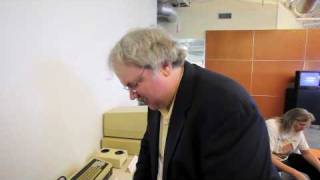
Video interview/tour (PlayDoh 50 at the Computer History Museum) with Brian Storms describing the PLATO educational computer system and surviving terminals/artifacts. Key points in this chunk: PLATO (acronym: Programmed Logic for Automated Teaching Operations) evolved into an early online social community in the 1970s; surviving hardware shown includes a prototype gas-plasma flat-panel terminal, Control Data IST1/IST2 terminals, rare Plato 3 keyboards and audio modules, Plato 4 (Magnavox-built, 512×512 graphics, slide-projection capability, released in 1972 at about $5,000 each), and Plato 5 terminals (circa 1977) that included microprocessors (speaker mentions a Z80-like chip and an assembler called PPT ASM). Brian notes only ~70 Plato 3 terminals were ever made, describes audio floppy devices used for language lessons, and points listeners to cyberone.org (an emulated PLATO service) and PlatoHistory.org for archives and upcoming HD video of the conference to be posted on YouTube.
Questions this video answers
Programmed Logic for Automated Teaching Operations.
512×512 graphics.
About 70 terminals.
1972.
About $5,000 each (speaker notes this figure for 1972).
All right, so who are you and where the hell are we?
I'm Brian Deer and we're at the Computer Histories Museum. And we're here for the Play Doh 50 event, which is just about to kick off in just a few minutes. And we're actually in the Play DOH playground which the museum has set up, which is just this amazing collection of artifacts, some of which are one of a kind. And let me quickly show you some of these things. Yes.
So plato, first of all, we've already done an interview with you about Plato.
But in 10 seconds. What is it? Plato stands for programmed Logic for Automated Teaching Operations. And it was set up as an educational computer system, but in the 70s, it became really the first social media online community. And this is what the hardware looked like. And the software actually, see what I call the friendly orange glow. And this, I wanted to show you this because this is a prototype of a portable plasma terminal. This is actually a gas plasma flat panel display. And this is something that Control Data built. This is a prototype color Play DOH terminal with all the intelligence in the box. This is CDC's famous IST1 terminal, which. This was mass produced by Control Data Corporation and sold all over the world. So this is what a lot of corporate type customers use. They didn't get the orange stuff. This was black and white, but still 512 by 512 graphics and a touchscreen, sort of a plastic feel to it. And there's actually a cushion of nitrogen gas in there to keep it nice and isolated. And an array of gold filaments that are invisible to the eye. So this is the famous plato, you know, keyboards with the next key instead of a return or enter.
Now, schools and corporations who bought these systems, these were millions of dollars, right?
Well, a whole system would be. Yeah.
How many terminals would be on a whole system?
It could be 500, 100, 500,000, whatever. I mean, it depended. There were lots of different things. Or you could just like lease the terminals and have just dial up to a CDC system. So there was a lot of that going on too. And this here, you'll love this. This is a Play Doh 3 keyboard. This is from the 60s. But this device here is an audio interactive audio device with a audio floppy. Whoa, check that out.
And how many bits are on it?
I'm not sure what it is. I think it's 16k or 96k. Somebody probably here knows. But, you know, this would have tons and tons of audio separately recorded messages, typically like in foreign language or what. And then the terminal would send a signal to this and the student would have headphones and you know, it would say like it would say a recorded French language message or something. And you could actually speak into a microphone and it would record too. And then you could compare your version of a foreign language sentence or something with the PLATO system. So these things were widely used at the University of Illinois and Delaware and other places. And so that's very cool. This is. There were only 70 terminals ever made for Plato 3. So this is really rare. And this isn't. This is. It's an RCA Victor monitor and a custom keyboard with an X button. And that's why when, when you logged on to Play doh, it would say press next to begin. And that was the famous. So you're going to probably see some people here who have T shirts or something that say Press Next Begin all over them. That's what it means. It's kind of an in joke unless you, you know, you're play Doh. So this is a Plato 4 terminal which had a built in slide projector inside of it. This one doesn't have it in it, but again, 512x512 graphics. The slides would project through the plasma panel. And so you could see up to 256 photographs with text and graphics superimposed on top of them. So if you needed to do an instructional lesson on veterinary medicine or something and show the cow or whatever and have little arrows pointing to the photograph or whatever, you could do that kind of thing. And that's this. This was the workhorse of play doh. This came out in 1972. 72, yeah. Magnavox built these puppies. About $5,000 each in $72. So now it'd be about 22,000 each. So they're kind of like super high end workstations. And over here are Plato 5 terminals that came out in 77 time frame. And what was cool about these is that these were plain, you know, Play DOH terminals, but they also had microprocessors in them. And so you could actually write assembler code. And I think it was a Z80 chip. And Ray Ozzy wrote the assembler program. It's called PPT ASM for these puppies. That was one of his major projects and contributions and he worked on that for quite a while. And so in fact I think they have some PBT stuff running on these. So PBT stood for PLATO Program Mobile Terminal. And that terminal over there is another control data one that was a little bit more compact called an IST2. But this is the playground and everyone's going to get to play around with these. They're all connected to the cyberone.org service, which is a fully emulated version of Playdoh Run. And all the games, all the play doh lessons from the 70s are there and typically at night you'll go in and there's a whole war going on in Empire or people are trying to go down in the dungeons of Avatar and all that kind of stuff. So you know, it's free, anybody can get on. And there's Mac and Windows emulation software to get into Cyberone. So I highly recommend that too.
Where do I learn more about the stuff you're doing?
Playdoh. Yeah, I've got a site called Plato Plato P L A T O history.org and that is sort of becoming a first. It's right now it's kind of a blog, but it's going to evolve over the following year into a lot of archival material, videos, audios, MP3s. We're putting this entire conference into HD video, something like one petabyte of storage from what I understand. And you can relate because you shoot video all the time.
We're doing through four gigabytes every single 14 minutes.
And they have three full high res HD cameras shooting tonight, plus I think a fourth to capture the screen on the up on the wall. And so they're going to be doing that for a while, but it'll all get on YouTube in the following couple weeks and totally free. So the whole conference program will be available. And so look for that I'll be announcing that and I'm sure the Computer History Museum will be announcing that too when it's available.
Well, thanks for the tour. Where do we find you on Twitter, by the way?
I'm Brian Storms and the Plato History foundation is Plato History on platohistory. So very cool. Cool. Okay.