AWE.tv Interview with Robert Scoble, Keynote Speaker - Rackspace
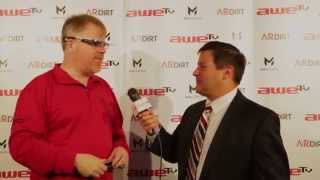
Robert Scoble explains how wearable sensors, location networks, and social data will merge to create predictive assistants that automatically buy things for you, book tickets, and know where you are. The tradeoff: giving up privacy for convenience.
Okay.
We are here at AWE tv. My name is Joseph Rampola and I'm here with our keynote speaker, Robert Scoble. Robert, tell us about what your talk was all about.
It was all about the fusion of data from sensors, from wearable computers, from location networks like Foursquare or Waze or Facebook, and add on all the innovations that's happening in the big data space and social networks as well. So you fuse all five of those things together and you can make a new kind of operating system. I talked about the app called Moves that Facebook just bought. It uses the sensors on your phone to know whether you're walking or running or driving or biking. And so it already knows four contexts. If it looked into your email and into your calendar and into out on the Internet, it can figure out other contexts of you. Because like right now I'm in a meeting, right? So why would my Google Glass tell me something about coffee, for instance? I don't need coffee right now. I need to be in a meeting context. So shut up for a while.
Absolutely. Now the thing that was interesting is you talked about these different forces, so why don't you just kind of sum up a little bit about the forces and why that's so important with contextual information.
Well, I learned after 30 years in this industry, if you see something that's going up exponentially, that you can build businesses on top of it. And Twitter, for instance, is seeing exponential rises in social network data. They're seeing half a billion tweets a day on Twitter and it continues to go up exponentially. Same thing on Facebook, same thing on Google, same thing on LinkedIn. The amount of data about where we're standing is going up exponentially. So there's whole businesses that just deal with location based data. Foursquare is a good example of that. And the data that's coming off of our wearable computers is starting. It's just starting, right? Because most people don't have Google Glass or something like it, but this is the first consumer electronics gadget that knows where I'm aiming, where my head's aiming and where my eyes are looking. So that's two new pieces of data that we didn't have before. And that data is going to go streaming somewhere, right? And things are going to happen because of it. New kinds of games, new kinds of shopping experiences, new kinds of museums that you walk around. And it tells you what you're looking at. Right. We're also seeing all sorts of new sensors. Like this is a 3D sensor from Occipital and you put it on an iPad and then it maps out the world around you in 3D. And so I could make a 3D model of your face and do all sorts of fun things with it that I just can't do with a standard 2D camera. So think about, Apple just bought Prime Sense, which makes this sensor, right? So think about a new iPhone that has that sensor built into it and you can just hold it up and take a 3D picture as well as a 2D picture, a 3D point cloud picture. So now I could grab your face and put it into my, into my printer right?
Now let me ask you, we're talking about Bluetooth sensor nodes and how is that going to kind of change the face of things? You kind of gave an example about, you know, buying some tickets for like a hockey game or something like that. How's that going to change the world?
We're talking about low energy Bluetooth beacons. In fact, I have one on my key. So this, this little thing here has one of these radios in it. This is spitting three numbers into the air every second. And my iPhone can tell how close it is to this thing, right? So if my keys are underneath the couch, I can figure out where they are just by using my iPhone. Soon these things are going to be all over the world. The Sacramento Kings Stadium has 35 of these up on the walls. So when you walk in the stadium, you know, your app knows that you're in the stadium, it knows where you are, and it knows a lot of context of about what you're doing there. And so you can, you know, standing in front of the hot dog vendor, it could say, hey, do you want this delivered to your seat? Or something like that. When you walk in, you don't have to pull tickets out because your phone already has the ticket, right? And it knows you're there. Your phone is your identity, particularly when hooked up to Facebook and other things, right? So yeah, it's a crazy new world coming at us.
Well, you also talked about some of the privacy. You didn't really get a chance to get into that, but it just seems as new technologies happen, people are going to adapt to, you know, these privacy concerns. And you know, you kind of mentioned about how if 15 years ago you would say to somebody you'd give a bunch of third party companies access to your email, you would have never done it. And now you have a whole bunch because you trust and you know that they're going to use that information for something important.
I don't really Know that. But you trust you hope. You take the utility that you're getting along with the pain, which is usually some sort of cool ad. But there is going to be downsides to technology. All technologies have downsides. Driving a car, right? 33,000 people in the United States die in their cars. We both drove here. And we take that risk every day. Because the utility of getting here and doing a speech or listening to speech is much better than just being afraid of the world. Right? And your phone is going to be the same way. There's going to be deep utility in sharing all this information with companies. You know, I give a story of saving a night in Chicago because tripit told me the flight's being canceled before the pilot did. Right. And I was able to get one of three seats out of town that night. But our world is being digitized. I saw a baby bottle with a sensor coming out my house. My locks are going to be electronic, My TV is going to be electronic. My thermostat. I have digital scales now, both for me and for my food. I mean, on and on and on. The world is going to be very digitized. And that means that this kind of thing could interact with my world in a whole way that we just haven't even really started to comprehend.
And it almost comes to the point where the world kind of predicts who you are. And, and that's. I kind of, I think the benefits of these technologies.
That's one of the things I said will happen for us, is we're getting new predictive systems. I mean, the code word for Google Glass is Wingman. Right? Was codename for this thing because it's trying to be an assistant. As I cross geofences into airports, it tells me my plane ticket and my gate number and whether the plane's on time. If I go into a restaurant, it can tell me, here's the three best dishes based on people on Yelp or Foursquare or Google Local. All sorts of data can be shown here as I'm living my life.
It was interesting because you brought up the point that there was one person that you know that doesn't really like technology. And you're pretty much all in. And it's kind of obvious talking to you that you're an all in technology type of person. But you kind of gave this story about how your flight got canceled and because you were connected already with all of your wearable technology, and you kind of caught one of the last flights out of Chicago, you know, to get it. There are these amazing Benefits that technology can give where if people have that perspective that, you know what? I just don't want to. I don't want to be all in. I don't want to get involved in that.
I don't know that you're going to have a choice, to tell you the truth. Because Mercedes just showed me a contextual car. They're going to have these 3D sensors aiming at you. They're going to know you're sitting in the car. And also, you know, this could be the future key. You know, my, my car key already looks sort of like that, right? You know, so I walk within 100 meters of my car, my car starts doing things, right? It starts going, hey, I'll cool myself down, I'll get ready for Scoville. And if he knows who, if the car knows who else is sitting in the car, it'll change what it tells me, right? If I ask it, hey, where should I get a lunch if I'm sitting with my business partners? It's a different answer than if my kids are in the car. Because if my kids are in the car, we're not going to no 3 star Michelin restaurant, right? Absolutely. If I'm trying to impress my boss, I might take him to nap. I go to Meadow Wood, right? You know, so the car needs to know my context to serve me better. And I don't know that you're going to have a choice because if you want one of these new cars and everybody's going to want one of these new cars because it's going to be cool, you're going to have to take the downside, which is your insurance company is going to know that you're speeding on Freeway 280.
All right, last question for you is like, what is the thing that excites you most about the awa?
I just find that this group of people are trying to dream of a world where we're going to wear a computer on our face or on our hands, where we're going to interact with fields of digital things, right? We already have the nest in our house, right. Most people don't, but these people are thinking about what's even beyond the nest, right? What's going to happen when everything in your house is going to have a little chip in it, a little radio, and it's going to be able to report itself, including the milk bottle, right? I was just at a park where the Macintosh was sort of invented, right? Or stolen or bought, depending on which story you hear. But they are spraying circuitry on anything with an inkjet printer so they can make circuitry for very, very little money and print it right on a milk carton. So now your milk carton is going to have a little radio and a little sensor in it and you're going to know the freshness of the milk just because you looked at the milk and it's going to say yeah, that's fresh and it's been optimum temperature range until you've opened it and then it will order some more. When it gets down to a third of the way down it will say to safely hey, deliver him another milk. He's getting low.
It's predicting what we're doing. So listen, you did an amazing keynote. Everybody was locked in. We really appreciate it and I think you gave a great thumbnail of where technology is and where it's moving and the bottom line is it's an exciting time. So thanks so much and I appreciate the time.
Thank you very much.
Appreciate it.
More from Robert








45: Sandy Carter Unveils the Future of AI: Myths, Agents, and Creativity | SXSW Insights


