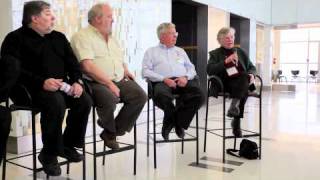
Panel of computer pioneers (including Gordon Bell and Steve) discuss a museum exhibit showcasing computing history. Speakers reflect on computing's rapid progress ("the computer has almost disappeared"), the exhibit's role in educating the public, the global nature of innovation (talks and visits to Nanjing University; moves of the museum), and specific artifacts (Apple II, IBM PC, Pong, Ralph Baer). Anecdotes highlight changing contexts for creators and visitors.
Questions this video answers
Gordon Bell.
Undergraduates of Nanjing University (lecture given October 15).
Apple II and the IBM PC.
Foreign.
The fact that it exists. And, and I would just say that there's no answers. Every, every person is different. So there's something different to one person wouldn't be to another. Every, every exhibit in there would be to a certain person most revolutionary. And I don't know if revolutionary is the right word. Maybe most inspirational or makes you get chills or gasp or emotional.
Yeah, I think the fact that there isn't any one big revolution, that the high speed of progress from the simplest machines out there to what we have today where the computer has almost disappeared, that's probably the most revolutionary thing to see the progress with how the soul industry has leap forward. No wonder industry has done that.
The incredible shrinking machine.
The thing that struck me the most was the way computers were actually used in order to prepare these. Behind all the product quality design that you see in a huge amount of programming.
Well, I took a geology course at Caltech when I was an undergraduate and the geologist told me, max, well, he told the class, you are living in a geological revolution right now. Well, this whole exhibit and computers themselves are the revolution of science, technology, and the whole thing is revolutionary.
I would say these are the most revolutionary things in the exhibit because they're all there and their friends are there and their colleagues and the people who've done amazing things over a couple of generations. So that would be my answer.
Any other questions?
Yeah, thank you. I don't know what's appropriate for this. Hi, I'm Todd Bezel. Alan J. Smith, this year at hotchips, asked a panel that was talking about technological development in Asia. He said, you know, when are we going to start worrying about the fact that we're bringing people over here and teaching them how to be the best engineers on the planet? The generation following this panel, and they're going home. And what happens when the United States isn't developing the next generation of what's in that brain?
Well, people ask me, you know, where are you from? And I have to say I'm a citizen of planet Earth. And I don't think we really care if the next generation machine is being built in Idaho or Massachusetts or California that strongly. We just really care that the, the next, next generation machine is available for those of us who want it and use it and apply it to whatever we do. So I don't really have an answer. I don't really care. My answer sort of like don't care.
Yeah, actually that's, that was my sentiment since actually, you know, it makes me happy that, that this is a Worldwide enterprise and it's not anyone. One thing you know, it's beautiful work in an advanced advance of civilization. And that's what I consider my life's work is a struggle against ignorant and a struggle against some other country.
Well said. Yeah, I agree. I don't think we should utilize this. If some other country can exceed in innovation, God bless them. I do think though that as far as innovation goes, I think the American culture still stimulates that, still sponsors it and allows it. But I think the more the merrier. If some other place invents something, then we'll come back and build on top of that. It's not competitive.
I gave a lecture on October 15 to the undergraduates of Nanjing University and they came prepared with questions. And I must say that the very first question was very interesting. Why should we study computer science? And I think, I absolutely agree that this where we are is global. There is not any way that we can prevent, nor should we prevent solving the global problems of communication between societies and all of other problems that we have with planet Earth. So I was very thrilled to see this huge room of students that were asking and pondering the same problems that we are.
35 years ago Gordon Bell started the.
Computer Museum in Boston because there were a lot of computer companies there. Fifteen years ago we moved it to Silicon Valley because this is now the center of the world for computers. Gordon Bell told me a while back that maybe in 15 years we'll move it to Shanghai. All the innovators.
Thank you for the positive.
I know I can probably thank. So I have been thinking back to the museum, to its valley rooms, you know, leaky warehouse and kind of had a squeeze through the table to look at stuff. And I'm just curious particularly hear from you who've been involved with the museum for a while, just your general impressions after having maybe more than once walked through that exhibit the other day. But what you're thinking about it now.
In the old days that you refer to, it was kind of a private club back then with all the pioneers and the guys admiring all the machines and having fun, reminiscing and talking about that and talking about new inventions. But it was kind of a private club and now this has opened it up to the public so non technical people can appreciate the breadth and this whole revolution in a meaningful way. I suspect young people today that are just born with computers all around them may not really have the perspective where it all came from and how not so long ago none of it existed at all. So I think that's what I see this about.
I've given tours in the old physical storage and I've contemplated tours here. And I must say that with the additional stuff here, there's a lot more you can say, a lot more things you can point out that aren't covered in the incredible amount of text and work that's been done. There are a lot of connections between different things. Like, for example, in the logic thing, I can point to a simple demonstration of logic which is the basis of all the logic in the prey one. And it's very simple. You can understand. It's just you make 2,000 of those and you can make a cray one.
At least in proceeding. Well, let's see. I have a question for the people who are in charge of the exhibits here. I did not see an Apple ii. Now, I'm sure you have an Apple II somewhere. There is, but I missed seeing it.
Well, there are almost a thousand artifacts there. It's easy to miss one. In fact, the Apple II is one of the two, two icon personal computers. In the personal computer alcove.
We have dueling icons, Max. We have the Apple PIM on the left and the IBM PC on the right. And they're still fighting it out.
Speaking of dueling icons, I was hoping to see Steve and Al playing Pong and Space.
Boz beats everybody.
I played the one time Ralph Baer, the inventor of television games, he really invented Pong. He got. He won the patent wars against Atari and whatnot. So I played him. And he's rather old. We're in Sun Valley, and it was his machine. He knew how to put the little upward. And now he spins on things. Very complicated Pong game. So I'd say, hey, what's that over there? And when he looked, I'd.
Sir.
Yeah, I beat him.
I was just beaten by one of our guests.
What do you think of the exhibit, Steve?
What do I think of the exhibit? I think it was well said that basically it's brought to the like. As Al said was singing put brought it to the masses. It's like a real. I've been associated with a number of other museums and the steps you have to take to make something presentable and understandable. Used to be you could come in this building and see an awful lot of incredible equipment. If you knew what it was and where you'd come from. You'd already sort of studied the history of books on your own.