Interview with Robert Scoble - Age of Context
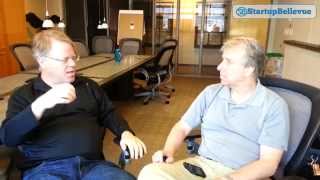
Interview (July 2014) with Robert Scoble and Steve Broback about emerging technology trends and startup ecosystems. Scoble outlines themes from his book Age of Context — fusion of wearable sensors, social and location data, and big data to create contextual services — and gives examples (Nest, DropCam, Moves, Google Now, IFTTT). They discuss smart homes, connected cars, body sensors/health monitoring, platform roll-ups (Google/Apple), privacy/silos, the sharing economy (Uber, Airbnb), and regional startup dynamics (Seattle, Las Vegas, Sun Valley). The conversation also covers investor opportunities, cultural drivers for startups, and practical examples of consumer services and devices.
Hi, I'm Jolene, the conference reporter here in sunny Seattle, reporting for Startup Bellevue. Today we have an interview with Steve Brobach and Robert Scoble. Steve Brobach, he is the co founder of Dent the Future, a conference you need to check out, as well as the founder for the Parnassus Group. And you probably know him from the tweet house. Robert Scoville I'm sure you've heard of. He's a tech evangelist and he's a DARP liaison for Rackspace. And he travels around the world looking for the latest, the greatest, the coolest, and what's going to revolutionize our future. All about technology. And he just wrote a book that you want to learn about. I'm reading and looking about, thinking about what our lives are going to be like in a few years. Very exciting. So let's go see what they're talking about.
I'm Robert Scoville. What are you doing? That's my favorite question, which has a whole story. But I'm a futurist for, for Rackspace Startup Lie is an officer at Rackspace and I go around the world and study the future. I interview tech executives all over the world, mostly startups, and see where the future's going.
Right on. And Robert and I go way back to Gosh 93. Was that when we were at the PageMaker conference together here in Seattle. And then ultimately we got to work together at Fawcett Thunder Lizard way back when. And then you moved on to Microsoft and onto Rackspace. You've had a rich and storied career.
Fast Company magazine.
Fast Company. So you've been doing the startup beat really aggressively.
Technology beat, technology innovation beat. I mean, I had Microsoft, I interviewed 600 employees, everybody from Bill Gates Song down to the Janitor, looking for what the story was and Microsoft and innovation. And I just continued that when I got out of mic shop.
And we're here, sitting here in Seattle on a beautiful Lake Union, sunny summer day.
Are we on some boats?
I know you're sticking around an extra day. Anyway, that's a separate conversation. So I kind of want to jump down a couple, delve into a couple topics today while we've got you available. One is primarily, we also work together on the Dent conference in Sun Valley. And we're very much on top of not only what's happening on the technology scene, but we're monitoring what's going on in terms of processes, business practices, fundraising, etc. Typically, VCs, angels and startups are really interested in that beat. So I Kind of want to go down that route of what you see as emergent, emerging and powerful new arenas that people should be paying attention to, because that's your passion. We'll delve a little more into also a little more of the regional stuff here because we are in the Pacific Northwest. There's been some very exciting developments on both the startup and the funding scene that we can delve into a bit, too. But let's open with you. People pound the pavement, talking to people, seeing things. And a lot of people agree you're sort of ahead of the curve on a lot of topics. What's got your creative juices flowing currently in terms of either technologies or investments or products?
Well, I wrote a book called Age of Context, which is about wearable computers, sensors, big data, social data, Twitter, Facebook and stuff, and location data from Waze and Foursquare and Facebook Check ins and Google Maps and NavTech. All these fusing together to make a new kind of operating system possible. And I think one that's going to know what you're doing and is going to serve you based on what you're doing. Mercedes just announced a contextual car this January, the Consumer Electronics show, where it's going to change what it recommends to based on are your kids in the car or are you taking a business executive out to lunch? Because if I say pizza, please, and I'm taking you out to lunch, that's a different thing than if I have my kids in the car. Right?
Yeah. Or if you're by yourself.
Exactly. And knowing the context of what we both like and what we both are expecting to experience will change what these things are going to do for us. Facebook just bought this app called Moves, which knows whether you're walking, running, biking or driving just based on the sensors in your phone. Right. And so you start thinking, why would Facebook want that? Well, maybe they want an automatic post writer. So, hey, you're sitting and it knows you're sitting because the sensors know that this is in my pocket or it's in my hand or it's, you know, or we're sitting in the valley.
Well, let's talk about the Nest being purchased by Google. That's also a cool. When you say context, that's a context play.
So let's split this up into different things to talk about. You have the home, that nest place, and the home is radically changing. So in the past year, I've gotten a drop cam on my front door. I'm getting lockedron locked so I can unlock my door from Internet on My mobile phone. I have a nest thermostat to run my house's heating system. And I have a nest smoke detector. And I'm going to get three more soon to watch my house. Those are all sensors that know whether I'm living there. I have a Sonos for my audio along with a new gramophone system so I can play music socially at the house. I have lights now from Philips that let me change the color and the brightness from my phone, but also by diamond, a few other things, you know. And I have a revolve unit that takes control of it all. And we're going to get more devices in the home. I've seen garden things that are like nests that control your garden and on and on. So the home is radically changing right now because the cost of compute is coming down like a rocket.
Sensors, cost of sensor sensors are going down.
Sensors, they're getting smaller, they're getting more connected. The house is getting more connected. And so that's rapidly changing the house. The same revolution is happening in your car with a connected car. Right. You're going to walk into a car of the future and your mobile phone is going to do stuff with the car.
Well, we just did this. We did that event in Palo Alto a few weeks back where buick had the 4G. They plugged 4G into the vehicles as.
Standard so the kids can be in the backseat watching their movies or whatever.
Device. Car, automotive related device. You've got is connected.
Yeah, right. Well, and then our bodies are going to be digitized. And so, you know, we're all starting to wear something that looks like this right now. A little activity tracker.
Right, Right.
But this is rude. This is rude and crude technology compared to what's coming. Because we're going to have sensors that are going to go inside our skin to look at our blood and look at things in our blood, our glucose levels, you know, whether you're having a heart attack even. I've seen sensors that are being developed for that. Whether you have cancer before there's a symptom so you can get that fixed easier than waiting until you're, you know, dying. On and on, we're going to see a huge revolution about studying ourselves with new kinds of sensors. Shirts that have sensors in them. Shoes are coming that have sensors and that are custom printed.
Another local company, every move. Russell Benaroya. That was our. We saw that, you know, what they're doing with that sort of data.
And.
Also turning into incentives. But the question is great. We know it's just like Sorry. As we go back to the old days, it's like the laser printer, The Mac and PageMaker all converged to create a desktop publishing revolution. All a whole new. It was very disruptive. Extremely. Now you're saying, okay, great, but we've got Drop Cam. Boy, I'd hate to be in the home security business after seeing Drop Cam. I bought three of them and I'm buying more all the time because they.
There's a reason that Google bought that company. It's a sensor. If you look at it as a sensor, every few minutes, if somebody walks into my house, you know, my wife walks in, I get a message on my iPhone, assuming that there's activity at the front door and I can click and see who was there.
Oh, it's.
Anyway, yeah, don't get me started on Drop Cam.
But the thing is, okay, the opportunity for investors, angels, VCs and entrepreneurs. There's a platform play here. Who is going to. Is there someone who's going to unify all this into some sort of platform that they end up owning?
Well, IFTTT is a good example of that. Ifttt, it lets you do things like when I check in on Foursquare, it grabs the data from that and puts it on my Google Calendar.
That's right. They glue those services all together, right?
So if a Drop Cam event happens, it can do something with that and put it over on Instagram.
Right.
So now you have an Instagram feed of everybody who's going through your apps.
And I'm not going to get the. We're not to the privacy thing. That's. I mean, that's a highly relevant talk, but it's been beaten to death. And anyway, there's lots of conversations. But I mean, for example, both for kind of the reasons you're here in town, the various startup associations, the Bellevue Startup, Seattle, where I mean, I want to focus on what are the opportunities as either investors or entrepreneurs that you're seeing.
I had breakfast with Dan Levithan, who started, who co founded Mavron, one of the most famous VCs in the world. It's here in Seattle. It's funny enough, most of the companies we were talking about were San Francisco companies, but a few in the.
That's the nature of the beast.
But I said, you know, I'm noticing a trend in my own inbound because every entrepreneur is hitting him for money and hitting me for PR. I have 7 million people listening to me on various social networks and stuff. And I noticed I'm really not all that interested in a laptop app anymore. We're all carrying these. So if you show me a cool iPhone app or a cool embryo app, I'm listening.
Right, Right.
If you show me a cool Windows app, it better be the most mind blowing Windows app I've ever seen. And how do you do a mind blowing Windows app that you've never seen? That's pretty hard. That's a hard. A high bar for an enterprise.
Well, that's why the new Microsoft CEO has said mobile first.
Well, it's obvious because Dan said, you know what? Yeah. All the best things lately have been either mobile first or heavily mobile. They get pitched on mobile. They have something interesting on mobile. Uber, Airbnb. Airbnb has a beautiful mobile app, right? Yeah. It's not mobile first you can use on the web, but it. But it has a mobile component to it. And you're going around the world wanting to stay places. Where are you going to use Airbnb tonight? If you say, man, you got to cancel your flight tonight and stay here in Seattle and go to something tomorrow, I'll be like, I'll pull up my Airbnb to find a place to stay.
Well, I was just down. We just did a robotics panel down at Comic Con, San Diego. Of course, the town is sold out, except we have our hotel. But I'm still obsessed with hotel tonight.
Saying, where did I get rooms tonight?
Sure enough, there were rooms in town throughout Comic Con available on hotel tonight. So I was obsessed with the mobile platform. So here's an issue I've got. I know you. The Age of Context is a great book and it talks about a future which I think is for sure coming. I'm not sure I'm in agreement with you on the timing. And let's talk a little bit about that. Is each data provider. Okay, so you've got the sensor data, you got the social data.
Twitter has a half billion tweets a day right now.
Right.
And it's going up exponentially. They had a great day yesterday.
I did 20% boost in their share price. And well, yeah, we've been part of.
That's the World cup. Because the World cup causes everybody to tweet. Oh, great. Everybody's on Twitter all of a sudden.
Which by the way, totally validates their, you know, sharing events. Live events has been central to their mission the last year, which seems to validate that. But hold on a second. You're right. And you know me, I've been sucking down Twitter data since 2009 and doing stuff with it. But the problem is everyone is also getting more and more and more proprietary about their data. So they've got lots and lots of beautiful little silos. And what I hear from you is and they're all gonna get connected. I'm like, I'm seeing more siloization than I did Twitter. With all due respect, they used to be very open with their data. Now they're very close with it.
But there will be a roll up at some point.
Well, that's a great question. Who's gonna do.
Google is rolling up the house. I mean owning Nest and the Drop Cam. They already own two of the best brands in the house. So their strategy is take over the house. And Apple strategy is compared to the house is we're going to build our own Nasta and our own Drive Cam and our own thing. And maybe that works, but I don't think so. I think Google is way ahead here in understanding this roll up of disparate data to make something like Google now work. Because if they can make Google now really, and right now it's fun, but it's not really working the way I think it will someday or it could someday. If Google makes that, they're going to own the house and they're going to own us.
Well then suddenly the other data providers have to play. They've got to.
Yeah, because Twitter the value is the data the value.
So you think Google's in terms of who's going to desilo this. Google seems to be leading the way.
Right now by buying things and Apple's buying other things. So there is going to be a roll up, there will be a crunch and there will be a roll up. And so 10 years from now we're going to be using 10 years ecosystem. Well, it takes a while for these roll up.
10 years is nothing. 10 years is great. But I have to tell you, I think about VR 1987 virtual reality. I'm reading that I'm going, okay, this is going to change everything. And a lot of people invested in it because they could see this potential was incredible. Well, here we are how many years later and finally Oculus Rift is like, yeah, but so here's my problem. I think of you every time I fill up my gas tank. Because every time I fill up my gas tank the gas pump asks me for my zip code and if it's credit or debit. And I think why don't you know that?
Well, they're.
Because they don't care.
No, they do know that they're using it for fraud detection. Right.
Credit or Debit. Oh, that's, that's a fraud detection indicator.
Partly. That's a fraud detection thing because they need to validate. Is that a credit card on the other end? And they know it. I know it. By looking at your number, whether it's a credit card.
Yeah, but the world you talk about in age of context is one where it knows I've got my phone and it sees my eyes.
We're in a disrupted world. That's not completely disrupted. Gas pumps were. The technology in a gas pump was designed 20 years ago. It is not the future.
It's just not evenly distributed yet. Let's talk a little bit about startup ecosystems. I think we all agree, I mean, the Bay Area is towers above the rest. The rest of the world. You said earlier up here in Seattle, we're kind of. You view it and I would have to agree. We're sort of a suburb of the San Francisco sort of.
You know, when I lived here in Seattle, I would fly down to Silicon Valley every weekend and go and visit startups every two weeks. And now I come up here every six months. Right.
Yeah.
There's important. Well, there's important. I wouldn't put it that way. You are a tech hub. I hate looking at things like, oh, we're competing with San Francisco. You're not competing with San Francisco, you're competing with yourself, you know, to build a vibrant ecosystem of things up here. Right. And you have some big hubs here. You have Microsoft and Amazon and Starbucks and Paccar, Boeing. Big companies that hire a lot of engineering talent. Right. So there's a lot of talent up here. The problem is they're all working in big companies. And so how do you rip them out of big company and create new value? And that's the argument a lot of countries and communities around the world are having. We had this argument in Australia. Right. The business expertise in Australia killed stock options or is trying to. And if you don't have stock options, you don't have startups. And if you don't have startups, you don't have a competitive.
You know what we had, you know what, what we may need is a recession, a deep recession. Because what happened at the dot com.
Bubble, how you get people to see the value of creating startups compared to a big company.
Yeah, but during recessions you have people laid off and people are getting laid off. Look at the dot com bubble. At first a whole bunch of those people started their own thing. And what about, let's talk about Vegas, because Tony Hsieh, as You know, has been very successful building a startup ecosystem.
There, successful in getting a PR for Las Vegas. I'm not so sure he's yet been successful at building a really good ecosystem.
Because compared to where it was, because he's remarkable.
First of all, he found a, a resource that was very cheap. The old Las Vegas, not the new Vegas where the hotel is, but the old Las Vegas had a lot of closed up commercial real estate. There was real estate sitting there ready, unused. So the government helped him, you know, use that resource. And now the government said, oh, you know what? Our future might not only be in construction casinos and getting people to gamble here. We need another source of growth in this city because they went through their own recession in 1990, where the rest of America got poor and wasn't willing to go to Vegas anymore and gamble. And there was a lot of commercial real estate seen and used in Las Vegas. So Tony Hsieh saw that and he just got some money from it, from the sale of Zappos to Amazon. And the government there said, let's help this guy because if he can build a startup ecosystem with hundreds of startups here, first of all, it'll help the local economy be more consistent and be more recession proof.
When you saw the one in Sun Valley, Idaho, the ketchup Innovation center, beautiful unused space that the city stepped up and said, this.
Help startups get going in your community. You have a more vibrant growth economy, which means you have kids who are not unemployed, which means you have lower crime, which means you have people a few of which might get rich because they build a new billion dollar business. And then all of a sudden they have more money to invest it back in and plow back into the company, into the economy, and on and on it goes. And then all of a sudden your tax revenues are going up and you can build a new firehouse or buy a new library or build a new school for your kids, right? This is, we don't think about it anymore because we're used to having a nice library here in Seattle and we're used to having a nice airport and we're used to having a sewage treatment plant. Why? His starvance started here and Microsoft started here and Boem started here and Paccar started here and AT&T wireless started here. So there's been a lot of startups that have gotten to the promised land here. So we don't think about the community that way. But there's a lot of communities around the world where they don't have a sewage trap and treatment plant yet, and they don't have a local library yet, and they don't have a nice college in there.
But the other element, the other element, the reason that I think we see places like Vegas being transformed is besides they've got that real estate asset. They have investor money there. There are people that have the kind of money that they can invest like we have here in Seattle with Microsoft money.
But it doesn't take just money because GoPro started with less than $100,000.
Okay, well, that hurdle has gone so far down, right?
But it does take having business expertise, people, people who are around a community who say, hey, you know what? It's important to have startups here. And it's important for a whole lot of reasons, Cultural reasons even. I meet a lot of people in my job, and people who build things are more interesting than people who don't build things. And if you want a better culture, a more fun time, on Friday afternoons, you know, have some people at your dinners that build stuff.
The old culture beats strategy for lunch thing. I think culture beats building.
Companies are, you know, it's the ultimate of building stuff because, you know, if you start building stuff and it's cool and people want to buy it. I just met a lady who started Hintwater. Hintwater is now one of the top brands at Google and Facebook. And she told me how she started. She wanted something other than Diet Coke to drink, and she started cooking raspberries and extracting the flavor from the raspberry down and making water. And she did it for herself. And then she put it on a shelf at a local grocery store and it sold out in less than a week. So there were other people who wanted the same thing. Well, boom, you have a company.
Jason Preston and I were going through this experience couple weeks ago, sort of what kind of person is it that we've been engaging with both, you know, at their conferences and everything else? We, of course, econ major here. The two by two matrix was people that are seeking tangible reward, which often Silicon Valley might say financial reward, commercial reward. They're trying to build a product that resonates and gets pickup. But also internal reward, which is. I find this work fascinating. And whoever is in that zone of doing both is the kind of people, obviously you like to hang out with. We like to hang out with. And the third axis, like wine, which we'll get into later, Wine is building stuff.
You talk to the people in that. The people who build wine are really interesting people to study.
It's art and science and that Little alchemy that's hard to define. That makes the magic of it all. Yeah.
So talk about, you know, that's why I like your conference, the Dent Conference. Right. There's people who build things, people who are innovators, who try new things. I met the guy who invented the.
Backward high jump there, Dick Fosberry, right. The very flop.
And he explained how he came up with that. And there was a lot of innovation that happened with sport, Right.
The enabling technology was the Porta Pit. And he said, what if I go over the bar backwards? And everybody said, you're out of your mind. And even his coach was saying, dick, please stop. It's ridiculous. And now it went from being alien to being called the Fosbury Flop. And now it's just called the high jump.
Not everybody does it. Right. And he transformed his sport. I like talking to those people. First of all, it's interesting to meet a guy who won the gold medal, Right. And has his name on the sport. It's fun to talk to those people because they did something interesting in life. Right?
Right.
One of my first interviews was with Steve Woznack, and he said, I just wanted a computer. Yeah.
You know, it's funny because he was not. He was not. The tangible reward for him was I had a certain type of computer. Computer I wanted. And the intellectual reward was, I really like building this.
Well, no, he had no choice. If he wanted a computer, he had to build it because he couldn't afford the real one.
You know, he loved. You talk about love. He loved doing. Changed the world.
He walked around the Computer History Museum and he stopped on a deck computer, and he said, this. This computer was so expensive. I told my dad I wanted one because it was a really nice computer, nicely designed computer. And his dad said, well, that costs more than a house in Cupertino, which today is more than a million dollars. More than a million dollars today. Right. And Steve looked at his dad and said, well, I guess I'll live in an apartment. Because he wanted a computer.
And it was a core, that passion. The other thing you get from people like that when you're talking to people like that is what we talk a lot about is this associative fluency. You learn something new and you think, oh, wait, that either the technology you're using, the technique you're using, or the people you're talking to, or the way you're financing it, I can connect that.
To what I've been trying to do.
And I come up with something new.
But anyway, it gets back to if you're in a community with no startups and even a community that has a great business, it's a boring community.
Yeah.
Because nobody's trying to do anything new in that community.
Yeah.
And number two, number two, it's a community that won't grow that fast because big companies have a lot of exponential numbers. And sorry, Microsoft is going to grow X percent a year, Starbucks is going to grow x percent a year. But a startup that comes up with a revolutionary new idea, a new way of looking at the world, or redefines something like Uber did, getting a ride from a taxi creates immense new value that is not growing at 2%.
But that's it. You've touched upon the investor class now. Now, if you're an invest even in China, you're sitting on a lot of American dollars and it's like, what do you do with it? Oh, t bills, gee, 2% a year or. Luckily, the stock market's done relatively well, quite well over the past year and a half. But you didn't know that going into it. But if you're going to invest in startups, it's like, wow, we could earn a fabulous return. People are tired of getting lousy returns on their money. And if you're going to take some risk, well, heck, why not take, you know, get potential for, you know, a thousand X return. So I think that's also driving this startup culture. People want to make money, but today.
You don't need a lot of money. And a lot of the people, a lot of people who build companies, yeah, they have a vision of someday maybe I'll make some money out of this. But they want to build something and they want to build something new and they see a new way of living, a new idea, a new way of getting a taxi ride. And that, that impulse is not, I'm going to get freaking rich.
No, it's just creativity. It's. It's two things is, I think when you look at a lot of investors is I can get in for not much money compared to 10, 20 years ago. And I think what they're doing is really cool. And I'm in five or 10 or 20 different plays and I like talking about all of them and I find them intellectually stimulating and that puts us in that upper right quadrant again. Tangible reward, possibility with intellectual reward. I will wrap it up because I know you've got other folks to talk to, but. So you've been here in Seattle for about 24 hours. What have you seen on this trip?
That's kind of like, oh, I'm about to see them. Other than hanging out with Mavericks co founder. And he, he gave me a. He gave me a good app for you. Where's my iPhone? Where's my iPhone?
Just go to.
Gotta show you this because you're a wine guy.
Oh, yeah.
This new app. Wine Glass.
Wine Glass. Okay. Wine glass.
It's five bucks. So it's inexpensive. Okay. You aim it at a menu at a nice restaurant.
Yeah.
And you click down through the wines and it out turns tells you what all sorts of stuff about the wine, like rating the.
Oh, that's great. And does it tell you how bad their markup is? That's what I wanted to go.
First of all, you know, people say, oh, why are you always at the Ritz? Well, first of all, I live by the Ritz, so I can walk home. But second of all, they have a 10,000 bottle wine cellar there. This is actually a new trend in the world. World. Why would you own. If I could afford to own 10,000 bottles of wine, why would I do that?
The Ritz has its store.
The Ritz has them. And there's people to look after it.
That's right.
And there's people who are there who find new wine to put in it every week.
Why am I going to convert a house, a closet or a room in my house to.
Let's say I'm paying 40% more for a bottle of wine if I went the safe way about it. I don't care because I'm paying for the.
Yeah, I do. I'm sitting in a restaurant with a fabulous view. I factor in the real estate. It's like, oh my God, they're 3x retail. But I'm like, oh my God, look at this view. No, no, we're good.
But the kids today are changing how they live because they know they're not going to own a car. Why would you own a car when you can Uber? Yeah.
One of our co owners just sold his car.
Why would you own a vacation rental when you can Airbnb? Why would you own. The sharing economy that Jeremiah Ol Yang talks about is a real thing. We are figuring out how to share with each other because we have new ways of communicating with each other that we didn't have when you and I were kids.
No, it is. It's definitely a brave new world. That whole thing about the stagnation of innovation, I think. Yeah. We're kind of in a lull in some areas. Physical innovation. Yes. We can't travel through space and time as fast as, you know, we expected we'd all be doing supersonic travel. Yes. It's true. I don't have my jetpack, but you talk about the other stuff that's going on. Yeah. I don't find the stagnation to be. I think that's overstated. I think we've got to wrap it up. I could do this all day. Let's do it all day.
Come to death.
Come to death. Sun Valley.
We'll get on there a week together.
That's March 20, I think. March 21, 2015.
Just don't compete with south by Southwest music because I. Oh, no, no, no.
We'll be there, too. We always do the tweet house.
All right.
Good to see you, Rob. Thanks.
More from Robert








45: Sandy Carter Unveils the Future of AI: Myths, Agents, and Creativity | SXSW Insights


