Introduction to the Revolutions Exhibit
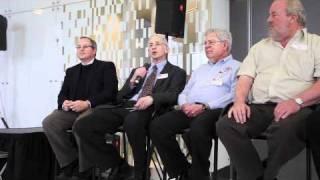
Robert Scoble tours the Computer History Museum's new Revolution exhibit with speakers including John, Lynn, and Paul. They discuss why preserving computing history matters and celebrate the pioneers who shaped the information revolution.
In the vacant chair. Come on over, Steve. I'm so happy not to be speaking to an empty chair. Steve, that's really great.
Thanks for perfect timing, Steve.
Thanks for bailing me out. You've always have been one for dramatic entrance, Steve. So you've just. Steve is, as you can see, is proudly wearing his blue Computer History Museum docent and shirt. That's the. That's the least of his accomplishments, though. Steve, as a programmer and computer scientist, is probably best known for creating Spacewar, the very first computer game in 1961 and 1962. That game was live all over the world. And that means we're celebrating or about to celebrate the 50th anniversary of computer gaming. And Steve is instrumental in having done that on deck. PDP1 at MIT. And we have a fully restored PDP1 back there, which I think you were dealing with a minute ago. Correct. All right, good. Probably playing around on. Al Alcorn is next to Steve. Speaking of computer games, Al, of course, is a pioneering engineer and computer scientist, the inventor of Pong, the very generous donor of the original Pong game, which we now have as the icon in the gaming gallery. Al, we're delighted to have you here. Next to Al is Don Knuth, probably one of the most notable names in the field of software. Don is the author of a comprehensive series of books on the art of software programming and just celebrated a birthday yesterday as well. Don, so happy birthday to you. We're delighted to have you here. Steve Wozniak down the way, just to the left of Don, of course, co founder of Apple, fellow of the museum, as is Don, and one of the great friends of the museum and has gone on, of course, to be an entrepreneur and has many wonderful stories to tell about history. So hello, Steve, and welcome. Max Matthews to Steve's left, one of the early pioneers of computer music. Max is featured in our gallery and is when you think of the early days of computer generated music, Max is absolutely one of the pioneers and we're delighted to have Max here. And finally, Fran Allen at the far end, also a fellow of the museum, an IBM fellow. Fran is one of the pioneers of software languages of compilers. As an engineer with IBM in the early 1960s did code breaking with a project called Alpine. These are some of the most distinguished names in American computing, and we're just delighted to have them here this morning to be a part of this launch and to talk about not only their personal histories, but what we're doing here as an institution. And now it's My pleasure to turn it over to Lynn, who is going to talk a bit about our history and what we're doing here at the museum. Great.
Thank you, John. They tell me I have five minutes, which is very difficult for me. But I'll try briefly to talk about three things. One is, why are we preserving the history of computing? The second is, how did this institution come to be? And the third is how did this exhibit revolution come to be? Why are we interested in preserving the history of computing? Well, computers are a big deal. They are changing the world. They're changing how we work, how we play, how we interact with each other. Everything we do is now mediated with computers. Our civilization depends on computers, and it runs on software. Imagine what would happen if all of the software that you interact with every day would suddenly disappear. You couldn't drive your car, you couldn't purchase anything in the store, you couldn't do any business transactions. It would be amazingly disruptive to society. It's one of the four or five top inventions, technological inventions ever in the world. It's up there with the printing press and the wheel and the cotton gin. It is like the engines of the Industrial Revolution that were at the Paris Furmatti. But the computer is the amplifier for the mind. It's making us smarter. The amazing thing about it, compared to the Industrial Revolution, is that it's happened in such a compressed time. We are living through the time when we're making a transition from there being no computers anywhere to there being computers in everything we touch. Because we are that privileged generation. We owe it to the future, to the people who come after us to preserve the artifacts and the stories of how that happened. We are here with Michelangelo painting the Sistine Chapel. We have to record the history of how that happened. Now is the time to do it. The pioneers, people to the left of us, are still here to tell their stories, and we need to take advantage of that. That's why it's important for us to do what we're doing here. How did this institution come to be? Well, it was the convergence of two different dreams. One is a dream I had about 15 years ago when I was teaching at Stanford, a graduate course in computer design, and realized that engineers were no longer learning the history of their field. And although that was probably the right way to teach computer design, I thought it was sad that there was history that was not being taught. And as I thought about it, it was a wider problem. It was not just engineers that were not learning about it. It was the wider public learning about It. And here we are in Silicon Valley, which is the center of the world for computers, and we don't have a computer museum. What's wrong with that? So I decided that was going to be my retirement project, a computer museum for Silicon Valley. So I started looking around for other examples and looked at all of the computer museums in the world, of which there was one, the Computer Museum in Boston. And it was a museum that had fallen on hard times. And I met with Gwen and Gordon Bell, who were the founders of the museum, and we basically hatched this plot to reboot it in Silicon Valley. So to make a long story short, over a period of the last 15 years, we've moved the Computer History Museum to Silicon Valley. We hung out at Moffett Field for a number of years in some Quonset huts, where we had this extraordinary collection that they had begun in Boston, which we expanded many fold while we were here. In 2001, we bought this building, which some people joke is the largest artifact in our collection because it used to be the sales and marketing headquarters of Silicon Valley. And we've gone on to do a number of milestones. And the most recent milestone, of course, is the opening of the Revolution exhibit. Well, how did that come to be? It's very difficult writing history in a contemporary subject because the people who participated in that history are still around to argue with what you've done. If you do Civil War history, they're all dead. But if you do computer history, many of them are still alive and will argue with you. So it was a difficult process to curate this exhibit. I wound up being recurator, which means I was the decider to decide what goes in, what goes out. But we've tried to tell the complete story. We involved many hundreds of people, pioneers, experts, historians, other curators from other institutions. Our secret sauce, our wizard, was Kirsten Tashev, our vice president of exhibitions and collections, who did an amazing job of keeping us all online and keeping us all on schedule and creating this exhibit. It is truly a collaborative effort. It is, as John said, an exhibit not necessarily for techies. It is an exhibit for the general public. And it is an exhibit that will live. There will be things that are wrong, that will correct. There were things that are missing that we'll add as we have the space to do it. And it is one of a series of milestones for this institution. It is not the end of the construction of the museum. We are trying here to construct an institution that will live forever and will be around 100 years from now to continue to tell the story of the information revolution, because it isn't over yet. So thank you for being here.
All right, Paul slides over to you.
Thank you. So we'll begin our tours. Each of the pioneers will be inside Revolution in the gallery that is aligned with their innovation. So we have a chance to meet with them again inside Revolution, as well as back here at 12:15 for our Q and A session. So let me introduce you to the guides that are going to bring you through Revolution. Dad, this is Dag Spicer, Kirsten, Tasha, Alex Bohannock, and.
And.
And Tim Robinson. So just arbitrarily attach yourself to one of the guides, and they'll go through in about 5 minute increments and bring.
You all the way through Revolution and.
Back out Here for the 1215 Q&A session.
More from Robert








45: Sandy Carter Unveils the Future of AI: Myths, Agents, and Creativity | SXSW Insights


