Just the Art from Stable Diffusion last night in 4K
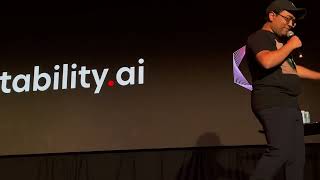
Chigozi Henry and Alex show how they use Stable Diffusion to generate images, then curate and transform them into oil paintings for gallery shows. They discuss APIs for artists, handling the glut of outputs, and upcoming museum exhibitions.
I'm going to hand over to Chia.
Who was part of the team right from the very beginning. And it's been amazing to work this year for these. Hi there. I'm so excited to see you all here. I'd like to introduce myself and also Alex. I'm Chigozi Henry and I'm a software engineer at Stability. And one of the things I've been working on recently is generally getting stable diffusion out into the world, so through the API and also through GM Studio. Sorry, can you. Can you hear me? And I also took part in an art residency this summer at Stochastic Labs, which is where I met Alex, who is an MIT trained roboticist and also an incredible artist. He's represented by Gazelle Art House, London, and he's exhibited at all sorts of exciting places. The Vienna Biennale, Design Museum, Ghent, and many others. He's been working recently on a series of artworks that use AI to probe human machine collaboration. And I'd like to let him describe some of those most recent works and then maybe we can have a short discussion about how to incorporate AI in the artistic process in general. So, Alex.
Thanks, Gia. So, on this video here, you can see someone making a painting. So this is a painting that was first described by a text, Generative AI. I choose the descriptions of artworks that I like from that system and then I feed them back into text to image generation. So it's sort of one AI talking to another through me, interpreting them. And then when those images are output, they are oil painted, so they cross boundaries between the digital to the physical, which I find quite interesting. There's a few more examples you'll see here. So this is what it looked like when it was up in Venice. So the main painting that was painted in the middle, and a whole bunch of other options of images which could be painted in the future if someone sees one that they like. On the top here you see the AI generated version and the painting. A few more examples of this. These are quite surreal or funny. And, yeah, this one I find really cool because the title, the aima for this one was Billy and Mel have an argument about putting together a light side table and decided to get a horse, which I think many of you have experienced putting together furniture like that. But, yeah, I'm always surprised by the outputs of these systems because sometimes they're humorous, sometimes they're really striking. Yeah. And the variety that you can get is quite amazing.
Yeah.
Oh, yeah. So this is what it looked like in a gallery in London. So this is the gazelle Gallery and again, sort of the oil paintings and Wal paper on the wall. So if a collector curator can and SOR1 that was generated out of the five options that they like, they can kind of point to that one and get it painted. Then they become part of the creation process. Again, this sort of human machine collaboration.
Great. So while we talk, I've put up this series of a selection of images that you've generated using stable diffusion, using this kind of process, but it's before the curation step, so it just represents the kind of raw outputs. And I think this really illustrates nicely the fact that in these systems you get an abundance of choice and also an abundance of beauty. And that's part of what makes this technology so amazing. But how do you think that that changes your artistic process?
Yeah, it's quite interesting. I think the usual artistic process is that kind of start with an image in your head and then create that image of its visual art. This is kind of flipping out on its head where I'm creating many, many outputs using an API that I can go through all these images and pick out ones that I like and then kind of work backwards from there, maybe make more variations of those or continue those further. So having something like an API that you can make generative outputs with creates this kind of curatorial relationship the artists can have with the machine.
Yeah, I think it's a really good point that the API is not necessarily just for developers. Even though it does allow these capabilities, it can also be useful for individual artists. So because you're so experienced in using these kinds of systems, as more and more creators try these tools for the first time, do you have any advice for them in how they should approach them?
Yeah, I would say think outside the prompt. Treat this like it's like a camera. So imagine like you first encountered a camera and you've never seen one before. I think everything you take a picture of is going to look cool and amazing because this was kind of new. But obviously, you know, camera, the camera is evolved into like this own art form on its own. So, you know, move from digital to physical, try different things and really push the boundaries of these systems. Because I think it's going to be one of these brand new creative tools we're going to look back at like we did for the camera.
Yeah, I love it. Finally, what's. What's coming next, both for you, but also in your view for these tools as part of the art world as a whole.
Yeah. So upcoming next year I'm going to have my first solo museum show in a major museum. I can't name which one quite yet, but it's gonna be a pretty big survey of AI art in particular. And I find this really cool because it kind of puts a bookmark in time where like a cultural institution has put their foot down and say, you know, this is a new and valid art form. This is something we're looking at very seriously. And yeah, I can imagine in the future we might see an AI wing, a museum just like we see photography wing over an SF moment over there.
Amazing. Thank you so much for Alex for joining us and I will hand back over to Imad for unexpected.
Hello again everyone.
Keanu leaves.
And I'm Stanley. Eh, ok. Actually can we queue the video you want to see?
Animation Animation.
Dream Studio Pro the next frontier of AI media creation Powered by stable diffusion, Dream Studio Pro represents a new paradigm in creative expression. Explore infinite latent space, conjure new realities and create powerful cinematic visuals in just minutes. Connect with your audience like never before with Dream Studio Pro's incredible versatility. Translate emotional stories and poetry into compelling imagery. Create an infinite variety of nuanced emotional animations. Use text prompts together with music to drive Dream Studio Pro's audio processing unit and create powerful audio reactive music videos Driven by AI With Dream Studio Pro and Stable Diffusion, filmmakers can go from a creative concept to a short animated film in just minutes. Draft and visualize your script with our powerful storyboard mode. Sponge your storyboards into the timeline for versatile scene composition, precision camera controls and groundbreaking latent space transition effects. While DreamStudio Pro is a standalone application, it is also a perfect addition to robust visual effects. Asset workflows create fully realized environments, asset textures and motion matched composition layers with 3D transformations and precise masking. All of the versatile API functionality is built from the ground up on our robust cloud platform. This way, studios and software partners can easily integrate DreamStudio Pro capabilities into their own pipelines. DreamStudio Pro is compatible with proprietary fine tuned image models, allowing studios, game developers and content creators to integrate DSPRO into their own production pipelines. With video diffusion and audio diffusion models coming soon, dreamstudio Pro extends our leadership into animation and video, cementing Dream Studio as the industry standard for AI image synthesis and media creation. The future of animation is now.
Very.
Exciting moments in, I would say the.
History of technology, the history of artificial.
Intelligence, that is the release of stable diffusion stable diffusion.
So stable diffusion, I think is going to really shake up the AI game.
It's an explosion of creativity, collaboration and open improvement it has absolutely blown up recently.
I'll just explain real quick. Hey, you got this big model. You can type in anything. You get a picture like, okay, well, I'm going to type my name in and, like, nothing comes up. I trained the thing for a week and a half, it looking like me, but guess what? On my drive down, this guy figured, I'm going to do it in 15 minutes.
More from Robert








45: Sandy Carter Unveils the Future of AI: Myths, Agents, and Creativity | SXSW Insights


