Lon Safko & Robert Scoble Famous Blogger, Scobleizer, & Author - Fast Company Historic Interviews
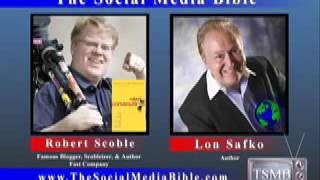
A recorded interview between Lon Safko and Robert Scoble (Feb 2017 upload) about Scoble’s background in blogging and vlogging, his book Naked Conversations, and practical advice for businesses using social media. Topics include the evolution from blogging to broader social media, the value of listening before speaking, the power of informal video ("scobalizing") for authentic conversations, and examples of companies successfully using social media.
Hello, my name is Lon Safko, co author of the Social Media Bible, published by John Wiley and Sons, the largest book ever written on the subject of social media. Today we are here with Robert Scoble. How cool is that?
Sorry about that. We're here in the airport, so if you hear some voices and stuff in the background, that's what's going on.
You're on your way to Berlin, you said. Yeah, that's cool. Well, Robert Scoble is the author of Naked Conversations, published by John Wiley and Son. He's also the famous Microsoft blogger and the Scobalizer. So we're going to talk a little bit about what Robert's doing and about social media. So let's get started. Robert, can you tell our listeners a little bit about your background and your book Naked Conversations and Scobalizing and what you've been doing?
I've been blogging since 2000. I used to help plan conferences for programmers and web developers and that got me into blogging and that got me into nec and that got me a job at Microsoft where I interviewed 600 employees about that number and that got me a job at a startup. And now I'm at Fast Company and I'm going around the world and interviewing business and tech innovators.
Wow, 600 employees, you said?
Yeah, 600 somewhere around there. 500 something.
Oh my gosh, that's amazing. Can you tell me a little bit about Naked Conversations, your recent book? I'm sorry, Naked Conversations, your recent book. Yeah, yeah.
So I wrote that at Microsoft because I was one of the first bloggers in a big company and so interviewed I don't know, 100 or so companies about how they were using blogging and wrote up their experiences and talked about how to get fired with a blog of the early set of blogging. Now blogging has changed to be not just blogging, but social media. And a lot of companies are having social media efforts that are pretty interesting, including Twitter and Facebook and blogs and basically all the online media.
You bring up an interesting point about getting fired by writing a blog. That seems to be, at least to me, one of the biggest obstacles where companies are afraid to get involved in blogging because they actually. They're afraid of losing control over the corporate message.
Yeah, that's a common approach. The company is used to really feel that they had control of the message and that they had control of their brand. And they would be able to talk to 14 journalists and get their message across. And now a kid in Australia with seemingly 50 or 100 readers or 50 or 100 friends can really change how you're perceived in the world.
Wow. Well, and you've been blogging for a long time. If someone came up after one of your presentations and said, robert, can you point me in the right direction? I've never done any social media blogging, vlogging, what kind of advice would you give them?
Oh, man, how would they start? I would start by listening and participating rather than trying to talk. Follow a bunch of friends on Twitter, read 100 blogs on Google Reader.
Go.
Over to Flickr and understand that community, go over to YouTube and understand that community and listen and see what people are saying about your company, your products and stuff like that, and your industry or your genre. And then only then should you talk. By then you're probably impelled to talk because if somebody's talking about you at a cocktail party, of course you're going to talk back.
Right? That's a good point. Yeah. So the advice is kind of get out there, participate a little bit, understand what you're talking about and try not to say anything until you actually have something to say. Right. Now, didn't you get a title for the number of blogs that you read in a 30 day period? I heard someone say.
I don't know about a title, but I read hundreds of blogs.
I thought I heard.
Yeah, I have 700 feeds in my Google Reader and I read 3,000 people on FriendFeed and I follow 21,000 on Twitter.
Oh my gosh. That's a staggering amount.
The thing is, it brings in, you know, I surf that to see what people are talking about and then I use search engines like FriendFeed or Twitter has a search engine now and you can see what everybody's saying about a certain topic. You know, like what everybody's saying about Barack Obama this morning.
And that's another good point that you brought up there, is that when I talk to people and I show them the social media ecosphere and the size of it and all the different tools, people have a tendency to kind of get overwhelmed not only with the tools, but the data. And so would your advice be just kind of focus on what's most important, kind of screen it out, but just be aware of everything else? Yeah.
I mean, if you're feeling overwhelmed, segment it and start putting it into folders or, or subscribe to fewer people. You know, back off on the number of people you're following or the number of sources you're following. I find I don't get overwhelmed. I find that you know, it's just hard to find the real nuggets among the noise.
That's a really good point too, is that there's a lot of kind of chatter out there, but not a lot of substance. Yep. Okay, here's another observation. You started out as kind of a type blogger and you kind of moved into the video and you've made yourself kind of famous for scobalizing and you've had some really incredible videos. Can you tell me what caused the transition and the power of video and what your thoughts are on that?
Well, there was a group of us sitting around lunch table at Microsoft and meeting with a developer and we wanted a way to communicate with people in a different way than just text and video. Let you know. I was, why can't we just video this lunch conversation? Why do we have to write that up? Because writing it up is just impersonal and not. It doesn't let us communicate the way I wanted to communicate with you visually. And so I was like, let's just buy a cheap video camera and film these kinds of conversations and see if we could change how people communicate.
One of the things that I notice about your videos is that they're not polished, they're not studio quality grade. But really what you're talking about is substance and content.
Yeah, some of them are. I actually do a show now every Friday in the studio. But to tell you the truth, I find it's really hard to have a good conversation in a studio because when people get underneath lights and get in front of professional cameras, they shut down. They don't tell you, they don't relax and they don't open up to you and they don't share what really they're about.
Also.
When you're in a studio. Where was I going? When you're in a studio, you're working with a committee to make media. And that media is often slick and professional, but it doesn't tell you a lot of stuff. I like video that teaches me something, that educates me, that makes me smarter.
So catching people, like, I just saw one of your recent videos with Alan Levy sitting on the patio of his house.
Exactly. Or like I just visited one of the architects who built the Staples center, you know, or I've been in the Tesla with the chairman of the board of the Tesla Corporation. Or like this week we're going to go follow around Mr. CES Stephen Leon, who runs a whole bunch of events at the consumer electronics shows around the world.
That's really cool. You've really had some Incredible names that you've scobalized. Can you do a little bit more name dropping to kind of show the power of this?
Well, I was in John Edwards plane and I have pictures of him with his mistress. That gives you an idea. Now that's cool Forrest Gump kind of moment. But I've interviewed, I mean, I've interviewed Rick Warren who runs one of the largest churches in the world, to Bill Gates, to Mark Zuckerberg, all sorts of different people who've done interesting things with their lives particularly. I focus mostly on the tech industry, but I'm broadening now to general business people who are doing innovative stuff in business. Yeah, I've been very fortunate to get it.
Well, you've left out one of the less famous names that you've scobalized. By the way, thank you for scobalizing me last March. That was.
Oh, no problem.
That was a heck of an honor. And didn't you recently do a congressman?
Yeah, we visited Washington D.C. a couple months ago and interviewed 600, I'm sorry, six congressmen and FCC commissioner and the chairman of the Cable and Telecommunications Association.
That's pretty exciting. I mean, the vlogging that you've done and the reputation you built is really kind of giving you a carte blanche to get into places that other business people really don't have those opportunities. Yep.
No, I've been having an unbelievable life.
Congratulations. Also, is there any misconceptions, pitfalls, things to watch out for? If somebody wants to go out and either start either blogging or video blogging or vlogging, what would you warn them?
The first thing is to listen. This is a two way communications medium. It's not one way, it's not like doing TV or that kind of stuff. And business people are usually really good about learning how to talk out, but not very good at listening and demonstrating that they're listening. And if you can demonstrate that you're listening and participating rather than talking all the time, you'll get more kudos than if you just are always trying to figure out how to get people to listen to you.
That's a really good point too, because doing the Social Media Bible, I was trying to do a lot of talking to the different people in the industry and nobody really has time really to listen. But. But when I kind of spun it and said, you know what, really the reason I was talking is, I want to hear your story. And we started this podcasting and it was really quite amazing how many people agreed to actually participate in the absolutely amazing Stories that they have to tell similar to yourself? Yep. Well, is there any success stories, specific kind of success stories that are kind of worked around blogs or vlogs that business related, where companies actually started doing it and recognized some successes or anything you can kind of quote to inspire us?
Well, Zappos, for instance, uses. It uses blogging and social media very well to communicate with its customer base and is getting a lot of kudos. You know the tax people who does taxes?
Irs.
I'm sorry, my brain is frozen right now.
Irs.
No, no, no.
Oh, H and R Block.
The H and R Block did a really good job with Twitter. In fact, while I was. I'm sorry, I was doing my taxes at H and R Block and I wrote a Twitter message saying, hope I don't get really screwed by Uncle Sam. And somebody at H and R Block wrote back on Twitter within 20 minutes while I'm still in the office saying, hey, let me know how it works out. Let me know if we could improve the experience at all. And that was an example of a company list and demonstrating that was listening to this new medium, not just trying to push out messages and getting ready to talk about them.
Wow. Yeah. And I heard this morning I was interviewing someone who was telling me that there was a person on LinkedIn that just blasted out a sales message. Here's my brochure, here's my website, here's what I can do for you. Hire me. And it kind of ticked off the whole LinkedIn crowd. That's a good point. Is there anything else that you can share about social media? Blogs, video, the stuff that you're doing that might help our listeners, kind of get them inspired to get out there?
Oh, well, I would look at like WineLibrary TV because he's using video to create the need in your head for different kinds of wine that you never knew you wanted. Right. You watch one show and you might create the meat in your head for a Peruvian wine. And another show will have an Australian wine or another show will have a really weird wine from Sonoma Valley that you've never heard or Sonoma that you've never heard of before. And so he's created the need in your head to try that kind of wine. And then he uses a social network on his site to help people argue out which wine is actually best. And then he has a wine store where he monetizes you where you can buy the wine. So those three things put together, I think are the future of how marketing is going to be done online in the Future. That's pretty much one place I would watch just to get some ideas and see how somebody is really doing something innovative online.
I love what you just said. Get out there and develop the need, build the need, engagement your clients. And then the second thing is user generated content where the customers are actually discussing the need. And then the most important thing that you sell them here is actually somebody's figuring out how to monetize it. Yep. Can you give me that web address one more time? Yes.
WineLibrary TV.
That's really cool. So can you tell our listeners, Robert, a place where they can find out more about you, see some of your videos, maybe a web address and also buy that book.
Thanks. If you search Google for Robert, I'm the number one Robert on Google. That's Google Juice. Yeah, that's pretty good. But I'm on FastCompany TV. I'm on scobalizer.com s c o b l e I Z-E-R.com cool.
And of course they can find Naked Conversations at Amazon and other booksellers.
Absolutely.
Yep. Well, that's really cool. Well, I'm going to let you get on your plane and get out to Berlin. I truly, Robert, from the bottom of my heart, thank you for squeezing this into your schedule before you leave the country. I'd like to thank Robert Scoble, author of Naked Conversations published by John Wylie and Sons, for sharing those amazing insights with us. Thank you, Robert. Thank you.
Thanks for having me on the show.
Thank you. This has been Lon Safco, co author of the Social Media Bible. Be sure to check out our other valuable social media tactics, tools and strategies that can be found in the Social Media Bible book as well as our companion website, www.thesocialmediabible.com. and if you want to find out more information about me, please by all means go to www.lonsafco.com. and again, Robert, thank you. Please have a safe trip.
Thanks very much.
Sorry about that. That's great. Have a safe trip. Thank you. See you. Thanks, Robert.
More from Robert








45: Sandy Carter Unveils the Future of AI: Myths, Agents, and Creativity | SXSW Insights


