PerkettPR Interviews Robert Scoble, Part 1
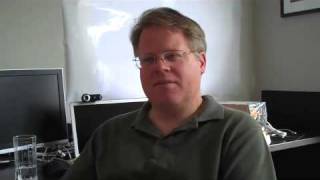
Robert Scoble talks about starting his blog in December 2000 while organizing conferences, his daily news habits using Twitter lists and Techmeme, and memorable experiences like interviewing Doug Engelbart and touring the White House.
All right, we have Robert, the famous, legendary Robert Scoble here for Prickett PR Persuasion blog. Robert has graciously agreed to do an interview here. So I'm just going to ask you a few quick questions and just kind of get a little bit into the brain of Robert Scoble here. So first off, who did you want to be when you grew up as a kid?
I think I got into photography in high school and I always thought, oh, I would want to be a National Geographic photographer or something like that. But I don't know that I ever had any concept of what I was going to do with my life back then. Certainly Apple Computer came out when I was in junior high. And so even at a young age, I knew who and Jobs were and I looked up to them as being part of this new world that was exploding right in front of us every day.
That's awesome. At what point in your career did you realize you wanted to blog professionally? I guess when you started getting paid?
No, it had nothing to do with getting paid, actually.
Oh, really?
In fact, this was 2000, so December 2000. I was actually working as a conference planner and stuff like that. And I was talking with all the speakers for the conference and hiring people like Dave Weiner and stuff. And Dave Weiner and Dorie Smith both said we should have a session on blogging because blogging seems to be getting hot and seems to be something that people are interested in. And I did some Google search and I was like, What? There's only 200 blogs in the world? I couldn't even find that many blogs. It was in the early days of blogging, before all the media coverage started of it and stuff like that. But they convinced me to blog. They said, you're talking to all these people. Why don't you just do a blog and share what you're talking about and how you're planning your conference and stuff like that. And so they convinced me to start a blog and it quickly took off among that crowd. Right.
I think Scobalizer is probably one of the top read blogs out there. It's one of my favorite. And I think absolutely, it reads like you've been in the industry for a long time.
I mean, there are some advantages of going around the world and understanding the press that covers it. Like, you know, in Israel last week I was having dinner with Roy and with Oriel from TechCrunch who cover TechCrunch in Israel and also understanding the companies and the influencers and sort of what the region is good for. You know, what kinds of tech comes out of there because of past influences. And. And then I read incessantly. I'm always reading Twitter and techmeme and other things, actually.
What are your favorite sites? Do you go for information and Twitter.
The first thing in the morning? Twitter, Twitter. Most people are like, what? How would you read that? But I have 20 different lists. I have lists of VCs, company founders, company executives. Companies. Right. So I can see what the press release is from Google and Microsoft.
Oh, right, right.
Amazon were overnight. And I can read all the tech journalists and what they're talking about. That's usually the list I refresh the most during the day because as they cover the news, like, there was a Hotmail thing this morning, and I want to see what they're talking about. What do they think about what was announced after that Tech meme? It gets a lot of my coverage. Then I go over to Google Buzz and go over to Facebook, and that's about it. That keeps you pretty damn busy. I mean, the flow on Twitter alone, just the news. The tech news folder. I have 500 tech news sources, like TechCrunch and BBC and New York Times and Mashable. I mean, 500 sources. That's a lot of sources. And you could just sit on just that one list all day long, refreshing it and watching it, you know, and going off to the various places in the world that it takes you to.
Yep, absolutely. That's. That's awesome. What was. I guess what was the best interview you ever did? Or who was the best interview you ever had, you know, in your illustrious career?
My favorite interview is with Doug Engelbart, and he pulled the first mouse out of a camera box and handed it to me and my son. Should we even touch this thing? This belongs in the Smithsonian. Oh, my God. It's like. That's awesome. Yeah. But he's one of the only people I've really interviewed that is a true visionary. In other words, he sees in his head the way the world will be. Even when he's 82, he's like, 85 now. He's really visionary. He talks to you about a world that will be one day, and he likes living in that world in the future, in the real future, not in his. The fake future that I live in. And he did that. Right. He did the famous demo in 1967 of something that really looked like the Macintosh. And it took the industry 20, about 20 years to ship the Macintosh. And then it took another 10 to make it run. Right. And so he saw a world that we all live in. These computers, the manuing system, the mouse. He all. He described this in 1967 and did a demo of it. And yeah, that's probably the most. I've been in some pretty good situations. I've been on the deck of an aircraft carrier. I've been in the. Had a private tour of the White House. I've spoken to the executive team at l'. Oreal. So I've had some extraordinary experiences and people I've come into contact with. But I look toward Doug Engelbart as still the prototypical visionary.
Great. Now on the flip side, what is the absolute worst interview you've ever.
I saw your question on that. I was like, I don't do bad.
Interviews or the interviewee.
I mean, I don't remember any one that has just been bad. I instantly thought of one at Davos that I did with Bill Gates walking through the hallway. And it was a great interview. But I found out later my audio was not. So that pissed me off because I had a great interview with a guy who everybody knows and here the audio didn't work. But that's what happens.
Tell us one piece of wisdom that your children have imparted on you.
Oh, man, I don't know that they impart wisdom. What they impart is a fresh way of looking at the world. I mean, everything they see is new, right? So they approach it and they like, you know, a baby will pick up a rock and put it in his mouth and try to experience it in a new way because he doesn't know what it's for. And if you watch a kid with an iPad, like my 2 year old son, he'll just keep clicking on buttons. He doesn't even know what they are. He can't speak English yet, but he'll keep clicking on buttons until he sort of learns what it does. So now he knows how to open up the iPad or the iPhone and turn on his favorite game and play his favorite game, Right? And he's learned that iteratively, without any fear of consequences. He's deleted our apps 50,000 times. And normal old people, we don't learn like that because we know there's consequences to deleting icons. You know, first of all, we know a little bit about what it does, but we know that there's consequences to that. And so we're afraid of learning where kids have no sense of consequences. They have no boundaries, no sense of that. They're gonna get sick by sticking a rock in their, in their mouth. And so they approach the world from a new viewpoint. And that's what I like about being around kids. Very cool.
Tell us one piece of advice your parents gave you that you still remember and use in your daily life today.
My dad wanted me to be an engineer, and I tried that for a couple years. I actually got through the second year of calculus and community college before I was in physics class during the 89 earthquake. And my first thought was, big story. And that's when I realized I was passionate about journalism and storytelling and photos and videos and stuff like that, rather than trying to be a scientist or an engineer. Trying to think of. Yeah, Both of my parents worked really hard, and my dad was the first one to go to college. So I think he imparted some sense of, if you work hard, you'll get somewhere, right? You might not know where you're gonna get to, but you're gonna get somewhere. And I remember him telling me, oh, if you were an engineer, you know, you could still work at McDonald's, but you would run the McDonald's, and you probably wouldn't want to run the McDonald's. You would have other opportunities. You would. Opportunities available to you. And I remember him trying. Trying that out on me, and I resisted that. I don't know why, but I had to find my own path.
You seem to be doing pretty well right now.
Yeah, but I think I approached it that way. I worked my ass off. And in school, I still own the record for the most stories written for the college paper in one semester.
And.
And so, yeah, even in journalism, I did approach it from, you work hard, and that gives you opportunity in the future to get somewhere.
More from Robert








45: Sandy Carter Unveils the Future of AI: Myths, Agents, and Creativity | SXSW Insights


