Real technology magic from Marco Tempest
Cyber-illusionist Marco Tempest demonstrates how he builds magic tricks with Kinect sensors, floor projections, and computer vision. He started with a NextCube, now uses PS3 cameras to recognize cards and neural networks for robots. He's open about revealing his tech secrets on YouTube because the real magic is in the psychology of attention and misdirection.
So first of all, who are you?
Okay, so I'm Marco Tempest. I'm a cyber illusionist, which means I combine magic and science to create illusions. And this is my New York City magic lab, where I kind of develop all my stuff. Like. So here, for example.
I came here because I saw you on the TED video and I loved what you did. I was like, wow, that is so cool.
Oh, thank you very much. So here is a Kinect thing, and actually let me show you how this looks like. So everybody is doing stuff with the Kinect and now it actually grabbed your skeleton. So if you want to step in the screen. So this is attaching particles to your hands. So it's. If you move your hands around. Like a superhero. Exactly.
Yeah.
Perfect. So this is something I'm working on. It's going to be a piece about storytelling and magic. And so I'm going to be in this virtual environment and stuff appears and disappears around me. And this is kind of a proof of concept. So here we see yourself. Okay. So here we see the depth image, then the RGB image, the cutout version of the person, which then gets keyed on, and then the. The skeleton tracking, which now just became active, which creates the particles. So this is just kind of a preview of what things might be in a couple of months from now.
So when you say you're a cyberillusionist, for people who haven't seen the TED video, you played with, I think, three iPhones.
Right.
And you did all sorts of magic tricks on the iPhones.
Right. And I can probably set it up for you really quick. It takes a few. A few minutes to start off. So I do. I use ipods and I use video projection and I use augmented reality, which I can show you in just a moment as well. What I try to do is I try to come up with my own tools. So I collaborate with people, mostly out of the open source community, and we create all these tools and some of them I make available for other artists so they can start a little later in the process and kind of get to the poetry first.
And it looks like you've been into traditional magic as well.
Right, right. This is actually from some Japanese TV show where a card in a movie theater appeared in all the movie posters. So it's a little bit corny, but it's kind of a ghost from the past.
What got you into magic?
I started at a super early age, and then in the mid-90s or so I started. I had this idea of using a computer to do magic. And Interact with the computer. And I was very fortunate. It was the time where Steve Jobs actually founded Next Computers. So I made the next wave of magic and they gave me a box, a NextCube, and I started creating stuff and I realized, oh, there's not even video playback on computers back then. There was no quicktime and nothing. So I had an Xcube on stage with a screen and a VHS tape player behind it, which kind of mimicked interaction and touch screens and things like that. And since then, kind of technology has evolved and with it, I tried to evolve with it, and now here we are with touch screens and voice recognition and pattern recognition and face tracking. And so I use all these fun things in my work.
What is magic?
Magic is, well, you could say it's the willing, suspicion, expansion of this belief. So you need an audience who's willing to kind of dive in, into that sense of wonder and believe what they see and take it with a smile and maybe not too much question what's going on in front of them. So it's kind of. It's an interactive thing. It needs an audience willing and a guy who's nice enough to show it to them.
And do you reveal your secrets?
Sometimes I do, like with these technological stuff, because most magicians don't. Right.
That's sort of code of ethics, right?
Yeah, yeah, the code of ethics, absolutely. And I think what's happening now is, and I experiment a lot with YouTube. It's like where maybe for the past like 60 years or so, it was like the content, which was really important. You just had like something, you produced it or overproduced it, put it, put it on tv, and that was fine for your audience. I think right now it's much more contextual. So what you put up there is more a conversation starter. So I put something up and they say, hey, how do you guys like it? And then of course, people will reveal the magic because they can rewind the video as many times as they want, or they can comment and talk to each other. But I think that's somewhat fine. It's like if my content can start a conversation, then that's fine already. Much, much better than just, hey, look at me, how cool I am, or something of that sort. Which is kind of the old model.
Yeah, I always assume that magicians were hackers, but hackers of our pattern recognizing system, our brains are pattern recognition systems.
Right.
We can look at a tree and instantly know it's a tree. The computer has to look at that for several minutes before it really knows.
It's a tree, right? I said, yeah. I was like, I think Edward de Bono argues that our brains are just pattern matching machines. And so the magician kind of leads people down a path and everything looks very similar and everything is very, very ordinary. But there's like a veneer of disguise which covers all these magic things we do when things look very normal. So the laziness of the brain by looking at stuff and looking for similarities helps, helps magicians a lot. But I don't think there is, you know, there's. Right now neuroscience and magic are like kind of have this marriage where magicians pretend to know everything about neuroscience and neuroscientists pretend to know everything about magic. I don't think neuroscience is all that far yet. And I don't think magicians really scientifically know what they're doing. It comes out of experience.
And here's one example. I heard that if your eye is moving from point A to point B, it actually is blind. And that's why magicians try to redirect your attention somewhere while they're doing a sleight of hand trick.
Right?
Because they can do something with their hands. And your, while your eye is moving from here to here, it's, it's a little bit blind, right?
Yeah, absolutely. There's something. And there's also like something we call like big movements cover little movements. So let's say I have to do something and I don't want you to see it while I do this. I just move my hand in a bigger motion and the small movement will disappear. So bigger movements cover small movements. There's something called change blindness. There's some really cool videos online. There's this psychologist in the uk, Richard Weissman, which does all this stuff with invisible gorilla and things changing around him. There's a lot of very cool psychological stuff out there. For people who are interested.
A lot of magic today is performance, right? Because it's, it's, you know, entertaining girls on stage, entertainment, music, flame, fire, you know, all the fun stuff that goes into a great performance.
Right, right. Yeah. I think, you know, it's like, at the end of the day, it is show business. And I think now for magicians these days, it's kind of they have to re situate themselves and see who they want to be because at the end of the day you really want to like this person on stage. So I don't know how likable or mass appeal there is for a guy wearing tails or for, you know, a guy who has a wind machine and a smoke machine and stands there and hits. Strikes a pose. Or how. I think it's like the Internet. Everything becomes more inclusive, more open, more close, so more normal. We stop dressing up and we dress down to reach our audience and engage them.
So how do you start a magic trick? We've seen the TED video, so let's start with that. How did that start? And how did you get to the story that you told in that video?
Well, in the TED video, I made this piece of software which synchronizes videos across multiple screens of mobile devices. And maybe I can start this up really quick. So that was the most fascinating thing I've seen. So the idea was that there's this piece of software which might help artists to create stuff with videos, because playing multiple screens can be very expensive. So the easiest way to do it is have an ipod and connect it to a TV screen. So I created this piece of software. It's called Multivid. It's available for free at the App Store, and people can synchronize videos or use it for presentations. And it does some fancy stuff. It does, like, endpoint behaviors in playlists, so you can have loop things and stuff moves around. So I wanted to show something. I wanted to show how this could be used in a performance environment. So let me start this up really quick. So basically what it is is there's an eye. Can I show these? Yeah, sure. So there's a controller, which just discovered these devices. 1, 2, 3, 4. And I can now start video synchronized on all devices. So they. They pretend to be ipods now, but actually this is a video frame. And here's my little teleprompter, which tells me what comes next. And here's the smiley face, which kind of tells me, chill out, have fun with it. Don't be nervous, because this is kind of. There's a lot of stuff going on. So I can start this. And then it's. It's basically. It's not really set up with all the props, but it's. I can. I can show the beginning. It's a story about deception. So there's very little magic in it. And it starts like this. I can say, well, one of my favorite magicians. Okay, let's do deception. One of my favorite magicians is Carl Germain. He had this wonderful trick where a rose bush would bloom right in front of your eyes. But it was his production of a butterfly that was the most beautiful. And then here, with a little bit of magic, a real butterfly appears in the stage version. So here will be A butterfly which is now invisible. Now, when he was asked about magic and magicians, he said this only honest.
Profession, a magician promises to deceive you. And he does.
And so it continues on and on. So that was kind of an experiment on how to use this and actually to kind of go away from doing a big magic trick. So there are no ipods disappearing or swarms of butterflies or. It's really kind of about the layer of the story of talking about deception and what it means to people and, you know, is lying good or bad? Is there a good way of lying? Or these kind of questions. So like a conversation starter. Yeah. And then of course, I want to have it more technical. So now I made this touch screen thing where when I move the screens around on them, they look cooler. Right. So this is kind of not really sure yet how this will look like. So. So it's just like playing around with visual quality. So this could be a really nice way to kind of accentuate and then maybe have graphics from below. And then maybe there's a projector which projects onto my hand. So there's a.
Now the TED video was just one video all the way through. And it didn't react to your touch or did it?
It didn't react to my touch. It did in the beginning, but then I was so concerned. Concerned with like being a TED with like a gazillion WI FI networks. So I was just worried that I might have communication problems. Like, I kept it simple and kind of mimed through the piece. I can show you something which is very interactive in.
Your hands are very fast. We watched it again last night and you were right on time. So that took some practice.
Yeah, it took a little bit of practice. Let me show you this. So this is kind of the hard.
Work and magic that you don't see on, on stage. Right.
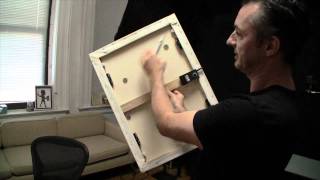
So this is kind of hundreds of hours. This is kind of the opposite of a self working system. So what this does is there's an infrared camera on the floor there with a projector which can track this canvas. So the video image sticks on the canvas. You see, there's a, there's a video image which moves around and also have kind of a screen.
I see.
Yep. And then I can do things like, for example, I can draw on it and then I can like explode whatever I draw into particles and have them go to somewhere happier. That's insane. And it's, it's a little. And there's a drawing system as well. So I can, I can draw something.
You're gonna ruin everybody's TED Talk. That's what you're gonna do.
Look at this. I forgot the floor. So this is kind of a digital storytelling tool. Hello. Hey, come over here. And then it reacts to, like, to do movements and such.
That's awesome.
So this is kind of. It's very modular. Again, it is like a 2D particle engine. You can load objects so they look like holograms and stick to the front when you move the canvas. And you can draw not only free, but also into masks. So here's a little mask I can draw into. And then it has, like, the usual things which magicians love to use. Come over here.
Now, how much of this is you knowing what's coming next and how much of it is.
A lot of it is me knowing what's coming on and then kind of, oh, now he wants. He needs something to stack on. So that's kind of my jump and run platform game. So the secret here is I track in real time so I can move this in real time. But then also there are these infrared LED tracking markers in the back which are battery operated. A remote control, some magnets. So there's kind of the tools of a magician combined with a little bit of science.
You're going to raise the bar for everybody's TED Talk. That's what you're doing.
Thank you.
So we're going to see this at Le Web.
That's definitely going to be part of my talk at Le Web. And at Le Web, I also show a little bit on. On kind of how I deal with the audiences online, like my viewers, how I manage my YouTube channel and kind of the experiments I run online. And there's going to be other stuff. So there's going to be some augmented reality and a little bit about creativity and how to get there and not be overwhelmed.
Very cool.
Really neat.
And you got a stack of awards. What are all these awards over here?
Oh, these are kind of. Some are from magician. So this is. Let me see. That's the World Magic Award for best contemporary magician. That's the Merlin Award. So magicians like to give awards, but then there's also. I dabble a little bit in television. I love graphics design. So I created my own television series and kind of sold it into 60 plus markets. So that's. That's a tally for. For graphic design. There's some for the music and some for the tricks. So these are not really all that hard to get. They're Not Academy Awards.
20 bucks on eBay.
Right.
Congrats. What's this thing?
Yeah, let me show you this. So this is a. I always wanted to do, let me get a fresh deck of cards. And I always wanted to do something where I could do something with playing cards and actually show audience members how it would be if they could have a glimpse into the mind of a magician when he does something as simple as a trick with playing cards. And the way I did this or tried to do this is with this contraption. This is a super inexpensive PlayStation 3 camera. So this project is very much designed so students can kind of do it at home. So it uses some open source software like the OpenCV intel computer vision library. So this is how it works. So here is the real time view. Let's pick a cart and let's mark it so we recognize it when we see it again. And I know you're really big on Google plus, right? Yeah. Okay, so let's put the card into the deck just like this and let's give the cards just a quick cut.
Alright.
So for those who don't play cards, a deck of cards is made of four different. There's hearts, clubs. There's sound with this too, not really diamonds and spades. So we have this like little augmentation of the cards. They get recognized. So performing magic is always about these multiple layers of reality combining. Now each of the, each of the four suits corresponds to one of the four seasons. So there's spring, summer, fall and winter. Now my favorite season is winter because winter is like magic involves visual wonder, drastic change and the delicate balance between its physical states. Now in each of the four suits there's a total of 13 columns and they represent the 13 lunar cycles. So let me see if I can get the lunar cycles going. Total fail, demo fail. Okay, that didn't work.
You get it working by.
Here's one I really, really love. These are the supernatural forces. So you can put three cards down and then there. This is very, very cool because we do background extraction. We cover the background, we photograph the cards, have them fly and then go back to the real cards. There's one which is very cool, which let me go out of sequence so this goes a little quicker. I love this one a lot. And these are the two jokers here. We can actually recognize the jokers and then haven't come alive. Hello, how you doing? Let me see what you got. Oh, oh. A pogo stick. Watch out. Oh no. So this is kind of another storytelling routine which ends with the card which we signed for no reason, very beginning. So the Card appears and disappears throughout the story. And it's about magic and cards.
That's awesome.
Thank you. And then, you know, there's always stuff in my studio which is kind of unfinished. This is a neural net learning robot which can interact really close to humans from this Swiss company which gave it to me. So, so I'm playing with this and kind of creating a routine where he's kind of interacting with me. This is a prototype of a super high speed pro zoomer camera. So I'm working together with another Swiss company which does industrial vision high speed cameras. And we took a little bit of the noise reduction library of the Mars rover and made a noise reduction algorithm for this camera which works really, really well. And now this camera outputs like cinema quality high speed at like a thousand frames. So.
Poor man's.
It's a poor man's Phantom. And I did, I have on my Vimeo channel, I have a bunch of movies I made with this. It's super, super awesome. Gonna be below 10 grands when it finally comes out.
That's awesome because the Phantom is like 200 grams, right? Did you see at Austin C City Limits Music Festival they blew up a water balloon.
Yeah, it's super awesome. Yeah, super awesome. There's a thing inspired by clean rooms. I was re, I was visiting this, this factory where they, where they make these computer chips in these absolute clean rooms where everybody wears like hooded and stuff. So somebody challenged me, said, well, could you do something in a hermetically sealed environment? So this is kind of something I'm working on right now. It uses multiple cameras to show it from every side and then I kind of stick my hand and it makes things disappear and reappear and kind of in a, in a sealed environment. So there's always a lot of stuff which is kind of not really ready, but in the works. Very cool.
Well, thank you so much.
Well, thanks for stopping by.
Well, it's going to be fun seeing you at Le Web and thanks for spending a little bit of time showing.
Us some of the technology and thank you. Where do we find you on the web, Marco? Tempest.com and I tweet a little bit which will be virtual magician.
Are you on Google yet?
I'm on Google, Facebook and Facebook. But like Google seems like it's. I like the quality of discussions going on there. It seems like people say a little more than I'm hungry or I'm, I'm landing in Boston or oh wow, this looks cool. So the engagement is just really, really amazing. I think what's happening on Google, so I think we're all going to eventually.
I told you.
Yeah.
Thank you so much.
Thank you.
Hopefully you don't make me disappear down.
More from Robert








45: Sandy Carter Unveils the Future of AI: Myths, Agents, and Creativity | SXSW Insights


