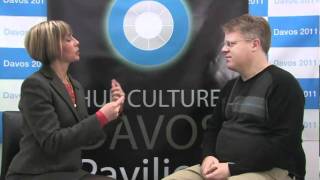
Short interview at the Hub Pavilion in Davos (January 29, 2011) where Edie Lush talks with Robert Scoble about the character of Davos, how technology executives are adapting (iPad, data centers, Microsoft Kinect), the speed of technological and societal change, and the role of social media in events such as the Egypt protests. Scoble emphasizes Davos’s eclectic, high-level attendees, the porous nature of information flow despite government attempts to shut networks, and leaders’ short-term thinking on long-term issues like climate change.
Questions this video answers
January 29, 2011.
The Hub Pavilion in Davos.
Edie Lush (interviewer) and Robert Scoble (interviewee).
I'm Edie Lush and I'm here in the Hub Pavilion in Davos. Very pleased now to be joined by Robert Scoville. We got you to come up the hill. Down the hill.
Great coffee here, too.
Exactly, thanks. I promise for you, I promise, the best coffee in Davos. Right.
You deliver.
Tell me what you think, what you think of Davos.
It's a remarkable event where, you know, I've been to TED and PopTech and all sorts of different conferences, le Web and different conferences in San Francisco, and there's nothing like this that brings in. Like last night at dinner, I was sitting with Peter Gabriel, a guy who owns a huge shipping company, a girl who's writing an opera for the Vienna Opera.
Right.
I mean, just really eclectic, different. But everybody's at the top of their field or is just rich. And usually they don't get invited. If you're just rich, if you just are a trust fund baby, you don't get invited, Right?
Yeah.
You have to actually be doing something and want to do something. And so it's a quite remarkable place. As a journalist, it's like sort of mana. It's a candy store. Well, it's even better than a candy store because a lot of these people you can't get close to. Like, I was hanging out with mark Benioff, the CEO of Salesforce.com and he doesn't have a PR team here because they can't afford to bring everybody. That usually protects him. And so you get to talk with them and meet Bill Clinton and then.
Exactly. It's very difficult to go back to your normal life.
Totally.
So tell me. I mean, you obviously go around the world. You talk to a lot of technology executives. We're at Davos. Technology follows the money, or money follows the technology. I wonder if you could give me your take on that.
Well, in the hallway, I've been interviewing all sorts of different people, and one of them was Hubert Berta, who is one of the top publishing executives or publishers. He's like the Rupert Murdoch of Europe.
Right.
And he got started. Germans are great engineers. He got started in the typesetting business, in the printing business. And that's a German mindset, Right. Building something out of metal, contacts, paper. Great at that. But now he's being pushed into a new world where you deliver the information not through a typesetter, but onto the iPad or onto an Android device. And so he's having to rethink his business and buy new businesses. And that's sort of what he was doing, was figuring out who should I acquire, who should I hire, who, you know, how do I, where do I move my business into the modern world? And that was interesting. You talked to Michael Dell. You know, I met Michael Dell and he's having to react to the same thing, the iPad. You know, you can see it all over the. All these executives have iPads out in just a year. Right. So he's having to react to that and it's interesting to watch him react to that. Dell is a big data center player. So we talked about the future of data centers and what's running behind the scenes. When we go to google.com or eBay or whatever, there's a big data center somewhere and he's doing pretty well on that.
It's interesting because I think when I've talked to people here, there's been a lot, there's been sort of, on the one hand, there's a ton going on. We've got sustainability issues and technology can solve some of these, these issues. And then on the other hand, I've got people coming in saying, yeah, I hear a lot of that. And then I hear let's do a pilot or let's do a study on that or let's, you know, have a discussion about that. How fast do you think, I don't know. When you've been, since you've been covering technology innovation, how fast do you think the sort of rate of change is going? Do you think it's speeding up even a little bit?
Well, the technology rate of change is going, you know, I mean, I mean, look at just the last year. We've got iPad and we got Microsoft Connect, which you use your hands to interact with the computer. And I think that's going to have a bigger change long term on our society than the iPad did. But I've been coming to Dallas for a few years now and they didn't foresee the financial crisis.
Right, right.
We sort of had tremors. You know, people were, two years ago, were talking about or three years ago, we're talking about the financial crisis. Then two years ago it had happened and they reacted and everybody was like, oh, we're still not good at really doing what needs to be done. We all know that global climate change is going to affect massive numbers of people in the next 30, 50 hundred years. Are we really changing a little bit here and there? Yeah, but not the way we will. When our cities are in the water and we have massive dislocations of people that we have to deal with. Then all of a sudden everything will kick in. And so it's frustrating a little bit watching the world leaders, because they're so short term. They think about right now, in the next six months, they really can't get their hands around what it means to invest for 50 or 100 years.
I wonder if you could just touch on maybe the kind of social media scene, which you obviously know a lot about. And it's been an interesting part of Davos. You know, Facebook's doing a ton of stuff. We've got the Twitter stream for, you know, just the hashtag Davos or wef. Like one thing every sort of five seconds. So how do you think. How do you think that's good?
It's one thing. Every second I'm watching 31,000 people on one screen and then I'm watching the Davos hashtag on another. That certainly was interesting last night during, while the Egypt protests were happening, because you could see how everybody here was reacting to it. What was happening around the world, what, all in real time. And it was fantastic. And I had Al Jazeera live streaming on my computer.
Doesn't your head explode?
Well, it's like having a CNN newsroom right on your screen, which is what I wanted for 20 years. That's why I remember being in journalism school and going, I want the associate class on my computer. And now I have it.
Right. And do you think it makes a difference? Do you think it's made a difference, for example, in Egypt? I mean, there's been a bit of discussion about that, but I'd love to get your take.
It has, but Egypt turned off the Internet, so it's hard to really show that it has. But certainly we're seeing real time reports. Even when the Internet shut off, societies are still pretty porous. Al Jazeera was broadcasting live TV right from their window. You can't shut down everything. You know, satellite phones still work, satellite trucks still work. You can't shut it all down. And so news still leaks out. I mean, in China, there's a firewall, right? I carried through China 10 terabytes of hard drives and nobody ever looked. And so it's a pretty porous system and society, you can't stop it anymore. You can try, but I think Egypt made a huge mistake by turning off the Internet. It's like, what keeps all the young people inside playing on the Internet? Oh, let's turn that off and throw them all in the street.
Really stupid, right? Bad move.
Bad move.
Robert, thanks very much for coming into the Hub Pavilion here in Davos. It's been a delight to talk to you. And I'm Edie Lush.