Robert Scoble of Fast Company.tv Interview at NewMediaExpo
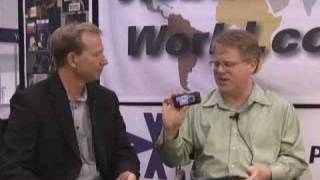
An on-camera interview with Robert Scoble at NewMediaExpo (Aug 2008) where he explains leaving Microsoft to run Fast Company.tv, describes expanded access to influencers (politicians, musicians, architects), and discusses being an early adopter of social platforms (Facebook, Twitter, FriendFeed). He emphasizes opportunities for online video in a 'trillion-channel' search-driven world and recommends keyword-targeting (Google Trends, titles/tags) to reach larger audiences.
Foreign.
Hey, this is Brett Tagi. We're back here at New media Expo, day two. I'm joining Mr. Robert Scoble.
Thank you, thank you for taking time.
Yeah, I haven't seen you since pubcon Boston was a good, good bar crawl now, right? Well, that was one of our smallest pubcons ever right there around Easter. So we'd love to have you back sometime November. Since then you've made some personal big changes. No longer with Microsoft, now managing director of Fast Company tv. How come the big switch?
Well, for Microsoft. Microsoft, I joined a small startup called PodTech and then we ran through the cache. It's like, well, I see how this is going to go. I got to get a real job.
Well, you got a real job for Cherry Gig.
Now I've been real fortunate and been able to get really interesting interviews with a large number of people from politics to technology, mostly technology. But yeah, we just took our show on the road and said where would it fit the best? What brand would help it out the most? Fast Company was one of my favorite brands. I was the columnist for the magazine for a long time, so just made a lot of sense. Sure enough, our access has gone way up to all sorts of fun stuff. We were in Congress for a whole two days meeting all sorts of congressmen and the FCC commissioner and the CEO of the federal or the telecommunications, the Telecommunications and Cable association, all sorts of fun stuff that's just in D.C. on one little trip. Next Monday, we're going to Neil Young's house to study how he wants to really increase the quality of music that we listen to. He said MP3 just isn't good enough anymore. And so we're going to talk to his audio engineer and talk about what it is to make music and what they have in the studio now and how they'd like to deliver that to everybody. And they can't because the machines aren't good enough and the distribution systems aren't good enough.
Well, you seem like you've really refound your passion again since leaving Microsoft, this stuff.
Yeah, I'm a geek. I like talking about tech and I like also studying businesses and studying innovators in business. I just interviewed one of the top architects in the world who designed Staples center in Los Angeles and the Philadelphia, Philadelphia Eagles stadium and all sorts of stadiums all over the world. Meeting guys like that and talking with them, it's just fascinating. You always learn something. Hell, after the cameras were off, we compared iPhone apps and it's always fun to talk to people like that because They've had different experiences than you ever could have, and they see the world a different way. I've never designed a sports stadium. What is that like to design something that takes a billion dollars to build? A lot of fun? Excell.
Well, you know, let's jump ahead a little bit. You played the whole social media thing. I think if nothing else, you are an incredible leading edge. You just have a knack for finding that. What's out there on the leading edge? Social media. You were playing Facebook before anybody else was playing Facebook. Twitter. You've got like a bazillion followers. What are you, 20,000 now or 30,000?
30,000, 31,000, something like that? I don't know.
And there was a bit of controversy last week because you were up around 30,000 and everybody else got capped at 2,000. Us little people, dude.
Hey. Actually, you know, it's when I see something that's getting hot early and I, you know, I mean, I was at the Southwest Southwest Conference. I saw everybody talking about it. That's how I'm early. It's like, you know, go and get as many as your friends to sign up for it as possible, because God knows when they're going to turn it off. I didn't do it for that reason. I was just trying to study how early adopters are using it. So I was following everybody I could who was an early adopter. Same thing right now on Friendfeed. I even put a friendfeed on my phone.
Okay, so FriendFeed is the next thing you're adopting?
Well, FriendFeed is an interesting thing. It's not good enough yet to go mainstream, but it was started by the guy who built Gmail and another guy who built Google Maps and another guy just joined who built Google Talk. So they're getting superstars from Google. That tells me that they're going to do something interesting right there. I visit hundreds of times a day, and it's almost always up. It's very rare. It's down. So that fills in some of the need of having a backup system to Twitter. And it also has a wonderful search engine, which makes sense given that they get superstars from Google, but it's not there yet. It's good enough for geeks like me and you to use it, but my wife signs, she goes, I just don't get it. I don't get what makes me so excited about it. I go, just hang out for a few months and wait for them to come out with a few more things. For instance, I can't Talk to the search engine. Very well. I'd like to talk to and say, pull me out every item that talks about podcasting that has two or more likes likes or little votes for something. There's Leo and you can't do that. So it's really frustrating. That's the bad part of being an early adopter is you hit the edges of things very quickly and you know where the edges are. And then when you see the edges move out a little bit, then you know, oh, the mainstream is ready. It's ready to go.
Bigger presentation today or your talk, I don't want to call it a presentation because you don't use PowerPoint anymore. In fact, that was one of the funniest things you said, was you won't use PowerPoint anymore. One thing he did say, though, is that we're pretty much on the leading edge of stuff here with video today. Not necessarily podcasting, but video, definitely. What's next? Just more expansion or is there going to be a tipping point here pretty soon? Are we still on the upward climb?
I think we're still on the upward climb because it's a trillion channel world by that, it's Google world, right? Like I said in my talk, most people understand only one thing about their computer. How to type into that search box. They don't understand what a file system is or what a database is or how to even install apps. Right? They don't know how to install apps anymore. They know that search box. That's all they know. So if you're in that search box and they're searching for things, it's very rare that there's video on that page. So that tells me that there's a lot of opportunity still to develop that video for this trillion channel world.
Until.
It even becomes competitive, Right. And until you have to start worrying about, oh, I'm starting to see two or three videos on each page, you know, and then you have to worry about being good, right? Because only the best one will be on the top.
Well, the interesting thing you talked about was keyword targeting. I mean, keyword targeting on video through Google Trends, that's actually fairly revolutionary.
Still today, I was really surprised that only about two thirds of the audience that even used that tool or even considered how people use Google to find their content, right? So if you don't understand that, then you're probably not going to do a good title tag on your webpage. You're probably not going to write about content that could hit an audience. You might be writing about something that's interesting. But if you just switch the content a little bit, it would be a huge audience. Right.
A little bit of optimization there.
Yeah. It's like Gary Vaynerchuk was saying, well, the way to get into the wine business now is to do a blog about Chardonnay. Well, you might use a tool like that to see which varietal is actually the biggest audience. Right. You might find out by using that tool that nobody's searching for Chardonnay, but everybody's searching for Merlot. So pick Merlot, don't pick Chardonnay. But you wouldn't know that if you didn't use a tool like that to understand how people are searching. How will people are behaving on the Internet?
Right.
Right.
Well, we are just about out of YouTube. Thank you for joining us. Thank you.
More from Robert








45: Sandy Carter Unveils the Future of AI: Myths, Agents, and Creativity | SXSW Insights


