Spatial Computing Catalyst #13: Computing History in the DigiBarn - Part I
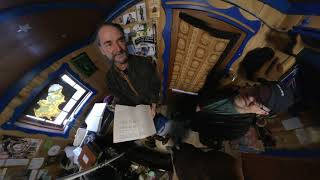
Dr. Bruce Damer and Carlos tour the DigiBarn, showing Engelbart's original 1967 mouse, an Altair 8800 serial #16 from March 1975, and early Apple DOS documents. Damer discusses his wet-dry cycling hypothesis for life's origins and his work on Mars 2020 landing sites.
Questions this video answers
1967 (SRI).
4-10-78; listed price $13,000 (1978 dollars).
Serial number 16; sent in March 1975.
About 3 billion years old.
About 4.6 billion years old.
About to see here.
This is some of the Digibarn collection. And this is a mouse from Doug Engelbart's group that was part of NLS. Yeah, at SRI in 67. So that's NLS in its early rendition.
I have a Doug Engelbart story.
You do?
Yeah. We were over his house. All good stories happen. And he goes into his bedroom and pulls out a Nikon 50F1.4 box, sits it on the table and he pulls the original mouse out of the box. Like not. Not the prototypes. Yeah, sorry, not the prototype, but the real one. I'm like, what the fuck is this doing in your house, man? This is like a natural.
This is.
No, this one's not just in a museum in Smithsonian, right? And now it is.
So they made about a dozen for nls. And this is one that had a matching key set for the cording cord. Key set, yeah. And this was connected to what was called the line sequencer. So they added later cabling. But that's an original Bill English. So Bill English, I brought this over to him once and he. He typed 24 words a minute on this keyset. But that's. That's measured so that it's his forearm length going in platen, you know, for the nls. And then there's some more here. So there's a lot more in the barn.
One thing I think about this camera.
Yes.
People are going to be in view headsets soon inside this camera, right. So they're going to be able to watch this video and be here and see what you're showing us.
So this is actually one of the original Cray books from Friedlander, who's a famous Depression photographer who photographed Americans at work. So it was a. There's only a few of these, but this was his documentation of Chippewa Falls was Scottish, where the Cray one was made. And it's interesting because this is Chippewa Falls, standard American town in the late 70s, right? And then it says it's funny. And it has the highest tech company in the world. There's Seymour Cray and the residents of Chippewa Falls making the world's most advanced computer at the time, the Cray one.
In this case, when Apple bought their first Cray, it was on the front page of the Mercury newspaper.
And so I have two Crays in the barn. I have a Cray one and the prototype of the Cray two. So that's the Cray book. And then this. This is extraordinary. So this was so in the mail when I Was in the middle of my PhD came this set of documents and I didn't know what they were. I didn't even open them up for the first few months. And then I realized when I did open them, this is the Shep DOS for the Apple ii.
So explain what that is. People don't remember Apple II days, right.
This is an order form for the Apple ii. Advance order information from the Byte Shop from Apple on Welch Road. So this is their first marketing literature really written by Steve Jobs. And then the problem that they had in the first year is that it was only a cassette interface for the Apple ii, which was unreliable and it's crap. And so Steve needed a real operating system for floppy disks fast and no one could write it. There were five people in the company. And so down the hall in the building at Welch Road was Shepherdson Microsystems. And there was a guy there named Bill Shepherdson and he had an incredibly good microcoder crack guy named Paul Lawton. And they sat in the booth at the Good Earth restaurant and made a deal that Paul would write the OS for the Apple II. So Steve came by his office and put 2024K into his Apple II and then he started writing it. And this is the system.
By the way, I noticed you said K, not megabytes, not gigabytes.
Here's the order for it. 4-10-78, Apple II operating system file manager, basic Interface Utilities for $13,000 in $1976. $78.
$1978.
That's the system contract. And legal people love that because like that's it, that's the system contract. Wow. And then this is all the rest of the correspondence. So Paul was, Paul sent me this. He didn't know what to do with it, so he said you want it? And so here's like Apple dos modifications by 620, 1978, $1500. And this is the change orders for changes to the os. There's a letter to, there's letters to Woz. And then here's the text back from Bandley Drive. Yeah. So here's. And that's when they went from Welch to Banbley Drive. So here's, this is.
Paul's writing was his garage or his parents garage?
No, it's just another office. And this is Woz's handwriting. So what Woz did was he had created the floppy controller working with Bill Fernandez over customs of 77. And they had cranked it out but they couldn't write nos. So when Paul came into the project. This is the boot sector for the Apple II floppy. And this is Fernandez's chip design. For this is Fernandez's layout, Woz's layout. 11378, January 78 for the board. And so there's the board which ran two floppies, two floppies in one. So sector map timing and had to write company.
That was a great day because no.
More loading for this. And this is the handwritten boot code. Actually this is the boot code for it. And then here's the actual code. So this is the actual listings of the Apple II dos. So this is how Apple.
I notice it's sitting on top of an Altair.
Yeah, I've got everything, believe me. So that's the symbol table. So this was built based upon IBM design principles, which is kind of ironic, but Paul was a brilliant Shep appledoss. Paul was a brilliant software engineer. And this has just bursted. So this was written on a National Semiconductor machine, punched out onto paper tape and then loaded into the Apple II with a custom interface. They didn't have a floppy, so then it had to be written to the floppy so then they could load it from the floppy to see if it would run in the Apple ii. And it's full of his comments too. So we did a restoration in 2013 on this whole thing, working with the Computer History Museum and we got it. They hand typed this thing in and then they assembled it and it booted a real Apple ii. And then they disassembled the delivered code, which is that to compare it line for line, and put Paul's comments back in to restore the original comments to the shipping version. It was just crazy. It was like a really nerdy project, right? And then me and Woz and Mike Markula. You know who Mike Markula is, right? First investor, right? Most powerful guy in the Valley. For many years he worked with Len Shustak. So this is what we did. So Steve. Steve was gone. It had taken two years to get the Mac paint source code released just for public, for historians. And we didn't want that to happen. So one day I had Woz write an email to general Counsel Bruce Sewell. I don't know if you know these names, but a little bit at 11:20am where we knew he was sitting in front of his Mac and then Markkle wrote an email that came in like 30 seconds later to get it. So basically Seawell looked at that and thought it was an order. So he turned around and he wrote the release for this like right there himself. He didn't send it to his department his group. And after lunch we got the release. So we said we wanted this for historical purposes, a release to the public domain. And we did it. And when we met we liked the high five because to get that through Apple legal that was what we needed. The chairman of the board writing and was writing at the same time hitting him at that time he wrote the release himself. So it was like a high five moment. So this code got released so that people could study it. VisiCalc was based on this, the first successful word process, everything. And so by having this code we could actually look at what Frankston did to get VisiCalc to run. Because it was released in October of 79 and it was a. It made the Apple II into a business thing, right? It was a revolution. So that's the Apple dos. So that's how Apple booted up.
That's the beginning of Apple right there in a folder.
It is amazing because they would have died on the vine as usual. They had a beautiful machine and they had incomplete manufacturing and support.
I know.
You know.
Do you know what I did around that time? I built Apple II for my mom because they ran out of manufacturing and was hired Hildy Licht to build the boards. And my mom worked for Hildy Licht.
Oh my God.
And was told me that those boards were built better than the factory built on. You know, I got paid allowance to load the boards.
I have, I have. I'll show you some other stuff. So this is a fully loaded Altair 800 with signed by many of the Homebrew members. This is serial number 16 unassembled that we were given in the box. It was never taken out of the box since it was sent in 1975, March of 75. So that's the oldest Altair that's in existence. And this is fully loaded and we use that to play fool on the hill and stuff. So you know, it was. We use it for demos, for events, for restoration event.
For people who don't know who you are, as I doubt very much, very.
Many people around the world who watch.
This video will know who you are.
Who are you? I'm Dr. Bruce Damer and I'm a scientist and collector, geek and author. And I work on origin of Life. I work on spacecraft design. There's some of the spacecraft innovations there. Done 20 years of work for NASA. I've come up with a new model hypothesis for how life began on Earth which is now spreading around the world based on operating system bootstrap principles based on that. So I went into the science of origin of life and applied computing complexity theory. Bootstrap. To put it together with Dave Deamer from ucsc.
How did we all start?
How we all started exactly.
How did we.
Wet dry cycling of hot spring pools with meteoritic infall. I can show you the stromatolites to prove it created protocells out of the membranes that were in solution that were compressing down during the dry bathtub film and making polymers out of the monomers. And then they would bud off and you get trillions of them. It's a combinatorial system and it selects the ones that stabilize their protocell. And we now have done it in the lab for years and we've done it in hot springs.
So we started in something like Yellowstone.
Yes, Jacuzzi. Yeah, exactly. We started not in the oceans because you just thermodynamically uphill. You can't get polymers to form an ocean environment.
But you needed an asteroid to come and hit that little pool.
Yeah, you need. During the early Earth and I can show you this stuff, but during the early Earth there was a huge protoplanetary disk that was very dusty. And the Earth was vacuuming material up and concentrating it in huge amounts of organics. Some of the asteroids we'll go after will be packed because we're going to turn them into biospheres so people can feed in space.
We should tell people that you're planning a company to mine asteroids, man.
Asteroids and satellite servicing open the solar system. Because none of these guys, like Elon and whatnot have a hope of doing what they want to do. If they don't have fueling stations everywhere, they need refueling. They need gas, mineral extraction and asteroids. You can't throw cables around them or bolt things onto them. They're dangerous friable rubble piles. But you can put an atmosphere around them in a helium balloon enclosure, manage them, move them, extract from them, chemically alter them. It's the way to do it. It's making small worlds. So it allows in a sense Gaia to reproduce. The biosphere has a future path. If it starts dividing. That's what we're for. We're the divisionary reproductive organs. Otherwise we're just eating hamburgers and publishing fake news or something. What else are we good for? But if we can allow, we're good at that. And that's all part of probably the division process. So I've got samples of 3.5 billion year old stromatolites over here.
Why don't you come on over here.
This Is what Carlos wanted to get a selfie with. This is one of my ancestors. It was a sea captain in the 1600s sitting next to. So this is what I picked up in Australia with this camera.
You don't need a selfie, by the way.
Oh, yeah, right. It's 360 degrees. Yeah.
So what does it say you're holding?
Carlos can hold it. So that's a 3 billion year old chunk of rock that's made by the laying down of microbial mats on a lakeshore 3 billion years ago. It's called a stromatolite and it's the oldest evidence for life on earth. And then in this little vial here. That one is awesome. This one is mind bending. Yeah. So this is an extract. You see that little bit on the bottom of the Murray meteorite, which is 4.6 billion years old, fell on the Earth. It's a carbonaceous chondrite. It's crammed with organics. It was what was feeding the system. If you smell it. Wow.
That's a very different smell than I've ever smelled before.
Yeah, it's a very deep smoky. That's 5 billion years of depth.
It's like a rock. Metallic smell. Old, dusty.
And that's your fault. You're smelling polycyclic aromatic hydrocarbons which break down into all these building blocks. And you're smelling amino acids and fat. You can see the fatty acid membranes on the side. So that's the building blocks of life. You just smell the most vintage perfume that you'll probably ever get to smell in your life. Because this was preserved for 4.6. It's older than Earth. Earth formed about 4.57 billion years ago. And this is older. And so that's. There's a number of other things. That's Mars 2020, which I'm the landing site.
I was just seeing them put that together last week.
You were? Yeah, I was on the third landing site committee group. For that we could take our, our landing site. So now there's more. I mean there's. There's stuff down in the barn. There's whole collections of.
Yeah, we'll go down there. Yeah, absolutely. Let me just stop this for now.
More from Robert








45: Sandy Carter Unveils the Future of AI: Myths, Agents, and Creativity | SXSW Insights


