Spatial Computing Catalyst #14: Computing History in the DigiBarn - Part II
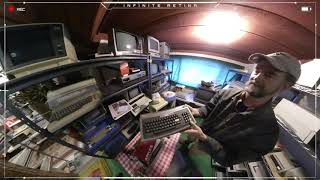
Fred Turner and Ryan walk through the DigiBarn's collection of computing history, from Xerox Alto workstations and early Ethernet to Apple prototypes and a 1972 Intel 8008 machine. They trace how ARPANET became the internet, how Xerox PARC shaped the Macintosh, and how counterculture and LSD influenced Silicon Valley's creative output.
Foreign.
We're about to see something very special.
Going to go upstairs.
Why is there.
And that's an old Wang computer. But we're going to go up to where there's more display.
Do you guys have an old Mac?
He has way older than a Mac.
But does he have an old Mac?
Keep going. Milan. Hurry. Come on. All right.
Look at all the shirts.
And my Alto computer is out on repair as we're trying to reboot it. But this is the computer that originally premiered Windows and icons.
Does this actually work?
That one does. So these are made by a company called Xerox and they invented the whole thing where you had a window and menus and trash bins and folders and networks and email. And then the world sort of took it all and put it into other computers. And then that's a network of Xerox Daybreak 685. This is the last generation of what you would call workstations. Steve Jobs Next Cube designed by Hartmut Esslinger who came here a couple years ago with his son. So this is a kind of computer called a workstation which no longer exists. Expensive etc. And the Alto. So this is Xerox Part ARC artifacts.
Here's a trivia question. Where is the next that the Web was invented on?
Probably in the Computer History Museum.
Nope.
No idea. Is that CERN was at cern?
Oh, I have Tim Berners Lee worked at cern.
I have Tim Berners Lee's modem. So this is the Internet or the Arpanet physical and virtual models in 1977.
So you should explain what Arpanet is.
So Arpanet is the predecessor to the Internet. Developed with government funds, built and executed brilliantly that then opened up later became what we now know as the Internet. The architecture was partially designed based on the Link which is a computer I have downstairs from 1962. It's the oldest working machine in the collection. But so the arpanet. This is some of the original Xerox media. This is Alan Kay's personal Dynamic Media Group with this is the Alto computer screens. And the Alto is being restored. But this is graphics and programming of languages. A visual interface that Steve jobs saw and Waz saw at park in 1979 which led to the Mac and Lisa projects. So this is the original Macintosh business plan. One of the most famous unknown business plans in history.
Brian, you want to see the original Macintosh business plan right here in his hand.
So this was written at Xerox PARC on an Alto because Steve. Steve wanted the Mac Businessman to look like the Alto computer with pull down menus. So they drew out the pages of the plan to look graphical like the computer they were going to make, which was basically stolen from Xerox. So this is the market segments, here's the competitors and they don't even know what IBM Chess is. But that's the IBM PC which is about to be launched. It became their bane. And here's the product comparisons. Now this is all laid out in the paint program on the Alto. So here's the Mac to be introduced in 82 for $1,500. We know that didn't happen. So these, this is the.
I think I saw this one in the other room.
Yeah, that's an Apple II. And there's a screen resolution comparisons. And this is like a rare document. This is the business plan for the 80s.
How many of these exist?
One. Daniel. This is a copy of Daniel's original. And Johanna Hoffman who wrote this on the Alto. Look at this. Will announce no Apple before its time. Orson Welles, famous drunk. But Johanna Hoffman wrote this.
That was the slogan for Palmessan Winery which was in Saratoga real near Apple.
Yes, exactly. So anyway, this is all Xerox Alto. That's original. It's an original machine from parc. This is the original Ethernet connection from Dave Boggs who is the co. Holder of the patent on Ethernet. So this led to the fundamental, you know, architecture first along with another important box which is the last time I had a ride in a.
There's a, a piece of that original cable still in the wall in the copy room down at Park.
There is. There should be. This was ripped out of the wall for me or the ceiling by friends at park, but it's related to this. And this is one of the only surviving packet radios from sri. So this was where the first time digital information went through the air. And it was in a bread van, a step van driving on Skyline with towers. And this was in the van and it was pictured picking up packets.
So this is like a WI FI radio and today it's smaller than a grain of sand on your iPhone.
So this became the Ethernet because PARC took the idea of the ether, which is random retry. So you find an empty spot and then no pet tokens or anything. But from the history of SRI written by, by Don Nielsen. This is a book about sri's history. And anyway, this talks about Diango Bart and everything and that project of course, but sri's incredible history, right as an innovator. Here's the Arpanet itself. So there's the ARPANET itself. You know how they. And they created the bank card system that bank of America used to.
A lot of things at sri. Yeah, hdtv, the Internet.
Yeah, Amazing. So this room begat this room which is. This is the early mid-70s. This is cool. Into this project which was. So because of the notoriety of this collection and the number of documentaries that have been made here, including William Shatner beamed me into the Cray for a documentary, people kept getting in touch. And one guy one day got in touch and said, I think we made the first microcomputer. So all these people making claims that they made the first Ken back people, of course those Altairs are clear. But who made microcomputers before the Altair? And I said, yeah, you and everyone else claims this. But then the guy called back and said we found it, do you want it? And brought it down. Surely enough. Woz checked this out and Leif Elsenstein checked this out as well. This was a project, we're not even sure it was either at Cal State Sacramento or in Oregon, in Beaverton, Oregon to figure out how to get a microprocessor. And this is a first run rev0 Intel 8008 from 1972.
Yep.
Right.
8088.
8008 oh, 8000, yeah. So this is well before the 8080. Yeah, because the 8080 was in the future. This was. Was made for a calculator project that was cancelled and they didn't know what to do with these things. And they're microprocessors, they're 8 bit microprocessors. So this team put it into boards engineered by Tektronics which made terminals. They built a card cage. This is it here. And a control panel on the side. And they managed to make a microcomputer in 1972. And the code for it is here. It's right in this board here. These are 1702 eProms. We put gaffer tape on them to protect the code and we dumped them one after the other. We got the code out of them and it's. It's an operating system they called the DOS for this machine. And here's the bus, look. And there were 13 other cars. This is basically the modem to connect to the mainframe in 73. This was running thousands of patient medical records, plotting color plots on the Tektronics. And it was a functional microcomputer that they used to debug this and told intel how to make a better microprocessor. Called the 8080, which was the workhorse of the computing revolution. But the predecessor came right from this machine here.
Is this the only Apple device you have in here that's old?
Well, no, there's quite a few here. But this one signed by Woz, there's one that's serial number 400, signed by Woz. But this is that card from those documents in my office.
So, Ryan, that was my first computer. I was older than you.
So is this the Apple 2, the Apple II? Yep. And this is a hat from the Macintosh team from Daniel Kotke.
Daniel was the first employee.
Yep. And here's. I actually have part of his Levi jeans from when he was working in the garage. He would sit on the bench. But this is here typical Apple ad. And here, this is something quite important that you'd like. So this is the famous Apple Red book, which was all the notes. There was no technical manual for the Apple II when it came out. This is typical, right? This is nothing. So basically they went into Woz's filing cabinet and they took out all of his notes and they hand transcribed everything. And this is the original file, the only surviving copy of Woz's notes for the Apple II that turned into the Red book. So this is Woz, they called this the Woz Wonder Book. And it's everything. It's hand typed stuff, it's code, it's hand drawn stuff. And we restored this. So we got this scanned guy in New Mexico did all this work on this. And then I presented this back to Woz and he burst into tears because there were things in there that he hadn't seen in 30 years. And then we released it under Creative Commons for the world. So this is another great restoration project around Apple and Woz. It's all on the dvd. Woz was thrilled. And then this is all competing machines. The Trash 80, Model 1.
Was it called the Trash 80 because it's trash?
No, in high school we used to.
Joke about that because it's Tandy Radio Shack TRS. So this is the TRS 80. So we call it Trash 80. But this was from 1977 and this was really successful as a computer. You had them in high school? I had them in high school. And there was also the Commodore 64, which was the most successful computer in the world by the numbers, by the units sold, CAD built in basic. And there's a video display and there's the inside. There's a Commodore PET that had built in cassette storage, Weird graphical keyboard. Jesus.
Hey, my First, Apple II didn't have disk drives like that.
It had the cassette. Yeah, and that was the problem that was killing me.
I only found two Apple things, one in this room and one in that room.
There's a bunch.
There's a bunch.
Oh, and here's a famous one. The Atari 400 with Space Invaders and Pong, the original Pong. This plays Pong on this TV. You can play four games from 76. There's doubles. Pong from Sears, sold by Sears. But this was designed for kids like you. So the engineers were like, okay, this 14 year old, 13 year old, 12 year old boys, they're going to jump on their beds and this is going to be on the bed and it's going to jump up and fall on the floor. So it's got to survive that. So then they're going to pour a whole can of Coke on it by mistake. So the keyboard is a membrane keyboard. So this thing could survive a thermonuclear war because it could survive you. It could survive a thermonuclear war. So that's the Atari 400.
So if I pick it up and I try to like break it, could it survive?
It's got an aluminum case. They knew their market, they didn't want all those service calls. So after the 70s, this is all the 70s. This is the famous Sol Terminal computer designed by Leif Elsenstein before Apple. Right. So this sold 10,000 units with this nice maple sides.
And people forget that there were lots of competitors in the personal computing space.
Yeah, Challenger. There's the Ohio Scientific.
The automatic winner.
Much like there are many potential competitors today for spatial computing. Right. We see the big guys and then we see a lot of small companies coming. The Adam family computer, the. Yeah, that's Atari. And then the big monster came the IBM PC in 1981, which was code named IBM Chess.
So that's why it got a gold medal.
Well, it got a gold medal. What does that say? Some belt buckle.
I remember when that came out, I was in high school and Apple bought an ad and the newspaper, the New York Times and whatnot, and said, welcome to the personal computer age.
Right? Welcome, man.
Yeah, welcome.
From 83, the computer.
I'm sure they were very afraid of what that was going to do.
This is 1983. This is their vision of a futuristic computer. More of a flat screen. And of course this guy's going to need serious body work. All the people saying, oh my God, there's people with bad postures.
I think this guy needs some Plastic surgery.
He needs. Yeah, he needs to.
Actually, you know what company this cost? Microsoft.
So then all of the computers, you know the Microsoft story.
The DOS story.
Yeah. Oh yeah. I have the original machine that was written for downstairs the Seattle computer products. So this. All computers had to be beige because of the steel case. So it became. I called the beige invasion. Yeah. And everyone was trying to emulate, emulate that. And so then we roll into the 80s. Rolling into the 80s. We've already been watching to make sure.
They don't, don't touch anything. This stuff is Smithsonian worthy.
So actually in the 80s is when I got into it and I wrote an operating system. This is my operating system that I wrote in the mid to late 80s. Complete windows and icons, everything from scratch in c, running on 640k. And then Xerox sold this worldwide. So that's how I got into the. This is the product. This is before Windows so there was no Windows. So we had to write our own windowing system. And this was used by IRS and the US Navy and the Paris Metro.
And precursor to what Steve's Park.
It was about this. It was later because the Mac had come out, but companies did not use Macs. They used PCs in the huge numbers. So we put a high res screen. Got it. I wrote this entire system and that's what it looked like on a T shirt. And this was E Commerce before the web. So this is 87, 88, 89. And basically when you called Schwab and they sent a stock trade, they sent you a form that had data on it, came off a laser printer in the mail. So this is the way that E commerce was done. And we were kind of in that gap. And so that was my work.
Is this amazing in one lifetime how far humans have come with their tools.
And then in the 90s I helped pioneer the avatar medium. The first 3D worlds on the Internet after the crash of VR in about 93 years, which crashed because there's been.
Like five of them.
It's another one now, I guess. But this is when first crash.
Can you go see what Lauren's doing? I just want to make sure you.
So this is 3D worlds on screens on PCs equivalent to going from Edison's Kinetoscope to cinema. Right. I got all the whole community together and held the first conference on this and catalyzed this. What became World of Warcraft and Second Life came out of this. This is from 96, 97. It's the first book about how to do something other than clicking on Web pages, which I didn't think was very interesting. And this is where leading into the work with Carlos. This is from work with NASA. In 2007, I did design work and one of the projects was to push NASA change NASA's direction. So what we did was with the teams on the inside and the outside, we designed how to take humans to the surface of an asteroid. In 2007, I pushed it out to the media out of an embargo state. You know how that works. July 31, 2007, all this came out of embargo and we had worked even with people in the public affairs and I helped them do the study of reference design for this hardware to take a crew to the surface of an asteroid. You can see it there. So you've got airbags, you've got a piece of station, you have Orion, which they're still freaking trying to build. And this would be the reference mission because no one had ever done a study. I'd studied NASA's history and in 63 they were designing the Apollo architecture. And I got to do this, I got to design the system. It was likely that if we did a human mission, it would look like this because I'd already done 25 projects for them. I'd modeled everything already 3D and simulations and stuff. So that was NASA's new target. It wasn't NASA's new target. It was our idea to make it NASA's new target. So when Obama was elected, they switched to asteroids as a target for exploration. That's why I have Osiris, Rex and things now. Then in 2014 with the asteroid redirect mission, we tried to catch them on the rebound to sell shepherd because we then came up with shepherd but missed it because they chose a boulder plucking solution. But it was interesting to steer the agency in a direction, wait, and then they're coming towards you and try to capture them like an asteroid. But that's where it started this audacious. And I did it under the direction of Pete Worden, who was our two star general. I said, pete, what trouble can I get in? He said, you can't get in any trouble at all. You're not a civil servant. You can't get fired. Because he'd been fired from the Air Force. You can't get fired. Okay, I'll do it. So who do we work with on the inside? Dave Morrison. We work with Public affairs, we work with the administrator himself. You do all this and then when you do your public talk. I did it at Industrial Light and magic at ilm. ILM in their auditorium, which is where.
Star wars was created.
Right. And outside there was Darth Vader in a glass case. And I called Pete and I said, I'm standing next to your namesake because they called him Darth Vader because he was the head of Air Force, Space Force, basically. Now I said, I'm calling you right next to Darth Vader. We've just done it. We've just put it out to all the animators at ilm and then we did a big public talk and had big graphics of this. And it was like, oh, it's NASA's new direction. Because we knew that there wouldn't be anyone to counter it, so we could steer them.
When was this?
2007.
2007 years ago.
So more computing. Here's the birth of desktop publishing. Adobe's launch. This is really nice because it's signed by Chuck Geske and John Warnock Inside the publishing revolution, where it started at PARC and then it grew out.
Warnock created the page description language there, right?
Yeah. It was an amazing bunch of work. And Xerox didn't of course, understand it. So the CEO of Xerox at the time actually told John, john, if you're so excited about this, why don't you leave Xerox and start your own company? That was Peter McCullough. John told me this. And he ran, didn't walk. He ran down the hall to Chuck's office and said, we're free. So they took the InterPress work and the work on scalable types and the page description language out and they made a RIP because they were just going to supply print shops. RIP stands for raster Image Processor. And then one day Steve Jobs showed up with this crazy thing, with this crazy thing and a Canon laser writer and say, can we get a page out on this Canon laser writer? Because we can't. This isn't going to be fast enough. Can you guys build the thing in between this and use your language? And they did it.
And people. That was a $4,900 printer, right.
It was expensive, but it sold shitloads.
Yeah, but people back then didn't think that a $5,000 printer would ever sell.
Right?
But people like me bought them for our.
And the thing was you bought it to write, to print to the Linotronic 300 plate maker. So what would happen is a guy would show up in a van with this, the Canon and PageMaker, and show them how they could do out to plate to production in one shot. And there was $35,000 for this package. And they would just write the check right there. How much is this? This will change my. Revolutionize my business.
Totally change my world.
Changed your rock your world, right?
It totally changed my world. I was at West Valley when we switched from older printmaking techniques to the Macintosh. And we did it at San Jose State in 91.
The Linotronic. Let's see if they could get out to linotronic because they could go into production.
The fonts were created by Adobe and then Microsoft. Hill, who was my first interview at Microsoft. Microsoft created font smoothing that he hid data in the red and the green fringes around letters.
Yeah, that's called. Exactly. It was called smoothing. Right. Now, these are portable systems. They got wet because we had a leaky roof. But this is earlier stuff. This is a comptometer from 1913. It has a hand crank that you crank. So all computing was electric, mechanical and electromechanical, mostly until 1970. And here's a beautiful example, the Curta 1960.
Have you seen the interlocker machine at Santa Clara Railyard?
No. That's a computing device.
You should go and see the numbers still in the rail yard today. And thousands of people go buy it every day. And they don't realize it's one of the oldest computers in Silicon Valley. And it's a mechanical machine. If you pull a slide out, it's an if, then else statement.
Right? Right, right.
If this is pulled out, then switch the track or else we're going to crash the train.
Right, Right.
So it was made for the railroads.
Once you set the numbers. Once you set the numbers, watch what happens when you receive this. It adds them up because that's called a register. And you crank it and it does an add operation. Designed by a concentration camp survivor in his head in World War II and made in Liechtenstein, the Kurda, one of the smallest countries in the world. This is the only thing you ever made in Liechtenstein other than cheese. And companies. And companies. Companies.
You can't make anything with this.
Well, you can add and multiply.
Yeah. Do you know how your grandpa added and multiplied in college on his first jobs? With a slide rule. Do you have any slide rules?
There's a bunch of them down there.
A bunch of slide rules down there.
And then this.
It's the same number because they sent it the 000. So it's always the same number.
That's it. Yeah, because nothing will get added. This is the wonderful transition between chips and core memory. So this is a Data General Nova 1972. And this is a 16K core mattress of donuts that are wire.
So using terms that nobody even knows. Ryan, can you listen, please? Core memory. Memory used to be little donuts of iron, right?
Yep. Little wires that way, that way and this way. There's one. That's reed one.
So this is really small, Little tiny.
Donuts on a board seam with a magnifying glass.
Yeah. This camera won't show them, but if.
You looked at them close, that's called a core mattress. And these were hand created in Japan. And so this is non volatile memory, 1972, supported by chips. Because chips were not being used for memory yet. They just weren't dense enough because this is all low scale integration, lsi. And so there's a whole bunch of different core generations.
How old is this?
72.
72 is when we started going from.
This, from this to the chip memories, which were really low.
That's what's really interesting when you get a tour. Woz gave me a tour around the computer history museum. And you see, he really walked us around his childhood and he said, this was when I was nine years old.
He comes here all the time and we boot machines up and run code, custom code that he wrote because we have all of his code. And he provided a lot of stuff here. He provided like hand drawn stuff, the Twiggy drive. But he came here usually once a year and the documentaries would want to shoot him here because we'd have it all set up and all the documents out and he would do his thing.
This is the real deal.
This is from the bezin. This is a Soviet computer. So the Russian guys would keep coming here and they brought the Soviet chips and stuff from the Soviet Union was trying to keep up with us and just getting farther and farther behind. But they still built the rockets in ours.
Well, my dad built military satellites and he said the reason that their rockets were better is nothing on their rockets lasted, so they had to send a lot more up. And they got really good at sending rockets up.
And they didn't use digital stuff. It was all incredibly reliable mechanical stuff. So this is the HB45 original employee edition for only $400. It's.
Is this what Steve Jobs sold to help fund the beginnings of Apple?
Yeah. So Woz worked on the display controller for this when he was working at hp and he didn't want to leave. Right. It was the best company in the world. Why would he leave to go to a dumb startup? And so, yeah, this is Woz's Original work at hp. Here's a slide rule. This is a Sigma siren. So this is what we went the moon on. We went to the moon on this.
So how does this work? Because I haven't had a good lesson on.
I haven't had a lesson in forever. But the world's greatest aircraft and spacecraft were made on this. Yeah. With drafting paper. No computing, no cab.
How do you restart the number on this?
There's a reset button. And this is one of the earliest meetings about computation. 1949. So this is as they were thinking. This is IBM hosted a meeting because IBM wasn't in computers yet, they were in tabulators. Right. They hit one launch, the first one. And we said, well, we've got the Altair, which is named after solar system in Star Trek. But we have this Cray one, which is designed by Seymour Cray, who is a Trekkie. It looks like a piece of Star Trek. It looks like the warp core connected with the transporter. And so this is serial number 38 from Lawrence Livermore Labs. It has hundreds of miles of hand wire. It has these copper back boxes, boards that dump the heat out of the copper heat sink. This weighs three and a half tons.
So this did the nuclear testing.
Yeah, this was at Livermore. So it was used for. In the film Tron, Jeff Bridges and the girl run behind. Not this unit, but the sister unit. They all look the same. There were four of them. And then that's the power cabinet for it. But they did thermonuclear yield calculations for weapons. This was used for weapons research. And this was used partly in Edward Teller's group. And that's the chair from Edward Teller's office. From Livermore. Right. Lawrence Livermore. So look at you there. Let me get a picture of you guys both here. Yes, down here. I'll grab your.
Here, take a picture. Don't touch anything. That's priceless.
It's pretty undismageable. Turn around so I can get your dad too. All right. Yeah, it's so fun.
The old and the new stuff.
I put him in the thing in the Avengers where Captain America got in the thing and like had super strength.
Yeah.
Now, this was filled up with a gas or a liquid, right.
This was water cooled. So you can see. You can see here's all the plumbing. So there were journeymen, plumbers that worked on these. And they pumped from a chiller in the basement. It's a full height subfloor diesel generator set. Now come and see the other most important computer in the collection that's all the spare parts up there. I have apples Complete history in tubs as well.
Apples consumed history in tubs up there.
From Lincoln Labs at mit. This is the first personal workstation ever made with an interactive screen, keyboard for one user and removable tapes that you could send around and share code. And it was all transistors. So here's the cpu, there's core memory and transistors and it plugs into one plug on the wall. And they home built these things. So links were sent all over the place. They were used by John Lilly for dolphin research. They were used in biomedical research. Here's a board.
How much did one of these cost to buy?
These were probably about 70,000 in $1963.
So hundreds of thousands.
Yeah. So this was the boards were engineered by a little company called Digital Equipment Corporation, Maynard, Massachusetts. That became deck tape and it became the PDP machines that came out of this project. PDP 5, 6, 8, 11, the basis for C, the basis for UNIX, basis for the ARPANET, Internet. Here's the original designers of the Link and there's Wes Clark who designed the arpanet's architecture, which is to put a small computer in between the big computers that would act as a router. And it was based on the Link. So this man was the designer of that small computer.
They worked at SRI.
No, they worked at BBN. Yeah, they got the contract to do the ARPANET and they shifted in 1969. But it was all based on the experience of the Link as the first small computer, reliable, interactive, personal machine.
Did you just get a random input?
That's what he did. That's Mary Ellen Wilkes who wrote the operating system for the Link. First woman to write an os. She was honored at the big museum in Germany last year.
That's not the same one as.
There's Wes introducing the link at MIT in 1962. This is as old as me. This works. We restored this. That team restored it. So you can boot it up and run the martini glass program on it. And it's on a desk from Park Park. I have the park original Caterpillar couch as well for Bill English. And this is all Apple prototypes. So the prototype of the Lisa computer is here with the Twiggy floppy drive up here being replaced. This is an engineering system where they were in the middle of replacing the Twiggy drive with an internal hard drive and the three and a half inch floppy. And then these are all prototypes. This is the prototype of the Apple IIC from 1982. You can see it says 83. This is engineering plastic. So these all came from Apple people. These are supposed to have been in the crusher. And this is prototypes, Wozes Apple IIGs where he signed it 20 years after his limited edition. And then this is all prototype units of the Bee box and related things. Macintosh tv. This is Lawrence Lessig's Computers, who created the Creative Commons. This is the computer he wrote Code and Other Laws of Cyberspace, which was a book partially inspired by my work in 1997. And this is. These are the computers he used in the antitrust litigation against Bill Gates for the Department of Justice. So that contains all the records from the antitrust.
Did they call it the Visa because it was named after. After Steve Jobs.
Girlfriend or daughter? It was his daughter. Daughter.
Now in here they say it wasn't, but.
So here's Apple's culture in the 80s.
That's Steve's personality right there.
The beach blanket. And all the things, all of the cultural things that are a mystery unless you worked at Apple. But behind you is all the homebrew systems.
Come on in here.
And this is an important one down here. That's the Gazelle by Seattle Computer Products. That's what DOS was written for by Patterson, Jim Patterson, before it was purchased by Microsoft. Yeah.
Do you know the story?
Yeah, because I heard it from Bob Cringley.
I heard it from the CTO who worked for Gary Kildall.
Okay.
Who explained why they screwed it up. So the story is the IBM people went to Bill Gates and said, hey, we're building that PC that's up there. Right? And we need an os.
Right. Can you tell it well that Gary wouldn't see them or something?
No, he explained that they did see him and that wasn't really the problem. They. But IBM went to Bill Gates twice. And Bill said, go down to California and meet DRI Digital Research.
Yep, yep.
Dri, Gary Kildall's company.
They dominated with cpm. Right. Just get cpm.
And the reason that they just kept putting off the IBM people was back then, an OS sold for more than $1,000 and they had hundreds of customers. They had existing customers. And IBM wanted the OS for 99.
Or 299, $29 or something.
Something cheap.
Something really cheap.
They couldn't change their business model because.
Microsoft never made any money on that deal. They bought the OS from Seattle computer for 50 and then they sold it to 75,000 to Del Low at IBM, who I knew because he was Xerox's CEO for a while. And that's where they made their money. And then it got bundled. But they did one thing in the deal, which is they could sell their own copies and they could sell to any other manufacturer, including clone makers because they knew people would clone the machine if it was successful. And that's where they made their money. And that's what built 174 buildings.
Who was Bill Gates Dad? He was a lawyer.
Yeah. In fact I work for his firm. I work for his firm now and then doing litigation support. Yeah.
So that's the trick, right? Understand how to write a contract when you're in business.
Yeah, that's what his son. So all of these are competitors in the homebrew era. Odds and ends. But it ends up, you know, just original intel blue boxes. But this is the first clamshell flat screen laptop. The Grid Compass sold for $9,000. And then these are the big.
And this is 74, 75.
This is 82. 82. Okay, so that was nine or ten that was bought by generals at the Pentagon. And then everyone else was buying Osbornes in that period.
A friend of mine had an Osborne.
Oh, and here's one for national security. This is from John Gilmore from the eff. This is a bare board plus these deep crack chips from the DES cracker that broke the DES digital encryption scheme from the nsa. And they had four cabinets of these boards broke daz. And that was an EFF project.
That's crazy.
And this was in the crypto wars of the 90s and they, they were trying to raise money to support cryptanalysts that didn't work for the government. So they were going to do these cryptid seduction videos, porn videos. Enter the shadowy world of horny cypherpunk hackers of sexy NSA spies. Find out who took the desmdomona chip and why. It's your national security versus your privacy. Anyway, but it didn't go anywhere.
You'll have to blur it out.
And then a guy. Let's go get it. That's when a guy named Richard Stallman showed up and started doing free software ideas and gnu. So this is from John's collection in his basement in the Haight Ashbury. But this is so much more.
There's infinite.
We could spend hours and I'll show you. There's a huge amount of company histories up there. Vast amounts of stuff. But in this room, since you're in Apple file, all of us got stored away against if I'm just doing construction all the time. This is the Apple history here from original beta Alpha manuals to product launch guides to marketing literature. That's sort of the Apple wall. And then this is HP calculators. Next Apple in house software. This is the whole history of PowerPoint from when it was forethought systems where they had the leather bound manuals that were so nice. Just stuff. It's all, all here. Aging rather nicely. It's crazy. Wow.
Wow, wow. How long you've been collecting this? Your whole life?
Since 87. Since I was 27 years old. I've been collecting since 87, so I, I guess I was in my late 20s. I just got obsessed. And that's the logo of the Digibarn. I'm a cartoonist as well. And that's a pig. See, the pig is next to the barn. The barn is a Commodore pet computer.
No, this is exciting. Milan is autistic, so he doesn't appreciate all the history of his.
If you know about the 60s history, this is all of Timothy Leary's extant library in this room. So this is the news archive and everything from Timothy Leary. So that's when Harvard fired Richard Alpert who became Ram Dass and Tim in 63. But this is the whole history of the counterculture drugs, documentation, books, records that came because I was the agent for.
Be careful of that.
Yeah, that's probably Ram Dass handwriting.
Why do you have so many of them?
They collected multiple copies because they were trying to document their history. They sort of cut a path through the world. That's like Life magazines from the 60s, drugs and counterculture. That's. Some of his ashes are in there.
So several books have been written about this culture. Yeah, I think Stephen Levy wrote a book about it.
Yep, yep. Been quite a bit actually.
And so would people come here and do research sometimes?
Yeah. Marijuana. At least 12 million Americans have now tried it. Are penalties too severe? Should it be legalized?
And when was that?
October 69. Yeah.
And we're still having these arguments.
Look at these advanced cameras. 29.95 color pack 2.
When was this newspaper?
Why was drugs or particularly LSD so important to the culture of technology?
I got a. It opened people's minds.
And explain how. Because I've done lsd, I'll admit to that. And I understand a little bit that.
There were engineers who wouldn't touch any of this stuff, which is most of them. And the ones that did seem to. Because you could go into worlds of code, worlds of visualization and worlds that were way beyond your waking consciousness, your code writing consciousness. And you could be shown things you could be shown what the mind could actually do. Whether it's coming from outside or it's coming from within your system. You could show what the capacity of consciousness was. So for Steve Jobs, it was like, oh, my God. The world that I see around me of A and W root beer stands and companies and business plans and stuff is just like this thin veneer of nothing compared to what could be. The world that could be. Could be as magnificent as the experience my consciousness just had. I could change the world. This frumpy world is not a fixed thing in stone. And so he can invent whole new industries. He could transform the world from bottom to top because of this possibility matrix that he could see what consciousness could do or it's capable.
Was it the drugs that got him interested in like, meditation and spirituality? He went to India with.
He was part of Daniel Kotki, right? With Daniel, yeah. I mean, part of it. It's all mixed up. And, you know, once you get cracked open out of the Muggle culture, you could call it of like, I feel the way that I feel because of what other people feel about me. Which is about 35% of adults, they have no, none of their own consciousness. It's all in relation to what's around them. And so the 2 to 5% of people who can actually see not only what their consciousness is, but what the state of the world is and what the state of the world could be, that's 2 to 5% of people that have this awareness and this ability to realm in time and space. And Steve was one of those. And it's probably because he was adopted. He got thrown out into the universe. Adoptees are weird. I'm one of them. They tend to be strange characters. But yeah, I mean, so the possibility. The people who totally, totally make change are not most of the Muggles. They're not the people who are looking at how they are seen by others. They realize there's power. You can directly connect to the matrix and you can directly plug into it and you can directly visualize new things.
More from Robert








45: Sandy Carter Unveils the Future of AI: Myths, Agents, and Creativity | SXSW Insights


