Spatial Computing Catalyst #16: VMware and Enterprise Spatial
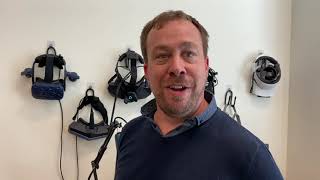
Robert Scoble talks with VMware's Alan Renouf and Matt Coppinger about spatial computing in the enterprise. They demo VR training and AR-guided workflows, then dig into device management and how VMware's Workspace ONE fits into the spatial stack.
All right, we're at inside VMware's secret spatial computing lab. And I can't get that whiteboard in there, so I'm going to get over here.
Who are you guys? Hi, I'm Alan Renouf, product manager for project vxr@vmware.
Yeah, and who are you?
Matt Coppinger, Director of spatial computing at VMware.
Very cool. And you guys are showing me all sorts of training apps and augmented work apps.
Exactly. Immersive training, augmented workflows.
I don't want to go too in depth with what you guys are doing because people can go and read, read about it when you announce products, but you're. What does VMware's play in Spatial? First of all, why do you call it spatial other than Scoville calls it spatial?
Why don't I take this off? Because it's a bit weird. Yeah. So we call it spatial because there's a lot of terms out there that all seem to seemingly mean the same things, but don't. I mean, there's a mix of ar, virtual reality, is it cross reality, is it mixed reality? You know, spatial to us means that you're using a computer device, but the information is all around you. And that could mean augmented reality or it could mean virtual reality or something in between. So that's why we call it spatial.
I call spatial too, because the sensors that are in here, right, can be the sensors that are in a self driving car or a robot and then virtual beings. You're going to see and walk around these spaces with us. Is that XR or is that ar, Is that VR? I don't know. It's sort of.
I think we agree with you. I think that spatial computing is about, is about understanding the world digitally in 3D and being able to either display or manipulate, display information and manipulate information in relation to the space around you. And that could be the immediate space that you're in, or it could be a remote space that may be through robotics, haptics, whatever, that you're actually influencing what's happening somewhere else.
Right.
To me, it's computing that's 3D, right? We used to com we today we compute on rectangles of glass, right? Monitors like that or on your phone, right? I'm filming you on a new iPhone and I'm seeing you on a rectangle, right? And you're 2D on that rectangle glass. But soon wearing something like a magic leap or a Hololens or whatever, we're gonna be able to walk through the computing Computing is gonna be on every surface, right?
Yeah.
And we're gonna control robots that are in working with us.
Yeah, we're gonna control everything.
So are the robots xr, AR and VR? No, it's spatial computing. It's computing where a robot, a virtual being or a human moves through the computing. It's in 3D. Yeah. So what are you doing with 3D here?
So actually what we demoed at VMworld 2019 is two use cases, immersive training, which is using virtual reality. Being able to put a user into a synthetic environment, train them up in a low risk, low cost environment where we can replicate a bunch of different scenarios. So we showed actually training people how to build a Dell server and a Dell manufacturing.
And that's what this was.
Well, that's what we did in virtual reality, actually. What we showed then is taking that same application and running on the magic be device and this, the same app, but now it's in kind of augmented reality mode. So now actually what we're doing is showing people how to build it for real. So you put the headset on, they've done the training and now they step back into the real environment and they're being guided by our technology. And the great thing about what we showed here is computer vision. So actually through the glasses, through the camera, we're using computer vision and machine learning to understand what objects are in front of you and where they're supposed to be.
Yeah, I've talked to a lot of factories. I'm writing a book on spatial computing. So I've been interviewing a lot of factories who are doing this kind of work. Right. Using augmented reality. And they're using the augmented reality to show that the product was put together properly. So it can turn green.
Yeah, absolutely.
If you do a job. Right.
There's the famous story of the rocket. Right. Where they put the inertial measurement unit upside down. And so when it took off it, it thought it was upside down and corrected itself. And that's, I mean, obviously, you know, those are the kind of things you want to capture. As people build things, it's not just about guiding them, it's also about recording and understanding, making sure they did these.
Things correctly and making the process better as well.
Absolutely, yeah.
It's not about how I build this currently. If I've got, you know, Jane that can build it 10 times faster, how is she doing that? And then how can I replicate that to everybody else? I can adjust the instructions, I can see exactly how she's doing that and I can give the updated instructions to people straight away.
Yeah.
And not just one server as well. I mean, obviously, if we're building custom servers for people, maybe somebody wants, you know, extra amount of memory, a different GPU in there, that custom order can come up on the screen, I can build that custom server, we can put it together and it can be shipped straight out.
Yeah. The other thing that factories are telling me is you get remote assistance. So if you're having trouble putting together something, if you hit a problem that you've never seen before and the system doesn't recognize because it wasn't programmed, you can call Joe across the factory and he can put on his glasses and he can go, oh, you forgot the red wire. Right. And we're seeing companies like Realwear doing a lot of that work on factory floors.
Well, I think in the future you can take that to the next level as well. I mean, when you have something wrong with your PC at home at the moment, you ring the PC manufacturer, they send an engineer out with a component. They come out, you know, all this process takes a couple of weeks for the component to get there and then schedule the engineer to come out and replace it. Whereas in the future, they'll ship you the component, you'll click on a button and it will say, here's how you install it. And you'll have the AR overlay on top of your computer telling you, exactly. Undo this screw, take this bit out, put this new bit in. You'll do it yourself. You know, Dell, save the. Or HP or whoever will save the money from giving that remote support and sending the engineer out. And you'll get a better experience because you'll be replacing those components twice as fast.
Now, we've been talking before the camera came on about managing these things. Right. I think that's what VMware is really trying to do, is provide is. I think that's what you guys are doing, is coming up with a way to manage tens of thousands of headsets, maybe someday soon, millions, Right. And secure them. Tell me a little bit about what is your team really doing in this little lab.
We're probably not at the point where we want to kind of discuss product or anything that, you know, might ship in the future. But what we can tell you today is obviously Workspace One is our end use computing offering that we have, you know, 50,000 plus customers using this globally. All the major enterprises are using Workspace One to secure the devices in the enterprise. We support iOS, we support Android, Mac, Windows, I mean, you name it, we Support it. And obviously, a lot of these new headsets coming into the enterprise. And so you'll, you know, today we support smart glasses, we support HoloLens, and you'll see, you know, in the future us supporting these types of devices. And I think, you know, one of the.
One of the challenges, yeah, Walmart bought 17,000 Oculus goes just to do training. Right.
And they're gonna need to manage that. Right.
And can you imagine loading these things up with. Even just by putting one app on an Oculus Go? How many minutes does it take?
Yeah, it's an IT nightmare. So, you know, that's what VMware does, is help, you know, enterprises solve some of those IT challenges. And so obviously, you know, you can see the immediate thing that VMware could play there is helping to manage these devices. And that's one of the challenges of spatially in enterprise is to go from a proof of concept to production. You really need to be able to be managed by it. Right. You need enterprise features, and that's what workspace one can bring a lot of these devices. That's not specifically something that this team is working on right now, but we're working closely with our end use computing colleagues at help make that happen. Yeah. And as you can see, I mean, what we've demoed here today is basically what we're talking about right now. And I'm sure you'll hear more from us in the future.
Well, this is going to be a real interesting field that I think is a lot bigger than just VR and ar. I mean, you go to an Amazon Go store and you're watched by how many sensors up in the ceiling and on the shelves? Hundreds. Right. 3D sensors, cameras, weight sensors, all sorts of stuff, all joining together with software and being shoved up into a cloud computing system somewhere. Probably running on VMware. Right.
But we actually offer an IoT solution, IoT Pulse. So a lot of people think of VMware as a virtualization vendor, and in fact, obviously, that's our bread and butter. But we've moved into other things. Right. We're partnering with all the major cloud offerings out there today. We obviously do device management. We do virtual desktop infrastructure. We do. So we do everything from the data center. We do network virtualization, storage virtualization, we do all of that. So everything from the data center, the network, the cloud, and then the end device, we're covering that. We just acquired Carbon black from a security perspective. So you need to think of VMware across all those different things. And we think that Spatial would be deployed in the cloud, on prem at the edge. And you're going to need an infrastructure partner that can help you manage that.
Yeah, it's a big field coming, big wave of new technologies coming that, you know, when you start thinking about factories and retail stores that are really starting to shift in the next decade, you're going to see huge shifts and consumers, you know, you can see all the VR headsets, how big and ugly they are today. In five years, they are not going to look like that. I'm already seeing the devices coming out of Israel that are like a pair of Ray Bans. Right. They're three years away, but that's not very far. Right.
And these are all here for different reasons. They're not just there to look pretty. I mean, it looks good, but they're there for different use cases.
Right.
You know, I'm in a 360 video. I might want a cheap headset that doesn't cost me much, that I can just put on and see everything around me. Whereas if I want, you know, visual clarity and fidelity and I'm doing design in virtual reality, then maybe I do want a bigger, bulkier headset that gives me a wider field of view that I can actually go inside of a car and see what the leather looks like and, you know, actually read text inside of that device. So, you know, they are all here for a different reason and different use cases for different headsets.
Thanks for spending a little bit of time. Where do we watch what VMware is doing with spatial computing? Do you guys have a website somewhere hidden in the corner of the Internet?
The VMware office of the CTO blog. I think it's octo.vmware.com or get you straight there. We've done some recent posts on what we're doing around spatial computing. Some of the things and some of the enhancements we're making to that space there. And we also have a project VXR Twitter account as well. Very cool.
Yeah, thanks so much. And.
More from Robert








45: Sandy Carter Unveils the Future of AI: Myths, Agents, and Creativity | SXSW Insights


