Spatial Computing Catalyst #6: NASA Jet Propulsion Laboratory (NASA JPL) Interview
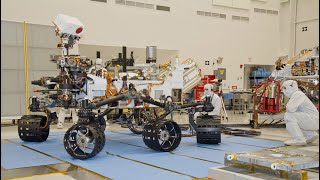
Victor Liu and Sasha from NASA JPL discuss how the lab uses VR and AR for Mars exploration, engineering, and public outreach. Projects include On Site, immersive reconstructions of Mars from Curiosity data, and Protospace, which overlays full-scale CAD models onto real spaces for engineering work. The team of 35-40 is exploring how future AR devices and AI could let the public experience Mars missions alongside astronauts.
Questions this video answers
About 35–40 people (roughly half work on natural user interfaces).
About four years old ("almost four years old").
About three years old ("about three years old now").
Access Mars (built on WebVR, being ported to WebXR).
Curiosity rover imagery and orbital data, primarily from Mars Reconnaissance Orbiter (over ~10 years of orbital data).
T minus 8, 7, 6, 5, 4, 3, 2, 0.
Lift off of the out.
Launching the first interplanetary mission from the West coast and NASA's InSight, the first outer space robotic explorer to study the interior of Mars.
I'm Irina Cronin. I'm with Infinite Retina. I'm sitting here at NASA jpl, which is awesome. I'm here with Victor Liu and Sasha. Okay, great. Victor and Sasha work in spatial computing, basically virtual reality and augmented reality. JPL and NASA has been using virtual reality for quite some time now. Internally, I know that it's only been very recently that the public is much more aware of what NASA is using virtual reality for, actually developing experiences at Mars and other types of things that are educated. So I am very happy to be here with you today, and I'm extremely curious to know what's in the pipeline about what you're currently working on.
Sure, Start. We're working on a number of projects that affect our primary users, which are our scientists, our engineers, and astronauts, and then, of course, by extension, the general public as well. And so for our scientists, we. We have a capability that allows them to meet together in a virtual environment. Our primary focus is on Mars. So the Curiosity rover takes a bunch of images. We can then take those Images, reconstruct a 3D model of the world, and then the scientists can meet on Mars, have virtual meetings where their avatars can come together and study what they've experienced so far and where they want to go in the future. So that tool is called On Site.
Just to mention. Yeah, that's kind of our oldest tool that we've created. It was almost four years old. Now, it's something that I want to stress is being used as a practical application of augmented reality coupled with WebGL. So it's something that different scientists all across the whole entire world can put on a headset or log in to a certain site and meet at a certain Martian day, or sol, as we called them, and be able to kind of study the different formations and outcrops. So it's mainly for geologists. It's for scientists that study the geology of Mars. So we're trying to kind of make an Earth analog to how they would do the kind of studying on Earth. So they're able to actually be there with the rocks, see dimensions. You know, in the past, dimensionality was looked at through an anaglyph, like a red and cyan photo. And now you're actually able to be immersed in the real data, which is kind of amazing. Yeah. So it's something that we use. And I think when we talk VR, when we talk ar, when we talk immersive, as you want to, you know, spatial computing in the future and the speculative future of what we're doing, I think we've developed something that has been, and I also want to mention that we did win software of the year last year for the agency. So this kind of work is being, is being kind of at least seen by NASA as very forward thinking and important and seeing it at the same kind of level as, you know, other software that's created here, which is a huge step in what we do.
So basically I would imagine that there's constant updates as to the visuality of the geology of Mars and that that's what's being looked at on a continuous.
Basis to study proof is in the pipeline, right?
Yeah.
I mean what they have before our tool was available was just the pictures that was in fact on the images. Right. But it's just only 2D assets. Look at a 3D world.
Right.
And so we've kind of transformed the way that they think about this data set because now we can create 3D content that they can navigate immersively and start to make decisions in this extra additional dimension.
And still kind of when you're on the web, part of on site, you're able to match up the 3D world with the 2D world. So let's say I pick a point right here and I'm in the immersive world. I'm wearing a HoloLens, I'm immersed on Mars, I pick a point here. But then when I'm on the web, I'm able to actually see, see every photo that Mars Curiosity took of that particular point and you get a little menu. So then you're able to click on the 2D image and it shows you where that point is on a 2D image and in a 3D plane. So it kind of helps you orient yourself in a way that you can do science in a place that's very, very far away.
That's really amazing.
Provides really good spatial context.
Yeah.
And you know, we talk about the future. If it works for Mars, it works for really any remote environment. So we're looking at doing this for small bodies like asteroids, looking at doing this for the space station, for lunar environments, the terrestrial environments here on Earth. Places where you can't send a lot of people, but we can send robots and things to capture this environment and then send it back so people can virtually explore at any time.
Basically the innovation here is the way in which the pipeline was created that creates the ability to see this data, which is obviously the Curiosity rover taking photos, and then also the orbital data that we have from mostly one orbiter, the Mars Reconnaissance Orbiter, but also other orbiters that have been kind of going around Mars for over 10 years now. And so we have all this data, and it's just a matter of how to visualize that data. Yeah, yeah.
So, so basically, I'm sure that it will probably be used in the future for behavioral kinds of analyses too. Right. Not just geological, because the idea is that you will have astronauts that will finally get to Mars and you want to see kind of the effect of what the living arrangements might be when you're there, which will be drastically different. And it's hard, hard to kind of. I mean, people talk about what that might be, that you wouldn't be able to go outside and all kinds of other issues. So to be able to kind of have a narrative of how that might be and then to visualize it and live through it, I mean, that's just a guess.
I mean, there's a lot of thoughts about how to apply, like, use this technology for psychological benefits.
Yeah, Right.
And it's almost the reverse of how we think about it here on Earth. Right here is like we want to use VRA to take a to places we can't go. Right. Like to go to Mars or to go to a concert or go to a football game or somewhere else. Right?
Yeah.
I think for the astronauts, as they go further and further away from Earth, they're going to want to go to places like here. Right. Their backyard or your living room.
That's what I always think about is that when you're on the flight to Mars, it's a long flight. And I'm sure at that point astronauts, and I'm not an astronaut and will never be, but they probably have the one moment where, like, what have I done? And to go back and to kind of see their lives and walk around their house and see, even if it's a recording of their family or their pets or whatever they want, I think would be very comforting. And there's a lot of. There are a lot of studies currently being done, kind of in an academic level of the effects of VR and AR on both the psyche and on people that are differently abled, et cetera. How haptics can be a really big deal in giving feedback and training for getting certain things to function in a way that they couldn't without that sort.
Of are you using robotic haptics with the VR yet?
Not currently we've experimented with haptics, but we've experimented with robotic arms and how to kind of immersively operate robotics. The human machine interactions, I think it's coming along, but the technology still has a long way to go.
I think for us too, it's just still kind of even figuring out the correct input control. Like the HoloLens has all gestural controls experimenting with, what if we use an Xbox controller, What if we use a different input? I think controllers are still something that really need to be figured out in the world and what works best. And specifically for our needs, we're working with people that aren't used to the gaming environment, that aren't used to navigating a 3D plane or a 3D world in a 2D plane, let alone being immersed in it, let alone being like, okay, what do I do now? So that's kind of where we're trying to. We have a whole department here that just is human centered design, and that's what they do. They figure out how to. To make these things work. We work alongside that department here and that design is a huge part of what we're doing and user research. So we're exploring that world. Haptics is like the next, next step. Yeah, like first let's make them not freaked out about the first step and then let's take the second.
You mentioned HoloLens. So HoloLens 2, the gestures that you have are basically more natural, I mean, almost all natural. So if you want to move something, you use your hand the way that you would move it to move something. So it's a great leap forward. And I know developers don't really have any of their hands yet, so I bet you'd really be happy to get that because you don't have to learn all these other gestures, but you'd rather like they have, when they announced it, they had a play piano, a virtual piano, and the person's just there doing that, or they're moving a lever or something, and it's all just regular, everyday hand use. And they have these little haptics. I haven't figured out how they do it yet, but there's haptics that are associated with certain things that you use with the hololens. So that'll be really good for you guys. I think just in thinking through how you see the differences between using virtual reality and augmented reality, do you see different uses between the two and how you're Approaching it?
Yeah, I mean, we see it as a spectrum and just like with HoloLens or anything, we try to use whatever is available on the market and whatever's upcoming and we try to see what problems we could apply to, what problems we could solve. And so we're not necessarily dependent on any specific platform between VR and ar. Currently, as of today, AR is just a little bit more approachable, especially the mobile phone type of ar. But even the headsets are a little bit more approachable in the sense that it's inside and out tracking usually, it's usually tetherless. And so the burden of the user getting it set up and putting it on is a little bit lower than VR currently. Right. I mean there are devices like the Quest and other things that are going to make it a little bit more approachable ultimately. There's also the, you know, I can't see anything else. There's a little bit of that. And so also, you know, with some of these VR devices we're going to have pass through and other things being able to maybe even have a mixed reality world. But at some point the spectrum is going to blend. Right. And it'll be all kind of arp.
I think so, yeah. In a matter of years it'll be that spectrum that you can move across. So I want to hear a little bit more about the different kinds of uses. So using it for basically internal understanding with the geologists, they're using it for possible psychological, maybe with the astronauts so they could acclimate themselves better, that kind of thing. What other aspects do you foresee in the future of using VR and ar?
Well, we didn't talk, so we talked about the science kind of flavor of things we do. We also have a product that's more engineering based, so created for engineers kind of, in my opinion, trying to create a AR tool that is indispensable in the JPL kind of framework of creating a mission. So that product is called Protospace and it's a, a way to see full scale CAD models in both the HoloLens and on the web and being able to collaborate. So we have the same thing again, we have a lot collaborating in the same location or in different locations. So when you're building out a certain spacecraft, you're able to kind of see it in full scale and get problems that would happen maybe even after you machine those parts, kind of catch them right away, iterate on the design and keep on going. So we're trying to get into being kind of a huge part of Both the design process and the kind of integration and testing. So actually like putting the thing together part, because there's a really big process with the way that missions are put together. Certain teams can't get in for certain for certain places. So there's this timeline and we're just trying to make that timeline accessible to more people in a virtual sense. So that's kind of, that's kind of the engineering flavor of what we're doing in this lab.
I can imagine that that's really useful, like having downtime and like you said, something could have been potentially built and you wouldn't notice until after it's built that there's an actual issue.
Yeah, and we're using, we're using April tags to kind of place objects in space so we can match up to a non co located space for the spacecraft to have, have the same exact kind of positioning. So we can really see kind of what everyone's talking about at the same time. We can take those April tags and stick them onto hardware inside of a clean room or inside of a lab and be able to overlay holograms over actual hardware, which, you know, we're doing some experiments with procedural work, but more importantly, just trying to help within the process of building a spacecraft. So that's that project. It's also kind of been a longer term project. It's about three years old now. And yeah, that's predecessor.
How do you get this built? Who's building it for you?
Well, we're making it internally completely. So it's been built and developed and designed here 100%.
How big is your team that builds for the spatial computing?
So in this lab where we work on a number of software projects, about 35, 40 folks.
Okay.
Let's say about half of that work on more natural user interfaces. Ar, VR computer.
That's great.
And each project fluctuates anywhere from like five to 10 people. And we work, you know, we're kind of like an agile methodology place so we can move people around, move kind of quickly. Within each project we have some R and D projects that we do and then we have some longer term kind of more mature projects like we've been talking about that take more time.
Yeah. So, okay, so in terms of how NASA is perceived by the outside world. Awesome.
Yes, definitely.
Awesome. The black hole news today.
Are you kidding? Come on.
Gosh. That just, that did blow me away.
The blow your mind emoji was used more today than I think I've seen in a while. Everyone kept just sending it to me.
Black holes are now real, and they weren't before. They were all theoretical and now they're real. So that makes a big difference. So I'm thinking for projects, obviously, NASA going to Mars and doing other things, the public needs to, to have more general awareness of it. Right. So it's not that, you know, up.
Until.
When people finally get to Mars, people are going to go crazy about that. But you have to build excitement. Right. To keep everybody on their toes as to what's going on.
We're still trying to make people excited about robots on Mars first. So that's kind of our first.
Exactly. So what I'm thinking is, do you have like a media. I know people working here in media. Are there any plans to integrate and use spatial computing, VR and AR for the public?
Both of the projects we talked about today have outreach spinoffs.
Yeah.
So versions where the public gets to use the same data set, but kind of in a more curated fashion. So for the Mars project, we have something called, called Access Mars, which is built on Web VR being transported to WebXR, which means essentially it runs on any device with browser, your phone, your.
Laptop, you don't need an app, it just opens. Yeah.
So it's kind of like a reform pipeline of the Mars terrain, only it works in a browser and you're able to. It's more curated. So there's a story. We have a geologist that works here, planetary geologist Katie Seth Morgan, taking you through kind of the story of Mars Curiosity. Why, when, what, how, and then you're able to kind of like go around. So let's say you have a VR device. You're actually able to go onto the browser on your device, and everything works flawlessly. So that was a really, I think, a win. But again, I think the problem is not what we make, it's like who hears about it and who uses it. Right. So I, I think one of our missions is to make a bigger footprint constantly. That's kind of NASA's charter. And the mission of the media relations department here, for sure, is to get the footprint wider, to kind of widen the web of why space is important, why engineering and science is important, and that it's not scary and that it's this wonderful thing where it can be visualization. So let's say you're a web developer and you're like, what would I ever do at NASA? Well, you could come work at the ops lab, where we use that all the time. A lot of people don't realize these connections exist. So things like Access Mars help us kind of spread the word about making us a little bit more accessible.
We do a lot of software development, a lot of user experience, design. We hire people from gaming and people with web backgrounds, mobile backgrounds. It's a pretty diverse crowd.
Yeah, I mean I could sit. How useful it would be. So you have the geologists that have their. It's like the internal meeting on Mars and how you could then turn that around to something that's outward facing and you could show the public what they're working. Obviously you're not going to give away the whole meeting, but have kind of like some snippets of understanding of what they're doing. I would definitely want to see something like that.
I think we almost like strategize a little bit too much because on top of the Mars release, we also had a Google expedition that was then for classrooms where you could explore 360s of Mars. And we had our education department put lesson plans together. But I think we just release everything all at one time and then we're like, we're done. Instead of like a steady maybe drum beat because we don't have the time maybe to spend because it's the thing after thing after thing. So I think any help from outside collaborators is always great. For Google Expeditions, it was great. Google was like, hey, do you have 360s? Like yes, we have so many. They're like, we will take them and help you do this thing. So that's always really nice because we only have so many people to do the work. But also. So Protospace has an analog for outreach as well. It's called Spacecraft ar. So that's a mobile app and you're able to actually visualize full scale spacecraft wherever you are and you can actually collaborate with another person. So look at the same one. So we're able to see some animations of how Curiosity takes out its robotic arm. You're able to explore some. I think there's some launch vehicles in there now and we're trying to update it with as many 3D assets as we can as well as, you know, incorporate more human space flight stuff. Because we do focus on robotics here. But you know, Johnson Space center has all of the assets for 3D human.
Space flights, especially as Apollo 50th anniversary.
Exactly.
It's a big deal for NASA.
Yeah, I know that there were lots. This is from last year that I was hearing that there's lots of stuff planned for that media. Yeah, I mean it is meaningful and I, it should be elevated for the Public to understand what it means.
And I think they do. Right. But I think that also, yeah, it's hard to tell your footprint when everything's organic. Like, nothing is monetized. We're not looking to make a profit. We're actually looking to educate, which is like a very interesting thing in this world, because I think mostly that's nobody, not to say nobody's point, but a large organization like this, to not want to make any money off of these products, to be like, take these and educate, and to just spread that word, is pretty unique. And so I think it's an interesting problem to have. As soon as people are like, wait, I can take any NASA image and use it in my project, they're like, what if it's like, take. Take it. Take our data, take our stuff, make cool things, teach people other things, like, you're gonna make a more creative thing, Then we can probably really make. Because we're already doing this other work. Or you can collaborate with people that work here. We're constantly looking for people on the outside to have fresh ideas. And we've actually hired a lot of people that have made really creative things with data and with data visualization and actually helping as a citizen scientist to make discoveries. So this whole world is possible in this wonderful way, but it's just. Just organizing it sometimes feels like a lot, but we're trying.
No, it sounds amazing. So, yeah, what I have in my mind as we were talking, so there's so much information that NASA has that compiles from so many different places. Visual, theoretical, scientific. It's like all this information, and then you have projects that obviously NASA wants to work on. And that information that you have is basically like fodder for R and D or for media or whatever. It's just there. It could be used for so many different things. But because obviously people have their own projects and can only do you only have so much time in the day, and you have to focus on making these things as perfect as possible. That this other stuff that you have, all this information, it's like a gold mine that no one. They kind of know that it's there, but they're not. They don't know about the individual aspects or pieces that are in there. So I'm really glad that I'm filming this today just to let everybody know that if you're a creator, if you're somebody that needs ip, like, everybody's always talking about how they need to get IP to get their thing off the ground, and IP is incredibly expensive. When it comes to, like, Hollywood IP or, you know, using anything that you'd have to pay for to get right, you're not asking anybody to pay for these amazing visuals, otherworldly amazing visuals, and other types of things. So I just want to make sure everybody.
You can come to NASA and get.
This for free and come up with all kinds of, like, imaginative, creative storylines and narratives.
There's actually a really. I think one of the kind of understated projects for NASA as a whole has been the Juno Cam project on board Juno.
Yes.
It's at Jupiter. So that is completely a citizen science project. None of the data is processed by anyone at NASA. So the only way that they can actually see the images and analyze them is by citizen scientists doing that work. So it's this beautiful pipeline. And those people always get credit, too, which rarely NASA does. But because this work is so important, and the people that do end up coming up with these visuals that are just stunning because Jupiter is beautiful in itself. I've also seen this community form inside of the Juno Cam project, where people that are wanting to learn data visualization are kind of asking for help and then learning by way of this data set. Yes. Which is just like that makes me so happy. But it needs to be happening on a bigger scale. I get that. But the fact that that curiosity is there and it's being fed and it's being kind of educated in its own ecosystem that's inspired by the data that is real is just very exciting to me.
Yeah, that's a wonderful example of taking something that is information, data and turning it into something that is meaningful. And people can then look at it and take what they can from that and go further. So, I mean, I think that's what VR, AR Spatial Computing. When you take machine learning and you take AI also with the data and everything, it's trying to organize what you're seeing. It's trying to organize how to think through things and categorize things. And I think for NASA, in terms of the reason why you might want to use VR and AR is for the same kinds of reasons, to organize people, to understand certain projects that you're working on for educational purposes, to point them in the right direction to take the data that's been unearthed by scientists and actually visualize that for people. So I guess one of my last few questions has to do with, let's say, five years down the line. All right, I will. I will tell. I'll give you a little scenario. So in 2020, everybody thinks Apple is going to come out with the glasses or headset, whichever, it's going to look more consumer based. I happen to know that there are at least four companies that are going to be coming out probably by 2020 which are going to be competitors. So now you're going to have a whole slew of AR headsets, AR glasses, they might be a little different. Apple is said to be pass through using the phone as a computer versus like Magic and HoloLens 2 and probably some other HoloLens 3 etc. That uses, you know, it's either in the back of here or checkerboard, but it's the same thing. It has a computing power. The thing is it's going to look pretty easy on the eyes and the consumers will finally have it. So five years from now it's saturated. Everybody has a headset, everybody's able to do ar. There's been lots of creativity, both from a business standpoint. You know, retailers are going to go gaga over it and business for their reasons. What does NASA do with this opportunity?
I think there's a number of things. I think 2020 for a consumer device is still optimistic from my perspective. I think maybe a year or two after that. But that said, five years from now we'll have definitely consumer ready devices. The Internet activity of those devices are still up for grabs in terms of input as we talked a little bit about this before. But haptics will be really important. Once let's say we have perfect tracking of our hands and our gestures, then we want to feel the things that we're touching. And once that happens, then we want to add some of the spatial computing capabilities of like AI. Right. So if we take our Mars example, right. We've always wanted the scientists to be able to pick up rocks on Mars and pick them up and feel them and share them with their colleagues. You can't do that today. Not really. Right. But with some of these up and coming capabilities in the next five years I think we will be. Once that happens, I think it'll be interesting to apply AI and machine learning to understand what are the science goals and how can we help them do their work more effectively. So for example, can we provide them suggestions on rocks so it knows you like these rocks? Maybe you would like these rocks also, you know what I mean? And so that really helps almost be one of their postdocs.
Right.
If the science is out in the field, the AI or these spatial computing capabilities could help them do their work more effectively, faster and ultimately do more science.
Yeah, I guess categorizing the different types of aspects of those rocks, any of the other things, and cutting through the chase of having to try them either mathematically or visually. Look at it one by one. There's too many. Yeah, it's cool.
Like we have son science stuff to count rocks or count craters today. That's great. But longer term, you know, we want to just automate all of that.
Yeah.
So for. Okay, so that's really great for the scientists and for internally, for NASA. How about for the public now that you have the consumers and you have their eyes?
I think like laying the groundwork now, which is what I feel like we're doing with creating, you know, as many 3D assets as we can with making repositories easier to get to, with kind of doing the heavy lifting of where this new kind of world can be organized in a way that's less so than kind of the way that all of NASA is. We have 10 centers, but the idea is organizing the information now. So when that consumer like wave comes and everyone has a device and it's easier to make these experiences that then it's exciting for me because we will still make public outreach materials, but the public will be able to help and to make them themselves also. So it's a way to kind of say, you know, we've been using these tools for this long. We'll be like the old grandparents of augmented reality. And these new people can come along and get excited about how these applications are being used at NASA and make their own kind of teachable moments and their own games or what have you. But I'm 100% sure they'll be educational and maybe if not the person themselves learning how to actually program for ar, which will be ever changing too, as we get the different inputs and as we can use mobile devices a lot easier. I think it's just like a massive wonderful thing for teaching other people new technologies. And then it won't be so foreign to put your phone up to something and see something. And it won't have to be just for entertainment. It could always be something you can learn from. So that's kind of what I see on that end.
Yeah, I mean, I'll tell you, before this, today I was at Intel Studios and basically there was a huge dome there. It's one of the largest domes I've ever seen with a green space. And so everything's digitized there. It's volumetric. It's amazing. I had a really interesting conversation with someone who works there named Dave Smitty. So he was talking about personalization. So he sees a future where. And it sounds similar to yours, which is great. So it kind of resonates to me where you have just regular everyday people. They're not tech geniuses or anything that they can actually take an asset like a 3D asset that is really easy to upload or it could be off of WebEx are they'll be able to manipulate it, they'll be able to include it in a narrative, they'll be able to tell an educational story. So if it's a teacher that wants to teach something to their students, they could do it on the fly. They could create a lesson like that very easily. Take a half hour and create a whole lesson. And it's all 3D and it's all very easy to put together for regular people. So this personalization aspect I think to me is extremely important. And it brings NASA closer to everybody so that it's not this weird, you know. Oh, it's a bunch of scientists doing math, figuring out how to build a rocket, you know, and like someday we'll go to Mars, you know, it's just like it feels very far away. Rather every day NASA's doing something very practical every single day. I know because I've worked with academics for a while before and I know but academics that are doing practical things, not like reading literature, you know, scientists. So I think that's extremely important for NASA to be able to first of all get a whole thing about funding for sure. Like continued mass good, massive amounts of funding thing to be able to do what you want to do. Because there's also stuff that's bigger than us, than Mars, right. I mean I can envision other things, right? Absolutely. So that needs a lot of funding. But in order to get the funding you need people to know, have a more personal relationship or understanding of what is done on a day to day basis or what goals are that NASA has. And I think that, that using AR is very good because you're in your reality, you're able to introduce objects and it's a little easier than going into VR.
Yeah. We want space exploration to be more tangible to people. Right. Like it's. We're doing it every day, but it's all. We're in space right now, all of us.
Right.
So what does that mean? How can they feel like they're in space?
They're our space, Victor. Not just you and me, everyone, we.
All take a bath.
So yeah, I think that you don't know exactly what we are I think that also people, like in terms of even the Mars thing that you mentioned, you know, why are we so obsessed with Mars? And I feel like it's answered all the time on like a NASA level, but just the very simple fact that Mars and Earth formed at the same time and there's probable life possibly on Mars and we'd like to try and find it because we'd want to know if there's other something out there. And that's really a huge goal of NASA too, is to find some sort of life somewhere else. Because why wouldn't we want to do that? But you know, it's just, that's not what we do every day. We just try to help the bigger thing. And you know, science comes in all shapes and sizes. From shooting up into space as an astronaut, to drilling into tiny rocks all day long to try and test different materials, to sewing the covers that go on spacecraft like NASA really does cover the whole gamut of what you could do with your career. I think it's just, I think a matter of hearing that enough times from people that work here.
Right. Just dispel the myth that it's just the rocket ship.
Yeah.
It's going in the air.
We don't even make, you know, we're called Jet Propulsion Laboratory. We don't even do propulsion anymore. We don't make launch vehicles. We just put the payloads on top that go to space. So it's no longer our expertise.
People think we're all rocket scientists or with PhDs or crazy academic backgrounds. I think we're just a normal institution with really ambition.
Yes, that's great.
It's dedication and vision. I think that kind of balance JPL out specifically. That's kind of the way people are here. Dreamers and doers at the same time.
Yes. That's the practical aspect that I think with having spatial computing, with having VR and then having the headsets, especially with ar, it can bring that closer to people.
Absolutely.
The long term dream we always talk about is after next five years and next 10, 20 years, we're gonna have humans on Mars.
Yes.
Right. And the next time we have that type of interaction, you know, it'll be the biggest media event in recorded history. Right. I think the last time that happened was when we land on moon when most of the Earth was tuned in via TVs. I think the next time we do this, it'll be Emerson and it'll be interesting because if we have the data already, we could already be there welcoming.
The astronauts as they land oh, my gosh. Yeah.
That type of co presence we're working on today, but that will be in place by the time the astronauts get to Mars.
That is a great way of ending the interview. Thank you so much. I love that visual. I want to be there when that happens.
Well, I'll be there.
Excellent look. Thank you so much, Victor and Sasha, and hopefully might be back in a couple of years to see where we are down the line when we have those AR glasses. All right, thank you.
More from Robert








45: Sandy Carter Unveils the Future of AI: Myths, Agents, and Creativity | SXSW Insights


