SRI International Tour: the failure team
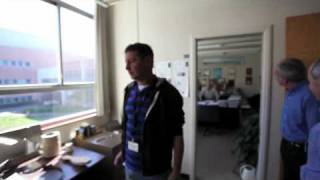
Robert Scoble visits SRI's failure analysis lab, where researchers investigate why things break. They've analyzed aircraft fuselage failures, designed transparent armor for vehicles, and tested cardiovascular stents for durability in arteries. The lab also studies fragment barriers and conducts forensic investigations on everything from bowling pins to missiles.
Questions this video answers
57,000 pounds per square inch applied to a 60-degree cone of an inch in diameter.
41 minutes.
306 people.
About half the people were killed.
About 4 inches thick and about 90 pounds apiece.
All right, this is why I sort of wanted to get into the hallways, because every hallway has a fun story out here. We're at SRI now. What hallway are we in here? So, Bill, this is the Poulter lab.
It does failure analysis and forensics. They look to see what happens when things fail and explode like aircraft engines. And it's a great part of sri.
That's what caught my eye. I saw this. I was like, what are these things?
They even look at small devices for failures, like stents in your heart, for.
Example.
Or why.
You might have a major explosion, what could cause it, and how did things fracture during it?
Yeah.
So this is studying what happens during an explosion, what happens to different materials. And this is testing cup.
Right, Which.
Oh, this is the testing cup with which we accurately determined that the moon's surface would be very firm. Tests showed that under the conditions existing on the moon, a finely divided powder would support a load of 57,000 pounds per square inch applied to a 60 degree cone of an inch in diameter. When they landed on the moon, they found our predictions to be correct.
Wow.
That shows you some of the stuff that goes on.
Yeah, some of this stuff.
Who are you?
Jeff Simons?
Yeah. And what do you do here?
Well, I do a lot of what you're looking at. So we look at. We're the center for freight failure physics. So we look at how things break and try to determine how to keep them from breaking.
It caught my eye. We were just walking through, and I was like, what is that? So can you tell me some of the displays that you have here? This seems like very historical stuff.
This is historical stuff. And a lot of it is from. This is particulars from the 70s when they were looking at strategic defense, like Star Wars.
My dad worked on that at Lockings.
Yeah, he did. And that's what here we're looking at. Those are kind of missile structures and looking at how they respond to different kinds of impulsive loads. And what you see is that what.
You call an explosion, an impulsive load.
Well, it can be an explosion, but it can also be other things too. So it can be impacted. But impulsive just means that it's high pressure for short time. And certainly explosions are that. But there are other types of impulsive loads.
Very cool. I saw some moon research down here. What other kinds of stuff is here in this case? You probably haven't looked for a while. You walk by it every day.
I need to read the little sign. And I've been here for 25 years, and some of These things. This particular row here, which is, you know, how these things buckle dynamic buckling of shells. That was done when I was here and then a lot of this other stuff is before I was here.
So today, what kinds of work are you guys doing?
So I guess you have gone down there? Not yet.
Not yet. We're walking down there.
Okay.
We were walking down that way.
Yeah. Well, actually, here, let me show you cool stuff. We have a little table that has examples of the sort of work that we've been doing. All right.
Advancing fracture science.
And here's Don, is the director of fracture physics.
Hi, Don.
Hey, Don.
I'm Robert Scoville. Say hi to the Internets.
How are you guys doing?
We're just going through and telling about some of the things that we've done. They got enticed by some of the pictures on the hallway.
So I actually.
Don, you could probably explain what's in the case there.
He's been longer.
He's been here long enough. Robert asked for an overview of sri.
And we're showing him some of the leading capabilities that we have to tell you.
We just set up this little museum out there. And Jeff can tell you about all kinds of things here.
Yeah, there's some really cool metal shearing here. What caused that to shear like that?
This one I don't recognize.
This is. We can just work investigating fuselage skins in aircraft. And if an engine bursts, you get fragments thrown out in all directions. And some of the fragments can penetrate the fuselage and they can sever the hydraulic lines. And that's what happened in sioux City in 1989. And this pilot was flying this plane with the rudder fixed and hardly any controls and flew it for 41 minutes with 306 terrified people on board. Finally brought into Sioux City, which had an airport that was. Runways are too short to land a widebody. And they almost pulled it off. About half the people were killed, but half the people survived. And Congress acted right away to mandate the FAA to take steps to make sure this never happened again. So we wrote a proposal to try to develop engine fragment barriers, sort of systems that we could put inside a fuselage wall to keep a fragment from ingressing into the interior and severing the lines.
Oh.
So we developed some things called. This is called. This is xylon. It's a high strength polymer material that we can put several layers in there and it can actually stop fairly large fragments. Yeah.
So almost like a bulletproof vest for an airliner.
Yeah, just very like that. Yeah, we have five and a Half inches between the. This is what's really interesting. This is fuselage skin. Yep. And this is the interior wall panel. This is a cosmetic stuff that you put your elbow on when you're sitting in the, in the window seat. And in between this, there's only some insulation blanket. And you guys think about this long bill when you guys go on the airplane again, the east coast, that's the only thing that separates you from the great outdoors. So maybe you want to drive a car.
Well, an airliner is safer than a car actually. At least until the Google self driving cars come along, right?
That's true.
Well, cool. What other kind of.
Well, here's some other things we're doing. We're developing transparent armor. This is used for windows in military vehicles. And to make them resist IEDs and projectiles they have to be pretty thick. And right now they're about 4 inches thick and they weigh about 90 pounds apiece. And there's four, six of those on a vehicle and that weighs about the weight of two and a half soldiers. So the military would like us to develop armor that will stop projectiles but make them lighter. So we're looking at different ceramics and different glasses and so forth to try, try to, in different laminations, different structures to make them more resistant.
Wow.
What were some of the things out in the showcase outside in the hallway, do you remember?
Oh, way down there. That's really old stuff. That was when Dr. Porter was around here and we were looking at weapon systems, shaped charges and EFPs, exclusively formed penetrators and, and doing explosive research. We developed some of the things in the Polaris missile way back when. This was way before my time, even though I'm pretty old.
What's the most interesting failure you've seen?
Oh gee, we've seen so many. I'll tell you one interesting one is this is these are stents, cardiovascular stents. This is what we put in blood vessels in the coronary arteries when you have a blockage. And what this does is holds the vessel open and allows blood to pass. Well, they've been so successful in the coronary that they're putting them in the peripheral arteries, the arms and the legs. And we're looking at stents are put in the Puppeteer artery, which is superficial femoral artery, goes down the back of the leg, it's about that thick. And up here they have no problem because there's just a heart beating supplying the loads. Down here, when you walk or lay down and go into fetal position, you have bending loads and compressive loads and they're starting to break in the body. So the FDA doesn't like that. And they gave us. They told the stent manufacturers to figure out how to make them more robust so they wouldn't break in a body. So what we did, we worked for a group of eight stent manufacturers, just about everybody in the United States who makes them. We did tests and computational analyses to show what properties were important and how they bent. We worked with Stanford University in this, and they had big MRI facilities and they'd take these female graduate student gymnasts and. And they'd put them in this MRI machine and make them sit like this for 30 minutes. They could do it. And they'd image the stents and they'd see what deflections were occurring. And from that, guys like Jeff could calculate the stresses. And then we provided that information to the stent manufacturers and they designed their own structures that would maybe resist these.
Very cool.
What a job.
Oh, we've had a lot of fun.
How do you get a job setting failure things?
I know.
You guys should talk at the failcon. There's a fun conference in San Francisco.
All about failure of companies.
But this would be a fun.
Yeah, right.
Yeah.
This is something a little different.
Or a TED Talk. A TED Talk on the failure of things would be a lot of fun.
That's true. That would be great. We've also worried about how bolting pins fail. Our bowling pin manufacturer asked us to figure out why the bowling pins were cracking at the neck here. And we again did computational analyses and tried to find out what the stresses were and how to design a wooden structure that would resist cracking. And we could make these fail safe with composite materials, modern materials. But they tried them out and the bowlers tried them out, and it does have the right sound. So we had to use wood.
Interesting. They don't like the bulletproof bowling pins.
No, I don't like that.
The carbon fiber bowling film doesn't make this the right sound.
Very cool.
So what do you think of the 787 that's built on all new materials?
Well, that's going to be interesting. I think that's a step in the right direction to make the planes lighter and so forth and more efficient. We have to make sure they fail safe, though, and that's a big step that's been delayed.
I know they have a bunch of them built and they're just sitting around. I know they're doing tests to make sure that they're totally safe.
That's right.
They got that going as test pilots, then to fly it upside down.
I'm not going to go on here.
Remember that demo of all demos? It was where the who was the pilot who did that in the 60s? He flew the jetliner upside down on a barrel roll right in front of 100,000 people.
That takes a lot of nerve.
His execs weren't happy with him either. Well, thanks so much for giving us a little tour.
Thanks for your interest here, too. Yeah, guys can buy any time. I'll give you a little.
More from Robert








45: Sandy Carter Unveils the Future of AI: Myths, Agents, and Creativity | SXSW Insights


