Stable Diffusion announcements
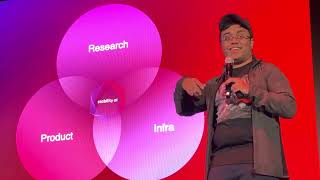
Emad Mostaque and Stability AI discuss Stable Diffusion's rapid adoption and open-source strategy. The roadmap moves from images to animation, video, 3D, and audio. They're building partnerships with governments and companies, funding researchers, and launching DreamStudio Pro and an animation API.
Hello everyone. How you doing? It's wonderful to see you all here today. Friends, friends to come. My lovely wife who's basically behind all this, but she doesn't want to make anyone aware of it. Very smart. Welcome. Sufficiently advanced technology is like magic, eh? And fly is stability hypo real. A lot of you in this room are thinking that because look, we came out of nowhere, we did a few things and I think we flipped the world of artificial intelligence. I think it might be more than that soon. Just raised $101 million seed round. Not bad, eh? From some amazing investors. We chose Kotu and Lightspeed, Shaughnessy Dentures and others because they have a support for open source, artificial intelligence and open source in general. And why open source? Open source, because this is the infrastructure of the future. Does it make sense that the most powerful technology in the world is controlled by a few with no accountability? No, it should be owned and controlled by everyone. I think databases and servers have shown there's a business model around that. We have 103 employees. They're not employees, they're friends. I've seen many of them here today. We've met for the first time. We just come together and again, it's been a rocket ship ride, like sure, I pulled a little bit together. But it's them that have created this technology, that have organized the communities of 100,000 people to go and say, anyone can build this if we come together. Because that's the reality. It isn't kept just by PhDs and big tech and others, but it's technology that anyone can build if we organize correctly because it reflects humanity. And another thing, you know, it's not us against big tech or anything like that. People in big tech contribute to this. It's the organizations themselves that a lot of discussions I've had, they'll be like, we're fantastically glad that you've come because we wanted to release this technology, but we're constrained, we're constrained by our own rules and other things and we don't even know what. We don't know why we can't release this. So thank you because this is exciting. I listened to before fun. This is magic. So that's kind of where we are. And I think we're at this point now where you have AI versus AI. What does that mean? We're moving from a time of big data to a time of big models. So the Internet used to be all about these massive data lakes and then we took those, we extended that and we personalized it to Target Jim with adverts or Thomas or others, you know, and that was because there was no other business model. People like, what is the business model? Ads are the best business model. So let's create AI that effectively manipulates you. We've all discussed kind of social networks and others and how do they make you happy or do they make you sad? Well, it's manipulative technology. It generally makes you a bit sadder in general. We've been thinking, is there an alternative now? There is, because we've moved from that. I call it btix. I'm former hedge fund manager, like extrapolation kind of thing to a first principles basis. Big models. This kicked off in 2017 with the attention is all you need. Paper from some fantastic engineers. And it's led to a revolution in artificial intelligence to build AI that can think like a human, that can learn the principles of structured data sets just like we do, which is insane. But it learns from us and it learns from what we feed it. And again, should that technology be available to a few? Is it Promethean fire that should be available for everyone? It has its dangers, it has its benefits. But we need to expand out the range of people involved in this. We need to take it so the world has access to it. Because it's getting crazy. Look at that. You know, no one can keep up. Anyone here, as a male practitioner who can keep up with a literally exponential curve in AI research, if. So you're hired. Please, you know, come join me after this. Right? The pace of research has accelerated because these technologies are so breakthrough. It is literally that exponential moment, that one in a billion moment in papers. And again, we're going to have to build an AI to read these papers. And then of course, what will happen is Sonal builds an AI to write these papers and back and forth occurs. Right. I had to look at this and I thought the only way we can do that is we create a new type of organization. Because it's not enough anymore just to have a few people on a team having breakthrough after breakthrough. Why? Because there's a lot of smart people doing this. There's a lot of supercomputer, there's a lot of data out there. So how do you build that framework models? How do you build the benchmark models? What you do is you combine these three things. So a year ago, it's been quite a year, right? I kind of came up with this idea of AI, open source and community. And that's where stability was. Because again, you can't have a Core team doing this. Be a core team with partners with community that absorb information and create information and then make it actually usable. Because it's not enough to have a research lab that just builds these things and it never gets to people. These models are based on us and they work best when they feedback from us. I don't give a damn about AGI. I sorry for some people here do. What I care about is AI that helps people. What I care about is AI that goes global to change our systems for the better. Our mission and stability is to build the foundation to activate humanity's potential. Our motto is let's make people happier. I think you have to focus on it. You have to give them agency and progress. Our sub motto is let's fix shit. Shit's broken and it's nasty, right? Our communities are our core. And you know, we were lucky enough to kind of accelerate and support these. A lot of people see us and they're like, oh, they're the image guys that make pretty pictures, right? No, we are lucky enough to have communities that crank out amazing things. Eleutherai, one of the cornerstone communities, does language models, does alignment. In the last month they've released the most advanced Korean language model. You know, they come up with a pile and GPT Neo and GPT J that we downloaded 25 million times by developers and created many wonderful applications. I see some of you here for users of that. It allows you to customize. I just take it yourself. Lyon Image data set the previous largest image data set with YFCC 100M 100 million images from Flickr. This year we released Lion 5B 5.6 billion image language pairs. 250 terabytes of information that are used from Google to Microsoft to Facebook to whoever. Okay, it isn't the best data set, but it wasn't meant to be. It was meant to be big so that you can figure out better data sets from that dream studio. You guys have seen the innovation around this space. Okay, I'm sorry we haven't been able to organize it, but when we tried to do it via Reddit, people got kind of angry. So we dialed it back a bit. It's a constant push pull. But the reality is that stability has been behind most of the open source art movement over the last year. We have from Disco Diffusion, Majesty Diffusion Deforum and others. Our developers are encouraged to actively collaborate and contribute because that's again how this grows. It's big enough pie for everyone to do that. Karpa's are representative from Trusted Learning Lab, that's a big word. It's about humans and AI and the interaction with them. So they just released the first instruct model that can take language models from 100 billion parameters down to 1. They're working on code models, they're working on some language models and other things that are even better to understand stories because stories are how we communicate. Understanding them is how we will progress. Harmoni is our audio music lab. Fantastic work done there as well. Just sneakily released dance diffusion so as not to get like angry musicians off it. No, musicians love it. Musicians are disintermediated already. We're intermediated by technology. I think that audio is at the first steps of where image is right now. In a few years you'll be able to create anything you can imagine. And I think it's going to be wonderful because again, we communicate that way work. We're doing protein folding models. We're training them right now. Why? Because we have the power of community and collaboration. We've got a core team, we've got our regular collaborators, our fellows that we sponsor, other partners that we just grants or compute to. And then this amazing community. We're doing DNA diffusion and other things and to come we've got things like Deep Voyage where I tell you about, but it's a secret so I'm not going to. And many other communities coming because this is what we actually. How do you organize communities so there's a shared narrative and psychological safety so you can say and discuss. You don't have to focus on state of the art and citations, but instead building things for the benefit of humanity. The infrastructure of the future. Because that's what these models are, the infrastructure of the future. To bring information where they're needed. And again, should the highways be controlled by private companies? No, you can build your own highways, that's fine. But the basic infrastructure should be available to all and open and it's better to do that. You need to have some amazing things. So I see some of our buddies at AWS here, they kindly built us one of the fastest supercomputers in the world. Let's go. Look here. Stability, right? So our cluster is about, I don't know, eight times faster than NASA supercomputers put together in the uk. It's as fast as supercomputer, no big deal.
There we are.
Yeah. Next year, you know, we'll probably, I don't know, what, five, ten times it. Easily, easily. There we go. Going to make it available to everyone because right now what happens is people quit their PhDs, they go work at big tech companies or startups because they have to, because they don't have the resources needed. There's a number of reasons for that, but that's why the number of large scale breakthroughs has gone from academia from 60% just a few years ago to 0% now. In fact, independent research collectives such as us are doing more breakthroughs in academia. But we're going to flip that around. This year we will fund 100 PhDs and they will come with grant writing support, paper writing support, mental health support and fat amounts of supercomputer. Don't give a damn about citations or state of the art. All they care about is the quality of your output. This is what we tell to our research as well. We don't care if you get things wrong. It's not constrained because you are creatives and artists building this technology for anyone that wants to join. We pay competitive salaries, benefits and we do revenue share. We do a 10% revenue show on any model that we run. Half of it goes to the model authors, even if they don't work at stability because it's worth it, right? The other half goes to a pool where again the criteria is put money into the coolest ship you can find because that's how you spur innovation and no one's given permission to do that. That's what we do at stability. We go and we say what can make a difference, but also what's cool because otherwise you go through these long processes, you don't activate creativity and energy. So this is going to be very interesting I think next year, seeing what that looks like. And we're also working with multiple governments now to build national AI models and national AI data centers. This technology should not only be in the west, it shouldn't only be controlled by us. We want to move to more decentralized governance in this because we've got some good ideas. But again, we can't be the choke point. I think that giving up of control makes us unique because we're really focused to where the value is in this new landscape. And we're going to change everything where it's not defensible by models. Not defensible. I can right now there's not much talent that can build this. We're going to train a hundred thousand AI engineers. We've got a fast AI course coming up. We're going to go to the IITs, other universities and makers. Everyone uses technology. Everyone should be able to use this technology and take it to an Indian version or An Indonesian version or a Malawian version? Like, what the hell? Yes, everywhere. Because everyone will use this technology to start now. Are we going to share the knowledge? We're not going to keep it and hold it for ourselves because it will create a brand new land. And that's how we kind of cognize stability as well. We serialized. It can't just be a research lab. Our research is fantastic. But we also have infrastructure, we have products, we have a full stack. There's not enough these models to be by themselves, but they must be usable. And on that, I'd like to introduce Tom, our CTO of Rat Dream Studio.
Thank you, Emers. Thank you.
Hi, guys.
Tom, she's here.
Thank you again to everyone who's put the event on. It's an incredible event. Thank you most of all to the team who has worked so hard over the last couple of months and all the community that's been involved. I came from that community. That's how I discovered this technology. So I discovered my love for it. And it has been a complete, utter joy.
Every.
Every day is amazing. Every day something new happens, either from Stability or from the community. Ten new things happen. And it's just an incredible journey and an incredible thing to be part of. So the first thing that we released was stable diffusion and DreamStudio at the same time. And we've had this explosion of creativity. So what is it? Well, it allows you to take some text and turn it into an image. Got some examples here of a latent spaceman himself, photorealistic images, the cooling ridge and the Isle of Skye, the DJ hamster. So the fundamental process is text to image. But there are other ways we can interact with the model as well. We can use dreamstudio with its different settings, to let people of any technical ability to generate images, but also from image to image. So we can take images, existing images, we can change them, we can make variants, we can take out parts of an image in paint new parts to. To create a dog in VR. Previously only a dog, now it's a VR dog. With our latest addition of clip guidance, we've further improved the image of the quality by guiding the diffusion process with additional layers of clip guidance. And the quality is just getting better. This is just kind of every week or two, the team is just releasing these incredible new things that just make the image coherence and the quality better and better and better. So we've got futuristic worlds, frogs as astronauts, Einstein as a cowboy, and architectural concepts. We've had some incredible growth from Dream Studio. And the Number of users, 1.5 million users in seven weeks, 170 million images created on the stable diffusion model, which is hosted for Hugging face. We've had 200,000 downloads, thousand projects created, and so many more each day. And each project, you know, things like textual inversion, which some of you will be familiar with, and Cheerin Alex will explain more about later. But some of these projects are whole new concepts, whole new things emerging from the model, each of which can become its own right, some new tool or part of a platform, or just an incredible inception, you know, routine every day. The stability platform itself is based obviously on the data sets that we're gathering through our communities, like LAN and Luther. And we have the research communities that are doing models in every modality from image to video to text to audio3d. We're servicing those through the product ecosystem and through the API into integrations. So we have obviously Dream Studio, we have other products that Civility will develop for each of those modalities. We have an API which powers all of those things and brings that to commercial partners who can use it to integrate it programmatically with their creative tools. And that goes to support as well the integrations that we have through applications of Splendor or Adobe Photoshop, where people are developing plugins such as Christian, who's here tonight somewhere. So then as we grow the partnerships, we develop those close relationships with those large data vendors and graphic platforms, but we're taking their data and fine tuning it into their own custom models. Case of arc. This can create ARC systems and we feed those models back into their own creative platforms through the APIs. We then become a foundation system through which anyone can embed generative models into their creative tools. The next wave of our technology we're hopefully releasing in the next couple of weeks will be animation and video. So Dream Studio, which was originally developed to be an animation platform, will allow you to animate AI art through 3D transformation and other tools such as prompt animation and audio activity. The animation system will be exposed via the API. So again, companies will be able to integrate animation into their creative pipelines. And we'll open source that. So we'll make it available to companies, to their communities to want to build on top of it. And again, community drive, community project. You can see here some examples of Dream Studio where you can animate prompts and integrate with 3D timelines and graph data driven animations. So this is all building towards what we call our generative application layer, which is taking all of these modalities and building one foundational platform for the future of creative and generative media and creative tools, image to audio and video, 3D. And for that Star foundation for tomorrow. Thank you very much. I'm going to hand over to Chia, who part of the team right from the very beginning. It's been amazing to work here for these time. And Alex.
Hi there. I'm so excited to see you all here. I'd like to introduce myself and also Alex. I'm Chidozi Unry and I'm a software engineer at Stability. And one of the things I've been working on recently is generally getting stable diffusion out into the world, so through the API and also through G Studio. Sorry, can you hear me? And I also took part in an art residency this summer at Stability, which is where I met Alex, who is an MIT trained roboticist and also an incredible artist. He's represented by Gazelle Art House London, and he's exhibited at all sorts of exciting places. The Vienna Biennale, Design Museum, Ghent and many others. He's been working recently on a series of artworks that use AI to. To probe human machine collaboration. And I'd like to let him describe some of those most recent works and then maybe we can have a short discussion about how to incorporate AI in the artistic process in general. So, Alex.
Thanks, Gia. So on this video here, you can see someone making a painting. So this is a painting that was first described by a text, generative AI. I choose the descriptions of artworks that I like from that system and then I feed them back into text to image generation. So it's sort of one AI talking to another through me interpreting them. And then when those images are output, they are oil painted, so they're. They cross boundaries between the digital to the physical, which I find quite interesting. There's a few more examples you'll see here. So this is what. What it looked like when it was up in Venice. So the main painting that was painted in the middle and a whole bunch of other options of images which could be painted in the future if someone sees one that they like. On the top here you see the AI generated version and the painting. A few more examples of this. These are quite surreal or funny. And yeah, this one I find really cool because the title the AI made for this one was Billy and Mel have an argument about Putting Together a Light side table and Decide to Get a Divorce, which I think many of you have experienced putting together furniture like that. But yeah, I'm always surprised by the outputs of these systems because sometimes they're humorous Sometimes they're really striking.
Yeah.
And the variety that you can get is quite amazing.
Yeah.
Oh, yeah.
So what it looked like in a gallery in London. So this is the Gazelli Gallery. And again, sort of the oil painting, paintings and wallpaper on the wall. So if a collector curator can and SOR1 that was generated out of the five options that they like, they can kind of point to that one and get it painted. Then they become part of the creation process again, this sort of human machine collaboration.
Great. So while we talk, I've put up this series of a selection of images that you've generated using stable diffusion, using this kind of process, but it's before the curation step, so it just represents the kind of raw outputs. And I think this really illustrates nicely the fact that in these systems you get an abundance of choice and also an abundance of beauty. And that's part of what makes this technology so amazing. But how do you think that that changes your artistic process?
Yeah, it's quite interesting. I think the usual artistic process is that kind of start with an image in your head and then create that image and it's visual art. This is kind of flipping on its head where I'm creating many, many outputs using an API that I can go through all these images and pick out ones that I like and then kind of work backwards from there, maybe make more variations of those or continue those further. So having something like an API that you can make generative outputs with creates this kind of curatorial relationship the artists can have with the machine.
Yeah, I think it's a really good point that the API is not necessarily just for developers. Even though it does allow these capabilities, it can also be useful for individual artists. So because you're so experienced in using these kinds of systems, as more and more creators try these tools for the first time, do you have any advice for them in how they should approach them?
Yeah, I would say, you know, think outside the prompt. You know, treat this like it's like a camera. So imagine like you first encountered a camera and you've never seen one before. I think everything you take a picture of is going to look cool and amazing because this was kind of new. But obviously, you know, camera, the camera's evolved into like this own art form on its own. So, you know, move from digital to physical, try different things and really push the boundaries of these systems because I think it's going to be one of these brand new creative tools we're going to look back at like we did for the camera.
Yeah, I love it finally what's coming next both for you, but also in your view for these tools as part of the art world as a whole.
Yeah. So upcoming next year I'm gonna have my first solo museum show at a major museum. I can't name which one quite yet, but it's going to be a pretty big survey of AI art in particular. And I find this really cool because it kind of puts a bookmark in time where like a cultural institution has put their foot down and say, you know, this is a new and valid art form. This is something we're looking at very seriously. And yeah, I can imagine in the future we might see an AI wing in a museum just like we see photography wing over like an SF mobile over there.
Amazing. Thank you so much Alex for joining us. And I will hand back over to Imad for.
Hello again everyone. Keanu leaves. I know. Okay. Actually, can we queue the video you want to see? Animation. Animation. Let's go.
Dream Studio Pro the next frontier of AI media creation powered by stable diffusion, DreamStudio Pro represents a new paradigm in creative expression. Explore infinite date in space. Conjure new realities and create powerful cinematic visuals in just minutes. Connect with your audience like never before with Dream Studio Pro's incredible versatility. Translate emotional stories and poetry into compelling imagery. Create an infinite variety of nuanced emotional animations. Use text prompts together with music to drive Dream Studio Pro's audio processing unit and create powerful audio reactive music videos driven by AI. With Dream Studio Pro and stable diffusion, filmmakers can go from a creative concept to a short animated film in just minutes. Draft and visualize your script with our powerful storyboard mode. Send your storyboards into the timeline for versatile scene composition, precision camera controls and groundbreaking latent space transition effects. While Dream Studio Pro is a standalone application, it is also a perfect addition to robust visual effects. Asset workflows, create four fully realized environments, asset textures and motion matched composition layers with 3D transformations and precise masking. All of the versatile API functionality is built from the ground up on our robust cloud platform. This way, studios and software partners can easily integrate DreamStudio Pro capabilities into their own pipelines. DreamStudio Pro is compatible with proprietary fine tuned image models, allowing studios, game developers and content creators to integrate DSPRO into their own production pipelines. With video diffusion and audio diffusion models coming soon, dreamstudio Pro extends our leadership into animation and video, cementing Dream Studio as the industry standard for AI image synthesis and media creation. The future of animation is now.
Not bad. The team's worked super hard. I'D like to thank them. I think, you know, getting products out is difficult. You'll see. Dream Studio Pro is quite something else. You know, as a full suite and as we add video, 3D audio and the other models we're working on, we got to build a holodeck. Going to be awesome. All right, shall we continue?
That's next.
Slide. There we go. The animation API. Not brick technology. Anyway, the animation API goes live next week. No, stay. And the Dream Studio Alpha will be awake in the next few weeks and the full release will be in November. So we look forward to seeing what everyone's going to do as part of this. The team have been working to get more and more efficiency, working with friends such as Nvidia and others. And so I'm happy to announce that we will be halving our non guided prices for image generation.
Now.
We'Ll need that with all the animation and that's not going to be the first. We're going to keep driving down the cost and improving efficiency because we're going to 24 frames a second. That's where we're going. And then it'll be awesome. Let's go. Yeah, tell the cloud provider over there. Right, this is the one to a billion moment, so we reckon about 10 million people using technology. It says 5 million down there. It's going to go to a billion. I mean, like if you look at the integrations in Canva, Photoshop, others, it's gonna be everywhere because this technology is unprecedented. It's not going to a billion, it's going to 7 billion or 3 billion. What's Internet? I don't know. We'll give everyone Internet. Okay. That's another thing we'll do to be announced later. Seriously. So I think it's interesting though because we get a bit like metaphysical effort right now. This is difficult for me. This is actually my ninth speech that I've ever given in presentation. I'm doing okay. Yeah. Speech is the easiest way to communicate. It's what we do as humans. Text is a bit more difficult, which is why you journalists in the audience, please be nice to me, get paid so much. You know, visual is the most difficult thing. We see the struggle of, you know, creating art, it takes so long. But more than that, we see the struggle of PowerPoint. PowerPoint sucks. It's the visual medium. We're doing this, we're making it so that everyone can communicate in every direction. So much of the world is creatively constipated. We're going to mix the complete rainbows it's going to be awesome. But now anyone, thanks to this technology can communicate with speech, with text, with our language models, with visuals and that changes things. In fact, I think it's the biggest moment since Gutenberg because Gutenberg allowed everyone to access text and now we're allowing everyone to access visual. My 7 year old daughter is one of the original creators of some of the image models. She created a beautiful piece that sold for three and a half thousand dollars for India currently, for last year. That's when I realized this was the big thing. I should probably put her out up, you know, if you want to have the best artist in lots of it. She's very smart though. She set up. Why don't you create more art? She's like, no daddy, one of one sell better this. I want a billion. You're going to pay for her in university anyway. So like I said, I think it's one of the biggest things because again, the world has changed. The world has actually changed. I think we've made people more creative, we're happier and I think this is just going to go around the world so anyone can create anything in the next few years. And then if we take a step back, what do we actually do? You know, we took a hundred thousand gigabytes of images and created a 2 gigabyte file that can recreate any of those. So we are probably Pied Piper from Silicon Valley. I mean, I'm Richard. I don't know. Anyway, I think you just gotta puke somewhere. Okay, so but just think about how crazy that is. 100,000 gigabytes, so 2 gigabyte far. Let's learn the principles. This is the power of the artificial intelligence. Intelligence is compression. So what we've done is taking information, compress it to knowledge, but that's not enough. And in fact I think we can go further. We'll be able to get this down further as we start instructing because you have lots of these neurons, but there's 100,000 gigabytes of random images from 2 billion. Why you start specifying this? Why don't we start optimizing this? We've got this working on an iPhone. How insane is that? It works on your MacBook M1. Everyone can access it together with it and extend it. The extension is the really interesting part because, you know, I think we've had this paradigm of the Internet. The Internet, whereby you know, you've got social media and all these things, but it's a centralized thing because there was so much happening around the edges. This Protocol that you needed AI to coordinate it. A lot of people talk about Web3 and things like that, but they talk about artificial intelligence. How are you going to coordinate that mess? It's a lot like, you know, my inbox is a lot. Someone please build me an AI for bestial like assistance. Yeah, the Internet had that paradigm and it was done like, again, you're routed, but it was not interoperable and the intelligence was the center. We're moving to the intelligent Internet intelligence at the edge. Because when you can have a 2 gigabyte or 100 megabyte model that can reflect your own input plus the collective knowledge of humanity, well, you know, let's make sure you get the right model. Let's do really good with data sets. You know, good data, people contact me. Then you move intelligence to the edge. It's a brand new paradigm. You don't need the centralized coordination points anymore. You have these generative search engines. So we talk about latent space. Latent space is the hidden layers of meaning between words and labels with text and text. So a cup can mean many different things from a world cup to cup your hands to other things. This is the power of this technology. It will be available to everyone. I mean everyone. And again, this is a new paradigm that I don't think we're ready for. But we can all work together on every person, every company, every country, every culture will have their own models. There won't be one big model to rule them all. I think this whole focus on big models, okay, they can get fantastic results. It's the wrong thing. It's about how humans interact with models that will allow us to build systems to enhance humanity, to extend our capabilities. And it will be available to everyone. Everyone. There we go. Culture, look. Yep, culture. So with that, I'd like to invite Rishika from Eros. And we're going to talk about India. How are you doing?
Good, how are you?
Very well. So India is a country close and dear to my heart. I think we've seen amazing growth there. In fact, it's probably one of the only growth countries out there. And you guys have been building something quite special. Eros is one of the top media companies in India. All the Bollywood movies, Disco Dancer, everything.
Thank you.
Please make sure we'll make Disco Dancer too. I really want that. I think you've got something to show us, haven't you? I have.
So we've actually been working on a super unique virtual universe powered by central kind of ancient mythology. It's the first time that you're actually going to have an intelligent universe, virtual universe. We're going to have more than 14 realms within that universe, and we're going to be doing it with Stability AI.
Would you like to show trailer?
I would love to.
Let's have a look.
And also is built upon the foundations.
Of ancient cosmology.
A universe embodied with mystery, wisdom and advanced technologies.
Where you.
Can live, play, create and read like never before.
Many of us know the cultures of myths. Everybody here knows who Thor is, right? But how many of you know about Hindu mythology? How many of you know about Chinese mythology? You're smart, Jinn. Of course, you know, right? There is a world of stories out there that are yet to be told. And again, our technology will make it so everyone can do it. When we partner with different entities, such as Eros, different partners and friends. I mean, would you like to tell us kind of some more things about, you know, why India is so exciting in particular, and the plans to kind of take that and extend.
Absolutely. So India, just the demographical stats are huge. You know, we're a population of 1.4 billion. We have the fastest, largest growing middle class in the world, which is topping 400 million million. The average age is about 27. And you'll just see in terms of connectivity, we typically tend to leapfrog with technology.
Right.
We've done that by giving data at the cheapest global rates possible, and we're about to replicate that with 5G backed on that. There are more than 600 million smartphones in the country today. With stability AI, we essentially want to. To empower a community of over half a billion people to start contributing to a highly intelligent metaverse.
Yeah, I think that's the thing. Allowing people to tell their own stories and then telling the stories that resonate. It's inevitable. And we're going to do it first and we're going to do it in partnership. I think that's the key thing, you know, Again, this is why across the world, okay, we have loads of really interesting Western partners and people from around here that we'll be announcing in the next few months. One of the things excites us most, again, is this leapfrogging capability, right. The ability to just go and move them forward without any of this existing infrastructure. Fully generative, intelligent Internet, an intelligent world.
I couldn't agree more. And I'm actually really excited to be able to empower the country itself with putting through all of our content, content in the supercompute, driving new outputs, creating new models in which we can start to tell stories, and essentially it's going to be stories for the people, by the people. Sorry I stole your tagline, but it was too easy.
I think someone said that before. It's all right. Yeah. I mean, like, again, I think one of the things is we're in one of the senses of technology, right? And there are people from all races and cultures here. They want to give back, they want to go home. And I think we're on the cusp of one of the biggest revolutions we've ever seen. Again, just think about this. You have 600 million handset users. In five years, they will all be running foundation models on the handset, compressing their collective knowledge and telling their individual stories. Right. I mean, I think. Where do you think India is going to be in all of this?
Leading at the front. And you just look at, in terms of how quick we're growing, just how young the population is, how technology happy they are. You know, we're a screen native country. People may not have televisions or land lights at home, but every single person has a mobile phone. So how do we get layer tablets into everyone's hands?
Not yet. We're about to announce that. So, yeah, I think this, I think that, yeah, contextualize it then.
So, you know, India, we kind of look at it like the United States of India. It's the global epicenter. And Eros Instability Partnership enables us to set the craft for a new universe of storytelling, a highly intelligent universe of storytelling.
That'd be a lot of fun, I think. I think, you know, let's kind of do this. And again, we're doing it fast. Stability, India. Next year, we'll be releasing Indian language models. We'll be taking the amazing content that Eros has created and allowing them to create even more amazing stories for everyone. And we can do that for every country and every culture and every race, because the people deserve it. Thank you, Rishika. Thank you, Amon. Thank you, everyone. All right, now, what I was going to talk about, let's think Metaverse. It's an interesting title, isn't it? What does it mean? I'm not sure. It feels like the Metaverse as it is, which has been very popular. It's just kind of like the Internet as it was, wasn't it? It's a place that you go and they charge you 47 and a half percent to be creative. Kind of sucks, but at least you get legs now. That's good. Nah, I don't think Metaverse is the way. Click, click, up There we go, graffiti. I think instead of the metaverse, what you have is a multiverse. You have everyone having their own models, telling their own stories. I think the multiverse is open. I think the multiverse is something where you have no barriers. I'd like to invade David from Leia to talk a little bit. How are we going to change it? Right?
Thank you, Ahmed. Buddy, how everybody's doing? I'm glad we had a soft introduction on the edited chat before.
So.
So, guys, we, you know, the world is 3D, okay? At the risk of being disclosing something that you don't know, we see in 3D, we perceive in 3D. We think we even realize in 3D. 3D is not just about depth perception. It's also about how you perceive light, how you create emotion, Watching a sunset or looking at the sparkle in the lover's eyes. And unfortunately, until now, there has been virtually no real mass adoption platform to experience 3D. In terms of visuals, we experience most of the content on our cell phones, on our laptops. Okay, there's VR now, but I mean, who wants to, you know, put a, sorry, frying pan on their head, you know, when they, when they wake up or. You know, I was kind of chatting with some people in the audience, you know, just showing them a little bit of the technology. You know, they would have had to kind of get their glass, you know, of wine on the table and kind of unstrapped and so on. Right. So I wouldn't say it is, you know, for the masses. So the core mission at Leon is actually to democratize the access to that immersive 3D imagery. And we create nanotechnology that is compatible with any devices like a phone, a tablet, a laptop, a computer. And that, you know, eventually will allow everybody Everywhere to experience 3D immersive content, you know, in their pocket. And I think it's the perfect complement to your vision.
You guys are fall off your chairs when you see it again. There are different paradigms of how we do it. So as I said earlier, the third dimension of narrative, of communication is visual. You've seen Dream Studio. Why are we creating it so we can do animation in 3D? We're doing it for experiences. Just like Leia. Leia is glasses free, resonant quality, 3D. It's being a very quick. And a gun always be.
No, just, you know, research over 12 years.
Right.
So it was an overnight success that took about 10 years of research. But, you know, once you get the nanotechnology detail figured out and the manufacturer.
Not everyone can build a company in a year, right? So I mean this is the thing, right? We don't want barriers so we'll have to stick with the Tai and our models do. There is no barrier. Anyone can do it. From a 3 year old to a 90 year old, you enter words, but do you really think we'll be entering words in the future? We'll be speaking to our technology and we'll be saying get em out a proper hat. Has he got a haircut or is he bald? Let's do that. And then on the other side, it's not only about creation but it's about consumption. As we see technologies like layer going forward, we just see this whole new world where there are no barriers to communication and creativity. We can tell and share our stories and that's awesome. And I think that a lot of people have the wrong paradigm or they might not, but this is the beauty of open source.
Yeah, absolutely. And so today we brought you a little surprise. We wanted you to experience the combination of the two technologies, the stable diffusion and Leia's 3D light field. So I think after the presentation if you want to go to that corner of the room there, we're going to fire up with a few tablets and I think you're going to be able to experience as a world's first stable diffusion content in 3D. So you know, I hope you like it and I've never seen anything like it and I think you're going to enjoy it. So you know, let us know your thoughts.
Fantastic. I think you like said you're going to be blown off your feet. I have worked with Leia for years. Now is the time. Exponential technology, it's here to stay. Thank you David. It's been so, you know, just like forget about the metaverse, just invest in multiverse. I think this is interesting, right? Because what you have is you have these trends that have a lot of potential but there's no, there's no immediate value. Like Web3 was an amazing solution. Search for a problem. We put a hundred billion dollars into self driving cars. Not really there yet. You know this is interesting because it's one of those first technological revolutions that offers value from day one. It makes you happier. Creation beats consumption any day. And we need to make it so the world creates and the world becomes happier. And so that's one of our missions. Slides back. Let's go back to slides. There we go. AI for the people, by the people. Rich, Kristan Al. I'm going to skip this slide. You Spoke about this before. Every person comes from your culture, and I think this is the thing. 100,000 gigabytes to 2 gigabytes. Is that enough? No. We need to make it so it's personal to every individual. That is the inclusion of Internet. Otherwise, it's the standardized Internet. And it doesn't reflect our diversity because our diversity is our strength. That's what America is founded on. That's what we've seen around the world. You can't have molo cultures. You. You can't have it living in your filter bubbles. A lot of people say, well, if you can create anything, then, you know, your citizens just be like Wally and fat and VR, blah, blah, blah. Yep. It's the wrong model, right? No, there's going to be something interesting, and you put yourself into that. And for that, I'd like to invite back my buddy Joe. Joe, where you at, man? Discuss this.
I got invited into coming up here.
And think it was gonna come up. Tell me about your journey, huh? Yeah, man.
So I used to be a YouTuber back in the day. Recovering YouTuber now. Yeah. You know, since 2006 is when I've been doing YouTube every single other day, and every single week, I would do a video. I got to 3 million subscribers, 500 million subscribers views, you know, and it just got too difficult. So I decided why not do something like the film industry. That seemed a little easier.
Yeah, I mean, easy, relaxed. I actually started my career in the film industry. You know, I did the Christian man of Film Awards. I was like, egos are too big. I want to become a hedge fund manager.
I see a couple other people here in the film industry. So, like, you know, for me, I have to prove to a lot of people that I can do that. I know what I have in my mind visually. So making concept art is really important. Turns out that I can't draw, and I don't want to waste the time of my concept artists. You know, I want to be able to just, like, come up with a bunch of ideas and then, boom, here we go. Like, send it to a concept artist, and then they can do their human thing to it, you know?
Yeah, I think you want to remove the barriers. Right. Because again, anyone should be able to create. It sounds like I feel like that little rat from Ratatouille. Anyone can cook, you know, Anyone can create. I think that's the thing. So, yeah, over the last period, you found stable diffusion.
Yeah, it was great, you know, and I, you know, made some things with Keanu I didn't Make Keanu leaves. That's a really great pun. Keanu Reeves with a W, I think, is also another pun, but it's harder to say for Brazilian especially, you know. And I started working on some concept art, and there were a few concept artists that I was working with, and there were a few people that I couldn't get into the model. People who it didn't know super well. It didn't quite look like them. So I kind of got hyper focused on how to add someone else. At first I was working with a couple actors that I knew, and they just got sick and tired of being FaceTiming and then saying, like, hey, can you show me what the bottom of your chin looks like? So I decided to put myself into the model because I'm self involved. And I want you to see what I look like as a male model or like with my hair made of paint or something. I don't know, like this crazy stuff.
That people are making.
I put out the code for free for anybody to use, and people made it better. And I keep getting DMs every day of people saying, like, you know, I am now able to make my son into Iron Man. Or I only had five pictures on my. And I used those to train a model and to recreate some of the pictures that I lost in a fire. And now he's gone. But now I can recreate those images again. So, you know, you kind of make. I made a tool for artists to kind of ideate something quickly for me to put myself or to put some other actors into the model that you have already created. And now I didn't realize that I was creating a tool to, like, personalize the model and to let anybody do whatever they want.
And, you know, the tool started using 48 gigabytes of reram. Three weeks later, community, eight gigabytes.
It's amazing.
Yeah. See, the power could be easy, right? Yeah. Appreciate it.
Let's show. Okay, so I have to preface everybody. I was asked to make a video that was very adhd and I went a little hard on the H.
And.
I talk about the Ds, but I think that'd be too sexual. So let's just show.
All right, buddy?
Okay. Very exciting moment in, I would say.
The history of technology, the history of artificial intelligence. That is the volume niece of stable diffusion. Stable diffusion. So stable diffusion, I think, is going to really shake up the AI game sa. It's an explosion, creativity, collaboration, and open improvement. It has absolutely blown up recently. I'll just explain real quick. Hey, you Got this big model. You type in anything and you get.
A picture like, okay, well I'm going.
To type my name in and like nothing comes up.
I trained the thing for a week and a half it looking like me. But guess what? On my drive down this guy figured I'm going to do it in 15 minutes.
Sam it that's pretty cool, eh? I think that just shows the amazing variety of what people have created. And it's just the beginning. You saw Tom showed off click guidance. We have amazing models coming that are even beyond that. We've got video coming, 3D everything. You'll be able to create anything you can imagine. And not just you, anyone would be able to create anything they can imagine. And they will use it to create their own models and share it again. This intelligent Internet intelligence at the edge, reflecting the diversity of humanity that is our future. And it's not possible if you're closed. It's possible if you're open. And that is amazing. Let's see. Maybe there now. You guys may be hungry. I put this back up. Like I said, technology is difficult. Ah, there we go. That's it. Corporation, not competition. So like I said, I don't give a damn about agm. What I care about is getting this technology out as far as possible. So we are the only company that's willing to cooperate with everyone. We're going to take this to every country, build national models, national data sets and train people how to do it. We're taking to every company and transform their static content to living. We're going to create a brand new industry. We're a disruptive innovation, but also market creating innovation. Respect to clay. You know what's going on the way we do it. We're creating a new type of organization. Look, can we make a $100 billion company to help a billion people? It's going to be cool. I hope you guys join me. We're going to build the foundation to activate human potential. We're going to make the world happier. We're going to fix. Cheerio Sam.
More from Robert








45: Sandy Carter Unveils the Future of AI: Myths, Agents, and Creativity | SXSW Insights


