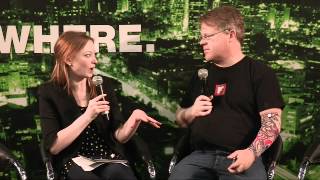
Robert Scoble reflects on SXSW's evolution from 600 attendees to massive booths, the Startup Bus program where teams build companies in three days, and emerging tech like Highlight, which let him collect 500 people within 100 yards. He discusses facial recognition and augmented reality while noting Twitter took six months to reach 15,000 users.
Questions this video answers
Eight years ("Eight years, if I remember right.")
About 600 attendees ("there was 600 attendees at the interactive part.")
Ten buses from around the country and Mexico ("there was 10 buses from around the country and Mexico").
About 500 people within 100 yards ("I've collected 500 people that have been within 100 yards of me on Highlight already").
About six months ("Twitter took six months to get to 15,000 users.")
Here we are. We're live at south by Southwest, TechCrunch TV with Scobalizer Robert Scoble. How's it going?
I'm doing great.
So how do you like this south by Southwest? How long have you been coming to the conference?
Eight years, if I remember right. And when I first came here, there was 600 attendees at the interactive part. And back then, music and film were far bigger than the interactive. We were just the geeks off in the corner, you know, and now we're. We've taken over the whole city.
It's true. Yeah. Do you still like it, though?
I mean, it's different, you know, it's. This exhibit hall, for instance, feels like ces, you know, it's. It's professional, and there's big signs and there's big booths, and it's growing up. When. When we first started coming here, there were just little card tables, you know, and people and entrepreneurs would have their little tables. I like it, but I miss the old days too, you know, it's like having a hole in the wall restaurant all to yourself. That's really great. And then it gets popular, and you have to wait in lines to get in the restaurant.
But the food is still good.
The food is still good. And it's still. Now it's a place that you have to go to if you're a journalist or a company or a venture capitalist, you know, I'm seeing. Well, I had breakfast with the guy who runs Al Jazeera online. Right. And that wasn't true six years ago. Right. Those kinds of people didn't show up. Mostly six, seven, eight years ago was web designers, people like Jeffrey Zulman, who just won a huge award here, Right. At a lifetime achievement award. Those were the guys who hung out at the picnic tables with us eight years ago and talked about web design and how to build websites and stuff like that. This is a different comfort zone.
Yeah. Great. And I also have to say, for anybody who's watching tweets at us, south by Southwest, Crunch, SXSW Crunch. If you have any questions for Scoble or me or anybody else, and I want to ask you, you came down on the startup bus, or part of the way, at least. How was that?
It was fun. I was on the San Francisco bus, and by the way, the team on the San Francisco bus won. But there was 10 buses from around the country and Mexico, so all driving here. And as they drove here, people grouped up and built companies, and it was. It's an interesting experience to try to build A company in three days. You have to come up with an idea, you have to pitch it to other people, you have to come up with a company name, you have to come up with a logo, you have to come up with the website and all that and prepare yourself to go in front of professional judges. You know, Dave McClure, and there was 10 or 15 different judges, VCs that you had to pitch to at the end. And that's a very interesting process. For anybody who thinks that sounds crazy, it really is great networking. So if you're looking to build your network in a certain city, it's great because you're forced to meet other people from that city and live with them for three days and see if they're cool or not. Second, it helps if you're really thinking of starting a company or you're in the process of starting a company. It helps you practice the art of entrepreneurialism. It really forces you to make decisions quickly and convince other people that you're right. And that's a tough skill, but it's a skill that is exercised. It can be improved.
And so you're the startup hound and you see this stuff every day. You get pitches all the time. I think we were standing on the sidelines and you got like three pitches in a few minutes. What do you think is the next big thing?
Well, the one that just left Highlight is definitely the hot thing at this show. I've collected 500 people that have been within 100 yards of me on Highlight already, which shows how fast it grows. It's amazing. By the way, I was on this panel this morning about events, and it's amazing how fast things move. Now. We expect things to get to 200,000 users in the first week or two to be seen as hot.
And it better not fall over.
And it better not fall over. Remember, Twitter took. And people in the industry forget this. Twitter took six months to get to 15,000 users. Right. And this world is moving much, much faster. And that's why the stakes are bigger. This is a bigger industry. And I think that's the lesson of south by Southwest. This is a dramatically bigger industry than it was even three years ago. Yeah.
And I know you were talking about some other super high tech stuff. I mean, thinking out a little further than this. South by Southwest, you're talking about facial recognition apps and these things.
Well, and Highlight is a piece of that. The fact that we now have Facebook, we have an identity system where we, all of our friends and everybody in the world, you know how many People in this crowd are not on Facebook. Probably less than.01%.
Right.
We all have smartphones, really nice, high quality computers with a screen that's really nice, that's always on. When Twitter got hot here at&t went down almost all day, it was hard to use here. I've been on all day long and not had a connectivity problem. And third, we're changing our behavior. We're changing our understanding of what social networks are. We're. We're moving that freaky line along. And now we have things like face.com which is being shown here where I can point my phone at you and it recognizes that it's you and pulls up your Facebook page. Right?
Yeah.
So take those three things further, like another 18 months when Google is supposedly working on these glasses in their new top secret lab. What if I could look at you and it would tell me stuff about you? It would tell me your highlight information or your Facebook. What if it could tell me where the great barbecue is? Or what if I could talk to the glasses and ask it to help me navigate around the world? Where is the Rackspace booth, which is back there, you know, and it could maybe navigate me there? Right. This is gonna be an interesting world to watch evolve over the next three years. Cool.
And speaking of Rackspace, really quickly, you didn't really get a Rackspace big tattoo on your. Are those Rackspace sleeves?
These are just sleeves that look like Hatman tattoos.
Just anyone watching at home might think that that Scoble went out and got inked one drunken night at South By.
That could happen.
We still have a couple days. And you brought up Google and I know that you're really active on Google. Do you have anything to say to the haters?
No. All great things are hated. When Twitter came out here at south by, everybody came up to me in the hallway and said, that is the lamest thing I've ever seen. And people are doing that with Highlight right now. Goddamn East Scoble, you killed my battery. And I don't see the value in this and stuff like that. All great things have haters, and Google is in a deep hole. They're still struggling to come back because they gave Facebook a six year lead in this industry and they're way behind on identity, they're way behind on interactivity, they're way behind on APIs. And they know it, but they have to catch up.
And that said, you're very positive, clearly. But is there anything you're hating on right now or that you think people should stop doing no.
You know, I've gotten pitched a lot of me too. Things. It's not that. You should stop doing that. I mean, Highlight has seven competitors. Right. So everybody's trying to nail this space because they know something's happening. There's enough money and enough entrepreneurial ideas there. But it's execution. And you know, the ones that are not coming out as well as Highlight are just they made some choices that aren't as cool.
Yeah. So it's the little things that really matter.
It really is. And it's tough to give feedback like that. But the market is deciding anyways, and that's how they decide.
Great. Well, Robert, thank you so much for coming by. And have fun.