Tesla FSD Beta 10.69 ride to birthplace of Silicon Valley
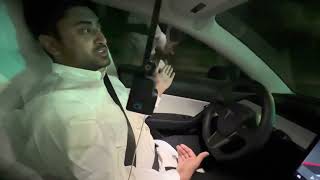
Robert Scoble and Omar test Tesla's Full Self-Driving Beta 10.69 on a drive through Silicon Valley to the HP garage. They watch how the car handles lane changes, bikers, roundabouts, and cones, and discuss whether Tesla's camera-only approach actually works in the real world.
Okay, so.
So we're going to the HP garage, which is the official birthplace of Silicon Valley. It's where Hewlett and Packard started their company in the, in a garage and made oscilloscopes for the U.S. government.
For.
Students at Stanford University, which. All right, so we just left the Los Altos History Museum, which is a trip of a place.
So I'm here with Robert Scoble and a couple of other guys we just met at this super cool event.
Hey.
Hey. And we are going to show them full self driving beta 10.69 and see what they think. We're going to the Hewlett Packard garage and pray for us because we're going to go there with just computer vision.
Right away.
It's smoother than crazy, right?
Yeah, smoother.
Now we got a right turn coming up. Yeah.
Now when it heads towards cars like that, it always freaks me out, but it always goes right around them, like, no problem.
I've never had it. Don't get too close yet.
On Saturday, the guy who runs the team that does the AI at Tesla the test.
So you can see it's. The car was blue there. That means I'm waiting for that car now. I made the right turn, it jerked.
Just a bit there, but smoother than usual. Ash Shock put up a paper explaining how this sees the world. And it sees the world as voxels.
Right. So stopping at the traffic light, you can see it's rendering the other cars in there. It's trying to get the road layout. It can see this car on this side. And yeah, it has no maps or anything. It's just purely from computer vision. It's constructing, as you can see the biker there, it's just constructing this road layout purely from vision. So we got a left turn coming up El camino real in 1.3 miles. So let's see how it deals with this biker.
People give me shit for driving without my hands on the wheel.
Whatever. Well, it's good to have your hand on the wheel. But when I'm making a video, every time I touch it, people go, oh, see, you're really driving. I was like, no, I just have to touch it to let it know I'm still there. Really? So you can see it kind of got away from this biker.
It shows the biker. Yeah, right there.
And it just picked its lane.
Yeah, yeah. And look, I can even tell it to speed. I can tell it, okay, go 45 instead of 35 and it'll just do it. I could even tell it to go 60 and it would do it and it would do it. Well. That's kind of my favorite part about the thing. You know, you can't do that in a waymo.
All right, so where are we? I have no idea.
Does it limit your speed? Was it top your 85?
It can't.
It cannot go up to 85.
It'll go to the speed that's safe on this.
Yeah, it won't go faster than it's safe. See. Okay, now the sign is mad at me. Yeah, but that's okay. Yeah, I was going 85 down 280 to get here. It was fun. Feels like you're on like a bullet train or something.
If it's on a non divided road, it limits you to a lower speed than 85 right now. It probably would let you go to.
What, I guess that was a little bit of unnecessary braking.
Yeah, I saw the blue flash on the screen. You have to give it some input.
Yeah. The blue is just like, hey, touch the wheel. Okay.
So I still want you to touch the wheel.
You put a little torque.
It just wants to make sure you don't fall asleep. Really? Yeah. Okay. You know, because you got to pay attention. It's not perfect. Yeah, it's. It's pretty good. But it makes mistakes, you know, every day, right? Yeah. As simple as like, okay, maybe I missed a turn to okay, that as a mistake mistake.
Even though it's not a fatal mistake.
It was a little bit confused about the left turn lane, but it looks like it did find its way in here. Snuck into this lane. Very cool.
That's crazy. It's very much, much smoother at that. Yeah, mine would be like, you know, hesitant.
All right, now we're turning left onto El Camino Real.
So this is 2 months newer build than mine. Mine is.
We've got a little median divider here and navigated that well. There was also a car coming on the other side, all with computer vision. It's doing this. It's like if you gave me a task like this, I don't even know how I would even begin to approach it. Right. For me, it's just like it's working so much better than I thought computer vision was capable of at this day and age. And on, you know, like an ordinary iPad, computer, just an ARM SoC. This technology could basically run on a phone, right? If not today's phone, maybe the phone of a few years. And you know, the power in a phone could drive any car with just cameras. Alright, so now we got a right turn on Charleston road coming Up.
How many cameras is it using?
8/1 inside to watch me and make sure I don't use the phone.
That's including the eight, isn't there? Seven.
This one's the nine.
There's nine including that.
Three in the front, two on the sides to look back, two on the sides to look forward, left and right, and then one in the rear. So we're getting ready to make a right turn onto Charleston. It's slowing down. It sees the light. We've got this little kind of right turn area here. So it correctly picked it up. We've also got some cones that it.
Needs to make sure not to hit on both sides.
And it made sure not to hit the cones. It rendered them all good. Next we got a left turn on alma street in 0.3 miles. The car is being cautious going the speed limit. So, you know, it reads the speed limit signs with vision as well. I'm going to tell it to speed a little go 30 because I'm impatient.
Have you tried it in rain or fog?
Is it still.
I mean, it. Rain and fog are a challenge, but it still works pretty well.
Much smoother than the version that's in my.
Oh, yeah, that's what my friend said. And you know, she always is like, oh, my God, don't use this piece of shit self driving. Just drive yourself. Like, you know, I don't want to put up with it. But she said, yeah, actually this version is quite a bit smoother. Okay. This is a tough intersection. I'm gonna be impressed if it can figure out where to go and doesn't try and like drive onto the train tracks or something. But let's see if it does mess up, then I'll have to take over and, you know, make sure it doesn't do that.
It did stop in the right place. It didn't try to go on the spot.
Yeah.
Tracks yet.
That was positive. Sure. I mean, easy for us. Very difficult for computer vision to look at a scene like this and know where the proper place to stop is.
There is a big white line there.
Okay, maybe not.
It is difficult to see the white line. For sure.
Yeah.
I didn't see the line.
It's all the line and I didn't. Yeah. All right.
It's just amazing. It. It doesn't run through red lights. Right. It's gonna save so many lives.
Oh, yeah. I mean, even. Even when you're driving manually.
Yeah.
It can alert you if you're about to run a red. It can, you know, hit the brakes if needed to Prevent a collision. They're putting this stuff even when you're driving manually. Their goal is to make it so it's literally impossible to crash the car because the car just knows what there is and not to hit it. Yeah. It understands what's around it. Okay, finally we got a green light. All right, come on. Don't go the wrong way. Don't go the wrong way. Okay. So you see how it paused?
Yeah.
It thought that car might be coming and entering the intersection, but it wasn't. So I'm actually going to send that clip to them.
How do you get the. This functionality to report things? Does that come with the data?
You have it too. I do, yeah. So you can just push that button if you have any kind of.
I don't remember seeing that.
Yeah, it's there.
Okay.
On that left turn back there. Is it because it couldn't see the arrow?
Yeah.
Or it's the car coming too fast. What do you, what do you think.
It saw the arrow. But you know, I think as its driving policy, it just doesn't always assume that people are going to stop. It waits to see that they're actually stopping.
Probably a call.
Yeah. Because people do run lights and stuff, you know, so you kind of have to be prepared for that. But I mean, it's a hard thing. The correct thing for the software to do would have been to just go. Right. Because that's what a human would have done. But you know, it's like walking a tightrope. You have to stop for all the things you're supposed to stop for, while also not stopping for any of the things you're not supposed to stop for.
What's kind of crazy? Like once all the cars are self driving, if they talk to each other.
Right.
If that car could have let this car know, hey, I'm stopping.
Exactly. Yeah. They can all share their policy with each other, sync information up to the server. Like, hey, I saw some construction over here. Maybe you should avoid the street. Like, that's pretty cool. We're really looking at an era where we might have like real time maps where instead of like Google Maps where it's like a static. Okay, here's what I remember the roads used to look like. It's like, oh, there's actually a fire truck on this street. This traffic light is broken and you're getting all this information in real time.
It's faster and more complete to see, to show you cars around you too. This system now is building a 360 degree view of this area in voxels and you can start saying, oh, that little white line has a voxel on it. And that could be shared among all the cars. Right. So if there's a police action in lane number two or a protest or a crash or a fire or something like that, it can communicate that eventually with the other cars. And you'll see Tesla someday switching over to lane. Yeah.
Just using the network, they could all talk to some server and just exchange information.
They already are with traffic. Right. You're seeing the traffic that took that a little.
Well, I told it to speed.
Oh, you told it to speed. But still, it should have been.
It should have seen that a little earlier and done it a little smoother.
I agree.
Yeah. And see, that's how critical we are. We're like, oh, this is. There's different bags of problems.
Oh, yes.
There's fatal errors. You know, those go into one. One bag, and then there's a whole bunch.
It's such a complex problem because on the surface there's like, okay, you can't crash into anything. That's like table stakes. Right. But even after then people are like, it's a little jerky. It was a little rough. I want it comfortable.
I want it.
Yeah, it's got to be better than me in every way. Right? Yeah. So the bar is so high for people and, you know, you show them one thing, they'll be impressed for a little while, then they'll get annoyed, they'll start complaining. And they always want it to be better. You know, they always want. They're always complaining about, you know, what it. What it does and what it doesn't do.
But thing is, people will complain no matter what. Like, if it's driving slow and cautious, people will be like, hey, but I want to get there faster.
Right, Right. Yeah. The head of autopilot software said, you know, you need to be safe, comfortable, and reasonably fast. It's EAS to be safe if you give up on being comfortable and you give up on being fast, because then you can just drive really slow, stop for anything, be super jerky, and you won't hit anything. Doing all three. That's actually the challenge.
Have you found that it's smoother at following the person in front of you? Now here's an interesting one where somebody.
Yeah, this guy merged, so handled that well, I think.
Yeah. Does it. When it switched to camera, only for me, it didn't feel quite as smooth at following people, particularly in stop and go traffic. That was interesting. And sort of.
It wasn't sure which lane to Go in. But we've got a right turn coming up in 300ft.
And it also slowed way down.
Yeah.
Because the speed limit here is 25. And you're turning. Okay, got it.
All right, so we got a right.
Turn a little bit. A little bit too fast for my take in the middle of the turn.
But a little bit right now so you can actually tell it. Assertive, average, chill. I'll put it on average.
I like assertive because that's where I keep it. And I'm judging how smooth it is. And it's very smooth compared.
Yeah, it's pretty good overall. I mean, it's got a few rough edges being a new version, but I think people who are using the software, the hundred thousand people, are gonna, you know, be happy with this update.
Yeah.
Okay.
Do you know when everyone will get it?
More people get it at the end of the week. Then, you know, in a couple weeks after that, they're gonna release it to all hundred thousand people.
Okay, here's a fun one.
Yeah, we got a roundabout. I don'. If it's going to be able to handle this. In the past, I've seen it kind of struggle with some of these kind of roundabouts here in the South Bay, but. Okay. It's being a little overly cautious.
Okay. Okay. Okay, cool.
That was good.
Good.
But too long. Too long to check if it was clear. No, he's.
Keep in mind we're on a fairly unmarked street here.
Right.
And you're coming up to. Oh, it's right here. Yeah, it's right here on the left. Oh, yeah, that's the plaque, and that's the garage. So we should go out and take a picture. Go ahead and park and.
Okay.
Yeah, then we can go back. We're going for a ride with Omar. This is sort of like getting a ride with Elon, only in a faster car than Elon gave me a ride in. What kind of car is this, OMAR?
Tesla Model 3 Performance.
All right. It's faster than mine.
All right.
You do 0 and 60 in three seconds.
Yeah. All right. Software won't be doing that today, hopefully.
Hopefully. Yeah, I'm recording.
All right, Stop for a second while I set this. Even the cars in the parking lot, it's rendering all their positions. Isn't that crazy? Look at that. I didn't even see that guy standing there, but then I noticed the guy and I looked. Oh, is there really a guy there? Oh, there is. So it really helps you see things every time you glance down at your speed, you get this 360 view.
How's it so good in the dark?
Well, they train it in the dark. They train in the light. They train it in every possible scenario. They got 3 million cars around the world going and collecting data.
One hint is, look at the camera. It sees more detail than your human eye does. So the AI can see more at night. It actually works better at night than during the day.
Well, yeah, there's a lot of traffic. When there's a lot of traffic, that's when you run into problems because people are crazy. You know, someone just does something ridiculous. Okay, now I think we're pretty much here.
Yeah, it was back there, but that's all right.
Looks like it missed the map in a little bit. Maybe.
Go, go right and then immediate right if you can.
Okay, we got to give it a destination now.
I was trying to get. Do you want to go to Phil's or do you want to go to Koopa? Well, I mean, I was trying to.
Get these guys hostage for too long, but maybe we'll.
No, I was trying to get to.
Koopa because Koopa, I mean, that's where we just were.
I know. What I want to do is take. It doesn't matter. We could go somewhere else. Java was invented in that building.
Wow.
We passed by where the vacuum tube was invented. The.
Chamath, famous BC Silicon Valley tool from Robert Scoville.
I met my wife uplock from here. Let's go by there. I know this.
That's a real destination.
I drive. I drive me.
That's a year. You just make minor corrections. And now it's gonna upload that to the server, and they're gonna say, huh? Why'd they turn it off? Oh, okay, we failed to see that speed bump. Add it to the data set, label it, you know, run the training again, and hopefully next time you'll see it. But it's a really tricky thing because if you have a false positive and you see a speed bump that's not there, you're gonna be slowing for no reason, annoying people. But if you don't see it and you don't slow down, then you might send someone flying. Like, man, I don't envy those guys. This is a hard problem to be working on.
Here's another one.
Let's see. What's it gonna do? Oh, see, now it's slowed down for this one. Yeah, a little bit.
Light enough, but a little bit.
I think part of the issue was I had it too fast. I had it going 10 over. So I think it, you know, maybe didn't have enough time to respond in the dark. All right, we got a green light.
It should have that as metadata, though, because I'm. I'm sure somebody else has driven this street before.
It doesn't usually use metadata. It's really pure compute vision. Like they kind of want it to fail in a way. Right, because they want to expose the flaws of the vision system. You could mask the flaws of the vision system really easily by having a map data and storing all this metadata to kind of cheat and get the answers. But really foundationally, the vision system has to be really strong to make it work. And you can always layer those cheats on top of the vision system once it's strong. But, you know, they wanted to fail. And then we provide the labels. Right. Every time time I hit the brake or I turn the steering, I'm. I'm giving some labeling to, you know, a situation that it didn't handle correctly.
I like the blue.
Yeah, it's.
I like the being able to see how. Where's our point of no return? Right where are we in danger communicating?
I mean, I, I can't believe it. I'm just, you know, telling the car where to go using voice rating buttons. And we'll just Dr. You all around Silicon Valley with, you know, you mostly just sit there, make a few corrections.
Maybe your blinker went on there. Was that you or did.
Yeah, it changed lanes. Yeah, it does that by itself. Okay, so see, it read that 50 speed limit sign and now it started speeding up.
Do you have. I have it set to go 10% over. So you have it set to just.
I do, but I'm on, on this profile that I use for videos. It's on the speed limit. Got it on my normal profile that I, I have it go five miles an hour over the limit.
Okay.
Okay. That was bad. Yeah, it was. It had it right. But then it decided to give up for whatever reason on getting into that turn lane, but it eventually found its way.
And that's bad because, you know, this has been tested a lot because, I.
Mean, it should work here.
The software was developed right up here.
Yeah, the whole team is right there. You would think it would, you know, it would work pretty well, but not.
Only the whole team, but a lot of the team. Yeah, because now there's teams all over the world who are working on different turns and stuff. Like Chuck's turn is in Florida. Right. So they have a team down in Florida working on. Oh, yeah, they got.
Well, they got the eight ass testers running everywhere. But A lot of the software team is here. Yeah. Even though the headquarters now has been moved to Texas, they're still keeping most of the softer people here. Yeah, because, you know, nobody wants to live. Like, I mean, you know, that event we went to tonight was just quintessential Silicon Valley. And why I love it here is like, where else can you find an event like that where people are just talking about deep learning, voice, AI and, you know, you've just got so many just impressive people like that where you.
Know who actually built it.
Yeah, exactly.
Google and Siri.
That's what draws so many people here at the end of the day. Right, Yep. That's why I came here, you know, and I wanted to go to college. Like, well, I want to go to Silicon Valley.
Please check in with security.
This guy's. Yeah, this guy's trying to kick us out. Yeah, we're not allowed to be in here.
No. Have you ever tried to come in here before?
Yeah. They tell you to leave.
So do they?
Yeah.
That'S funny.
All right, so let me turn this thing on.
My wife works across the street at Rubrik. No. VMware.
Oh, VMware. Okay, cool. All right, so we're seven minutes away from the starting point, so this will be our final trip.
Still is very cautious with those left turns.
It's cautious is good. Yeah, I like cautious. You know, you can always push the accelerator to tell it to go faster.
Yeah, it's like.
Wants to see around the corner.
Yeah, yeah. And I think it's also dark here. There's. In sf, it's pretty well lit. There's street lights and everything here. You know, it's pretty dark. But, you know, I was taking it in Los Altos Hills the other weekend, and it was doing pretty good up there too. You got some pretty green. Crazy roads.
You ever take it outside California?
Like, I've taken it as far as Arizona. And actually one time I sold my last Model 3 to somebody. So we drove it on FSD from Los Angeles to Miami. Wow. And we had 16 takeovers the whole way.
Yeah.
Across the whole country.
16,000 miles you're usually on.
And well, that was a while ago, so I bet now I could even get less than 16 if I did it again. So it's only a matter of time before someone does the first LA to New York Drive.
00 takeover.
Drive takeovers. Right. I mean, I think people should be trying it every month because someone could get lucky.
I can't wait to be able to like, get in my car, go to Sleep at night and wake up in la.
I know. Oh my God, that'd be incredible.
Sun Valley, Utah. Go skiing.
Oh, absolutely.
Leave here at 6pm you'll arrive there at 9. Refresh.
Oh, I know that drive way too well. I was wishing self driving existed every time I did it.
Yeah, going over Nevada isn't as tough. Although it has to watch for things like tire treads on the roads and stuff. Chuck and I were talking about that. I drove mine to Detroit. That's the print stuff.
Oh, really?
That works pretty good. Keep in mind most of the driving is straight, you know, interstate.
So we got a tough little right turn here. I don't know if it's gonna make it or actually. No, it's actually that one. See, this is good. The softer, sometimes better at figuring out which right turn it is. Okay, that was a little jerky.
Yeah.
But I might have maybe tried to go into that right turn lane. Yeah, but the software is good at knowing. Okay. It's actually this one, not that one.
All right, cool.
Yeah, you can figure that out without having pre programmed. Yeah, that exact turn.
It's incredible. So you know, software, just amazing what you can do with software. Yeah. Here we are decades into the microprocessor being a thing and software just continues to blow us away with what it can do, you know, I mean, they're really getting into like Westworld territory with this stuff. Building a humanoid robot and trying to make it do tasks that humans can do using the same type of software that helps you move through the world.
Are you excited for the first software video blogger?
Scoville's been found redundant by the AI because the AI now can blog on its own. It doesn't need Scoville to tell us anything anymore. Or Omar.
Yeah, what can we do? AI is going to take all our jobs. I mean, you look at GitHub Copilot, it's like, shit. Hopefully they don't keep working on this too much.
Or GPT4 is coming.
Right.
I hear it's as mind blowing as GPT3 was.
Yeah, I mean OpenAI is just doing incredible things. Everyone at the event tonight, they were all. Everyone had to at least mention OpenAI once, right? Yeah, they've really captivated people's imaginations. It's crazy how large some of those models are, you know, like it'd be great if you could just run it on your phone or something. But it's like you look at like the size of like GP3 and it's.
Like for Dall E225 million images that are ingested. Well, even this. I mean, each car is uploading 30. Somewhere around 30 gigs a day right now, right?
Yeah.
So you start thinking, oh, there's 3 million cars in the fleet. You know how many of those actually are uploading? That quantity? A good chunk of them. It's a lot of data. I think at AI Day, they're going to show us the auto learning.
Yeah, I'm excited for that.
All right.
We got this little thing in the middle of the road. Made sure not to hit that. That's good.
It's really good at not hitting things.
And the video, you would hope so.
Well, now that Ashok showed off the video where they show how the math works, it's like, oh, that's why.
Yeah. I mean, that guy doesn't get enough credit. Ashok, he's really done something amazing here, leading the team to do this. I mean, I think this is kind of probably deep learning history because, I mean, you see a lot of cool deep learning projects.
Yeah.
But few have the. The bar set so high. Right. Like, okay, you have something like Dall? E. You generate an image from Dall? E. And it's like, kind of weird. If you look at it closely, you can kind of see like, okay, this is kind of not really what a human would generate. Generate. But it doesn't need to be that good because it's just kind of a demo. Right. It's not life or death. Here you have something where it's actually potentially life or death. So it needs to be very, very good. So you see a lot of kind of deep learning projects where they get to, like, 90, 95. But it's rare that you see someone really. You know, I have to try to get to 100%.
Yeah.
It is.
Pulling in the parking lot like this.
Yeah. And there we go. Now we're done.
I'm there. Bravo.
Bravo. We made it out alive.
The robots didn't kill us again.
It was good to meet you guys.
Yeah.
Hey, thanks.
That was a lot of fun.
A professor here. So he probably had, like, a lot of friends at Stanford that he was visiting off and doing these roundabouts every day, going to the office. All right, now we got a longer one. Boom. Just beautiful.
Much nice. Yeah.
Oh, this is going to make the European so happy. Happy when they get this.
Oh, yeah.
It's not perfect, but, yeah. It blows me away every day that this is possible today on our existing cars.
Yeah, I wish the same on my four year old.
Yeah, Right?
It's crazy.
Yeah. There are cars built in 2016 that can run the software. That's crazy. Like, what's your 2016 BMW doing?
More from Robert








45: Sandy Carter Unveils the Future of AI: Myths, Agents, and Creativity | SXSW Insights


