The future of augmented reality glasses with Lumus
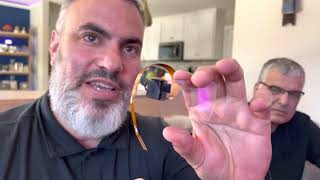
Lumus representatives discuss how their 2D reflective waveguide technology enables smaller, brighter AR glasses with wider fields of view. They cite brightness levels around 4000 nits for outdoor visibility and expect consumer AR devices by 2024, with manufacturing partners Quanta and Shot ramping production.
Questions this video answers
2024 (speakers note this timeline could slip).
Quanta (Taiwan) and Shot (production line in Malaysia).
Speakers mention ~4000 nits for current efficiency, say the Maximus will be >5000 nits, and note >2000 nits as a threshold to begin supporting outdoor AR visibility.
Smaller natural-looking glasses: ~20–30° FOV; more immersive devices: ~40–50° FOV; plans discussed to reach ~60–65° in some form factors.
Well, this is a treat. Loomis is visiting my home, showing me the bleeding edge of wave guides and augmented reality glasses. So who are you guys?
I'm David Goldman. I'm a VP of Marketing at Loomis. Yeah, thanks for having us.
And who are you?
I'm Eli Glickman, Chief Product Officer at Lumos.
It's really an honor to have you in my home, Shawn, showing me the future. So you've been showing me over several years now. Four or five years now six years.
Now six years.
It's crazy, right? And you know, it's hard to show these on video. Right. But the picture quality is getting brighter. The field of view is getting wider, the image quality is getting better. Right.
And the form factor is getting better.
Oh, yeah. And things like battery life are starting to get come into play. And manufacturability.
Yes.
So maybe we should just talk about where do you think? Because you're in the middle of it, you're building these things with a whole company. What's going to happen in augmented reality? How far away is it from me as a consumer buying one of these things and wearing it all day long?
Yeah. So what we're hearing, because we're sort of in the vortex of the ecosystem and we deal with a lot of companies that are building software, smart glasses, is that 2024 is the year that a lot of the devices will be coming out. In terms of AR devices that of course could slip, but that's the current timeline for consumer devices. Like you said, they can be in your hands or on your face.
And when you say ar, we should define that because what Apple's coming out with next year is not. You can't see the real world through that device. So it's not going to be something you're going to wear to a shopping mall.
It's a pass through device. It's a pass through. So I mean, there's sort of a spectrum that everybody's used to seeing this PowerPoint slide. On one end you have virtual reality, which is like completely immersive and all digital. It's all pixels. And on the other side, you might have something like a version of augmented reality. You could call it assisted reality, which is just basic data snacking that shows up in your view of the real world. So, you know, it's, it's, it's relatively few pixels relative to the VR. And we work along that spectrum. Not, not necessarily full immersive VR, but we're capturing the sort of smaller form factor, Natural looking eyeglasses market 20, 30 degree field of view. And then we're up at the also higher end of the 50 degree field of view, which is much more immersive. Could be glasses, could be a visor of some kind. And Loomis plays across that part of the of the digital spectrum. And we're seeing two camps essentially for OEMs that are going to be doing these glasses. One is focused very much on the natural looking glasses and the data snacking type applications. This is navigation or like we saw recently, translation, which I think is a very exciting application. But you don't need to have like 50 degree field of view for those type of applications. But what you do want is a bright image that you can use outside and a battery power that lasts hours. That's critical for those natural looking glasses. So we're there working with those camps and we're also working with the camps that are focused on a more immersive, 40, 50 and even higher degree field of view.
Very cool. What's the breakthrough that's happening right now? Because it's clear that this is starting to become real. Right. Three years ago when you were last year, you could tell it was a ways away. It was still. The projectors were big. In fact, you have some of the early projectors. Right.
The visual is probably the easiest way to sum up in terms of lumis where we have come. Yeah, let's see this one.
Yeah.
The last time we were here, we showed you the vision, which is actually a top down. The projector pod sits above with the Elkos and you've got 1D expanding waveguide. So it's just one set of facets and then the image was projected downward.
When you say facets, there's little tiny mirrors.
Yeah, we actually use the most basic optical element, which is a mirror. It's the most efficient. It also means that we don't have to break up and reassemble color. The colors are reflected perfectly in the tir. Total internal reflection that are in the waveguide. So that's inherent to our technology. It's using mirrors to pass the image. This. Each of these facets are cascading mirrors that are embedded inside. First of all, we're working always on how to make them less visible with the system off. And then we also. So the biggest breakthrough I would say was in the aesthetic as well as the performance by migrating from 1D expanding waveguides to 2D expanding waveguides, which is where we are now.
Okay.
So you can see the difference. I mean the projection module is much Much smaller. And we're using two sets of facets which you might be able to capture on the camera. There's a. This is called the Hloe. It's the.
Let me see if I can zoom in here.
That's the first set of mirrors that are joined together with.
It's hard to see in the camera.
That's good. We don't want it to be that.
No, there's a diagonal set of.
Yeah, there's a diagonal set that are pushing image across in one dimension. And then there are another set of facets that are aligned that actually push the image down. So you're getting 2D expansion in the waveguide, which allows for a large field of view with a smaller projection module because the entrance aperture is actually a lot smaller. And that's what determines how big the. One of the key determinants of the POD projector modules. So that was a huge breakthrough for us. And another breakthrough was on the manufacturing side that we were talking about earlier. We're now working with two supply chain partners, which would be Shot in Germany. And Quanta, of course, we've been working with since 2017. And they both have lines, mass production lines now that are set up.
Where's Quanta?
Quanta is in Taiwan. Taiwan. And Shot has set up a production line in Malaysia. They actually have a line in Malaysia. So that's the. You know, I would say on the. We have all the advantages that we had before from the 1D, which was always considered the gold standard in terms of performance. But now we have 2D which allows for this better form factor. Wider field of view, smaller pod projector. Very cool.
Yeah. The. The field of view on this. Everybody is interested in field of view. Right. Because field of view. I mean, I have an 83 inch TV and this is about a 50 degree sitting from where you are. It's about a 50 degree field of view.
Right, right.
And so the image I saw on this was actually taller than st.
Correct. Right.
Because it's. And a little bit narrower.
Yeah. In this particular optical engine, we're using an EL coast, which also helps determine the field of view and the aspect ratio. And it's a one to one aspect ratio. So you have a taller image than your big screen television. Got it. So the width is probably about the same in terms of the width of the image, but we've got a much more immersive tall image. And because the MTF or the image quality is so good, it actually feels to most people that put it on, like yourself, even more immersive than 50 degrees.
Yeah, ELCOS, you mentioned that. What is that? Because people are hearing these terms, silicon.
It's one of the micro displays that Lumis works with. This. Now it's. We actually also work with oled. Like your TV is powered by also micro LED and lasers. I mean, I would say those are. There's also dlp, that's a, that's another one that we're not. When we could work with it, but we don't. But we have the ability, we're sort of agnostic when it comes to what type of micro display we use. And in some cases companies that are working with us want to take all of the optical engine. In some cases they're only interested in the waveguide and they're going to do the projector module themselves. So they're going to be using perhaps Elkos because it performs really, really well on all wave guides. But they might be using laser, they might be using micro led. So very cool.
So if I'm working at a Microsoft or a Meta or a Snap or a Tesla maybe or an Amazon or any of these competitors that are going to come in the market, I assume you're not getting Apple because if you were working with Apple, you wouldn't be in my house. That's one of the rules of working with Apple. You can't come to Scoville's house.
I can't comment on who we're working with. But we're in, we're in, you know, high level discussions with a lot of the companies you mentioned and we're a top candidate for all of them, mostly because of not just the image quality, but because of now the relationship that we have with shot to produce the waveguides and quanta as well as the efficiency, you know, the efficiency, the brightness we're talking about. We're the only waveguide that's ideally suited for outdoor use. So everybody can be used indoors. But we believe that ours is the only waveguide that you can actually affect the world use outside without draining so much of your battery because of just. Not because we're smarter than anyone else, but because inherent in our technology is incredible efficiency or luminance efficiency. Which means that is that because your.
Mirrors are better than anybody else means.
That because we're using mirrors and we happen to own and have moats around that patent, we're able to use those mirrors, which are the most simple basic optical element, which are extremely efficient. Right. We don't break up the color and reassemble it. The image get passed through, through total internal reflection. And we have very little loss. First order losses, second order losses, very, very few. The other waveguide companies tend to have. That's more of a challenge for them. So you'll hear that their systems that are based on their optics tend to not last that long in terms of battery power.
So let's run through the things. If I was working at one of these companies, you know, building glasses, deciding on you the trade offs. Right. We have field of view. How do you compare to the competition on field of view?
We're right up there at the top with the field of view and we have plans to go 60, 65 more actually we're not limited in terms of the field of view. I think where the field of view gets beyond, you know, the numbers I'm talking about, then getting it into a glasses form factor might not be as achievable. But you certainly we're going to have all sorts of devices as you know, you know that are going to be either maybe a visor form factor or maybe something akin to the hololens or you know, a computer on your face. There are many paths potentially for smart devices.
Right. Brightness.
Brightness. We're at the top of the game. There's. Nobody disputes that we have incredible luminance efficiency. Incredible brightness.
My HoloLens is about 400 nits. Right. Magic Leap is somewhere around here.
Yeah. You can see from our.
You're way brighter.
Oh yeah, we're. We're at 4000 net for the efficiency.
That we are going to have in the Maximus is more than 5000 needs per V. This is the efficiency that we are.
Right. So that's orders of magnitude to see.
An image outside in bright sunlight. How many nets do you need? So somewhere around like that.
Yeah. I mean if you're above 2000 it starts to be possible to experience. Experience AR outside. But the gap between 2000 and 4000 is a big gap and it means for all towards all sorts of ambient lighting situations outside, inside you'll have enough brightness to see well and battery life. Battery life and that. That's sort of the flip side of the efficiency.
Right.
Like brightness and efficiency are very much linked. We can get very bright without using a lot of battery resource. That's again built into the. To the. To the technology. The reflective waveguides that we're using don't need as much power to achieve the kind of brightness that we're talking about to be able to use outside. So that's a, that's a huge thing. You know Our battery life. We go. Tag did a, an article about this recently and he's looked at our stuff and he says it's about 10 times as as bright and efficient as in terms, in terms of some of the other waveguide companies.
10X heat. Because heat is real important. If you're putting a device on somebody's face, if it heats up in any way. Really. Yeah, it becomes a problem.
Yeah. So, you know, and some companies used to solve that by putting fans on the, on the devices, some who remain anonymous. But yeah, absolutely. I mean, if you have a budget that you can work with in terms of the battery life and the efficiency and the brightness, then you don't need as much heat. The heat would be connected to how bright or how much you have to jack up the energy in order to get a bright image. So because again, because we have this incredible efficiency advantage, we expect our all devices based on our optics to have much less of a heat dispensation problem. Price is a big one. So price is a big one. And what we've been able to achieve.
With, let's say I'm buying a million. A million.
Well, I won't, I, I won't, I won't off one foot be able to give you a price for how much it would cost for a million. But what I can tell you is that we're price competitive with all of the other waveguide companies. I'm talking about the internal optics teams at some of the big guys as well as some of the diffractive waveguides that are still not yet acquired. We're, we're right on par with them. And like I said, we have performance advantages. So cost is, is, is, is in line with the market. Got it. Consumer devices. Rudiger at Shot has gone on record, he heads up their AR development. He said, he's on record as saying that we're priced for a consumer device.
And then there's quality of image. I mean my TV has high dynamic range video. That's why you spend that, you know, thousands of dollars on these modern TVs. Where are we in terms of image quality? Like if I'm watching a Top Gun movie or something like that. And yeah, I agree, because you're getting good enough. Yeah.
So there are, you know, a few parameters there. There's contrast, mtf. There's contrast. You know, brightness is certainly part of it. Yeah.
Color.
Well, the color also. Again, that's, that's a thank you for reminding me. I mean that's, we're not as we're not disassembling and reassembling the color. It's incredibly good. Like in terms of natural color, our waveguides, if again due to the fact that we're using mirrors that are transparent, you don't see them, but they're passing along the color. True color, we like to say. So that means white is white and white is white.
Because in my hololens white is like a rainbow.
Right. It's actually kind of similar to what we have over here with the light setup that you have.
Lots of different colors. Yeah.
Some companies were even using that in their logo. Right. They were like actually showing a white that looked like that. Maybe they were hoping that we to were going get used to that as true white. But yeah, look, if I want to read your blog or I want to follow something that you did on Twitter or LinkedIn, I'm using a white background. Right. To see that. Now maybe eventually they'll start doing black ground so the text sort of floats because black is actually see through in ar but for the time being a New York Times article or whatever it is, it's a white background so we don't have any distracting rainbowing going on. It's true white.
I'm going to get nerdy virgins and accommodation. You know when your eyes get. When you, when you get something really close to your eyes, your eyes start getting in and accommodation is when your eye actually changes sh. Shape to focus on something close.
This is.
This comes up with stereoscopic.
How close can I get something virtual?
So there are a lot of. There are a lot of solutions with like that solve the vergence accommodations conflict. One of them is a company called DeepOptics in Israel who I don't know if you've met them, but you should. They actually, they also have a consumer product that they have out but they're helping using liquid. Liquid crystal displays. Right. They're doing. Or LCD transparent displays that just reassemble the molecules and allow for the vergence accommodations conflict to be solved that way. There are other approaches. There are at least four paths that we know of that we can use that work perfectly well with our wave guides and they don't add a lot of extra bulk or weight to the system. So they're like basically transparent layer added on that solves that problem.
This is a general issue of waveguides or normally things that are solved. And there is, as they've said, there is several options to solve the virgin accommodations problems.
It's funny because it only actually affects a portion of the population Right. Is it's if you're under 40, so you're going to have a completely different experience than as if you're over 40. So this means that potentially the C level executives don't notice the problem and then the, the engineers that are working on it do. So it's kind of interesting when you're at a trade show and you're showing the optics.
I just know in my HoloLens I can't get a virtual thing closer than about 2ft away from my Holland.
They have options that it's too close, they shut down the.
Right.
The image just disappears.
Right.
You try to get too close. Yeah. So there are a lot of approaches that we can take for that. But that's good, a good question. It's a, it's, it's definitely again, it is a system.
Not again, this is a system problem.
Right.
The ODM or whatever, the manufacturer that going to do this, you're going to solve this, right.
If he wants to solve like RX integration. Right. Like that's something we're again, we have at least four paths, four different companies, some large, some smaller that we can work with to do to solve the RX layer. We just recently put out a video with lux. Excel, does 3D print lenses and we're able to. Do you bring that one? Yeah. Oh, okay.
So they look so good in this.
In this case they encapsulated. In this case they encapsulated it into a plastic, you know, which, you know, that way it protects from moisture, from dust, everything else. And this is our, you know, our current optical engine, our waveguide rather that it's based on. And everything is encapsulated in the plastic and the prescription is embedded on there through a 3D print. But we've also got at least three other paths to that. Some, you know, using with an air gap, some without.
So this is an interesting question because I have to wear glasses. Right. These are fifteen hundred dollar glasses, they're titanium frames. They're really amazing lenses, progressive lenses and stuff like that. This is what you're really going to be competing against.
Yeah.
You know, how durable can you are these lenses and how flexible are these lenses at fixing a variety of different eye problems that people have.
Right. So again that's a system level, you know, challenge. And so we're not, we're not maybe at the, we're not at the point in the ecosystem that we're making those decisions, but companies that are certainly sourcing our waveguides or optical engines are. And my Understanding is there is going to be some tunable lenses coming out from company that we know well and there are other solutions. And if they're going to do tunable lenses, I would assume that some of the competition are going to do tunable lenses again, using liquid crystal to do this. Liquid crystal display allows for a tunable lens where. And then if you get eye tracking in there, it's going to be very, very easy to determine, based on where you're looking, what to put in focus.
Yeah.
So that's another.
Those are.
That's one path in particular.
Very cool. What am I not asking? What should I be asking somebody like you who's developing the future of these glasses?
I mean, I think, you know, the question that we, that we get asked the most, where we don't have always the best answer are always the use cases, you know, because there are companies, teams of a thousand engineers, sorry. Working on that. And they're, you know, so the use cases that we've been exposed to that excite us, you know, I think most of us are already familiar with, but I think there's a lot more that's under, you know, like sort of below the surface that's being worked on. And I think that that's, that's what interests me a lot. I mean, I've seen also in terms of input.
Right.
Like, we know that it's voice, we know that it's going to be, you know, gesture recognition, eye tracking or gaze tracking. But this, I think it's ecg. I forget what it's called, actually, the.
Band that was just recently Meta bought a company.
Yeah. So I like to say that's, that's all the control without all the crazy. Right. Because it's just very subtle gesture, you know, movements that will help you navigate content that you're looking at. So this is like really, really smart. And I think we're going to see a lot of innovation on that side. So it's not necessarily our expertise, but because we partner with a lot of technology companies in the space, we're privy to sort of what's coming and I see a lot of innovation on that and on the haptics.
So we could spend an hour just talking about these cases. In fact, on Twitter spaces, every night we talk about. But I guess we have Twitter spaces that go from six to midnight.
Okay.
Oh, really? Yeah, we talk about it a lot. Well, thank you so much for coming out and showing the latest estate.
It's always a pleasure.
It's hard to show anybody what, you know, through an iPhone, camera, what these things look like, but they're dramatically better than the last time you got here.
Yeah, it was a pleasure.
It's coming. You can tell the whole industry with the Qualcomms references and they just showed off, you can tell that glasses are coming.
We're also tracking all the IP activity, right? Because we have a very extensive IP portfolio and we're always tracking it. We're tracking the competition. Interestingly, our waveguides are cited more than any other waveguide technology, you know, by all the big guys. Right. They have to put us in the prior hour. But what we're seeing is an explosion of IP right now, which means that in two years time we can expect to see consumer devices. I mean that's another indicator.
So totally, I know, totally agree. It's going to get exciting. I think WWDC is next week we're going to see some new neural radiance field technology which is the use cases.
Right.
Apple's going to start showing us a few use cases for why we want glasses instead of a screen like this. Right. Because a screen like this can only do 2D, right. We can't do things where you can walk around a 3D football station, stadium or something, or a classroom or something like that.
And companies like Unity and Unreal and all the, all the work that's going into there. Nvidia, you mentioned earlier like there's so much coming.
Welcome. Where do we learn more about it?
Loomisvision.com we just actually launched a new website which has a lot more detail about the technology, how it works, products, you can view them either, you know, waveguide, optical engine, you can see the form factor that results from the waveguide and also follow us on social media. LoomisVision, thank you so much. It's our pleasure. Thanks.
More from Robert








45: Sandy Carter Unveils the Future of AI: Myths, Agents, and Creativity | SXSW Insights


