Tour of Giant AI's Robot Lab
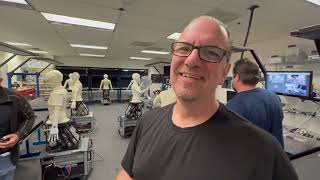
A filmed walkthrough and interview (Robert Scoble with Giant AI founder Adrian Koehler) showing Giant AI’s ‘universal worker’ humanoid robots and explaining their low-cost, cable-driven hardware, perception and learning-based control, and deployment strategy for manufacturing and service work. The video emphasizes perception-and-dexterity over precision, safety-by-design via lightweight plastics and tendon-like actuation, teleoperation/puppeteering for fast task teaching, and the company’s focus on manufacturability and large-scale labor substitution.
This is a real special treat. We're about to get a first look at a top secret stealth mode robot company named Giant AI. And the founder, Adrian Koehler, built the computer vision system for the first Stanford autonomous car, which became the Waymo company and built this core software for Magic Leap, which became one of the bigger augmented reality glasses company, just won best of show at Augmented World Expo a couple weeks ago. And he wrote literally the book on computer vision that's used in a lot of computer science classes today. So it's a real treat for us to get a little look inside some secret stuff.
Well, this is the robot school. So what you see here is a large number of robotic agents that are actually practicing and training and learning. The secret sauce of Giant AI is the artificial intelligence that controls the robotic bodies, right? So if you think about this robot, why, why don't people make robots out of plastic? You know, in the past, right, and that's because in the past the paradigm was the robot should be precise and it should do things in a repetitive way. But if you think about environments that are designed for humans, this task is not exactly repeated twice ever, right? It's going to be a little different. You know, you're going to flip a burger, you're going to flip the next burger, it's going to be a slightly different burger being flipped in a different place, you know, whatever the cheese might be in a stack and you got to just grab a slice. Whatever you're doing, it's going to be a little different every time. So this kind of paradigm of precision doesn't even work for normal human tasks. But if the paradigm is one of perception and dexterity, that's what we humans do. We look at what we're doing, we feel with our hands what we're touching, and we interact with our senses to constantly adapt for changes, not just in the environment, but our own bodies as well. So these robots that you see in the background here, every one of them is in some sense slightly different than every other one because they're manufactured using high volume consumer type processes. But it doesn't matter because the AI that controls them quickly learns to inhabit that body and quickly learns how to achieve a task using its own form, even though it's not a precision form, right. When it reaches with its hand, it looks at the relationship between its hand and what it's grabbing and constantly adapts based on what it sees. So it doesn't really matter if, you know, a moment ago I tried to reach forward and I ended up half A millimeter short of where I thought I'd be. It doesn't matter. I just look at where I am, and I do the right thing for the moment that I'm in. What's happening right now is the robot, you see, is actually learning. So hugohu, standing behind the robot, is both offering it objects to handle and manipulate and also, in some sense, grading it. So if it does something badly, he'll say, hey, robot, you know, that was bad. And if he does something very well, then he'll, in effect, give the robot a treat in a digital sort of sense. So what you see is the. The robot is learning how to manipulate this kind of rigid object that's somewhat complex in shape. And it's practicing this phenomenon called loading rails, very common in a factory setting, loading something into a machine. So it's kind of learning that, but it's not just learning about the rails. It's learning about this object that it's holding. And it's also learning how to be efficient, how to be fast, and how to handle objects that it may have never encountered before. This object is rigid and round and shiny and has many properties that are somewhat antagonistic to the algorithms of the 20th century.
That's cool. Tell us about the AI because, okay, you covered, the arm here is very low cost. It moves around a lot, right? If there's a little. If somebody's walking around or there's a machine next to the robot, it's shaking it. It's not, you know, it's not precise, as you put it.
Well, I mean, to us as humans, we don't even see that lack of precision, right? And we're talking about fractions of a millimeter. But if you want to grab a general object, you want to reach over and pick something up, if your finger is off by even a little bit, if you're not, if there's no feedback, you can't see that you can't adjust, then you won't pick up the object. Correctly grasping is difficult. And placing something, you know, between these rails or some other version where you're inserting it into a machine or whatever you're doing. You know, even those tiny fractions that aren't easily perceptible to us as people is actually sufficient to, like, not place it where you want it to be. We are so good at this as human beings. We don't even notice that we're constantly adjusting and adapting everything that we do. So for the robot to learn that behavior that mammals generally and humans specifically have, you know, that's actually quite difficult. But one of the payoffs of this is that this arm, which is entirely made of plastic, all of the actuation is done through a kind of tendon like fibers. So there are no motors inside of the arm. It makes the arm very light. It makes the robot naturally safe. And it means that the motors can actually be very small.
The motors are down here, these are.
Transmissions, but the motors are slightly behind.
Got. Okay. And it's pulling on cables that go up through the arm and are pulling on.
That's exactly right. And so this sort of cable driven robot has been, you know, people have tried to build these things for many decades. But the difference here is that humans who are essentially cable driven, we rely on a very sophisticated control algorithm to make that work in practice. And people who have tried to build factory type precision robots in the past actually had a lot of trouble doing it with cables because they didn't have sufficiently advanced control algorithms to be able to manage that. For us, this is the punchline. This is the heart of the matter. By using a sufficiently advanced AI, we can build a cable driven robot. By building a cable driven robot, we can make it out of plastics and low cost materials. By doing that, we can build something that is as sophisticated and capable as a human form for what is actually a tiny fraction of the price of even an industrial robot arm that frankly doesn't even come with a hand.
This seems really useful. I mean, imagine you're in a manufacturing line and I'm a human doing something over here, and there's a bunch of cans going by or there's a bunch of objects. Right. Do you see this as what they call a cobot, in other words, a robot that works with the humans. And I would hand something to a cobot.
Well, we don't use the term cobot because over time, cobot has become. Become a very specific term in the industry. So a cobot technically refers to something that looks like a traditional robot arm, but has sensors in it that can sense its impact with a person or something in the environment, stop its motion. So it's designed to be safe, but it's otherwise the same as traditional robots. In this case, this, what we call universal worker is safe by design. It simply cannot hurt you. Right. This entire arm weighs one or two kilos. It doesn't really have the capacity to harm you. It's not like a traditional robot arm that's made of steel and might weigh, you know, 100 kilos.
Right.
So this device is sort of safe by design. But if you mean sort of philosophically. It's similar in that sense to a cobot. You can work, you know, elbow to elbow with it, it can't hurt you, and it can do work in a space that is the same sort of shape and confines as where your, where your coworker used to be before he would and moved to Hawaii.
I noticed that the head actually moves like a human being. But that probably tells me something about the perception system that you built in the eyes. How is that thing seeing? How is it perceiving the world around it?
Yes. So the. Well, first of all, the universal worker has a variety of different senses. And this particular model you're looking at here has vision sense and it has a touch sense through its fingers. It also has a lot of proprioception. You know, it internally, kind of knows how hard its various muscles are working and so on. But notably, it can see and it can touch. Okay. So when you, when the robot looks at something, if it, if it didn't have a mobile head, a workspace that was designed for humans would often have parts in places that you wouldn't be able to see. So it needs to be able to orient its head towards something it wants to grasp, grab it. Once it has it, then it can look at where it wants to put the thing, just like we do as humans. Right. But again, it comes to the issue of how human beings operate in the spaces we designed for ourselves. Right. So if you're going to design a workspace entirely only for robotic use, then you can do lots of things, but you're spending a lot of time and money, right, to do that. So in most cases, that's very impractical. We've had these robots for decades. Everything that could be roboticized pretty much has been. And now we have this labor shortage. It's a myth to think that the traditional robotics were there to solve labor shortages. They were never there to replace workers. They were never there to do the work that used to be done by human workers. They were there to do something new, something better than a human worker to could do.
For some narrow classes like Tesla has a huge robot that flips the car around in the air and puts it on another line, which reduces the space. Right.
Superhuman strength is something that humans obviously don't have. Right. So if you want to move around huge car parts, you know, it's hard for people. They had to have a lot of gantries and, you know, things hanging on hooks and moving everything around. It was very, very difficult. Whereas a single robot arm can pick up something as large as an entire car. Right.
You're one of the few people who's built an autonomous car and a pair of augmented reality glasses, and now you're building, manufacturing robots. How are those similar or different? What are you learning by building all three of those things?
That's a great question. They're much more similar than they appear. I mean, there's a reason all these technologies are emerging in human history in the same decade. And at the heart of them is artificial intelligence. And some of these things require more perception. So for example, a self driving car is relatively easy to control. It's easy to make it do what you want it to do, but it lives in a very dynamic environment. So the life of a self driving car engineer is very much dominated by problems of perception and not so much challenging in the world of control. Right. Whereas some of those other things, obviously in augmented reality control is not an issue. But you, because your glasses are not supposed to be driving you around.
So that's until you see the ones coming out soon.
Well, that's true, things could get weird. But for now, glasses though, they, if you think about virtual reality, you don't need a lot of perception, right? Because the entire world is provided by the glasses. But in augmented reality, then content is actually injected into the environment. And so if you think about early kind of augmented reality, it was more like heads up displays, just showing you some information in your vision. But if you think about modern augmented reality activities, there's a lot of interest in creating this sort of cinematic content that's actually embedded in the world in a sensible way. So for example, you want to have a conversation with somebody in a kind of teleconferencing mode. You want to perceive them as a sort of hologram that's actually sitting in a chair at your dinner table, right? Well, that's, that requires that your glasses know that there's a chair there. It also requires them to know that there's a table, because the table of course occludes part of the person's body. So figuring out how to create a rich augmented reality kind of cinematic experience embedded in the material world requires a rich perception of the material world. Now if you're a robot, that's the next step. It's all of the above. The robot has to have a rich perception of the material world in the same way that augmented reality device does. A car needs only concern itself with things that cars tend to see. Other cars, bicyclists and so on. An augmented reality device needs to live in your natural space. For a robot, it's very similar. The robot operates in a natural space created originally for human use. And so it needs to be able to handle objects it's not never seen before, and changes in environment and going from one factory to another and so on.
This robot is, can it work in a dirty environment, a wet environment, or is it designed to be in a fairly dry, fairly clean environment?
Well, the one you see in front of you is a R and D implementation, right? So we have focused up to this time on building units that had very high capability to allow our artificial intelligence team to really work on the algorithms and develop the control paradigm and perception and so on. So the next step for the company on the hardware side is to build versions of this that are designed for higher volume manufacture and more general robustness in the environment. But one of the things that's interesting about this robot is, for example, if you were working in a restaurant where there was hot grease, clearly the robot is not readily designed to deal with that hot grease. But then neither are humans. What do humans do? They wear an apron or gloves or something like this. Because the universal worker has this humanoid form factor, it can use an apron or gloves instead of some custom manufactured thing that might be very expensive. You can just go online and buy gloves for it, or go online and buy a face mask for it, or whatever you would need to protect it.
I was thinking about all the factories I've visited around the world. One was the Louisville Slugger Bat company, right? And there you had a human putting a piece of wood on a lathe, letting the lathe do its job, and then taking the bat off the lathe and putting it in a box. Is that something that this. The question is, how heavy an object can this robot lift? And could it do that kind of job where it's maybe a three pound bat or something like that?
Sure. The normal lift, actually. So this is a funny feature of building robots in America, because all these spaces that were designed for humans, this is not the 1930s, right. This is the 21st century. So there's a lot of rules about repetitive stress injuries and things like that. So human workers don't highly repetitively handle excessively heavy objects without some kind of other infrastructure that supports that, Right. So here what's happening is that the worker is designed to handle objects on the sort of one to two kilogram range, not extremely heavy, but that's actually quite typical for repetitive work. One of the things that you get for having two hands, though, is that not only can you in essence be stronger if you pick something up? There's some other subtleties in having two hands. If you pick something up in a two handed grip, you now mostly move it with your arm muscles, not so much with your wrist or fingers. Right. Also, on many objects, they may not be extremely heavy. But for example, the bat that you mentioned is actually very hard for a robot to handle traditionally, because a robot typically has just one point of grip, and so it may have a lot of kind of leverage, right, to twist in the grip. Whereas if you have two hands, large objects are much more easy to handled for that reason as well. So that's a very classic job in the US in many of the advanced industrial countries, manufacturing is dominated by this task of essentially taking material, putting it into a machine, letting the machine do whatever it does, and then taking the material out. Right. This is called machine tending. And this is a major market for us to just operate that machine where the machine is maybe been there for decades and is going to continue working for many, many years. But the owner of the factory can no longer hire the sort of labor they need to just stand there and put bats into a lake.
My other friend Barry runs a jewelry company here in Santa Cruz. He has a huge factory that does a lot of jewelry. Could your robots pick up small things like rings or, you know, earrings, or things that you put in your nose or things you put in your tongue or things you put in your ears?
Right. Just like a human. Right. A young child couldn't handle something like that either.
Right.
And as the, you know, baby becomes a little child, and little child becomes old, they become able to handle more fine things. Our workers are going through a similar kind of evolution. As the artificial intelligence controller evolves, it becomes more and more capable of handling more and more challenging objects. So, you know, things that are very fine or, or things that are very thin, or a little bit later, things that may be flexible. If you think about handling a piece of paper or folding a towel in a hotel, these are things that you will be able to do. But the AI controller is in essence growing up in the same way that you would expect a child.
On the other side of that, a lot of jobs I've had to do on manufacturing lines require some force. Screwing in a screw or, or even loading a motherboard. I built Apple II motherboards when I was a kid, and putting those parts in the motherboard required some force to get them to snap in. How much force can your robot do and is it designed to do that kind of Work where you have to put some torque on a screwdriver or a.
In general, it should be able to do whatever a person can do. It's not super strong, it's not designed to be stronger than a person, but it's designed to have enough strength to do anything that a person would at least repetitively do. One of the differences between kind of biological form like a person and the form that we use for universal worker is that people are capable of kind of burst outputs of force or energy, and they don't have quite the endurance of the universal worker. The universal worker is a little bit more tuned to repetitive action than the human body. But if it's something that a person does all day, then you would expect this, this robotic agent to be able to do that as well.
Now this is your, where you do the AI this lab. Then you have other labs where you actually build the robots. Right. Tell us a little bit about Giant.
Sure.
The company you're building.
Well, so there's actually three labs. So there's an AI lab which is pure software. Right. Then there's this lab which is where it kind of all comes together. And then there's another lab which is a production lab, which is where the robots are actually built and where we're doing the foundation work to design, you know, the next generation while we're producing whatever generation is coming off the line today. So the AI team builds algorithms, the hardware team designs and builds the universal worker. And then they kind of come together in this lab and we actually install the software. And this is where they learn and practice and play with their toys and grow their dexterity and their understanding, understanding of the world around them.
How does a worker, like your worker here, train this and how fast is that being trained? Because in previous AIs, it took a lot of iteration to train something to do a job like what you're trying to do with these things. Tell us, what's the state of the art of the AI? How fast?
So this is something that's happened in AI broadly that is really game changing for us, but really for the entire AI community, there's been a big shift from a situation in which you have to kind of train some kind of algorithm every time for every different task, to a situation where you have something analogous to what's called a foundation model. In natural language processing. You've done a great deal of sort of generic training and then only a small amount of additional information is needed that's kind of task specific or tells it what to do. In fact, in this case, the greater challenge is simply how do you convey to the worker what you want it to do rather than per se programming it to do that or even teaching it how it's not how, it's just what is the big challenge. Right. So these universal workers, they've practiced all kinds of things and done all kinds of things and seen all kinds of things before they ever get to an installation. So then when it's time to actually learn a task at a, at a factory, they need to be shown the task and then they practice it for a couple of hours and typically by the end of the day, they can do whatever it is that the human worker was previously doing in that work cell.
How does the worker interact with the robot? Is it via screen and a computer clicking on a screen, or are they eventually going to wear augmented reality?
That's a great question. So maybe I'll take you over.
Yeah. Because I see somebody wearing some gloves over here.
So the way that this works is an operator who might work for us or might work for the customer who's, you know, leasing the robot. The operator has these sort of wearable exoskeleton, if you like. This exoskeleton is sort of a virtual exoskeleton. It used to be a rather mechanical one. You can see over here on the right. But it's actually now it's the gloves and it's these sensors that are worn and these are sort of prototypey sensors. So I, you know, apologize. They're a little chunky looking. They would be, you know, pretty invisible in production. So what happens here is that the gloves, once you take control of the robot, however you move the gloves, then the robot will move. And these other sensors are the body, allow you to control, you know, that it will naturally emulate all of your body motion, including your head motion. So we talked earlier about how you look for things or how you sort of acquire visually an object you want to grasp that's inherited from what the operator did. So what will happen is. Well, let's see, let's. Let's look a little bit at how this works. So can you. Do you want to do it with the VR headset or you want to do with. Sure, let's do what the VR head said. So if the operator is near the robot, they can just look with their eyes, but if they're remote, which is often the case in a practical situation, they can use a VR headset to see from the point of view of the universal work. Right.
So they can be Running a factory line from their house, they could.
Well, they don't have to run the factory line. All they have to do is. Or the robot worker, what to do on a new task. Right. Once it's learned the task, it can do it on its own. So here Robert is wearing augmented reality headset, which allows him to see in stereo from the point of view of universal work. It's not. Because this is not. He's not going to do the job this way for the customer. He's only going to configure the robot this way. And once it's been configured, then it will learn on its own and it doesn't need his further intervention.
Got it. These are pretty. Did you build these gloves? These are specialized things.
There are, you know, various kind of data gloves in the world, but the. The things that you can buy are nowhere near satisfactory for our task.
Got it.
So if I bring attention to this worker here, this is the one he's controlling. So if he wants to teach his task.
Hi there. You're waving. See, Haney's over there waving.
Okay. If you want to teach it a task, then you just need to move it through the motion. We call this puppeteering. So the puppeteer or the operator is gonna pick the object up and do whatever it is that they need done.
And you can see how. Thank you. Oh, wow. That's cool.
Pretty good stuff.
Yeah, yeah.
So these demonstrations, the operator will demonstrate for a while. They'll demonstrate a few dozen times because the task may have some variability. Right. The object to be picked up might start in a different place or whatever.
Like. Like I just lay it down like.
You just came some other place. And so the operator.
And the operator dropped the object.
Oh, yeah. If the operator drops the thing, then they're not teaching the robot very good habits. But when they. When the operator does the task, it sort of tells the universal worker several things. You know, what objects it should be manipulating. What's the point? Like, what's the end goal? What are you trying to do with, say, the water bottle? In this one case, it was pass the water bottle to Robert. Right. But it may not be, you know, maybe in a different case, you're supposed to take the water bottle and put it inside a machine or inside a packaging box or something like that. Right. So when you puppeteer the robot, you're telling it what. What you're working with, what part of the world is to be interacted with. You're telling it what the goal is. And it also inherits kind of a Hint about how to actually do the task. For example, you know, when Robert was operating the worker, he picked the bottle up with one hand and passed it to the other so it could then pass it to you because you were on the robot's left side. Right. So that is kind of a strategic tip that the robot doesn't try to figure out on its own.
It will.
It will say, well, if that's how Robert did it, that's how I did it.
It's really interesting. When it looks at me, it feels human, which is. We were having this argument in the AI community. Is AI sentient? I mean, it starts. Your human mind is too simple for this and starts ascribing human qualities to this almost instantly. Right.
Obviously it has this humanoid form, which is very tempting. Right. And we discovered early on, you know, they didn't used to look so, I don't know, anthropomorphic. Right. But they were kind of weird to operate around. They were human enough. They had five fingers and sort of, you know, eyeballs on stocks. And that was actually very uncomfortable. So what we learned very quickly is that people generally, and think about those co workers that are right next door to the thing in a factory, they interact with it much better if it's more human. Like, it's not an uncanny valley thing. We're not even close to the uncanny valley. It's clearly a big plastic robot, but it is a robot that presents itself in a way that's familiar to human beings. Right. And for example, you know, it has a nose and it has a mouth. And you might ask, why does it do that? If it doesn't. If it doesn't eat, why does it have a mouth? And the answer is because it can't smile at you if it doesn't have a mouth. Right. If you imagine the same universal worker, we're with a flat face, it would look evil, like a stormtrooper or Darth Vader or something. But by having kind of a pleasant presentation, it's simply more psychologically comfortable for humans to work around.
It's very interesting. It sort of is trying to communicate with me, even though it's not. Your mind starts ascribing that to it instantly.
That's right. Well, when the worker is under active control, control of an operator, of course, it.
Sorry, yeah, it's actually him talking in that sense.
There. There is real kind of life behind it. Right. But at the same time, once it's practiced its activity and it's doing it well, it's going to do it. It's going to emulate that operator as well as it's able. Right? And so by doing that, it will naturally pick up these sort of ticks and weird behaviors that are very sort of human things to do, because that's sort of what it's teaching.
What is he seeing in the VR headset? Is he seeing a bunch of control surfaces that he uses eyes or anything?
No, he just sees what the universal worker sees. He sees right out through its eyes. To the extent that he sees hands, he doesn't see his hands. He sees the workers hands. In the case of remote configuration with the VR type environment, then the operator perceives themselves to be the universal worker. So at this task of, let's say.
Handing a water bottle or putting a water bottle in a box or something like that, how fast is the robot? Can it keep up with the human being, you know, doing the same thing.
As with everything else? The universal worker is designed to be sort of human in capability, but not necessarily superhuman.
Right.
If you think about a complex work environment that was designed for humans, it's not useful to be twice as fast because the guy you're supposed to give the work piece to next is not twice as fast. Right. So high speed is great if you can. If you're going to rebuild the entire production process from end to end, then, you know, if every robot is twice as fast as a human worker, then you get twice the throughput. But the actual practical reality for all these factories and hotels and, and fast food restaurants and everybody else is they just don't have enough workers.
Right.
So they're trying to fill in the empty spaces that have been created by people leaving that sector and not being replaced by new workers. So faster is not necessary, but human speed is the goal.
Is there anything I'm not thinking of? Because you've been building this for years now. You know, I don't know all the questions to ask. Like you told me on a previous visit, the eyes see neural radiance fields. We did a talk on neural radiance fields. Nerfs. Is there something else that I should be asking about?
There's a vast degree of, you know, inner space inside of the robot's proverbial head. You know, this is. I don't think we could, you know, get through all of it standing here in the middle of the lab. But it's right, there's a lot of emerging technologies, technologies that play into how the robot operates, whether it's, you know, radiance fields or it's, you know, transformer stacks and foundation models or all these other things. And all the technology that you see coming from all these different parts of the AI world is being in, in a sense gobbled up and remixed by everybody every day to make, you know, the next generation of things and the next generation of things. So, you know, kind of like the transformer stack itself. We're constantly taking whatever happened last month and not just we, everyone in the AI community, all the exciting things that happened last month and you know, remixing it in a way that's relevant to us and then producing new output that month and then other people will remix that.
And that's it's not just every month. Just this morning there was 47 papers at this conference on just neural radiance fields. How do you keep up?
It's hard work. So, you know, several of our AI team members are at, I assume the conference you're talking about is cvpr. We have, you know, several people at CVPR right now. And before they went, I mean there were 2,000 papers that they went through. They split them up. Each person took several hundred. They went through all those papers and figured out what they were going to be most interested in, had a discussion ahead of time. There's a lot of pre planning. Going to CVPR is like trying to, you know, capture Osama bin Laden or something. I mean it takes a whole team of people, it takes a lot of planning. There's maps and whiteboards and, you know, arrows drawn on the board. You know, you go here, you go here. It's, it's really quite an endeavor. And you know, even when there isn't a really big salient conference like CDPR or NIPS or iclr, there's you know, papers coming out on archive preprint papers in the AI space. You know, every day there's dozens of papers that have to be at least given a mode of modicum of consideration to determine whether there's something there interesting to us.
If you got a tour of a competitor's lab, like a Tesla lab or something like that, what would you be looking around at?
Spandex? Well, I mean, you know, I don't know where, you know, other people are on these kinds of things.
Right.
Tesla has been very public about their desire to build a humanoid robot. Their conceptual robot is one with legs that also walks around. That presents a lot of really serious engineering challenges. Challenges also power though, I suppose Tesla's a, you know, if you need a big battery in your robot, Tesla is a reasonable place to go. But their approach is, I think, more Typical of a large company is to set a very complex omnibus approach that has sort of everything you want in it and then try to build that. It may take a very large team and a large amount of time, but the concept is to then finish with something that's very complete. Of course, giant AI is a startup company, so we focus on things in a very priority basis. Right. So, for example, we talked about why the robots don't walk. Most of our customers don't really pay their employees to walk around. In fact, they would prefer they didn't. So it's, you know, we don't focus on that. And so we have many advantages. The robot can be plugged into the wall and it has ample power for its, you know, AI activities and so on. If you're going to walk around, you don't have that. So, you know, there's efforts to build any number of kind of advanced robotics programs in different places. But I think what we're doing is very distinct. I think it's distinct in the focus on price, the distinct focus on manufacturability, distinct in the focus on very high volumes. We want to build something that's going to radically change the labor market. Not just now, but forever. Great. Over the next 20 years, this problem that these employers have of having trouble getting low skilled and unskilled workers is only going to get worse and worse and worse. And you're seeing it on set in the United States. It's been a problem for a while. You're now seeing this problem onset, for example, in China. So our ability to make up for our shortage of workers by just buying stuff made in China, well, that's going away. So the whole world is beginning to feel this. So we want to produce a technology that's really globally transformative and that focuses our attention on certain particular aspects, like, you know, manufacturability, like how it is that you can make something that is low enough cost that it can compete with all of the manufacturing that goes on in the world.
Very awesome. Thank you so much for letting me be first in the lab. I know that's probably scary to you because everybody's watching this and go, they, you know, they have a good idea on the fingers or something like that. And there's a lot of fear of that, right?
Well, I mean, there's always critics on the Internet. You know, I think, you know, for the critics, you know, we're not really concerned about you guys. For the other people out there who are building like exciting new robot technology, then, you know, this is. This is the thing to be doing. Like, you're doing the right thing. And so are we.
Thank you so much.
Absolutely.
More from Robert








45: Sandy Carter Unveils the Future of AI: Myths, Agents, and Creativity | SXSW Insights


