Tour of NASA's wind tunnels
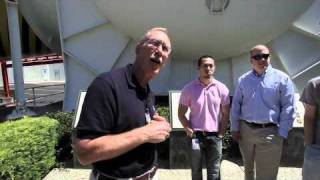
Herb Finger and Scott Rich walk through NASA Ames' wind tunnels, showing how they test helicopters, aircraft, and Mars parachutes. The National Full Scale Aerodynamic Complex is big enough to fit real planes. They explain power costs, safety procedures, and how data gets collected at speeds up to Mach 5.
Questions this video answers
40 ft tall by 80 ft wide.
80 ft tall by 120 ft wide.
40x80 runs about 300 knots (~345 mph); 80x120 runs about 100 knots (~115 mph).
11-foot transonic: Mach 0.2 to 1.5; 9x7 supersonic: Mach 1.5 to 2.5; 8x7 (available): Mach 2.5 to 3.5.
Typical facility power exceeds 100 MW; the 11-foot can reach about 176 MW and the 9x7 about 192 MW (quoted peak figures).
Foreign? No, we're going to start off together. So the sort of. The plan is we'll talk a little bit outside the building. I'll probably start doing most of the talking. Let's talk about this wind tunnel for a second. And then, then we're going to go talk about this set of wind tunnels. And then we're going to go after sort of a little preparation, then we'll actually go inside one of the test sections over to the 9x7 wind tunnel. Let the bus go by. Scott's actually a test engineer. So as far as aerodynamic and how the tunnel works, he's much smarter than I. I'm a data guy, so I can talk about the, the data systems and the like. So we'll go into the facility, go into the control room, sort of show you what the control room looks like, then go into. Actually go what we call the dance floor, and then into the, into the test section. And you can see what it's like inside a supersonic wind tunnel. But before we go into that one, just wanted to talk a little bit about this facility. So this is the. What you see here is the largest wind tunnel in the world. It's called the National Full Scale Aerodynamic Complex. When I came here, and I came here in 1970, so I'm an old guy, when I came here, there was just this test section, which is the grayish building sort of that doesn't look like everything else. And it was a circular building. That whole section wasn't here. And it was called the largest wind tunnel in the world. No, it was largest wind tunnel in the free world. So somebody. There was some tunnel in Russia, I guess. So somebody didn't like that distinction or something. So back in the late 70s, early 80s, we added this test section that you see sort of sticking out diagonally from the main building, and that became the largest wind tunnel in the world. And so what do I mean by large? Well, first of all, that test section is called the 40 by 80. It's 40ft tall, 80ft wide. It'll hold the Learjet hole. Just to give you some sort of spatial reference, this test section is 80 by 120. So it's 80ft tall, 120ft wide, holds a 737. So if any of you have flown on Southwest, you know, they use 737. That's what you've got here. Back in the early 2000s, we had a plane, something called a Dash 8, which is a prop plane, equivalent size to a 737. It actually flew into the, on Moffett Field that we have, you know, Runway back there. Actually landed here at Moffitt, was defueled, tugged over to the test section and this big yellow crane actually lifted up the model. The wall of the building actually is a set of doors which opened up the crane, put it in the model in the tunnel, gently plopped it down, ran the test doors open, take it back out, tug it back off to the, to the Runway, fuel it up, fly it out. So a real plane again, 737 size. Now if any of you are in the supercomputer building, which is sort of down there, and you're sitting in your office looking out the window, imagine what it's like to see a plane being pulled down the street right by you. But you know, one of the things you do when you live in an aeronautical center. So this is again the largest wind tunnel in the world. However, its use, it currently is being run by the Air Force. So NASA used to run is primarily used for helicopter research because it's a relatively slow wind tunnel. The 40 by 80 section runs about 300 knots. I think that's about 350, 345 miles an hour. The 80 by 120 runs about 100 knots, so about 115 miles an hour. So it's a relatively slow tunnel, but is ideal for helicopter research. We've also tested on my watch, when I was still over here, we tested the Mars parachute. The parachute is they use for the Mars lander. It turns out that while the atmosphere, the lander goes at a much, much higher speed, the atmosphere is much thinner. And so the forces on the, on the parachute were, could be matched here in this facility. And it turned out to be a very nice facility. It had the tunnel running at speed. I think it was about 80 miles an hour. You shoot the parachute out and literally it was a shot. And then it opens. And they had about five or six different different models of parachutes or types of parachutes to see which one would open, open properly, not tear, all those kinds of things. And they then narrowed it down to a couple and then finally made their selection. And it all worked. So we can count that as a successful test. We've also done tractor trailer trucks, so we don't usually do cars. But in the case of a tractor trailer truck, they were interested in the turbulence. Let's see. I think in this one it was the turbulence in between the cab and the, and the trailer. That turbulence ends up causing a drag which then causes a Fuel loss. And so they were trying to make it more efficient in other tunnels. We've actually looked at the back end and seen if there's a way because, I mean, if you pull a tractor trailer, there's a vacuum created, air has to fill it. That causes a bit of a tug back on the trailer. And so they were also looking for ways to make it more fuel efficient that way. So primarily helicopters, but some other oddities as well. So why don't we now. Yes, general question. Isn't the direction of the wind tunnel isn't that perpendicular to gravity though, in real life? Well, here it's perpendicular gravity too. I mean, the air gets sucked in from that end. If you talk about this test section and gets blown out in your building over by 233. I'm just thinking of the parachute, though. The parachute's going against the wind and the gravity would be this way, whereas on Mars they'd be in the same direction. Yeah, they were looking really at forces and they figured out that that wasn't a factor. The tests here section, the inlet here is about the size of a football field on its side. So it's pretty impressive if you happen to drive around the front of that. But the airspeed right at that inlet is about 10 miles an hour. So we don't suck in birds. We do, however, suck in gnats. You know, in the summer in particular, a late afternoon test gets a lot of little bugs on the model. So that can be a problem. But in general, not. So now we're going to walk. Yes, we have a lot of debuggers here.
Howard just reminded me.
Very good. Well placed. Excellent. So we'll be counting on you shortly. So any questions before we move over to the high speed tunnels? Okay, so I'm going to, we're going to walk over right over here. You'll see the NASA meatball and talk about the high speed wind tunnel. One, I think will argue that we're number one than two in the world. So these are the two best wind tunnels in the world. We have one of them. So what we have here are three test sections all running off of the same drive. So you can run only one at a time. But we run, you can start up the tunnel and either run the 11 foot test section, which is a transonic test section, goes from 0.2 Mach to 1 1/2 Mach. So 1 1/2 times the speed of sound. The 9x7 is a supersonic wind tunnel. So it starts at 1 1/2, just where the 11 foot ends and goes to 2 and a half. And then over here we have the 8x7, not currently in use but available. And it goes from 2 and a half to 3 and a half mach. So we can go from essentially the same model. You could put in the 11 foot and test it from 0.2 Mach all the way up to 3 1/2 Mach. I don't know that it's been done, but we certainly commonly, even today test in the 9 by 7. I mean in the 11 foot and the 9 by 7. So there are oftentimes tests which will run in one test section and break down the model, move it across and run in the second test section. As far as this is a tunnel that will run continuous so you can start up and sort of run to your heart's content. It takes a lot of power. I mean, we're talking about running at, you know, typically, I mean, the normal range test range is 0.9 times the speed of sound is the typical testing range 0.9. Yep. And so, and you can also pressurize the tunnel so you can go up to 2 atmospheres, so you can make the air more dense or you can evacuate it and make it less dense. So power wise, this uses well over 100 megawatts of power, depending on the configuration. I think it can go up to in the 11 foot. I think you can go up to about 150, 160, 176. Okay, 176. Which just to get a frame of reference, you know, city of Mountain View, you know, as much electricity as the city of Mountain View. The nine by seven goes, even uses even more power, I think gets up to about 192, last number I heard. So that's the city of Santa Clara. So we really suck power big time. But we're lousy customers for the electric folks because we turn on the tunnel. We turn off the tunnel. So unlike the city of Mountain View, which is, you know, sort of continuous, so we have historically scheduled with the power folks when we're going to run, you know, how long we're going to run. In the summers, particularly several years ago, when electricity was sort of tight, we were forbidden from running from essentially noon to 8:00 clock at night. So we abuse our staff by starting a shift at 8 o' clock and going till 4 o' clock in the morning or 4:30, have the other shift start at 4 and go till about noon. So again, double shifts here tend to be night shifts, you know, a swing and grave. If you Will, in the winters we're a lot better. We can run day in swing. Typically a test will run two shifts. We have on very rare occasions run three shifts. So we'll do a 24 hour cycle. But the tunnel can handle it, no problem. I assume it's not running right now. It is not. Right. You would know if it's running. So. And in fact, particularly if the 9x7 was running, it's very loud. We'd all be wearing hearing protection, which is again, you know, if you live in this environment, much like, you know, you guys have sort of the tools of your trade around here. One of the tools, when I was a branch chief over here and I retired about seven years ago, you know, you always had a pair of earplugs in your pocket. I mean, that was sort of a requirement, you know, to walk around. But, you know, there's a lot of big safety issues. There's lots of power. You worry about lockout, tag out. So all sorts of things that are, you know, sort of unique to this place. Again, if you look over here, as Scott mentioned, virtually every commercial thing that you've flown has been tested here. You know, all the Boeing aircraft before that, Douglas, all the military, you know, the Navy in particular tests here a lot. The Air Force tends to go to the one in Tennessee that the Air Force runs surprise. But the Navy comes here, the Marines will come here. So you get those military aircraft. And then we have had the, you know, we're a NASA place, so we have tested the shuttle and, and we do other testing now for the new exploration initiative. We'll do some of those kinds of testing as well. Questions? Why can't you do this with computer. Okay, simulation. Good question. Why can't. So, you know, back in the. As the N FAC the NAS came up, the supercomputer facility and Computational Fluid dynamics came about. The word was wind tunnels are dead. You're going to replace all of that with computational capability. And it turns out while many things are being done now computationally, and there's even some cool things done inside the tunnel that look like that, these folks still, there's still a validation needed with a model. And no airframe manufacturer that I know of is willing to just go with the computational models they still want to test here. They're very serious about it. Boeing will come here time and time again to make sure that they have tested on their model and tested the different configurations. So I don't know if you have a better answer of why wind tunnels still.
Yeah, think of wind tunnels now as doing more refinement rather than gross configurations. So now we'll do refinement of wingtips or nacelles or things like that. So there's still going to be wind tunnels around in the future because we have the right answer. So, yeah.
Kind of of interest is now Boeing has a wind tunnel of their own. They have a transonic wind tunnel. It's. Don't quote. Well, you're gonna quote me anyway. It's sort of a McDonald's kind of wind tunnel. You know, it's, it's, it's, you know, it's, it's a good wind tunnel. It's not a high quality wind tunnel, but that's okay. In the beginning of a, of a airframe construction. I mean, you're designing an airframe in the beginning, you just get, you know, getting close enough is, you know, close, as good as you're sort of laying out the design. But when you really want to, you know, when you really need to do that, those final refinements, that's when you show up here. Because we, we do have, by all accounts, all, we have the, the highest quality. Again, Tennessee guys may disagree, but certainly between the two, as we have the highest quality, and that's when you're going to eke out those final drag counts, the final efficiencies that you might get. What makes a wind tunnel high quality? Okay. How can we tell the difference? The straightness of the flow. Okay, so, you know, how pure the flow is, the laminar in the flow, the least amount of turbulence. So again, having good quality flow and then the quality of the instrumentation and the data system, you know, the data collection process, I think are probably the two things we also think, and I think we have also understood during what were some lean times for NASA, the concept of customer service. And so we really put a lot of effort into production providing a high quality service our customers. I mean, if you are a customer and walk over to a wind tunnel operator and say, hey, the printer paper is out. He'll go fix it. He won't say, well, that's somebody else's. So we really have ingrained in everybody the idea that we have a customer. We're not just a government entity that provides a facility, but we really do understand the concept of customer service. And we, we have a feedback session with the customer at the end of the test. And the best thing I had happen was we had a customer came in, end of the test, we actually have them fill out a form and then show up on the last day of the test to talk about what they filled out. And the first comment out of the customer is, well, he was a repeat customer. He said, well, all the things I raised last time were fixed. So it was very obvious. We also listened to the customer when they, they tell us that something needs to be improved. So that's the other aspect.
Now I was just at the Boeing.
Facility where they're making 787s. Obviously a 787 isn't going to fit in here. Right. They make high precision 2%, 5% models of those things to fit in the 11 foot. We also are not cheap. Is the other thing. Our price now is probably under 4,000. Is it a little higher? 4,500. Oh, we're up to five. Okay, so somewhere between four and $5,000 an hour plus power. So efficiency of the operation again is an aspect of why we're, you know, why it's important for us to recognize, hey, the customer's putting out a lot of dollars for this facility. Savings time being efficient, getting good data when they're here, getting data that they can make real time decisions. I mean, we run a test and somebody says something's happened here that I don't like, I'd like to go back and do it again or I'd like to refine my sweep or test conditions. We provide them data in real time so they can make those decisions and be smart in their test so that they really get the bang for their, their buck.
How much data do you generate during these tests? What's your data rate like?
How much data do we generate? Terabytes?
Yeah, absolutely. Depends on the type of test. If it's a dynamic data test where we measure dynamic pressures on the model terabytes, I mean just per hour, how do you measure all of that? I mean, what are the instruments and how do you collect it? Is it all, is it visual like that smoke test that goes over there?
Save that question for when we get in the control room. That's a good question for up there.
I got another question. Do you have any engineering horror stories like a model breaking loose in one of these things during one of these tests?
Okay, so the worst horror story is in that tunnel. It was a Sikorsky, I think it was a Sikorsky helicopter. It was in the 40 by 80. It broke its strut. So it started to break off a wing, a propeller blade snapped and actually went flying in at that time, this is back in the 70s, went actually flying into the control room, which at the time was at the level of the test section. You inferred properly another test in there that I, that I. A model in the tunnel, and there was a loose floor plate. So here we have, you know, the tunnel's running and all of a sudden the floor plate lifts up, then starts flying down the tunnel and dented it in several places. So here, I mean, the worst eyewitness is just parts coming off a model, which is again, a big deal.
Three and a half mach. Yes.
Yeah. That's like a bullet, right? Yeah. Well, in this case it was only it was at the 11 foot, so it was under a mach and a half. But even at that speed, I mean, so we are very concerned about whenever there's a model change, you actually look at the model, make sure everything's still there. We do visually look at the model, but primarily not for data, but for just that safety question. Did I miss anything there? I think no.
No, you're right.
And we have things to catch. I mean, we have grids that will catch some of the stuff that might fall off to confirm the compressor, to.
Catch your screen, to catch any parts that might fall off the model, but any kind of screws will still go through that. And so we go to great extremes to make sure that nothing falls off the model, that the safety factors are extremely high. The dynamic pressure on the models is, you know, an 11 foot is about 2,000 pounds per square foot. So you're talking high strength material, little bitty things take on a lot of velocity, can do a lot of damage, damage. And so losing parts is not good. So we always avoid that.
And there's a guy here on the contract who reviews every test for just those kinds of things, the quality of the model. So we in essence will reject certain models or designs because we just don't think they're going to survive. And I always find it interesting. It's a guy named Harold Reimer. And many years ago we were doing some downsizing, so we started looking at sort of ranking staff from most important to least important, the most important guy. I mean, somebody once said to the contract site manager, if it's you or Harold, nice to see you, Phil. I mean, here's a guy who essentially has a go, no go authority on a test and well respected. Well respected here at the center, but well respected by the customer community. But every test will come in. We'll provide some engineering drawings, a thorough analysis we've done by him or one of his folks to ensure that the model will not break up during A test because of all the reasons that Scott said not only does it mess up the test, but it could damage the facility. So we do have a self interest there as well. Any other questions? Are humans ever involved in testing inside things or anything? Humans are involved in testing, but never in the test site. No, no. We have had in the nfac, I think there has been. Well, the example of the parachutes. The parachute would open, they would then now the parachutes open, they would actually slow the tunnel down slightly to the point where so instead of 80 miles an hour, they'd slow down to about 30 miles an hour and then allow someone to walk in. I think he was tethered nonetheless, but allow him to walk in to actually look at the parachute, how it opened and were there any tears? But certainly not here at any of these high speed tunnels. Okay, thanks. All right. We staffed by the Ames people and the area over there is typically staffed by the customers. So we do have, I mean these are million dollar models. The customer has a tendency to want to see how the test is running. So they'll be here for their test. A minimum crew is five. So to operate a tunnel you have to have at least five people. There are two tunnel operators. These are wind tunnel mechanics. Nominally one flies the tunnel, one flies the model. But that's not always the case. But that's sort of the case. The person who's forget now if it's here is someone like Scott. You have a test engineer, test manager, they are in charge of the test. They are the quarterback of the team. Test manager says what's being done, who's doing it, what run schedule, we're going to run again, much like I used the football analogy, quite much like a football team, there is a playbook that's sort of written out. We're going to run these sort of runs, this thing. And you follow the playbook to a large extent. But in the middle of the test something comes up and you say, hey, we're skipping this run or we're moving on to this run or repeating that run. So the test engineer is the quarterback, decides what we do. Everybody follows along with what the quarterback says. If not, we all get in trouble. And I don't mean by penalties we have problems with the facility. What would the engineers be seeing on these screens if it was running right now? So again, different things for different people. So if you are a tunnel operator, you're going to be seeing how the tunnel itself is performing. You're going to be seeing speed of the tunnel, pressure of the tunnel, power being used by the tunnel. Anything else that it depends. You'll see.
On all these screens will be something. Some will be video of the model, Some will be facility control systems. Some will be data flows, data plots. Over here you'll have balance monitoring or instrumentation monitoring diagrams that we look at dynamic and static loads on the model. So every bank of screens will be full with something pertinent to the people sitting in front of it or repeated screens around. So if I'm walking around, I can park, find what I want quickly and see what's going on.
So I've talked about three people. I've got the test engineer who is the quarterback. I've got the two tunnel operators, and then there are two other people. There's an instrument tech and a data tech. And those typically were out of my branch or what was my branch. So the instrument tech is actually looking at the raw data coming off of the sensors from the model, looking at the quality of data, noise, electrical kinds of things. And the data tech is looking at the performance of the computer and the computations in particular. So it's not so much whether you know what the load is on the computer, though some of that is reviewed. But really are the computations being run. And typically the data system. The way the data system works is there is a continuous. We do continuous data collection. So we're constantly collecting data. The model in most cases runs in what's called a pitch pause mode. So we start off at, let's say minus. Minus 2 degrees, take a data point, say what that is in a second. Then it will move up to move up by half a. So we're minus one and a half one, and we'll sort of sweep at an angle of attack. Typical example. And at each point, there's a interaction between the control system and the data system that says, hey, we're on conditions. Take a data point, in which case it will then capture the next second's worth of data and store it away for prosperity, Even though it's continually going. And then say, we're done. And then the control system will then move the model to the next one. Same sequence occurs. There are some interesting things you can do if you're continuously collecting data. So one of the things you can do is one of the things, I think these folks who worked for me were very clever. They were actually able to look at the certain criteria because the airflow and things like that does have some variation, and selectively collect only that where the speed, the mach speed was at, you know, 0.64, whatever was the requirement at that particular data point or the angle, because there might be some bouncing in the model. The angle was exactly at the angle that they wanted. So they can do some intelligent data capturing, which then improves the scatter that ultimately the customer sees. So we've done some clever things in data collection as part of our. Part of our effort. So, again, typically five people. There is oftentimes a sixth person from the government side or the NASA side, which is a data engineer, which is looking at a much higher level of the data being collected. I mean, now really looking at some computations and the output of the computations. And, you know, if you have questions, talk to Scott. He understands that stuff better than I. But so that's typically the five or six people. Now, the customer can bring their own computers. They can bring their own people. And so typically, a customer will have three or four people on the shift, and they, too, will have someone who is the quarterback for their side. So, again, they're the customer. So they can say, hey, we want to change the direction. They can't change the direction. They go to the test manager and say, hey, we've seen something. We want something done. Obviously, there's a lot of interaction, but ultimately, the person who makes that final decision is someone like Scott, who is in that position. But the customer certainly has a lot of influence on how we're going to collect the data, because ultimately it's their data. So we want to make sure we do what they want.
Watch everything. There's hazards everywhere. We're going to go in, and I'll go turn on the light, but go in and stay on the tarp. We try not to put our feet or shoes or anything on any of the painted surfaces. If you get a nick in the paint or a scratch, the shock wave will actually come off of that and cause problems. So we're very careful with our floors and walls. So while we're back here, we can talk about instrumentation. All the things that Herb talked about, pressures and balance forces and whatnot, all come back to this carousel where we use taper pins and all types of different connectors to connect our balance data or our balances and instrumentation from the model to our facility wiring, which goes all the way into the control room to that instrumentation racks that you saw inside there. On the left side. On top and bottom, we have high pressure air that we bring into the strut. This whole blade will move side to side depending on the angle of attack of the model. And we actually can vary the pivot point of that. So where is the model? Okay, the model would be normally up front. Okay. Taper here that the model steam that supports the model goes onto this taper. And models typically ride out this area around the windows. And so we have cameras and whatnot over here in the windows to look at the model. The monorail is just to help move in the models because they're going to weigh. With the steam support on the model itself, it'll weigh a thousand to two thousand pounds. So we need a way to get that in here. So what you have up front here, let me show you, is the asymmetric nozzle. So if you look, you see it diving down to the bottom, and if you look up to the side, you can see where there's yellow marks and scrape marks on the wall. Well, this whole floor, including what you're standing on, another 15 or so feet behind you, moves back and forth. So as it moves closer, it increases the montanum or the throat decreases. Okay. So you'll have a shock wave come through. And the shock wave actually pushes past the model and goes past down another 15, 20ft down that way. So the air comes from that way and then hits the collector after it hits the. Or the sensors after it hits the model. Well, all the sensors are in the model. Okay. So you have cabling running back to there. So that's just the connection where we hook things up. So the model is out here in the flow, in a clean flow, and then put in a supersonic tunnel after the shock wave. When you pass the model, it doesn't matter. The pressure waves aren't going to move forward. And so none of this really has any effect on the model or the data. Questions?
How long does it take to get the tunnel up to speed?
It takes a couple of minutes. Drive start, and we come up to 685 rpm. The flow continues to get faster and faster, and then about 580rpm, you'll see a shockwave actually come through here. And you see it go by the window, little fog, mist, and it just sweeps by the model. So most of the time, it's very benign situation. But on some models, it moves around quite a bit. But once you go supersonic, it gets real boring because there's no dynamics. The model just is rock solid 99% of the time. So there's really not a lot to watch. But the problem is, because we have an asymmetric nozzle, we run our wings vertical rather than horizontal. Think about a load or flow coming up at an angle on a model puts a lot of force on it that we don't want. So we run them vertical. So alpha is like this, beta is like this. So the difficult part in this tunnel is once you go supersonic, no problem. We have starting loads that we calculate out and account for. But if you unstart the tunnel, that means that shock wave is coming back on your model. And if you're in a bad angle of attack, it gets exciting. So running is not very exciting. But if things go bad, it gets exciting in a hurry. So we have to really pay attention to what we're doing. So like I said, this moves back and forth in 11 foot. This is vertical rather than horizontal. This is called the knuckle sleeve. I don't know if there's any other NASA facilities that actually have this. It's actually two conical sections that rotate within one another. So we can sweep out an arc of plus or minus 15 degrees. So it's a very unique system. The people that designed this tunnel are very intelligent, very good designers. You'll find if you look in the records, a lot of the facility calculations were on one guy's handwriting on one engineering pad. Wrote everything out, one name on all the drawings. It was very impressive. Questions. A lot of echoes when we have our auxiliaries running and our make up, air compressors, everything. It's loud in here. It's not so much that you can't communicate, but it gets loud in here. So you know when you're running, you know when things happen, it makes a lot of noise. We use different types of instrumentation in here. The model is out here. The most important thing to know is the angle of attack. Well, we're not in a gravity plane.
So it's a little more difficult.
So we use a FERRO arm, a digital inspection tool to reference off the walls and the floor to where the model is. So actually take points on the floor, take points on the wall, create two planes, take points on the model at certain locations, project lines down on the floor and get the angle of attack or the angle between the walls and the model itself so we know exactly where it's at. And then we can adjust our calculations to offset those angles and get it right. So doesn't attaching the sensors mess up the airflow over the object? Well, they're all. See the balances are inside the model. So typically the balance is cylindrical. So the model itself slides over the balance and gets pinned. And so all the forces go through that balance. And so all pitching moment rolling Moment everything goes through that pressure's on the outside. That's where the pin comes in. Well, the pressure on the outside are little orifices, say, you know, they're the 40,000th holes, okay, with a very sharp lip on it. So the air is passing over it. It doesn't affect the data, doesn't affect the airflow enough to impede any kind of flow. So you're measuring that pressure. The pressure sensitive paint lets you have fewer pressures because it takes a lot of money to literally drill the holes and put a little channel, you lay a tube in. And it's quite expensive. So by having fewer pressures and then covering the whole model in pressure sensitive paint, which actually is turning out to be pink, it allows you to calibrate the pressure paint and also get better fidelity over the whole model. So whether wing tips or fuselage, wing junction, things of that sort, you're able to really zoom in on and get fidelity that you want. And you talked about there's no problems with the sensors or anything like that when you're supersonic because the shockwave doesn't go forward. But what if you're subsonic and the other tunnels are. It doesn't matter. Subsonic, it means that some acoustic noise can travel forward and backwards, but it's behind the model. So, you know, what happens back here is really not important. If you look at sensors on the model, you can. Dynamic sensors. You can see the acoustic signature of the strut in the other tunnel you can see things like that. And we see blade passing frequencies, the compressor rotation speed and its harmonics. You see all those things on the dynamic data, but it doesn't affect.
Look at the spectra.
You know what that is? You know what that peak is? Disregard it and go on. So you can sort out facility related items versus model related items. Very cool. Thank you.
What's your. Who are you? I'm Herb Finger. I used to be branch chief over here in Wind Tunnel Data Systems. But now I'm retired and still working at the center. I didn't really retire.
Scientists don't retire, they just stop getting paid.
So I've been here for 40 years. Wait, we get paid 40 years?
And how are you?
Because you were given part of the tour as well.
My name is Scott Rich. I'm a test manager here. So I operate the tunnels and manage test. So kind of like a project manager for wind tunnel tests.
He's the quarterback of a test.
What's the coolest thing that you can tell us about?
Because I bet you can't tell us about the coolest thing you've seen test appear. Let's let this gentleman in. I mean, I just think we're. I tell you, the work atmosphere for me is the best because you have. You really are badge blind. So, I mean, the test manager is. The test manager is responsible. I was asking, what's the coolest object you've seen tested here? Coolest plane or coolest? Well, the ones that you can tell us. I mean, to me, the parachute was one of the coolest.
The Constellation spacecraft. That's interesting. I mean, when you get into how it operates and the multiple jets and interactions, I mean, that's all new. No one's doing that. So that's interesting.
Well, thank you so much. Was real. Real. I lived here all my life, and this is a real thrill. Thank you.
All right, guys.
Thanks.
More from Robert








45: Sandy Carter Unveils the Future of AI: Myths, Agents, and Creativity | SXSW Insights


