Tour of super stationary maker @TinyPrints
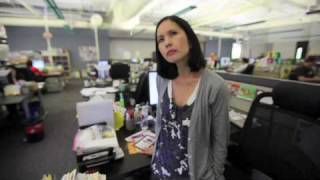
Interview and tour of Tiny Prints (2009/2010 era) with founders Michael Mothner and Laura Marion and host Robert Scoble. The company specializes in customizable stationery and photo cards, emphasizing customer service, human quality control (not "web-to-print"), exclusive designer networks, and technology that simplifies personalization. Tiny Prints started ~6 years prior, was bootstrapped (approx $10,000) and grew to ~150 employees; it serves wedding and consumer markets, uses live chat, phone, Twitter, proactive support, and partners with US and Dutch manufacturers to fulfill global demand.
Here we go. Take two.
So who are you?
So my name is Ed and I'm one of the founders of Tiny Prince.
And what does Tiny Prince do? Real fast.
Yeah. So Tiny Prince today is in customized stationery. So we build products that are highly intimate but that allow you to really express who you are, but also have an element of sharing. Sharing things about your life, about your biggest life, moments about your children, about your wedding, and really allow you to showcase, share, care, you know, preserve.
And how old is the company?
We are six years old. The website's been up for just over five years. So we celebrated our anniversary in March. And, you know, we've got about 150 people now. Wow. So we got started six years ago with three of us who started the company. All of us are still very active in the company and still very excited about the future. How did you get started? So we got started. The three of us were friends to begin with, and we found ourselves just kind of naturally talking more about entrepreneurship. And so it wasn't necessarily the idea of tiny prints that drew us together, but it was more about the idea of starting something and creating something from scratch. And so we got started with no idea, but just a passion for entrepreneurship and started to define the type of company we wanted to build. And one of the first commitments we made was to try to bootstrap the company because we really cherished the idea of building a company to last from the very beginning, one that didn't focus on short term results or short term outcomes.
So you didn't take venture capital or anything?
We didn't take any venture capital. We started the company on about. We don't really know exactly, but we think it's about $10,000 of our own savings. And so out of necessity, we've had to be profitable. So we've never. A few credit cards.
Right?
A few credit cards dipping into savings and things like that. We had just all, you know, two of us, Laura and I had just graduated from business school. And so, you know, we didn't have a lot of funds, so. So I was a bit nervous putting anything into the company.
So I've toured a few really interesting companies, a lot more than a few. And I keep seeing at the really good companies, I see a mission statement.
Oh, is that right?
Usually somewhere.
Well, hopefully we're done something right then. Yeah. So this is our mission statement. And this is something that we try to live every single day. This is one of the reasons why we started the company in the first place. There were many motivations for starting the company, the biggest motivation was to really try to start a company that was different than the kind of companies that we had worked in in the past. Nothing against the companies we had worked for, but we wanted to create an environment that really cherished the idea of lasting value and core family values and a passion for the customer. And so, as our mission statement reads, we're really motivated by delighting customers. And customers are defined very broadly here. So obviously they're the customers of people who shop on tiny prints and wedding paper Divas, which is our wedding site. But we think all of us who work here are customers as well. We're internal customers and all the partners that we work with are customers as well. So every day we try to delight all of those customers. That's an important part of what we.
Do to study one part technology.
We're building pretty cool technology too. I think one distinction that we like to make as a company is that we're not really a technology builder. We like to use technology and I think we're doing some pretty innovative things. But we like to think of ourselves as enabling a great user experience using the latest and greatest technology out there. And so our focus is really on identifying what would resonate with our customers and building that experience using technology. And so we've really homegrown almost everything that you see on our site and a lot of things you don't see on our site because there's a very complex back end system that allows us to do what we do, which one of the distinctions about our company is that we're one of the very few people who focus on this sort of core category of stationery. But we're probably the only one that really doesn't go web to print, which means that we have human hands touching every one of our customers orders. And we think that's been a critical factor to our growth because really what customers are used to is dealing with boutiques and small stores on pretty much every main street, in every small town where you go to buy your stationery, whether it's your wedding invitation, which is oftentimes the very first experience you have with stationary or personal notes, to birth announcements and party invitations and things like that. And so we've always believed that we have to at least mimic the offline experience because that's where really the most of our market is, and only enhance the experience beyond that using technology.
And that's why I came to you, because, you know, I study a lot of the technology companies usually like Google's, but The thing on Building 43 is I'm trying to find how normal business is being changed by technology. Stationary is a normal business. It is hundreds of years.
It's been around for hundreds of years. There is a lot of interesting innovation happening both on the manufacturing side and in the online space. And I think we've been very fortunate to be kind of at the, the center of the convergence of those two. But yeah, we're definitely a user of technology. We don't pretend to be anything but hopefully a technology driven retailer and a builder of a pretty cool product.
Well, let's go get a tour.
Great. Let me show you a couple of other things. This is Jenny who helps us pretty much everything around the office and Leah, who's communications lead.
Yep, she arranged our interview.
Yeah, exactly. So some things that you'll see that hopefully is consistent with some of the things that I've told you about our culture and mission is we really like to think of ourselves as a family here. And that was one of the important factors in starting the company. And so as I mentioned, we didn't take any funding. We really wanted to think long term and we wanted to cultivate a very strong culture, a culture that was passionate about the customer, about ourselves, about our community and all those things. So you'll see on the wall here one of the traditions that we have is at every company meeting, which happens every month, we have certain initiatives that the company is focused on for the year and we sort of have a peer to peer award ceremony where the recipients of each of the awards from the previous company meeting get to pick somebody outside of their own department to give the next award to. And so this year we're recognizing people for customer intimacy.
Obviously very important that I've been using a lot lately. Yeah, yeah, we'll talk more about that later.
Yep. And we think that's a responsibility throughout the company. Everybody from traditional customer service who are talking to customers every day, to, you know, engineers who are building an experience that is meant for, for the customer, not for technology's sake. Productivity, we think especially in this environment, that's extremely important. One of our core values is to be creative, but also make every dollar count. Because of our heritage of being self funded, we take productivity very seriously here. And then growth. Growth has been a super important source of pride and cultural value in the company. We've had triple digit growth rates from the very beginning, still growing very rapidly and even in this economy. And so it's something that really gets people excited and passionate and makes people look forward to Monday's year. Yeah. So let's walk around and I'll show you the rest of the office.
Thanks for doing the poster. That's sort of fun.
We are a printing company, wanted to showcase what we do.
Yep.
So this is kind of our traditional business side of the office. And we have, by the way, the.
Guy in the back is taking.
This is Rick.
I met him at Google.
There you go. He's the connection to you, I think.
Yeah. And he's the technologist here too. That's right, one of them.
Semi professional photographer. So we have kind of the core business functions here. We have PR and marketing. As you can see, we have a very open office environment. Nobody really sits in offices unless you do confidential work. And so everybody sits out in the open. We don't have high walls. We like to communicate and be accessible. And so we've always had this open office layout. I think this is our fourth official office, if you don't count the apartment that we got started in. And we've always kind of had this tradition. So some of the things you see on the walls are just inspiration boards. Inspiration for our brand, inspiration for our designs. One of the things that we've really distinguished ourselves on is our trend setting designs. And so, you know, we find inspiration from all sources. We have designers who are exclusive to us, who we find inspiration from. We have a lot of inspiration just from inside the company. And so you'll see inspiration boards throughout the office. This is our creative team. They do all the great work that makes the experience with our users beautiful. I'll show you my desk. All right. I sit back here. So I tend to move around depending on where there's an open desk. And this is currently my residence. And I, of course love cards. And so you can see some of the cards that I've done in the.
Past, pull some of them out and tell stories about them.
Yeah. So this is the very first year my son was born. And so I did a three photo card with my oldest daughter and my son here, two of them. And you know, this is when we first sort of introduced the idea of what we call inside layouts, where you can customize the inside as well as obviously the traditional panel. This past year I did actually a bunch of different designs. So this is my card from a couple years ago. This last year I ended up doing five or six different designs because I couldn't choose which one was my favorite. So this one is a photo of my family and then I get to be a little bit more creative on the inside. And so I did kind of a collage layout with what we call a story card. So I told my family story over the course of the year. On the inside, we work with various different charities. So this one was actually designed by an organization called Robin Hood in New York City that fights poverty. And so they have their mission statement on the back. But, you know, again, another way to just sort of send the holiday message myself. This one, I think, was designed by William Arthur, which is more of the traditional stationary designer. But we've had a great relationship with them, and they've also become a designer on our network. And so we're, I think, the only one where they only sort of online retailer where they actually design specifically for our platform. So I thought that was a pretty cool card. As you can see, I'm not much of a filer, and I'm kind of messy, but it works for me. That's right. Let me introduce you to Laura. She's. Hello.
Hi. How are you?
Founders as well.
Good to meet you.
Hey, how are you doing?
Great. So Laura is really the inspiration behind all of our stationary designs. She spearheads all of our merchandising and content, so she works with all of our designers. One of the things that's unique about Tiny Prints as well is we were the first to build a network of exclusive designers, both from the stationary world, but just from more of a traditional design sense. And so we work with designers all the way from the Gap, for example, who are obviously known for apparel, who are now extending the brand to stationery, to more traditional stationery designers like William Arthur that you'll know of. And so Laura's really been super instrumental in bringing all those designers on.
So can you show me some examples of things that you're working on right now?
Sure. So the team right now is focused on holiday. Oh, okay. And one big hit for us last year was a story card format where someone can really add more personalization onto the inside of their cards and tell stories or. Or update their friends and family with, you know, what their two children were up to last year, what their achievements were, their summer travel plans. And so we're trying to take this to the next level in even greater personalization. And so our customers will be seeing our holiday line debut, you know, more around September of this year.
So you're working right now for the Christmas season?
Yeah, it's that early. We just came back from the stationery show to really look at research and trends as to what's going to be hot for this year. And we have some good stuff up our sleeve, I think in terms of new product formats for our customers. A lot of different options this year.
How is the. Because I used to help run a camera store here in the. In Silicon Valley, and back then it was all film. Right. How is getting people getting cameras like the one I'm using changing the expectations of what you do on a photo card?
Yeah, I think that's where we try to be different in terms of really excelling at customer service and not being web to print. So what we pride ourselves is at.
When you say web to print, what do you mean? I've heard you mention.
Yeah, so for a lot of other companies, especially photo companies out there, when a customer orders something, whatever they upload and whatever they type in is exactly what they're going to get, regardless of if it's a great quality photo or not so great quality, and regardless of if there's a typo on the card or whatnot. What we pride ourselves is that there's really four sets of eyes that touch every card for the most part that goes through our system. So once a customer places an order, we make sure that the photos are up to our standards. If it's low resolution or if red eye needs to be corrected, we take that step and we call the customer to suggest that these corrections be made and to get their permission, we also look at etiquette, whether that's for a wedding invitation or how to say Merry Christmas in the most appropriate way. And if you any typos are made that we go ahead and correct that. So we have a whole team of designers and customer service reps and QA folks on that side of the building that really help us with that process. So we really try to elevate ourselves and so that we ourselves have really high standards. And so a lot of times when we call a customer, they're surprised and they say, oh my gosh, thank you for correcting that. Or I understand. I really appreciate you wanting to make my card better than how I made. Might have even imagined it.
Yeah, you probably get a lot of people who aren't all that familiar with technology. They might not even know how to upload a photo. What happens then?
Yeah, we, you know, there's a lot of help pages on our site, but we like to, you know, staff our call center so that we have photo experts and we have folks that can spend, you know, up to 15, 20 minutes really walking someone through how to get a photo from their camera onto their computer, onto our website. And so it's really servicing customers at all levels and all levels of sophistication.
I can just imagine people watching this, going, wait a second, call 15 minutes. Probably costs about $100. And how much are you selling your cards for again? So didn't your profit margin just go out the window?
Yeah, I mean, we thought long and hard about that, and obviously we can't do that for every customer, but we think it's really important for those customers that need that extra time to take the time, even though it costs us. I think in the long run. That's all part of our service mentality.
Our philosophy on technology and customer service. One is to be available. And so we use traditional methods like phone and live chat, but we're available through Twitter. Any way that you can get a hold of us, we want you to try. And so we publish our 800 number right on the homepage, on every single page, above the fold. We want you to know that we're here for you. But our mission in life is to simplify technology. And so, you know, we find that we try to abstract away a lot of the complexities of what we do because it is a very complex personalization experience on the site. To personalize your stationery is. Is not simple. Uploading a photo is still not simple for everyone. And so we try to really hand hold the customer throughout the entire experience and build technology that is pretty complex kind of in the background, but that simplifies the entire experience to the end user. And so I'll give you a demo here in a sec of some of the things that we've done to try to accomplish that. But I think Laura points out there's a lot of ways that we've impacted the decades old industry with technology.
I would guess many of your competitors still are wondering what Twitter is. Twitter now is on the front page of the USA Today and on Oprah. So they are probably getting a clue.
They've probably heard the term now.
And that's what I'm getting around the world to see. Companies who are using the 2010 web, and certainly social networking is one attribute of that. Tell me about some of the other things that you're seeing an innovative company like you do to use the web, to use the Internet, to communicate with your customers. You mentioned one chat. So you have a chat. Do you have a chat window so people can get help?
We have live chat that is both reactive and proactive. And so, you know, we find that, you know, certain customers are just more comfortable with written customer support. So we Obviously have email, but that's not real time. And so with live chat, we've seen just tremendous success with people who, you know, are just more comfortable in written communication. And so a lot of folks just ping us on their own through live chat. But also we have a proactive channel chat, which is a feature where we try to predict what customers might be struggling with based on time spent on a certain page. For example, if they're on the FAQ page for three minutes, we might assume from that that they're not able to figure out what they're looking for. And so if they're not able to pick up the phone, we actually reach out to them with a quick ping to see, hey, how can we help you? Is there something that you might be struggling with?
Is that a human doing that or is that a computer that's noticing that behavior?
Yeah, it's a script that basically launches a window that has a human person behind it to be there for the support in case they do want the help. It's fairly non intrusive, but it allows us to communicate that we're here for you in case you need that extra level of support that you can't self service on the site.
What's the best thing you've done over the last six years to. To get customers to know about you? You know, is it Google Keywords? Do you do advertising? Do you?
Yes.
Tell me how customers find you.
We have a pretty aggressive customer acquisition program, but I think that the best thing that we've done is really focus on customer service, believe it or not. So by focusing on customer service, we've I think, really innovated on the customer experience on the site, but also just built a great product. And so in addition to all the great designs that Laura's team works on, they really work on sourcing the best paper, the best envelopes, ensuring that the digital press is printing the best color. And so we're really proud of what the product stands for. Our name is on the back of almost every single product and so it's pretty important that we stand behind it. And I think to this day the biggest source of customer loyalty and customer acquisition is word of mouth for the company. And so I think building that brand has been super critical. Other sort of traditional channels that we have relied heavily on are obviously keywords. We have always paid great attention to search engine optimization and so keeping the Google Gods happy has been one of the core missions of the company. But we do advertise in traditional channels as well. We're in all sorts of magazines. We're heavy on primary social media has been an important initiative in recent years. And so we probably use a dozen or so different channels of acquisition.
One of the things I imagine, especially with a wedding customer who wants to spend hundreds if not more money on this kind of stuff is like, I don't want to use a web company. I want to use somebody I can go in and yell at if they get wrong.
You can yell at us. Yeah, we get that all the time.
And so can you show me some of the examples of wedding of wedding work that you've done or higher end work? Probably.
That's. Yeah. Why don't we let Lord give me a tour?
Okay. So we're at the wedding department.
Right.
So this is our samples team. And to your question about how we make the online experience very comfortable and safe for customers that are used to shopping and in a physical retail store, one is to have a really strong samples program. So we believe, especially for the wedding customer, that obviously they want to be able to see and touch and feel the final invitation. And so a wedding customer can go ahead and order any invitation that they want and it will have. Let's take a look here, the matching component. So you can see not only the wedding invitation, but the response card, a sample of the envelopes, and then all the different colors that it comes in. So one powerful tool that we have online as well is that you can love a design but also choose what colors it comes in. And then we take it even a few steps further in that if you don't love the suggested colors, there's also color palette that you could choose from to say, well, I love this floral vine design, but I really like it in this begonia as well. And if you, if you are more on the higher maintenance type of bride and have something really specific, maybe you have an orange bridesmaids dress that you want to match. You can actually go ahead and call us with that specific color and we'll match it exactly. So there's different levels, I think, of service depending on the customer's needs.
Do you have any data, either of you, on how much a customer spends for your business versus going into a stationary store and doing it the old way?
Yeah, I think, you know, various research have said that the average wedding invitation order in the United states is about $500. I think ours is not that different from what the average is. And so. But back to your question about, you know, how do we cater to all the different needs of a bride? Because there's Such a variety of brides, you know, I think sort of ultra customization is one of them. But we have some tools online that will handhold you through some of the etiquette, which is often one of the struggles in the invitation process, but also just catering to everyone's needs. And so we have things from the digital versions of the stationery that you just saw to the very highest end of wedding stationery, which is typically letterpress. And so we have various different printing techniques available on the site, depending on what your needs are for the wedding and your budget. Yep.
Are you a worldwide business or just for the United States? So how does the culture of different countries or different languages come into what you have to do?
Yeah, we have presence globally just because we tend to follow demand and there's just been demand worldwide. And so we established a manufacturing facility. So one thing that you see here is that, you know, while we fulfill a lot of our samples in house, all of our manufacturing actually happens off site through partnerships. And so we're sort of virtually vertically integrated. We have two partners here in the US and one in Holland, and we launched the Dutch partner last fall to service that global demand that we have. And so we haven't quite gotten to the point of being able to offer, you know, designs or, you know, etiquette based on cultural differences. But there is enough demand for our products that come from outside the United States and Canada that, you know, we feel that we have to service.
Yeah, I imagine that's going to be an increasingly important part of your business, you know.
Absolutely. Yeah.
As more and more people get on the Internet around the world.
Yeah, for sure. Yeah. And I think, you know, Western Europe already is one of the fastest growing sort of E commerce markets. And I think in our. In our space, it might even be outpacing the growth in the U.S. and so, you know, definitely important new markets to explore.
What else can you tell me about what you're trying to do with design or push the industry forward or new things you're learning about, you know, the 2010 line of. I call it the 2010 because the cars are all 2010 now.
Right.
What's happening in the design space right now? What are you noticing that people are doing today that they weren't doing five years ago?
We were one of the first to going back to the whole digital space. We were one of the first folks to really focus on that arena, because I think our mission is really to present customers with unique, fresh designs, but at a very affordable price. And so we've Been really keeping pace and trying to keep ahead of our competitors in terms of what we're doing digitally. And so even in coming back from the stationery show this past year, I think more and more people are focused on that type of printing technique and all the different possibilities in terms of designs and cards that can happen there.
Yeah. Tell me some of the other things you do. Do you do calendars? Because once I have photos, I want to do it. Posters and calendars, prints. What other kinds of things do you do?
Other than. So the core product is stationary. Today, we, you know, we are building other products that you'll probably see later in the year that allow us to better preserve the photos. But today, we're mostly about sharing, showcasing, and caring. And so the stationary product has been the core product for five years. But I think, you know, later this year, you'll see other products that we branch into. Yeah.
How does the company learn? How does it stay fresh and learn and make sure that it's innovating and bringing in new ideas? We've heard some of them. You go to trade shows and make sure you see the latest industry stuff.
Absolutely. I think we learn from each other. Mostly. We're 150 people. We're really passionate about some aspect of the business, and so we have a good pulse on different ideas around the company. But we're constantly serving our customers, talking to people who didn't become customers who came to the site but chose not to shop here, and trying to learn from those experiences. We conduct focus groups and, you know, trade shows. We talk to our designers. Anybody who'll talk to us, basically, and give us input. So, you know, every opinion is taken pretty seriously.
Very cool. Well, I'd love to go and see a demo and talk about the website and talk about what you're trying to do there.
Absolutely.
Thank you so much.
Have fun.
Thank you for coming.
More from Robert








45: Sandy Carter Unveils the Future of AI: Myths, Agents, and Creativity | SXSW Insights


