Tour of the new "Revolutions" exhibit at Computer History Museum
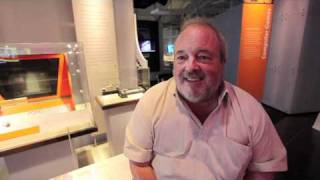
A walkthrough-style tour of the Computer History Museum’s Revolutions exhibit, recorded as a YouTube video led by Robert Scoble with contributions from museum curators and pioneers (Mark Weber, Allan Alcorn, Tim Robinson). The transcript visits early mechanical and electromechanical calculators, ENIAC/UNIVAC/SAGE/mainframes, storage evolution, software/Fortran, supercomputers (Cray, CDC), minicomputers (PDP series), personal computers and portables, video games (Pong, 1972), and the origins of the Internet (ARPANET/IMPs/packet radio). The host summarizes artifacts, technical context, and anecdotes throughout.
So I'm at the new computer history museum's exhibit called Revolutions and I'm going to just take you really quickly through the entire exhibit because the official tours are taking too long. So I want to get you through in a few minutes to to get you a sense of what the exhibit is and show you some of the highlights. Hey there, Robert. Hey, what's up?
You're an old pro at this anyway.
Oh yeah. So the museum starts with early computing machines from mathematical tools to early calculators to early devices that would let you add numbers together. And we'll just to a piece of the Babbage engine, the difference engine where in the lobby there's actually a working copy to actual some of the early calculators and census machines, mass produced calculators. Then we'll come down here. Now this is Hollerith's punch card machine which was used for the census. And you can see they have beautiful displays. Take a look at some of the earlier machines here during the Great Depression. Alphabetical, duplicating, punch and so on and so forth. So let's just take a run through the museum, get a look. There's some official tours going on.
We'll bug those.
This machine is actually a differential analyzer which is used was used to do autopilot. Nordic machine and it aimed at artillery balancing variables such speed, trajectory, friction, other forces. So here's an analog and digital computer. Again part of the revolution exhibit is what were the revolutions? What were the changes? The paradigm shifts in computing. And you can see already here it's a mixture of digital and analog. That's a paradigm shift. Here's the ENIAC computing here a piece of it, a small piece of it. We're not supposed to take pictures.
This is not the one that was on the television.
This is a UNIVAC system. IBM, early IBM computers. As if the calculations will have we Talked about the 52 or 56.
The 52.
This is what the entire Sage computer looked like. It was many, many stories. This is a huge, huge computer. This is only 1 1000th of a sage. As they showed us on the original tour. You can get a sense of the scale of the equipment that ran our defense systems for many years. This ignored bomb site. You would have been killed if owned one of these back in the World War. But this helped change the way bombing was done. There are many businesses that have had a computer before at the time. All right, moving on. This, this is IBM System360 Dominique competing in 1961 with 2/3 of the American IBM was named in an antitrust suit. Took IBM 55 years. Took Microsoft but a couple dozen. This is a mainframe, one of the first mainframe computers. So we show this film here called the Digital Dark Age. There's this idea that as we store more and more data on floppy disks. Used to do floppy disks now, maybe on CD ROMs, maybe on other types of media. How do we recover this data going forward? This is the storage section. The first hard drive is over here. Back here you can see some of the progressions of how data is stored and processed. Bipolar memory tape that stores bits and punch cards that used to record programs. Optical storage, which today is pretty quaint, but back in the day was a ton of storage.
Together.
Which way should I go? Which way do you want to go? I don't know.
Instead, compilers were written to translate Fortran.
Programs for any computer. Fortran was written for the scientists and engineers who first needed and supported computing in 1959. Some of the ideas about the art of software programming. Now we're going to go to the more modern computers. The Cray, which was in the early 80s. Apple Computer owned one of these.
Understood when the 360 came out that work on this machine was quite. 360 was successful and it really was necessary. But all the invention that this machine.
Had.
Put IBM really on track for being able to engineer and build these hydroponics containers.
Just the operator's consoles was like 50 cabinets. I think there's a huge room that.
You can see there.
And we do have the rest of the machine in our warehouse.
It takes a whole row in our warehouse, a whole row of pallet racking to store.
But the other, the other.
And I was involved with the compiler for this. This is the translation of the codes to. Of the programs to this machine. But you know, I was one of the. And I had a core piece of the compiler work. But what I ended up doing was involved with another version of this machine, which was for the National Security Agency and code breaking. And my role there was to. To work with the people at NSA that knew what they wanted. NSA didn't exist publicly.
No such agency.
No such agency, yeah, no such agency.
Yeah, that's right. On a language and a system that was compatible with this in terms software wise, all software.
What year was this?
That was. I went to the age that it was in 60, 62. We delivered that part of the machine and I went down there. I'd been working with and others had been working with the National Security with the people from the agency. And one of the. One of the. That and the Harves component was totally different than this, but totally compatible with this one. And this is John von Neumann here, the chief engineer in building that impatible machine. Harvest was hired by IBM and he worked with the agency and was the chief engineering for the Harvest machine itself. Ultimately, that it ran for. That machine ran for 14 years, and nobody knows how good it was, how many codes got broken, no customer studies. But I spent a year essentially in the basement where it's being worked on.
And.
It was a very different machine. It was streaming the data. This machine had actually just single instructions that, you know, very, very complicated internally to get the performance, but it would.
Oh.
Well, anyway, yeah, there's a lot of wonderful stories with this.
Thank you. Yeah.
When Steve was, like, giving us a tour, he talked about the importance of this computer and how it changed architecture. But look at the wires. They were all measured and hand built. The amount of labor that went into building computers back then. This is a CDC 6600, which is just one piece of it. It's a Seymour craze design. Almost 10 times faster than any computer ever designed, devised, stunned the computing industry. Really cool stuff. And so there's a whole exhibit here about supercomputing. And let's walk back this way. This is a computer that Seymour Cray actually physically worked on and built. The wiring is just beautiful. Steve Washag, if you watch the tour that he gave us before, specifically mentioning that computer.
So right down Here is the PDP 8, perhaps the most successful small computer of all time. Tens of thousands of these machines are built in about 12 different versions of it. This entire computer was available $18,000.
See what else we can see.
Now. There are many examples showing around here, many of the competitors. But someone asked about PDP 11. We have small model PDP 11 on display there. They came in again, many different sizes. So if you look at the picture behind it, you can see a much larger PDP 11 installation.
And these are prices in the 1960s.
At the times when the. When the computer was introduced.
Because the house in Cupertino was about $25,000 back then.
Right, right.
It gives you a sense of how much investment it took to buy a $9,000 computer back then.
Yeah. Oh, it was still very significant, but it was orders of magnitude lower than the cost of computers had been up to that point.
Absolutely.
So this was one of those moments where the industry started to explode because computers could be used in new, novel ways in applications that hadn't been considered before.
You're one of the dozens here.
Yes.
And what's your name?
Tim Robinson.
Hey, thank you. Thanks for giving us a little tour here. We're gonna move on.
So.
Prime.
Now.
We're getting into some of the digital machines, how they work. Simple Simon, Relay logic machine analog. Steve Wise. I talked about building some of these for science projects. Vacuum tubes and the movement to transistors. So it's not just inventing. And planar transistors from Fairchild in 1960. Just shows you how the memory starts doubling and that Moore's law starts kicking in as we move along. That leads to better and better computers. The PET intel chips. Now a modern RISC 1998 computer. This exhibit is showing us. Well, here gives you an example of the Moore's law that I was just talking about walking you through the exhibit. As the number of chips doubled, every number of transistors on a chip double. This is a robotics display.
Along with.
Area to sit down and watch. And we'll move back this way. Display of robotics. Early robotics, early computer graphics. This is the Utah Teapot. If you've studied computer graphics, you know the role that this teapot's played in the industry. This was the model for many of the first computer graphics programs. Martin Newell bought this teapot later famous as a computer graphics model in a Utah department store. The actual teapot is skinnier than many of its computerized images because the data was created for the rectangular pixels of the early displays. Not sure what this room is. Let's just take a peek. Silicon Graphics. We're in the marketing department of Silicon Graphics, which now is gone. Shows you how a dominant computer company can disappear within a decade or two. These are input devices, so all sorts of different mice and keyboards and stuff like that. One of the first Altair computers today is a lot of fun. And that leads into the modern computing era. And look who's sitting here.
Hi, Al.
Hi. You're the inventor of the Pong, right?
Yep. Yep. Are you from the irs?
You made a few dollars on this thing? Yeah.
Pong was very, very good to me.
Tell me a little bit about building the original Pong.
Well, this original Pong was an exercise. When we started Atari, the first thing Nolan wanted to do was actually make a game that would do better than Computer Space, which was kind of like the space war game. Steve Russell. Space War. It didn't do that well. But he thought the real product would have been a driving game or something even more complex, complicated. So. But he hired me young, cheap Engineer a buddy of his at Ampex and said he had a contract from General Electric for a home game. And it was a simple ping pong, just the simplest game. And so he told me he had to have it out quickly and it had to be a consumer home game, very, very cheap, very difficult. So I started and put this thing together and he never told me it was a throwaway. It was just exercise to get me a. The speed. So I tried, I added speed up to it and the sound and a lot of little things to make it playable. But I was kind of depressed because it had more components, it had like 75 chips and I figured 10 chips for, you know, for a home game. So in one sense it was a failure. But then Nolan said, well, it's a pretty good game. Let's put it in the box and put it in a bar down the street and see how it does. And so that tent was built over the weekend, put the coin box on this bolted to the side and people started playing. It blew me away because all it says is Pong. There's no instructions. Player, one player. It's the only game that required two people. Only video game I know of it. You had to have two people play. But it was this big hit. So I was as surprised as anybody.
What year was this?
1972. December 72. Started it in June and that thing was out at end the Tavern by December.
When Steve when was giving me a tour through here, he stopped here and he said that the software and hardware was built together. It wasn't something that was perfect.
Well, yeah, there's really, there's really no, there really is no software. It's a, It's a dedicated TTL machine. Remember back in 1972, the only microprocessor available was an Intel 4400 which was just very, very slow. It couldn't do anything at video rate. So what this was, was a very high speed TTL digital device that just played Pong.
And how long did it take you to come up with the idea for this?
I designed it. Three months.
Three months.
Three months, yeah.
How much, how many millions of Pong games were sold since then?
Yeah, it was a good one. It was good. It's been hard to recreate that thing. Yeah. Hundreds of.
And millions, right?
Well, yeah, and, and, and, and we did that. Then we did the home game, the home version. That was another enterprise. We actually put the whole thing on a single chip. It was a lot of fun, very exciting. We risked the whole company to do it and hell it worked.
I bought one.
Thank you.
Well, thanks. Thanks for making my childhood more. More interesting in the Valley. I grew up in the Valley, so I remember some of the early arcades where some of these games would show up.
Yeah.
People would wait in lines to play them. Yeah.
In fact, if you look on the top of that machine, there's cigarette burns and there were places where people stack their quarters, you know, getting ready to go play. So that's a real war horse that's been out there in the field.
Absolutely. What have you been doing since then?
Oh, I've started a bunch of different companies. I'm really a electrical engineer, entrepreneur type. So I started a slot machine company, did a company that monitored television consumption using cell phones. You know, I like to just start companies and I'm looking at other companies start up right now.
Going to start up another iPhone app company. No, no games.
I've been there. I've done games.
You've done games. Well, thank you for giving me a little look into the history of pond.
You're welcome.
We'll continue our tour. What a treat. You get an idea what's going on here, Odyssey? Computer games. So this whole room is about the history of computer games. And it's, you know, it's one that I realized that when I first started working on, I was like, oh, past revolution might be the thing that goes beyond that.
Turn video games into something that is.
Having a backup hair past a support colleague. There's lots.
Actually. I went to one. I. I lied. I went to an elementary school called Sarah School in Sunnyvale, but then they built, I think called Fairview or something just across. That was where once they built that. My younger brother went to that one.
I think it's called West Valley now.
West Valley.
West Valley School.
That's the one. Yeah.
That if I were.
If it had been built when I went to that, I'd be in school in Los Alcos, in middle school in Sunnyvale, at Cupertino, Junior high and high schools in Cupertina, Homestead. So I'm right on that border.
Yeah.
Where do you work now and what.
Are you involved with now?
I'm involved with Fusion IO, which is.
The leading company in the world. We just put up a video with Wise. This is the personal computer exhibit it, which shows you, you know, the Commodore pet, the Apple ii. Let me jump over your tripod here. All sorts of different computing. Sinclair Z80, ZX80. I bet there's a Trash 80 around here somewhere. A TRS 80, Kookaburra and moving all the way their exhibit takes you into the PC of the early 80s and into the Mac Macintosh of 84, Elise of 83, and the Turbo PC of 85. So that's about the extent of the personal computer history they have here. And they come in to start moving into the revolution where the computer starts getting smaller and smaller. We have Palm Pilots. And let's move around here and see what else is going on here. First wave of portables, you know, Sony type quarter, Scribd portable. I mean, you think these are the laptops of today. Xerox notetaker 1976, Osborne 1. When you hear the that Apple's worried of Osborning itself. Well, the Osborne Corporation let known that they were coming out with new, new stuff, and it killed their sales and killed their company. Apple Duo Laptop. This is when I was in college. I remember that was the hot thing to have in College. It cost $3,000 for a really underpowered notebook. But it was pretty revolutionary to have Grid Compass laptop, 82, all sorts of different calculators. And now we're getting into tablet computers. The GridPad and the EO and these inform that now it is the iPad or the Motorola Zoom that just came out. So where do we take from there? Now we start getting into the modern web age. And this is the first Google computer, which actually, if you visit their data centers, is a little bit similar even to today, although the components are smaller and more modern and less wiring. But they came up with this rack idea with breadboards, and they wouldn't even put cases around them because then they could have better air cooling and make it cheaper. And that's the key to Google's success, the execution that they would build tens of thousands now, almost, probably a million of these breadboard computers that are distributed around the world all working together is really the key to the modern web world. We're with Mark Weber, who created this part of the exhibit, the Mobile, and. Well, tell me about this exhibit.
Let's see.
I curated the Mobile Computing Gallery, which is right behind us. And then this is Networking in the Web. So this is the story of communicating online from clay tablets to the Internet.
Excellent.
So we started with the telegraph.
So this shows that you can actually send information over distances using electricity.
Yeah.
And this was invented in what, 1830s? 1830.
So it's a hundred and what, 70 years now?
And this was key to opening up the west because the transcontinental railroad used this. Railroads around the world used telegraph and had telegraph wires sitting next to the rail lines, right?
Yeah. And often they were very formally business partners. So the railroad would give them the right of way. They would build the telegraph lines and then the telegraphs were used to make the transportation safely. They would say like the train is coming. And it allowed them to run many more trains without collisions.
Little known history One of the first computers in Silicon Valley is still in the shed over at the Santa Clara rail yard. It's an interlocking machine. It's a mechanical computer. It's not electronic. You pull out a slide and it has an if then else statement on the slide. It's a beautiful machine. But it was running the rail yard there from 1910 ish on up to almost 20 years ago. And it's still in the. They can't remove it because it's sort of a historical artifact.
But is it well preserved?
It's beautiful. And you can't get a tour unless you know somebody who has a key to it to the shed.
But it's safely preserved.
It's safely preserved. There's a club that keeps it, keeps it and a bunch of historical stuff inside the rail museum there, which is one of the first depots west of the Mississippi. And it's fun to go there and see all the pictures of the rail yard there with nothing around it. And then you see it today and you see all the.
Have you gone and filmed that?
Yeah, Although I need to go back with a high res camera to get a better image of it because it's one of the more fascinating. I wish it was here in the museum because it's a mechanical computer and it really explained a lot about how railroads were run. Anyways, we're going to move on. Thanks for building this. It's really a beautiful exhibit and it shows that you have one of the first ARPANET computers here. Right.
The end.
Yeah.
I just wanted to say goodbye and thank you so much. I don't want to take up any more of your time. No.
So I'm filming. So let me. Come on, I'll come back to you. Yeah. So this is. Well, tell me about the history of this machine because it's really an important machine and in the beginning of the Internet.
Right.
So this is an interface message processor, which is a big word for basically it was a computer that acted as a translator between mainframes at the time and the network. So this was one of the very first networks that connected different kinds of computers to each other. Prior to that, most computers were totally incompatible. I mean there was just no be like hooking your microwave up to your refrigerator. I mean, they were just meant to be standalone machines. So the ARPANET was the first big experiment in connecting different kinds of computers to each other. This was the way they chose to do it with these imps, because basically the network was just between the imps, and then you had a special interface between each imp and its mainframe computer. So it made it simpler to build. Another approach was used in England. This is Britain's National Physical Laboratory Network, which was just about a year later. And this was done by Donald Davies, who's one of the other inventors of packet switching. They did an approach more like modern networks, where the functions of the imp are actually in the computer. So both approaches work. But this made it quite easy for them to build the network fast with a number of different kinds of machines. And that's part of what made it so successful. They started with two nodes in late 1969, and they were. I mean, now it doesn't sound like much, but within 10 years they were up.
Where were those two nodes?
So the first one. Well, I mean, the first two were UCLA and SRI here in memo card. And the first connection was between those late at night, two young programmers who we had a year ago for the commemoration and interviewed them. But those are the first two users of the arpanet, which was later converted into the Internet. This van is the van where the Internet was born. And in the late 70s, this was packet radio research van by SRI. They were experimenting with connecting different networks to each other. So the first step was connecting computers to each other into networks. But then you had different networks like the ARPANET and the British National Physical Laboratory Network that couldn't speak to each other. So the next step is networks of networks, which is called Interneting or Internet, hence the term Internet. So this van was used for some of the first big experiments using the arpanet, connecting it to other networks. And they were driving around the Bay Area sending information while moving over the radio network to the arpanet, which sent it to a satellite network to Europe, where it went around and came back all in milliseconds so that you have live data as you're driving.
And the government was paying for this.
Right, because this was arpa.
We needed a way to move troops around with information.
Right?
The packet radio was definitely that was intended for field communication. And actually around the corner there is one of the radios that came out of that research. The basic networking was. Obviously they thought it would be useful for the military, but it was pretty basic research. There was no immediate military goal. And if you look in here, if you can zoom in Mickey Mouse.
Yeah.
So that is based on a photograph In a real event they were testing out voice over IP which now we know as like Skype so they were sending packet voice from the van and they wanted to demonstrate that there was no special equipment involved. So they went and they bought an off the shelf Mickey Mouse phone to show that you could in fact use any kind of equipment.
Very cool. Well, thanks. I'm gonna take off take off and see the rest of the museum. It's great stuff and thanks for building us because it's beautiful. Thank you. So we're close to the end. What's next? There's WAZ and you can come to the museum. It's open, it's free and it's beautiful. The new Revolutions exhibit at the Computer History Museum, Mountain View, California. If you can't get to the museum, everything's online.
See you.
More from Robert








45: Sandy Carter Unveils the Future of AI: Myths, Agents, and Creativity | SXSW Insights


