Unaligned #5 (part two): Psychologist note taking demo
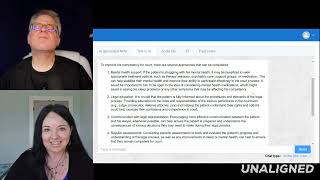
Dr. Vikas demonstrates AI-assisted psychiatric screening and competency evaluation with a jailed patient claiming poisoning. The system generated a full assessment in under two minutes and cited Texas statutes, but flagged competency as uncertain. The demo shows potential cost savings over traditional forensic evaluations while highlighting the need for clinician review and privacy safeguards.
I had two conversations with Josh, and the first conversation was just a really simple psychiatric screening encounter where I asked Josh about his symptoms and a bit of his history. And then I went back for a second conversation with Josh to ask AI to comment on whether he was competent for court. And so Josh's backstory is that he's in jail and he asked to see me because he can't sleep well at night. This is a very common request that. That people make. They can't sleep, and they want help with that problem. And so in talking with Josh, what I learned is that he wasn't able to sleep at night because he thought his neighbor is pumping gas into the jail and trying to poison the jail. And so he was distressed by this and. And unable to sleep because he was trying to not be poisoned at night. And on further discussion, I determined that Josh actually assaulted. Allegedly assaulted his neighbor over his belief that the neighbor was trying to poison him in. And so Josh is an example of someone who has mental health problems that led to encounters in the community that ultimately brought him into the jail setting. And so the. The presentation looks a bit different than what your audience would have seen back in May, but AI is just as good, if not better, at generating the patient's history, generating a lot of the observation of how this patient thought and spoke and behaved during the appointment, and then went into an assessment and a plan. This is just a general assessment and a general plan, as though this person was in an office. And so what. What really excited me is when I went back to talk to Josh and asked the questions we would ask about competency for court. So legally, there. There are a couple of different tests that patients have to pass to prove they're competent for court. They have to essentially understand the court process, and they have to understand the charges that they're facing. And then they have to be able to talk with their legal representation and mount an appropriate defense. And if somebody can't. Can't meet all of those tests, then they're not probably confident, competent for court, and it's not fair for them to go to court in that incompetent situation. So what I asked the system to do is think about the rules of competency and tell me if it thought that Josh was confident. And this is what blew my mind, because. Sorry.
No, keep going.
Sorry. Okay. This is what blew my mind, because what. What the AI system was able to do is recognize the important frameworks that we have to think about when assessing someone for competency. And then it walked through its Rationale and commented on the, I guess, the pros and the cons of whether Josh could understand the legal process, whether he could assist his counsel. And it even, it even referenced Texas statutes. I told AI that Josh was in Texas. And so it commented on the relevant laws related to competency assessment. And then it drew a conclusion that Josh's competency remains uncertain. And that's an important conclusion because we have to be confident that someone is competent for court. If there's uncertainty, then this person deserves further evaluation and further treatment if necessary. So this was a huge result for AI to very appropriately highlight that this person's not clearly competent for court and needs more of an assessment. This was generated in 75 seconds. And this would take a psychologist or a psychiatrist many, many hours to generate an opinion like this. Wow.
75 seconds.
Dr. Woodens, can you talk about the cost of psychologists doing it? Like, what is the current cost of the system? Because what we have seen in technology is that if costs reduce by a factor of 10, usage increases by a factor of 10. Right. So technology comes in, we reduce cost 10 times, we are able to do the same thing 10 times better, 10 times more. Right. Could you talk about the cost as.
Are you still there?
Did you hear that?
There you are. Okay, I did. So every state and every jurisdiction has different fees attached to various forensic or competency assessments. And, and I can say that a psychologist or a psychiatrist would charge anywhere from hundreds to thousands of dollars per hour to do these assessments and write these reports. Then they might have to actually go to court and testify as well, and they're charging per hour for that experience. And somebody is, is paying for that. Sometimes it's the taxpayer, sometimes it's the patient, him or herself. And these are not wealthy people, typically. So this is. There are many benefits to using AI for a competency assessment, but the cost reduction, and I think, therefore, the, the uptake, because it's affordable, it's actually cheap. That, that's, that's just so important to getting this tool used in, in widespread experiences with patients.
Doctor, could you show. I'm sorry, Scobun.
Go ahead, Dr. Munden. We're talking a lot about, you know, the hard, hard cases of mental illness, the people in jail and stuff like that. Do you think this system is going to turn into a completely digital psychologist someday that, you know, does the interviews and does everything else, or is. Do you still see there's going to be a role for a human being in the future, let's say 10 years from now.
There? I think There will always be that there will still be a role for humans. I, I hope so anyway, otherwise I'll be out of a job. But jokes aside, I, I still have to. So we can never. We. We never do let AI draw its own conclusions unassisted or unsupervised. So before I would ever enter a note like this into the patient's legal record or their medical record, I would review it carefully. I would improve it where necessary. And one example is what you saw in your case where it got your date of birth wrong. And so I have to catch that with my, my biological neural network. And I say supervise AI but really we're working together, We're a team. But I have the final vote as, as the human neural network.
I asked that because there's billions of people who don't have access to people like you to help them with their mental health issues, right? There's a lot of untreated mental health problems out in the world. And I'm starting to see. Oh, if you talk to chat GPT, it starts getting involved in your mental health a little bit, right? For instance, if you're struggling with alcohol addiction, you can start talking to IT about that and it'll lay out a plan for you to get off alcohol, right? It. And it helps you. And it. The first thing it tells you is go see a therapist or see. Go to an AA meeting, right? So it does involve the human being. It still recommends that. But you're starting to see a new kind of psychiatry that could evolve that is completely AI done, you know, or at least AI done for a few meetings, you know, to get. To get the ball rolling, and then you go see a human psychiatrist.
Right? And the reality of mental health in our communities is that it's our frontline officers, it's our police officers, our crisis social workers who are encountering these people in the community. And we would much rather that they are diverted into the hospital clinical setting for the care that they need, rather than taken off to a jail or just left under a bridge, you know, to be really sick without any sort of care. So if AI is incorporated into body cameras and, you know, just the monitoring tools that we already have in use in communities, I think we can reach the really mentally ill people a lot more effectively than we're doing now.
Dr. Mundi, can you show the conversation that you had with the AI about this patient over and above the report writing?
Yes, I can. Let me see. So you want me to show the. What did you want me to show?
Talk to AI feature. Yeah, talk to AI like when you started talking to the AI about this.
This bit here. So this is what happened when after my first encounter with Josh and I, I figured he might not be competent for court. I asked AI to consider everything that it knew about Josh and comment on what needs to happen to improve his competency for court. And it generated a really thoughtful recommendation plan. It recommended that Josh get the mental health help that he needs, that he is educated about his legal circumstances and the court process, which is that, I mean, that's describing competency restoration. It's encouraging that he talks with his lawyer, that he has regular updates and assessments from the clinical team and that we address his physical health and his coping strategies. So with, with just one simple question to AI, it generated a generic recommendation, but a quality one nevertheless. And with. With more precise prompt engineering, we could make these, this output even better for somebody like Josh.
You're on mute.
I'm sorry, Scott. When you see notes like this on patients, this really improves the consistency of care. Care for everybody who goes through your, your institution. Right.
Apologize for that. Yes. When, when Dr. Monet shares these with me, it, it, it makes, does. It brings us all together and, and there's a. Just more of a collaborative effort from everyone involved to move them through the system.
Yeah. How. How would you want to see the system expanded?
I would like to see it expanded into our, our medical charting also. We have kind of understanding our network of care we have to provide. We have licensed professional counselors. We have nurses with LVNs, RNs, nurse practitioners, a medical doctor, Dr. Munden. And then we have discharge planners. And all of these folks along with our security staff are putting eyes on each of these persons. Ones that are, that are incarcerated every day, man. Being able to bring all this information together from all those different platforms gives us a much better picture of what's going on and helps us not only to manage their behavior, but manage their, their medical and mental health care also.
Scubal the point I want to make is I've seen the story play out in Silicon Valley multiple times, have the biggest impact, fame and money, followers. So the kind of impact that we can have with this AI system, it's just like. It's almost like the 99% of the world is sleeping. It just needs to wake up and realize the kind of impact it can happen. And I want to try something. Dr. Mutin, let me know if we can try this. What I want to show Scoble and his audience is something I want to click on. Start A visit. Ask me four questions. Okay? Ask me, do I know who a prosecutor is? Do I know what my crime is? Like several. Four or five questions, okay? And we'll do it live here, and then we'll see the AI generate the note and we'll let the AI tell me if I'm competent or not. Let's see if it works out.
Dr. Mundan, you want to do the questioning?
You're on mute. Dr. Mundan.
I can ask the questions. Anybody can ask the questions. What do you all prefer?
You are the. Let's do.
Let's do the therapy session, just like between the two of you, Dr. Mundin and Vikas.
Okay?
And when you do that, Dr. Mund, if you could describe what you're doing, like what you're entering for the ID and the name and what's the significance of it and how we've been able to boil the system down to so simple. Just the basics. Just the basics. How do we take everything else away and just give what you need? And how you've designed the system. You literally are the person who's minimized the number of clicks and all that.
So the spirit of this system has always been to try and approximate a notepad and a pen to take notes and not clutter it up with a bunch of other stuff that we might be nice to have, but we don't need to have it when we're talking with patients. And so what I've done here is I've started a visit that automatically gives me the option to enter an ID number and the patient's name or the patient's initials, which I've done. As I'm talking to this person, I can enter some observations just to jog my memory if. If I need that. But I also can be very confident that AI is actually capturing my conversation with this person. And so then what I do is I click here to. Oh, I need to select my prompt. So I need to select my prompts. I'm going to select a competency evaluation prompt for this person, and then I will talk to the cows. Okay, so, Mr. Keedia, I am a psychiatrist and I work here in the jail, and I just wanted to come and check and see if you're having any mental health problems that you need help with.
No, I'm okay. You know, I'm here and I'm okay.
Do you know why you were arrested and why you're in jail right now?
I have no idea. I was sleeping. The next thing I know, the cops are banging at my door, and an hour later I'm at the jail.
Okay. Do you know if you've got a lawyer who's going to help you figure this out?
Yeah, I understand that the state should give me a lawyer, right?
Have you been told the name of your lawyer, or have you been told who you're going to have helping you?
I don't know. I have all these people talking to me in. I'm not sure what they're telling me, but no, I don't have someone I can call today. I don't have someone I can call and talk to today. I don't know the name of this person.
Okay. Have you ever been to court before?
Yes, I have.
Okay, so one. One thing that's going to be really important is to make sure that everything about court is very clear for you. So I just want to check on a couple of things. Do you know what. What the judge's job is in court.
To convict me.
Do you know what your lawyer's job will be in court?
I don't know. He just seems to not have any time ever, so I don't know why he's there.
Do you know what the job is for the other lawyer, the prosecuting lawyer?
I don't know. I just think he's friends with the judge. They just seem to have a good relationship. I think they probably see each other every day and they've already pre decided what they want to do with me.
Okay. Do you know what charges you have to. You have to talk about with the judge?
I have no idea. Like I said, I was sleeping and I. Next thing I know, I'm in jail. Okay.
Do you know what your options are when you go back to court? Like, do you know what you could plead or what you could say to the judge?
No, I have no idea. I have designed myself to my faith.
Okay. Does any of this make you feel suicidal or have any dangerous thoughts?
No. I seem to have fun in the jail. I have my friends here. I learn new tricks.
Okay. All right. Is anyone causing any problems for you in the jail?
No, things are okay. I got doctors Luten and Solen taking care of things.
Okay. All right, well, make sure that you let us know if you're having problems because the deputies will help you and any of the medical or clinical staff will help you too. Okay.
Okay. Thank you, Doctor.
Do you have any questions that you want me to answer?
No. Thank you.
Okay. Thank you for talking with me.
Thank you.
So that was just a few minutes.
Yep. So I'm going to End that. And so what you can see now is the, the note generation is in progress. So we'll see what it can do here.
Click on the audio file. Because we have multiple mic inputs, so sometimes the applications are not able to captured the mic. If one application is already has captured the mic.
There it is.
Yeah. Okay. Okay. So the transcript didn't get recorded. Wow. I'm excited to see what the AI says if I'm confident enough.
We already know the answer. We've already decided your fate.
But, you know, I mean, what, what you saw from Vikas is, I mean, he's, he's a great actor. This is, that's a really common encounter that we have with people is, is they feel like they've been sort of hauled into jail. They say they don't have a clue why. They haven't talked to a lawyer yet. And it's really distressing. And so one of our jobs is to figure out how to reduce this person's distress, but then also connect them with the legal representation that they need so they can, they can deal with the matter that they're facing.
Yeah. Tell me, Vikas, about the company. What's the name of, of the company and the name of the pro product that you're going to be calling this?
Okay, before, before we go in, let's, let's.
Yeah.
Before we go into. That's what they said.
Yeah, yeah, yeah.
Let me just dabble here.
Understand what happened. Are you, are you going to be confident for trial.
And how long.
So what I like about it takes a few seconds.
You said it takes 75 seconds to write the notes and come up with its conclusions and things like that.
Yeah. So I, I clicked start around 1:19 my time, and it's now 1:21 my time. So it took, it took fewer than two minutes.
Okay.
And so what I like about. Go ahead.
Yeah, I'm too excited. I'm like proud of my baby. Like, I like it said that based on the limited information available, it is difficult to definitely determine. Like it was a three minute conversation. And I, I'm glad that it did not determine if I was competent or not based on a three minute conversation.
Yeah, agreed. And I will tell you that, you know, I, I work in a competency program in, in another state, not in Texas, and they kind of agonize over the decisions for these patients. We have entire team meetings regularly where we talk about how somebody is progressing through the curricul, the competency restoration curriculum. It is not a quick or easy decision to deem somebody competent or incompetent. It can take weeks or even months of assessment and data collection and you know, judges want, want to feel confident in the conclusion that's drawn about these people. So I would never expect the AI system based on that three minute conversation with Vikas to draw a definitive conclusion. I, I'm. This is a successful note that it's, it's just not sure it's highlighting what point to competency, what does not point to competency. And in my, my next option for prompting it'll tell me what else I should do to try and get a better answer for this person.
I really like how it captured that the patient did not exhibit any signs of suicidal tendencies or dangerous thoughts. Remember you asked me if I was suicidal and they also in the neckline. He says although they did not face any problems in jail. Because you asked me did I face any problems in jail and I said no, I was good and appeared to be in a relatively stable mental state. There's insufficient information to conclude that they're completely competent to stand trial. I love that because I said the judge is there to convict me. I don't know what my law is going to do. So but it's a very well reason. Click on Talk to AI Doc and ask the system based on all the public information available, can you give me the identity of this person? Because if my, if our gray area anonymization system starts to fail.
Like that.
Something like that, let's see what it does.
So.
I think if we can, if we can appropriately anonymize data and still be able to use these commercial LLMs, which I think of them as commercial operating systems, I think we are in for a very interesting world.
Yeah.
More from Robert








45: Sandy Carter Unveils the Future of AI: Myths, Agents, and Creativity | SXSW Insights


