Ushahidi leads way to crisis news curation systems
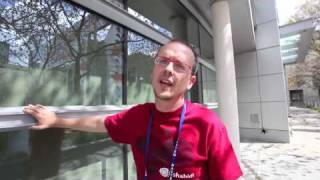
This is a 2010 YouTube interview (Robert Scoble interviewing Patrick Meier) about Ushahidi's role in crisis news curation. Meier describes deploying Ushahidi for the Haiti earthquake (rapid install within an hour, heavy daily customization, mobilizing roughly 60–100 trained volunteers and a broader pool of ~300 volunteers with a core of ~80). The team mapped over 3,500 individual events in Haiti and updated maps every 5–10 minutes during daytime. He outlines major operational challenges (media monitoring, tedious geolocation) and describes Swift River — a system recently released in an initial version to start aggregating Twitter, SMS and other feeds, cluster/tag reports, and compute veracity/trust scores; a fuller Swift River release was targeted for November–December of that year. Meier discusses trust-weighting (reputation-like scoring), cross-validating multiple media types (text, photos), distribution to humanitarian actors (UN, Red Cross) and ideas for scaling via universities, Mechanical Turk–style geolocation, and leveraging baseline signals (cell traffic, search trends).
Questions this video answers
Over 3,500 individual events.
Between 60 and 100 volunteers trained (broader pool ~300 volunteers; core ~80).
The first version of Swift River was released a few days before the interview; a full/final version was targeted by November–December of that year.
He blogs at irevolution.net and said his Twitter handle/username was given as 'Patrick Moss' (spelled out P A T R I C K) in the transcript.
Who are you?
Hey, I'm Patrick Meyer. I'm the director of crisis mapping with Ushahidi and I'm also in charge of strategic partnerships.
And what did you build for Haiti?
Haiti was interesting. So basically we have a free and open source platform that allows for the crowdsourcing and dynamic mapping of crisis information in near real time. So two hours after the earthquake is when I found out on CNN that that had happened. I immediately called our tech team and we deployed the first.
And where were you located at that?
I was in Boston. Snowy Boston. It was snowing outside. I called a tech lead, David Covia, who's based out of Atlanta, Georgia, Kenyan colleague. Within an hour we had the first install and we literally for the first four weeks continued customizing the platform every single day, adding new features on the fly. It was quite remarkable. Then I basically mobilized hundreds of volunteers. Either had is. I'm a PhD candidate at the Fletcher School of Law and Diplomacy at Tufts University in Boston and basically sent out an SOS and said, okay, I'm going to need some serious help in doing near real time crisis mapping in order to support the search and rescue operations and the emergency relief that was going to go on. So within about five days we had probably between 60 to 100 volunteers trained who were literally combing the web, Skype, you name it, Twitter, Facebook, groups, listening to the radio, television, everything, any kind of event related information, crisis event related information to Haiti that was somehow searchable on the web would end up being structured and mapped, geolocated in near real time, which literally then first responders like the Marine Corps would take this and literally take this information and send out the choppers as a result rescuing people. So we quickly, within the 12, within 12 hours of kicking off, we became the go to platform for real time geotagged crisis information. The UN found us, the military found us, and that added a lot of pressure to keep this going for a while.
So believe it or not, that's not why I found you interesting, but I.
Can talk about that.
Although this is really where do we find your software, by the way? So if there's another earthquake, if there's another earthquake or another disaster, a hurricane or something, and people need to use a system like yours, where do they find you? Where are you? Ishahidi.com and how do you spell that?
Oh, it's right here.
Okay, cool.
Anybody can, like I said, screen open source software, download it, you can start customizing it. We're working on a number of things that are going to make it Even more appealing to use very soon. But then very much connected to all this because one of the problems. We had problems in Haiti. Just to loop this into the validation issue.
I'm interested in curation because I'm interested in curating news events. Right. And both for myself, because I see patterns in the world that are different than what other people see as happening in the world. Like, if this building blew up, I would have something to say about it, right? And there would be other people and I would know who those people are, because we're all at the ware conference and they're, you know, so no, Brady Forrest would run out here and, you know, and we'd interview him and all that fun stuff.
You know, your question is. Basically, it gets to the most challenging part of what we did in Haiti, which is why we needed literally over 300 volunteers. Okay. There was a core of about 80, I'll be honest. But ultimately there were 300 volunteers to comb this ecosystem of information sources, right? From Twitter to Facebook and so on. And literally we did this ad hoc. This was on the fly. What we did is we basically had a Google spreadsheet where we literally had over 300 or 350 individual sources. Links, whether it's links to Creole radio that was streaming live, Whether it was 50, 60 Twitter users who we knew were in Haiti. Skype chat. Not Skype. Yeah, Skype chats, Facebook groups, and then like, I don't know, hundred links to blogs, to social media content that was breaking information live, you know, from Haiti, taking that information and then structuring it, giving it a title, giving it a description, geolocating it, which was another very tedious and not automatic part. We worked directly with the Haitian diaspora in Boston. They were phenomenal in helping to. They know their country better than anybody else. Right?
Yeah. I told you. The first I was seeing the Haiti earthquake in live time. And the first 10 tweets I was able to find, even before USGS website verified that it was a big earthquake, none of them said, I'm in Haiti. None of them said Haiti on the bio, only two of them used the word earthquake. You know, some of them used shaking. Some of them said, my room is falling apart, or something like that. And so finding those original 10 tweets and verifying that it was a real news story was difficult until the USGS website painted all those original tweets.
It almost contaminates the fresh. Yeah.
So, I mean, so how does your system. So what did you do when you saw somebody report something new?
It would be manually triangulated. Right. I mean, and there is an example of a church collapsing or collapsing more in Port au Prince that we got where we had two text messages and a tweet within an hour. One in English. And the two text messages were in Creole, but different words, different language to describe what was happening, but obviously the same church. And it was in Creole and from two different numbers. Yeah. So manually we said, okay, we marked that as verified. So better than just having just one data point. And just to let you know, we mapped over 3500 individual events in Haiti from day one onwards. So we were literally with the map was being updated every five to 10 minutes, especially during the day. During nighttime, the user generated content would go down quite a bit. But on the validation, what you can do, what you just referred to is really important. What we're working on now is, and have been working on for the better part of a year already, is a platform called Swift River. And the whole purpose of SwiftRiver is to validate that crowdsourced information in near real time and to provide veracity scores around that information so that you don't necessarily have to be glued to your whatever Twitter interface you use to see if there are three people talking about shaking in China, but that it would automatically send you. Heck, we could make it as an automated text alert. You get a text alert and say, okay, three tweets just came in about an earthquake in Istanbul. And then you know how to go get there. But the idea of Swift river is aggregating content from all around the ecosystem of information. Twitter, SMS, online news, blogs, Flickr and YouTube doing some machine analysis and machine learning around some ontologies that are going to need to be crowdsourced, but basically it's predictive. Tagging meets crowdsourcing and then veracity scores so that you can not only.
How does the Barrassi score work?
It's almost. I mean, I wrote the pseudocode for it and I'm not even a tech person, so that says a lot. It's pretty straightforward if you think about it. I mean, analogy they'd like to give is if you're in a courtroom, right, Your honor. And you're presenting a case, right. Exhibit A, exhibit B. Witness one, witness two. You're basically trying to prove to the jury beyond a reasonable doubt that this crime really did take place. We're basically taking that simple approach that's used in that context, but also by investigative journalists. They have their different stringers and this and that. So the idea, for example, is you get eight Tweets. And the whole idea by the way of Swift river came from two close colleagues of ours, Kaushal and another colleague from Medan, Chris Blow. Right. During in the midst of the Mumbai terrorist attacks, when we were all glued to Twitter and looking at basically 100 tweets a minute, not being able to extract the value from that torrent of information. Got it.
We're right in the flight pass.
Sorry about that, but. No, let me. But the idea is very, very simply, let's say you get eight tweets from different handles, different users within 20 minutes, half an hour they're talking about attacks, bombing Mumbai, something, something you can assign the event Mumbai attacks as a high veracity score compared to if you just had one tweet that came out. Right. So what I'm getting at is you can do Veracity scores within.
So your tool lets you bundle eight tweets together, for example.
Yes, by tagging them, you basically because you're clustering them, you're taking the tweets and you're reducing them to tags and then like tags start to cluster. It may not be a nice electron cloud, it'd be a little more sort of messy. But the idea is you can start doing some pattern recognition on that. But the advantage I think of Swift river, just taking it a step further. The two, the one I haven't said yet, I think you'll be excited about the first is we're not limited to just doing Veracity scores within just immediate. So we're not just going to look at SMS and do Veracity scores. The fact that we can take text messages and cross validate with Twitter, for example, or social media or Flickr, you know, then the veracity goes up and up and up. If you've got a picture of Tibet protests or the Chinese crackdown, right? And then you got seven tweets and you got no seven pictures coming from camera phones from different angles. Right. I mean, all of a sudden you start validating that a pretty high degree. And we were just talking before this about gaming the system. Right. So the whole point of swiftriver, in terms of how, why I'm excited about it, is to be used in sort of like non permissive environments, repressive regime who may be interested in gaming this environment. But Swift river is supposed to be for me, how I articulate it, a pain in the backside for people who want to game it. If they have the time and they have the resources. Yes. It's not a silver bullet, they will game it. But I want to get to A point where if they really want to game something that never happened, they need to move to Hollywood and do a wag the dog scene and get all the actors, the hundreds of people marching and pretending that the marchers attacked the government first you have to stage it. We're talking about now Spielberg and company having to come into the picture. I don't think repressive regimes are going to think about that. When they're feeling quite threatened, they'll just shut down the network. But the second thing I really wanted to point out was there is we want to try and do this via sort of self organized or self trusting in the sense that you know how you have with ebay or Amazon, right? You have sellers that sell, they have number of stars and okay, this is five stars. This person sold 20,000 books and he's just fantastic or she is just fantastic. The idea Etsu in Swift river is also to, to start weighting the sources themselves. And you know, once you start contributing, you leave a digital trace, right? So it's a long shadow. It's sort of Axelrod meets sort of theory of cooperation and all that stuff.
Well, and this is where like when an actress dies, you look for actors or people who, you know, who know them, right? Like Ashton Kutcher knew one of the actresses who died. And his tweets were more important to all of us than anybody else's tweets.
Were because he would get that kind of inside information that he would share. But check this out, this is even more beautiful. And it comes from a project that Al Jazeera. So Al Jazeera used Ushahidi in Gaza. They were the only media organization that was allowed into Gaza a year or two now. And so they had their journalists literally in Gaza texting and tweeting live to the Ushahidi Gaza map, right? But they were very clever. They did not make it what I call bounded crowdsourcing. They kept it unbounded. It just made a difference between their own journalists, professional, certified network entities versus the crowd. So they also opened it up to people in Gaza to report information because we all know that user generated content can save lives. Haiti is a perfect example and the most recent. But check this out though. So you've got, you've got color coded dots that represent the trusted sources, right? That represent, let's make it green. Green dots represent the Al Jazeera journalist. And let's say the blue dots represent the crowd. You can start creating a pattern and history on this because you look at how often a blue Dot an unknown entity starts reporting in line with what a journalist has reported, you can start assigning that person higher sort of of confidence score.
Absolutely.
And so the beauty of that is you don't even have to meet or know the who this person is. Right.
A company called Spigot is using these kinds of veracity scores inside companies on how good you are at bubbling up ideas and talking about ideas and what. And delivering them.
You know, you bubble up. You bubble up. You kind of dig up and so. So you don't. The beauty for me of that is you take a trusted network that goes. A trusted network of nodes or just nodes that go out to report, and that network can act as the flame of truth and sort of casting anybody else in that area that reports that's not retweeting, but just reporting something similar. You can automatically expand your network of trusted sources. Sources without ever needing to know the identity of those. They can be completely anonymous. But as soon as they start creating that pattern.
Right.
For me, that's incredibly exciting.
So if this building blew up or something happened here, we would. You might be a professional journalist and I might be an amateur, but because I'm reporting on the same news that you are, you're conferring, you're conferring some of your authority to me.
Right.
Interesting. And then you can also verify that by the location where we're actually broadcasting from. And you can also verify that from the pictures I'm taking. Right?
Yeah. And you know, on Twitter, I'll look at the other 2,000 tweets that you basically put out over the past two years. Right. If you're a clown, I'm going to figure that out pretty quickly based on your history. It's that whole point of leaving that digital trace. Then the long shadow that I think is. I really want to write a blog post. An actual Rod meets River means all this stuff. I think it's. Anyway, I get excited.
So where do you guys go? Is this going to become a commercial conversation for them?
And there's certainly.
Sorry, my camera just went off. So is this going to become a commercial product with free open source?
Ushadi platform is completely free and open source. We just released the first version, as I mentioned earlier, of Swift River a few days ago, literally. So anybody can start downloading it. And it's the first version, meaning we're not. We don't have all the feeds, but people can already start using it for Twitter, for example, and we have a veracity slider as well. So you can.
Are you Bringing in any of the location data like Gowalla or Foursquare check ins on top of the map? Not yet, because I'm seeing more data like this being put in there. And Gowalla lets you post photos to Gowalla so there's some data about the location.
Put it this way, I really do think the sky is the limit. Ultimately we want to have, we want to have the final version of Swift river out by the end of the year, November, December. This is the first version. We've got nine months to do a lot of fun stuff with it and actually it's very important. This is a community led initiative. Me Dan has been involved colleagues with other groups in the technology community have been involved in helping to inform the conceptual development of this. And that's why we're open source. We have an open swiftriver Google group that anybody can chime in and work with the code, add certain features.
Now you've read my post about the 7 needs of content curators, right?
Yeah. I briefly looked at it and it's really great to meet you in person.
So it does bundling. So it does number one, does it let me reorder items in the bundle. So can I move an important tweet to the top of the stack?
So right now, the first version that just came out a few days ago, you can tag your sources as trustworthy.
Yeah.
So it's really just, it's either you take it as a given or you know that it's a. It's your brother down.
So you don't have true reordering.
But that, I mean like, I mean that's, that's piece of. I mean that's peanuts in terms of.
It's not though, because now you need more. That's true.
So you're, you're studying user define what subjective sort of perception they have of the sources. And they rank it. Maybe they make it rank or.
So you're studying the metadata of the rank itself on each individual item.
That would be, that would be where we would want to go.
Right.
But now even. And you know, you mentioned, I really like what you mentioned earlier, the idea of the five minutes, that's really important. But I wonder how we could, I mean those would have to. Those weights. The user could sort of could identify the first weights for each of these sources. But should they be static, should they actually be dynamic, waiting?
I think they should, yeah.
It gets hairy.
Well, in an earthquake, for instance, if I say there's an earthquake, everybody should mistrust it a little bit. But as soon as USGS website, which is usually within five minutes, says that there's a big earthquake, then all of a sudden you've marked the USGS has verified the information I just gave you. And now all of a sudden I become more relevant and more trusted.
Right? You're absolutely right in that sense, yes.
Or like if this building blew up, if I'm the only one who sees this building blow up, you should mistrust it. Right. But if I start posting photos and videos and then you come along and verify, oh yeah, this building's burning now, my original information should get more relevant over time.
That's something that.
Or less relevant. Right. If you come here and say that the building's not burning, what are you talking.
You totally get a minus, whatever, 10 score or something.
Right, Right.
So that's really interesting. I will definitely bounce this off the Swift river team because I think I hadn't thought about that, but it's very clever. I like it.
What about distribution? The third thing I put in my list is now that you have a bundle, you need to distribute it back out to Twitter and back out to Facebook or back out to Google Buzz to get an audience onto. And in the NGO case you want to forward it to the Red Cross and say, hey, you better get your team together to go here because there's something happening.
So I mean, two things on that is with Haiti, when we do this all manually, a lot of people did come to us within a couple days saying, can you share with us your Twitter lists? Because obviously we had curated manually, many of them ourselves. And then in terms of the interface with the humanitarian community, that's sort of as being the token non tech guy on the Ushahidi team. So that's where my background is in the humanitarian development crisis sort of background. So I'm really interested because the humanitarian community is literally still five to 10, 10 years behind on the technology front. There is still a lot of pushback, but there are more and more allies. And the idea is to show them that this is something that they can leverage themselves. Right. Ideally, honestly, if the UN could have been the ones who deployed Ushahidi Haiti, as opposed to 300 volunteers in a basement at Tufts University. They don't have the comparative advantage, that's another issue. But ultimately they have the comparative advantage medium to long term. I think universities, which is something I'm really excited about thinking about a universities for Ushahidi project, where you basically have situation rooms that are at universities, because Columbia University replicated that In Chile they were up within 24 hours. They had 60 people trained and they were doing near real time crisis mapping. So I'm going to be actually pitching this to the Clinton Global Initiative University next month. Have universities in Africa and Asia and South America where they have their 12, 20 person team that within an hour can get an OOSHAETI platform out and start doing near real time crisis mapping, supporting ocha, the Red Cross. Anyway, I can go on and on.
No, that's really cool. It'll be really interesting to see in San Francisco's big next earthquake. You know, whenever that happens, we're not.
Too far away from San Francisco. This is not the time.
Well, you know, an 8.0 here would be pretty devastating just as it is in Haiti, only there's a lot more geeks here.
So we'd have all the curation done in no time.
Well, you don't know because what's going to be really interesting is how much infrastructure stays at, you know.
Well, I would hope that the standards are somewhat comparable to Chile. Right. Chile standards are comparable to Japan. So yeah, I'm hoping that, you know, because you look at Chile and Haiti, that's night and day.
Yeah, that's gonna be, that's gonna be interesting to watch. What, what happens in the next disaster. Where do you think, what other kinds of news situations do you think this is good for.
An organization like CNN and Al Jazeera? It's getting that first breaking news story before anyone else. Right. What I was talking about, the cluster of tags that one little dot on its own is an outlier, could make the difference if it's there for two minutes longer than anything else. And then you've got CNN that's down on the ground with their stringers and taking pictures of them.
Now that's interesting. I knew about the Chinese earthquake 45 minutes before CNN reported it. That time is getting less because they're catching on. Oh, we better have somebody watching Twitter and Facebook all night long and not just going to sleep. And that there is something about the signaling of these crowds that tells you that news is happening, happening. But they're also now watching USGS website, you know, which is. That happens four or five minutes after. So that's pretty fast.
No, they're getting there. And you know, another thing that sort of comes into all this is baselines, you know, and if we could get access to. This is never going to. Well, I should say never. If we could get access to real time cell phone traffic data. Yeah, that would be huge. That would Be huge. We wouldn't, I mean completely anonymized, but you could have baselines and you have a little spike in of front place like Madagascar and you know something's up. You just don't have all of a sudden 5% of the country calling. Actually there's some research on that using sort of post, but using cell phone traffic data from Rwanda. There was an earthquake, a 5.0 earthquake like several years back to assess the potential impact on the population just from the traffic. I find that stupid. It's just really interesting. You can definitely push.
Google is using this to watch where. Google's using this to watch where swine flu is showing up. Because people who are feeling sick start doing Google searches about their symptoms and so you can watch in real time where the symptoms are showing up in searches. Right, Right.
Yeah. So I don't know. I have my concerns about that, but it's a great space and the AI for development, Artificial intelligence. There was a conference at Stanford last week that I attended and the Google guy who is behind this project presented actually. But there's so much. The next sort of frontier of all this I think is really we've been talking about crowdsourcing crisis information at Ushahidi. To be completely honest, the Haiti example and the Chile example are more about network sourcing because it was right. I'm a Fletcher school student. I reached out to my Fletcher school school network, a social network that's already predefined, pre existent and there's social ties there. So I know a bunch of. I have good friends at Fletcher. They like what I'm up to. I say help and they say, and they call their friends and you have 300 people show up. But the two most tedious tasks were the media monitoring, which SwiftRiver can sort of start getting at, but also the geolocation, especially in a place like Haiti.
Well, even in San Francisco. How many people are putting geolocation on tweets? Not very many. Not very many.
So what I'm really excited about and did a blog post recently on is can we move from like network sourcing, which is effective. Obviously it is effective and it's going to remain effective from net sourcing to crowdsourcing. But what I'm really interested in is this idea that I don't know if I'm the first to code it or not, but TURC Sourcing Turk Turk Sourcing Mechanical Turk Services Human Intelligent Tasks Meet Crisis information. Can we reduce the process? We would spend sometimes up to an hour trying to find a GPS Coordinate for an orphanage which we knew was running out of water like two days straight. 20 kids, no water. And there was this local name for this orphanage and impossible to find. Right. So could we. I mean that's a worst case scenario really. Like sort of one of the most vexing challenges and problems. But can we reduce the geolocation, the geolocation of crisis information to a mechanical turk type service and really just farm it out? I mean I've been just kidding a bit. I need to run this by Mikhail Maron at osm. Can we add, can we add some kind of skin or user interface on top of OpenStreetMap where we can try and do some turksource? I don't know if it's possible but that's what I'm really excited about. I think that's what we need to move towards.
In the 89 earthquake that was one of the things I saw. The media instantly focused in on the Bay Bridge and the Marina district. But where some of the worst needs were was up in the Santa Cruz Mountains which were not one. They weren't sexy, they weren't burning down, they weren't causing huge plumes of smoke to go in the air. There wasn't a lot of cameras around and it was hard to get to, you know, because all the roads were closed. I remember my school teacher couldn't go home for 72 hours because he couldn't get over the hill. And so it's those weird out of the way places that have people who are hurting who need help and they can't get help because the infrastructure's down.
It's not a media rich environment. And the perfect example again was with Mumbai where definitely media rich but apparently at the same. And I say apparently just to show you at the same time 2, 300 people died in northern Nigeria. Sort of conflicts that they. That tends to erupt every once in a while but totally not covered at all. You think if we had one tweet on it? No. So that's a problem, right? In a way it is statistical analysis. So you want your end to be large as much as possible. But okay. Still if you have two text messages, better than none. You can actually differentiate it from just one text message.
Where do people find you?
Me personally? Yeah.
Twitter. Facebook.
Yeah. Patrick Moss on Twitter. P A T R I C K. Yep. Or you can just Google Irevolution like iPhone but irevolution.net and I blog profusely on all these crazy ideas.
I think Apple's going to want to buy that URL?
I don't know. They'll have to go with a high price. I've kind of identified psychologically with this name.
Very cool. We'll check it out. Thank you so much. And I'm looking forward to using this for curating these.
I'd love to get your feedback on it too.
Thank you.
Thanks.
More from Robert








45: Sandy Carter Unveils the Future of AI: Myths, Agents, and Creativity | SXSW Insights


