Walking through computer history with Apple cofounder Woz at the Computer History Museum
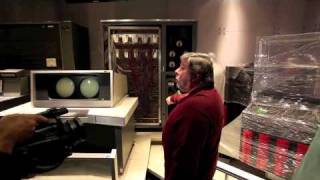
Steve Wozniak walks through the Computer History Museum, tracing computing from abacuses and punch cards through vacuum tubes and transistors to the Apple I and II. He shares stories from the Homebrew Computer Club and explains how each breakthrough led to the next, from mainframes to the machines that fit on a desk.
Okay.
Okay.
First time I get my cheat sheet out.
It's all right. Everyone find a buddy.
Punch cards. Your cheat sheet's on paper. Okay. Yes. That's pretty.
So this area here is our first stop. So let y' all filter in.
Okay. In here, of course, we've got the early abacus machines that everyone understands, but it's important to us that people actually sat down and were extremely skilled. And of course, you see the guys on TVs that can beat calculators with abacuses. So, you know, that's always been a part of this museum. It's not one of the things I'm talking personally about today.
And so this area will feature Kevin calculators From more than 2,000 years total, from slide rules through early attempts at doing Napier's Bones, things like the Pascaline and mechanical calculators like the Curta here.
Some of these devices, too. I mean, they figured out ways that you can actually twiddle things around, do calculus on physical devices in the early days. These are really historic items.
And you can see a wonderful graphic of a table abacus.
I believe that's from England in the 1300s.
Let me go down this way.
Be careful.
It's so beautiful.
You can't see the stairs.
This is the Hollerith machine used to do the 1890 census and one of the most important machines that really introduced automatic counting basically to the world. This is used 1890 census, counted 60 million people and was actually the winner of a government contest to find a way to mechanize the census, because you have to do it every 10 years. And the first and the 1880 census had taken seven years. So the 1890 census would have taken more than 10. Constitutional crisis, big problems. And the winner. And of course, the Hollerith company combined with three others to form IBM. So. But Steve's going to talk about a couple machines over here.
Now, this one goes back a lot. Some of these machines predate my own time zone. But when I started learning how to program, I sat down on a key punch just like this. You type your data in. A card would go through and punch holes. The data is in the holes. It's a computer concept, not a human concept. Human concepts are you write words as you walked in the entry to this building. You actually walked over a floor that had punch card layouts. And they are. They actually have meaningful information. I don't know what it is, but you can ask somebody. My new name card. I have a metal name card and part for my phone number. I actually used The Hall Rhythm card. Get up here. It's got columns of 0, 1, 2, 3, 4, 5, 6, 7, 8. So it's got numbers. And I actually punch out the numbers on my business card to, you know, it's sort of symbolic of these machines. And we punch our cards up, get a program in the deck of cards, feed it into a reader. Don't see the reader right here. Feed it into a reader, go into a computer. The computer would do the printout. You'd get your answer back maybe, you know, four hours later. And that was how we did it when we started college. That was when Introduction to Computers was a graduate course. Even if you were a freshman, it was a graduate course in most colleges. And very. Some of these machines here are sorters that you can actually program wires underneath and cause them to sort numbers a certain way. Just like today, we take a database. We want to find a list of everybody who lives in Maine and is over 40 years old. That's what these machines could do it all on their own with no other computer. They were essentially minor computer database machines as they went. And this was the whole start for me. One of the little stories of interest that I pride myself on is at Berkeley when I was taking programming courses around finals time, you had to wait 40 minutes to get on one of these key punches. To get your turn to punch a change in your program, you'd have to wait 40 minutes. Oh, my gosh, it would be midnight. 1:00am 2:00am Well, I found over on the side, they had a couple of other key punches. Most people were using the Model 19. I used the Model 26. Nobody else used the Model 26 because it was for a different computer. But I discovered that if you touch type, all these special characters, like a left parenthesis might be hold your left pinky down and use your middle finger and hit up near the E key at the same time. You'd even use the same hand for two button presses. But I knew how to do it on the key punches. So, well, I discovered it punched the same holes even though it printed the wrong characters. So I'd go to these unused machines, not having to wait 40 minutes. I'd punch out my programs this way, and it would read wrong on the text, but the holes were right, and the computer only knows holes, and that's what matters. So a lot of us, and a lot of us grew up this way. You do, you do you know what works and what matters. So let's move on.
This is our section about analog computing. And this will actually eventually, the Nordic Differential Analyzer will actually be demonstrating that in the future. And, you know, it's great to have these wonderful classic machines that will actually work and to be able to show folks how they go. And our next stop is right around here.
So we'll go this way.
Point out the giant machine Jotiac, named after John von Neumann, one of the inventors of the computer. Also point out the Enigma machine. You may have heard of that. Oh, yeah. And our next stop is right over here.
This is a very, very simple, ancient contraption, yet it's where I actually started with computers. The simplest computer logic circuit is a light switch. You turn it on, the light goes on, you turn it off. Very similar to that are these devices down here called relays. You're not seeing very many real electronic parts. You're basically seeing batteries, relays, and a couple lights. And this was an adder that could add 1 and 0 and it would get a 1, or it could add a 0 and a 1 and get a 1, or it could Add a 0 and a 0 and get a 0, or it could add a 1 and a 1 and it would get a 0 and a carry. Take that and you multiply it, put it side by side 10 times. You can add and subtract numbers up to a thousand. And that's basically the heart of computers. This was before vacuum tubes, before transistors, before chips. So way back in time, people were starting to play around with how could we make circuits do a little bit of work for us? And as large and expensive as it looks, we wouldn't have our iPhones today if we hadn't started with devices like this. My first science fair project, one of them that was huge was it had like 92 switches for the natural elements, 92 lights for where electrons might pop up in orbit. And I used a lot of relays to make decisions inside about yes or no, which switch is on, which is off, which lights are already on. So that's a tribute to our early start, and George Stibbets invented that.
Feel free to get a couple of shots here, and then we'll move on.
I said George, and that might be wrong, but that's George. That's because it was George. Okay. Because it was introduced to me by a stimulus, was introduced to me by a guy named George also.
Oh, wow.
So I'm more wondering that I confused him.
Okay. This is one of the most famous computers ever. This is the Univac one. And for While in the 50s, Univac was the word people Used to mean computer. And this annoyed IBM greatly because there were people who would actually say things like, oh, did you hear that national lab or university got a new IBM Univac system? And you know, branding like that would really annoy IBM. We'll move on here. This is our going to be the section for early computer companies. And this is on real time computing. And this is a model of one computer. This is a model of a Sage installation. And Sage, which is this machine also behind me, was probably the largest computer ever built. There are 23 or 24 of these around the US and one up in North Bay, North Ontario, Canada, one of those cities. But part of this was underground. And this whole bottom section would have been just power generation, air conditioning. And this top was all the processing power. So this is a huge, huge building. And as you can see here, this is probably maybe 1/2 of 1% of 1 installation. So you can just imagine how huge this machine would have been.
And an iPhone, of course, does a million times more and it does a million times faster and it costs a million times less. But what that tells you is in our past, there were applications for computers that made an iPhone worth a trillion dollars. And those applications caused these machines to be built, which took us on the path that led us to today's iPhone.
Better put than I ever could have done. Of course, every museum needs a Mercedes. And we'll go on to mainframes. What's the Mercedes for? That's actually ABS brakes, has automatic braking system. You can see there's the little case that has one of them in front of it. Very cool. Of course, mainframes here. The IBM 360 is sort of the rock star computer of the 1960s. Hugely important and really gave IBM a nearly permanent grasp on the mainframe section.
Of course, even when you had this computer, you had to turn it on and turn on tape drives, and turn on disk drives and turn on printers. And we had one of these at the Anza and a friend of mine had it copied the key so it would sneak in at night. A computer at midnight should not go unused.
Does the Computer history museum still have a rule that Nothing newer than 10 years is in the museum? It's a flexible rule, but that's a very important guideline to us. And of course it's very important to show the artifacts that would have been used, the peripherals, the tape drives, the disk drives that were actually being used with these machines. Because really without them, you're very limited.
In what you can do.
So that's an important part. So our next thing we're going to show you is the memory section. And Steve's going to talk about this thing that looks like it could be fermenting beer.
We have here is put back together a Ramac disk drive. It was really the first hard disk drive under today's type of hard disk mechanisms. They had strange things like the head had the floor float above all these spinning cylinders. The multiple spinning cylinders were for parallelism. So you could have five megabytes of data in a small space. And the head that flew over had a little forced air that kept it floating. A very different approach than what we use today. But it was the step that made it possible. And this took us a long way. This disk was designed in the city I was born in. San Jose, California. 99 Notre Dame Street. You can go down there if you like. The old spaghetti factory. It's across the street almost. And you can see the little plaque that commemorates it. So the start of hardness was here in San Jose.
They were developed at IBM's research lab.
IBM. It was developed at IBM on 99 Notre Dame street in San Jose, not the one in Almaden.
Give you a couple seconds to get some shots there of it. That one go over this way. So this section here is also about mainframes, but it's also about time sharing. The ability to use for one person or for multiple people to use one computer. And so line reservations, Univac system that would have used one computer but had sometimes thousands of terminals all over the place.
Finally they had a system where you could. Before that you'd go to get an airline reservation at an airport and they wouldn't know how many tickets had been sold or which ones they'd have to get on the phone and call people. Finally we figured out we could put computers together to do the job in modern times. We figured out ways to make that not work. But probably a lot of you remember this sort of thing in your schools.
Also one of my favorite stories, the VAX 11780. Every Mervyn store had one of these up until about 1998. So this is also the first time sharing system I ever personally used at the computer museum in Boston when I was there.
Interesting.
Okay, we're going to go through here to supercomputing and you've got to stop here.
Well, Kendra, the time sharing exhibit was all about expensive hardware that many people could share at the same time to make the value go out. The cray was more about a personal computer that one person at A time would use run programs on. But to have extremely high speed that was needed to solve certain kinds of applications in the world. And Seymour Cray got earlier experience at cdc. We're going to visit one of his machines right over here now at two of the universities I attended, including Berkeley. At Berkeley we have this model of Cray computer, I mean CDC computer, the CDC 6600. And you can see that, you know, all that wiring that's done on the back that wasn't offshore in those days. These computers were built right here. So it's an immense amount of effort and work that went into these large machines. To have something like a few video screens that could give a little information to the computer operators was unbelievably expensive back then. But this was pretty much the most expensive computer in the world. I think back then it probably cost tens of millions of dollars in today's dollars. So it was very expensive. One of the things that Seymour Cray pioneered was making computers extremely fast. That's why they're called supercomputers. Today. The supercomputers of the world are measured by how which ones are the fastest, could do the most calculations per second. And this was certainly one of the champions in its time zone, in its time. And the largest version, a large version of the CDC 6600 was operated at Stanford Linear Accelerator center for all the physicists to calculate the effects of atomic collisions. In the early days of exploring that level of physics, quantum physics, but to get high speed parts heat up. So Cray was very famous, especially in the Cray computers, for liquid cooling, pumping liquids into the chips and arranging. It was more of a hardware design, a plumbing design than the electronics that made it work. Although the electronics is fantastic, the wires are actually measured for their distance and how long the signals will travel on them was a big part of the design of these early supercomputers. So, and this one, when I programmed it, one thing I discovered was you have architecture. Many different buildings can have different flavors. A museum looks like a museum, it feels like a museum. Computers had sort of a rough von Neumann architecture similar to other machines we've visited so far. This machine, when I got to program it in college, even though it was only graduate courses and I was an undergraduate, I got to see. Oh my gosh, they have very strange things. You move a little bit of data into one register and whatever address that is, it moves another register out to that address. It's like you've got multiple things happening for the shortest number of steps. And I Came to admire so much computers that were designed around shorter steps along the way that electrons have to flow to get things done makes those operations faster. And it's called RISC architecture now. But it was just amazing to see that people thought of things that were so different than all the other computers of the time. So different than the way IBM did things with very complicated instructions that could tell the computer to do very complicated things. This had the very simplest instructions, but they executed so fast that in the end it was a faster computer.
Yeah, people actually touched. And this was actually built by Seymour Cray. So you know, it's, it's like, you know, he's the closest thing to a rock star, other than Woz, of course, that we have in computing. And you know, this is something that he actually fiddled with and made himself. So I love it.
When I saw this, my heart just skipped a beat. And when I heard that story that he actually hand wired it himself and geez, just amazing, you know, when a pioneer actually did it himself with his own hands. These days it's like somebody hits a company, does it? Exactly.
We're heading into minicomputers. How far should I go? We're going to meet you over in that little section next to that red thing. As we walk over to our next stop, I want to talk about one little machine here. This is a PDP 8e minicomputer by Digital Equipment Corporation, who played a very important part in founding the museum. The original museum founded as part of Digital Digital Equipment, but this is actually used at Mass General Hospital to perform brain surgeries. Before that, you had to keep your patient awake while you were doing the surgeries. And this allowed actually impulses to be measured in the brain and so they could be unconscious. So you know, computers directly affecting people through surgery. Just to me, that's the entire story of computing that just, you know, how it affects us. But Steve's going to talk about a machine over here that I sadly did not unwrap.
Now when I was in high school, I accidentally stumbled upon a manual that describes the architecture of the CDP8 over there. It was a manual called the Small Computer Handbook. And I opened it up and it described really how a computer that was made and sold worked. First time in my life I discovered such a thing and really inspired me to say, wow, I wonder if I could teach myself how to design these things. There were no books, nothing on computers. So what I did was I found a way to get the manuals for all the minicomputers when there Were no stores that sold such things. What I would do is go to Stanford Linear Accelerator center on Sundays with a friend, and we drive in thinking nobody's there. And the smart, smart people that work there, they always leave doors unlocked. So we'd always get into the main building that had a library. And I'd go to the library and read computer magazines you could never find in normal magazine stores. And there were little cards you could fill out and order the manuals for almost all the mini computers you see here. I would order their manuals when they came home. I'd go in my little room at home, shut the door. Nobody knew I did this. No friends, no parents, no teachers. And I would just start to design with chips the chips that were available in those days. How many chips could I make this computer in, Try to get better and better and better, Competed with myself. The Data General Nova was introduced. The whole computer fit on one board of chips. And chips, you know, basically chips are, you know, a dollar each. They're sort of inexpensive. Back then, though, a chip could cost as much as 50 bucks. But this computer had a different architecture internally. It's like if you imagine a building that has a very different architecture and whoa. Than all the other computers around here. Very different than the CDC 6600, but really strange. So when I sat down to design my version of took half as many chips, it turns out that the architecture had been designed around the chips that were available. And it became important to me to cross the disciplines if you want to do an excellent job across the disciplines of being a designer of an architecture should also know the components it's being built with. The designer of a building should know the lumber and the different parts and mechanical assemblies and what is the least. And then be wanting to make the trade off what is the absolute least I can use and get the same result. This computer was just as fast as the others, Half as many chips as all the other mini computers around here. And, you know, I discovered the reason and influenced my life so much. I told my father before I was out of high school, I'm going to own a 4k data General Nova someday. Because 4k is enough that I could type my programs in like I used to do with punch cards. And of course, I'd have to buy a teletype, cost as much as a car. My dad said, how are you going to do it? It costs as much as a house. And I said I was stunned. I didn't realize that was the cost. And I said, I'll live in an apartment. I was going to have a computer someday. This particular computer and that drive hung with me. Funny thing is, there were other people around the country. There were hundreds, thousands of us who did the same thing. They said, someday I want to have my own computer at home that I can sit down and program, and nobody can tell me what I can and can't do with it. So this Data General really changed my life. When I was in high school, I had posters on the wall that came from the company of two versions of this computer. One looked like this, and the other looked like a little desktop computer over here. That was an inspiration for today's personal computers. In my mind, all of a sudden, I had this idea. This was a computer sold by Neiman Marcus for doing menus and numbers. You get a programming course, cost 10,000 bucks. A lot in today's money, a lot more in today's money. I mean, and you bring up little code numbers that told you what items to use and how much to use of them. So it really wasn't as good a recipe as using a book, but the shape of it said, oh, my gosh, a computer could actually look like something that you'd see in a home, like a fancy car. And that image stuck with me so much. Well, they had the Dana Journal. Nova was in one of these sort of shapes on a glass table. And I had that poster on my wall in high school and always wanted somehow to bring things home to this scale. The Apple II looks like it was.
Influenced a lot by this design.
Was it? I don't think so, but I couldn't say for sure. In other words, I didn't remember a specific design that closely, but I just wanted to get some. The Apple II was sort of like a typewriter. I was more. I'd say the Selectric was more of the model for the Apple II. Apple 1 and 2. Apple 1 and 2, yeah.
It's also had one of the rather telling 1960s advertisement slogans. If only she can cook as well as Honeywell can compete. Mad men at work.
That's funny.
Where are we going next commercial? We're going to go over here into digital logic, all about processors, and Steve's going to talk about one of our machines here. Okay.
Yes. Obviously, the movement in electronics that makes Silicon Valley, Silicon Valley that gives us iPhones was a trend from the big, hot vacuum tubes. It was actually the first little adder. I showed you these relays. Then we moved to vacuum tubes and computers that were full of thousands of vacuum tubes. Then we moved into transistors that allowed the computers to be small, smaller and a little bit cleaner, cooler, faster. And of course, we moved to today's chips. One of the big steps in my life was my first transistor radio. First time ever. I held a gadget in my hand that I loved what it could do. It brought me music, it opened my world up. I could sleep with it and hear music all night long. And music's become such a big part of my life. And I looked at my little radio and it had six transistors in it. Hand built in Japan, but hand built. And my dad worked at Lockheed. The only people that could afford the early chips and really spur this chip industry was the military and the very largest corporations, their needs for computers. So my dad had access to the companies in Silicon Valley that were about to make the first chips ever. And he took me to a show when I was maybe 8 years old. And I went there and I saw a gentleman presented a picture that showed little blocks and said, this is a picture that we're going to turn into a chip with six transistors on one chip, one piece of silicon. And I went home and I went to my dad and I said, wow, so they're going to make better transistor radios. And he said, no, no, no, these chips cost way too much. Only the military can afford them. After a number of years, there's surplus that they don't need anymore. And that's what people get. And I always felt, darn, you know, the needs of real people for things in their home that bring them enjoyment should be pushing our industry. Well, what is pushing the state of the art of the silicon industry nowadays? Personal computers and now games. The highest, most powerful chips that are made on earth are made for game machines. So the legacy of the little personal devices come true.
All right, give me a couple seconds and we'll scoot around here. I think next is Homebrew Kitchen.
Come here. Trench radio. Yeah, Homebrew.
Homebrew. Okay, so we're going to walk this way past a number of. This is all about the semiconductor industry and machines that use microprocessors like the Commodore pet. The channel F from Fairchild with the first video game system to use parts. So 20 something years of hitting people with a camera poisoned years of cartridges as video games started with the Fairchild Channel F. Keep coming through. You can see very important. That's my old PlayStation. Just like to point that out. Donate for a good cause. Yes, this is a section on artificial intelligence and robotics. And that guy Right there. The blue one is Officer Mac. He was used by the Sunnyvale Police Department to actually teach kids about bike safety. Don't talk to strangers. He has a little TV in his chest that allowed him actually to play little things and came to my school every year. And I shouldn't call him a he. You shouldn't anthropomorphize robots. They hate that. But it's one of those machines that kids connected with and around the country, actually, this company actually provided Officer Mack all over the place and taught thousands upon thousands of kids about bicycle safety and so forth. Sadly, we don't have his hat. He actually had an official Sunnyvale police hat and badge. So I love that.
I believe we still have a huge future for robots doing a lot of things for us that are useful in our lives. And, you know, it's common. It takes a while, but it's a great field for young engineering students to be studying in. I used to go to Stanford Artificial Intelligence center, where I had a friend that worked, and I would see some robots doing different tasks, being trained to pick out cubes of a certain shape or whatever, just mesmerized me, you know, and I thought, wow, computers, this is like artificial intelligence. Well, it was kind of a low level of it, but. Well, we keep asking, are we going to build robots that are all of a sudden smarter than us and they take over? Well, we always have this idea we can turn them off. Well, today's biggest robot, the biggest example of intelligence we have is the Internet. You used to ask a smart person a question. Now who do you ask? Starts with go, and it's not God. And so you ask your question, you get back all these incredible answers. Usually you get better answers and quicker and get what you want than asking a human being. And so the part of the brain has now become come about. And the Internet was not designed to be that part of a brain. The Internet was just, you know, designed to be connections between people and searches. And because of its magnitude, it has maybe an order number of magnitudes, an order of magnitude the number of nodes that we have neurons in the brain. All of a sudden it turns out to sort of be an intelligence. Well, can you put that computer aside? If you think about these early computers, we saw that they made very few of that cost, you know, of billions of today's dollars for the military. Those were very important steps to them. And all of a sudden, we've lost a lot of control. We can't turn off our Internet. We can't turn off Our smartphones, We can't turn off our computer. How would we live a life without any of those things? You know, for the next six months or something? How would we, you know, cars without computers? So all of a sudden, technology. We've just built it in to help us, but we're dependent on it. And eventually we're going to have it doing every task we can in the world so we can sit back and relax. But now we're not needed as much as the technology. So who's the master and who's the slave, I always think. But it's not like we design, take over, like it happens by accident without us knowing what we're doing.
We're gonna head this way and.
This.
Is gonna be the section for computer music, graphics and art. It's not installed yet. You in there and brag because it's one of my sections. And this section is sort of. This is the following again, the I O section. So it's nice. I'm sorry. Mouses, printers, displays. You can see a wonderful early version of a heads up display right there, that welder's mask looking thing. All sorts of things that use to actually talk and get stuff in and out of computers with. And so this is a wonderful section with some crazy things. There's a mouse in there that weighs about seven pounds. I don't know how you would possibly use it unless you had really buff arms. So all sorts of strange things. Also about a half dozen foot mice. People had this concept that you would use your feet to move a mouse. I don't know why they would have thought that, but good on them for trying. So you can key more and use your feet to move the cursor around the screen. Yeah, I think that's a theory.
Well, this is a very important exhibit because the biggest changes in computers throughout time are usually in the areas of input and output. The devices that really connect it to the human being. Did we pass up Chris where the Homebrew computer club showed?
No, that's actually here very quickly. This is Pong. This is the Pong prototype designed by Al Alcorn, who loaned it to us for this wonderful exhibit. Probably the game most responsible for the explosion of arcades of the 1970s. Also the most pirated computer game ever. I think for every official Pong Atari sold, there were about 15 pongs that were unauthorized that were sold all around the world.
This was built by wiring wires between chips that signals went up and down, up and down. No program. You didn't tell it a sequence of steps to follow. You had to program it to actually wind up putting white and black dots on the screen at certain places. You had to actually design it that way. And it was very difficult in those days. I mean, it would take maybe a half a band year at least to design a machine like this and a program. It's maybe half a day. One of the early courses in introductory computers in college, you learn how to program things like that. When did you start working at Atari? Was it. I didn't work at Atari, but I saw Pawn in a bowling alley. I went home and said, oh my God, I have to have this. And my way was I, I'm a good designer. I designed my own 28 little $1 chips on a board. I had Pong playing on my TV set at home, snaked the cable and figured out how to do it. And eventually Steve Jobs came back and he took my game down to Atari and he got a job. Atari was in Los Gatos, California, where I live now. Very proud of that. So I used to go in and visit at night. They had Steve working at night night so he wouldn't be around other people. And then he got us a job. I designed the first breakout game for Atari. Yeah. So I didn't really work there. They tried to hire me, but I said, never leave Hewlett Packard. I love my company, I'm loyal. You built that in one weekend, didn't you? Breakout four days. Four days and nights. It was a half man year job. I didn't think I could do it. And we stayed up all night night, all day, all night long. We both got the sleeping sickness, mononucleosis. Steve Jobs and I both got it. Doing that project delivered a working breakout game. And it was one of the highlights of my life because I loved games, I loved things that young people do, children do. It related to my interest in education and also had a big impact in how I designed those game like features into the early Apple computers, especially the Apple ii. Because games were going to come into computers. Game equipment like knobs and paddles and buttons and sounds were going to be an important part of computers. And I hope I had a little part in history in accelerating that. And then the computer gaming. As games became software, they took off to what we have today.
So we're going to go over to personal computers and Steve's going to talk about the homebrew.
Okay. At our homebrew computer club there were a lot of people that were low level, not executives in companies. 500 people every two weeks would meet in an auditorium. And they all wanted to talk about the social revolution. We wanted to feel that we were leaders of something. We were the spirit. The big computer companies didn't realize that a computer in the home, a computer in your own possession, was going to be so valuable, worth so much, so meaningful and emotional. So they started saving their money. And only a few of the people in the club, even after half a year, were able to afford their own little machines that were sold as kits apart. You've got a kit of parts and some instructions, you start bolting it together, soldering things like I did to my ham radio in sixth grade. And you'd wind up with a little working device. You could toggle switches up and down, ones and zeros, you could push buttons. And those ones and zeros would go into a little area called memory. And it's very important now what we talked about these machines would be used for. They were going to empower people. We young people that knew how to program the computers were going to become masters within our companies. We'd go into our company, put a computer on our desk, type in the company's financial data and come out with the output as to what the company should do next, how it should use its money, and we were going to beat their million dollar computers and their high paid programmers just on our own. We were going to be able to type messages into one computer and 100 people would read it an hour later. And we could communicate in ways that had never been imagined before. Young children were going to be given problems to solve and their solutions would be judged and they would be told if it was right or wrong. And their brains were going to be accelerated 10 times more than normal brains. And we had all these great ideas that inspired us. And I said, I have technical skills and I want to donate my technical skills to this effort. So I built an Apple one computer by hand, all myself, all the hardware, did all the software. Bill Gates had written a basic. I said basic, you need BASIC on a computer to make it really usable. So I wrote my own basic. You need enough memory. So I used the right type of memory that was affordable. And the Apple one was not exactly completely built like a hi Fi. You pull it out of the box and use it. But it totally gave away the formula that you should type on a small keyboard that's not here, a human keyboard, like a typewriter and see your answer on a video display. That that was the way to make a computer affordable. And other computers that we passed already followed in that model. Once they saw it. Now, I didn't design this computer to make a lot of money to start a company. I wanted to accelerate the world's advancement in the social revolution that it would cause. So I gave away my designs for free. I passed them out on Xerox sheets and gave them out to everybody at the club that wanted them and said, look, it's so easy, you can build your own. But eventually Steve Jobs came and said, why don't we build it for them and start a company called Apple? And after Hewlett Packard turned me down five times on the idea, this device, the Apple one computer, was done in a very quick time, just a few months. But the key to it was I already had a device. I had most of it already designed and built and working so I could talk to computers across the country. The early inspiration for today's Internet was the arpanet. It was an inspiration that gave us the ideas of connecting far away computers together. And I like being at home and I could type on a little keyboard and on my TV screen that wasn't playing Pong anymore, I could see a list of computers across the country and I could log on to MIT and then it would have things. I could log in as a guest and I could run some programs that were available to guests. And it was an amazing experience. I just said, why don't I put the computer a microprocessor chip? These microprocessor chips were new. We didn't have very many transistors in those days. And why don't I put a little program that when you start up, it watches for you to type things, like our calculators at Hewlett Packard. And that was really the formula to make a computer more like a calculator, something a human being turns on and starts to use right away without having to go through the steps of building it. Understanding the technology, knowing about even ones and zeros. And the Apple II was really a more thorough job of a beautiful computer. But this one wasn't designed to be a computer. It was designed to be a terminal, to talk to a computer in Boston. And I modified it to be a computer. And that was the Apple one. And I look at if anyone looked down in those days and saw this few of chips, they were on a much smaller board. They would say, that's all you need to be able to type a computer program in and run a computer game. It would really be an amazing experience. So there aren't very many of these apple ones around.
One just sold for what, $220,000.
Yeah. One just sold at Christie's auction house for extremely high price. And. But the bidder knew how. The seller knew how rare it was. He had bought it a few months before on eBay for 50,000. So then he sold it at auction for 200. He just. He just. He knows science and technology and what's worth what and how to, you know, that's his game. It would have been nicer if it was an owner or creator.
So we're gonna head back to the exit theater or the entrance theater where was. Want to do some Q and A? I just point out a couple things on the way.
Of course.
The Apple tube. Steve, can we get a picture of you with the Apple 2?
Sure.
Yeah.
The Apple 2.
More from Robert








45: Sandy Carter Unveils the Future of AI: Myths, Agents, and Creativity | SXSW Insights


