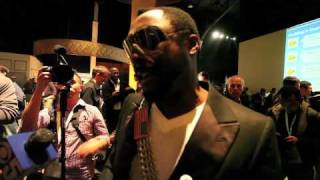
Short excerpt from a YouTube interview (April 2010) where Will.i.am and an unnamed speaker discuss how Twitter and real-time social platforms change performer–audience relationships, allow instant feedback during or after shows, and enable new distribution/remix practices (e.g., releasing stems as "invasions"). The speaker notes constraints imposed by legacy record-company contracts (song length, rights) that limit fully dynamic music experiences.
So will I am Black Eyed peas. We talked two years ago at the TechCrunch party and you guys have the most interesting ideas about music and how the music industry is changing. But what are you thinking about how Twitter is changing what you do?
Twitter allows me to have a direct relationship, one to many, in real time. It allows me to. To a show and see what people thought about it right after I perform.
Yeah.
Or while I'm backstage changes, seeing what people are saying. Wait. Because when you're performing, you don't have the ability. You're performing.
Yeah.
And sometimes you want to know.
I want to know that stuff.
I want to know what they thought about that last number. Right. So am I checking twits backstage? Sometimes. Do I check Twitch after my DJ set? All the time. Do I check Twitch after, after a performance? All the time. You know, because it lets me have a gauge on what's going on with an audience or a potential person that might become the audience again.
That's interesting to hear performers say that. Because a lot of people are really freaked out about doing public speaking or getting in front of people and talking. And they're even worse freaked out if they see what people are thinking of them in real time.
If you get somebody says a bad comment, oh, that sucks, that's cool. Somebody says, oh my gosh, that's great, that's cool.
But it isn't.
That stuff you look at.
You have.
To look at it all and see the truth in it all, the bad and the good. If you got a whole bunch of good stuff, you don't grow from it. You got a bunch of bad stuff and you were sensitive then it enables you to grow. You're like scarred for the rest of your life. So that's why you have to have thick skin and at the same time, you know, be level headed and your feet to the soil. When you get a whole bunch of good stuff. Right. And you use that information on what to do next.
When we last Talked at the TechCrunch party two years ago, you said you wanted to make your music morph over time, change over time, respond to the audience over time.
Yeah.
Are you still thinking that way? And yeah, tell me about some of your thinking there.
We executed that on the end this new record where I would. We did a song like I Got a Feeling. And then three weeks later, I Got a Feeling invasions came out on itunes where we invited other DJs and allowed our stems to go out. And there was different versions of I gotta fill in some call them remixes we call them invasions, and they're all. They always change. But I'm still chained. I can't execute that concept 100% because I'm still signed to a major record company.
Yep. So the labels are keeping you from changing your music the way you really want to.
Well, the music, the gravity, is still on old contracts.
Yeah.
A song is 3 minutes and 45 seconds. It can't be 10 minutes. Right. You're still blinded by old contracts. And the reason why that is because RCA Radio Corporation of America, the people that provided radio for soldiers in World War II, when that product became a consumer product, radio in your homes. They also bought Victor's chalking machine. Right. And that became the lacquer that we call records. And that phonograph is also our Grammy. So the rules that RCA put on records that were sold contracts when they had ARS to make records are the reason why we still don't get paid terrestrial radio rights in America when our songs get played on radio as performers. Because the same company that sold you the record owned the radio station. So a lot of those contracts, those laws are still in effect today. What a song is. A song can be anything. Now, you don't need a stereo or big amplifier for your music to be heard in miles.
Now, you can't.
You don't even have to hear it. You put your headphones on, you press play, and if everybody's connected to my phone or my computer, everybody can hear it at the same time, and there's no lag.
How big is the iPad? I assume you have an iPad. I don't have an iPad.