Scott Duffy: An Entrepreneurs Guide To Manage Through Covid-19 & Uncertainty, Episode 22
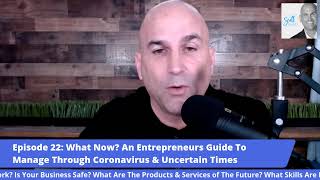
A live broadcast (April 2020) by Scott Duffy offering guidance for entrepreneurs and small businesses to navigate the COVID-19 crisis and to prepare for long-term economic shifts. Duffy reviews current U.S. COVID data and reopening conditions, describes short- and long-term demand changes, highlights accelerated trends (automation/AI, entrepreneurship growth, aging population), and lists emerging high-opportunity industries and jobs (healthcare, organ creation, AR/VR, drone traffic, supply-chain agility, trash reengineering, self-driving car mechanics). He gives practical pivots and examples (hotels, spas, janitorial services, chefs offering home experiences) and answers audience questions about stimulus programs, insurance, and small-business resources.
Chapters
Good morning, everybody, and welcome. Welcome to what's now a guide to managing through coronavirus and uncertain Times. I am Scott Duffy and it is so good to see all of you today. We have got so much to talk about. I have so much to share with you this morning and it's really been a big day. It's been a big day for news. It's been a big day in terms of having data come out that shares us, what businesses are really working right now and what businesses are adapting into things that are working and what kinds of new products and services we should be focused on as we come out on the other side of coronavirus and all this craziness going on. Again, I want to welcome you to our show today. And for anybody that's just jumping in, you're hopping in for the first time. I want to invite you to please drop your name into the comments. So drop your name into the comments. What it is that you do, the biggest challenges that you're facing today so that we can go ahead and customize, I can customize this show for you. We have so much to talk about, including word from the government, word from the cdc, word from governors with regard to a slowing spread in some areas of coronavirus and when that could mean we actually get back to work, get back to what's probably more of a new normal. Also, we're going to talk about what comes next. What is the future of work, what does that look like, what jobs are going to be the hottest, pay the most, and what skills should you be focused on acquiring in order to best position yourself as we come out of this period in the strongest place you can be? And also, really, you know, for me, it's not just about thinking about, you know, the next six months or the next year, it's about thinking about the next 10 years. If you're an entrepreneur, you're a small business, you're building a company, you want to create something great, then it is really important that you understand what, what trends, what new things are going to be impacting not only industry spending, the job market and other things so that you can design the products and services that'll be the most relevant and put you in the best possible place to succeed. So again, I want to welcome you from wherever you're joining us, on Facebook, on YouTube, on Twitter, on Periscope, on LinkedIn, and of course on Dash Radio. I want to thank all of you for joining and if this is your first time, please make sure to drop your name into the comments. The industry that you're in and the biggest challenge you're facing so that I can customize this show for all of you. And good morning, Sarah. Sarah, it is so good to see you again. I hope you had a great morning so far. And good morning to you, Sita. Good to see you again. Terri Simpson, thanks for joining. And again, if you've gotten any value out of this show for the past three weeks, if you wouldn't mind sharing it with other people in your group. Because what we're going to talk about today is super important in terms of how to position yourself not only through the rest of this crisis, but as you come out, as you come out so that you're in the right place at the right time with the right product, with the right service, and you put yourself in the best possible position to really succeed and to thrive, going not just into this new normal, but also over the coming decade. And that's so important because I think one of the things we'll talk about today is how these shifts over the past few weeks have accelerated a trend that has been predicted to happen over the next 10 years with regard to the job market and with regard to what types of businesses consumers really need going forward. So I'm gonna give this just another few seconds here, another 30 seconds before we get started here on radio. And I want to thank all of you guys for joining again. From wherever you're watching, if you could drop your name in to the comments, what industry you're in and the biggest challenge you're having, I'd love to do everything I can to help you to help to address that issue and customize this show. And also if you are a business that has applied for small business relief, if you've applied for the EIDL program or the ppp, I would love to get your comments and your feedback about your experience. We're going to talk about my experience in the experience of other people in my network so that you can use that to help yourself put yourself in the best position to get money quickly from the government. So with that, let's get started.
Good morning. My name is Scott Duffy and this is what Now? A guide to Managing through coronavirus and Uncertain times. I want to welcome you from wherever you're listening. You can tune in each day at 10:00am Pacific Time to watch the live broadcast on YouTube and Facebook, listen nationwide on Dash Radio or download the podcast. Now, this show is for entrepreneurs, small businesses and those thinking about starting their own companies. It's for people affected by this economy. Maybe they lost their business, their job, they were furloughed or they saw their consulting contracts canceled and it just happened like in a heartbeat. It's for people asking, what do I do now and how do I get out of this period? Even stronger on today's show, we're going to focus on what comes next. What is the future of work? What's the future of your business, of your job? We're going to focus on the skills that you're going to need to acquire in the jobs and the services that are going to be needed most coming out of this and into the next decade. So important.
Let's start with the news. So I woke up this morning and I got to tell you, I was confused. I was confused again because when we take a look at the messaging out there about when things are going to return to a new normal, there's two completely different streams of thought and there's two completely different types of messaging that we're hearing from the government and from the medical community. So from the medical community, what we're hearing is that we're still in this and we're going to be in this position, the position that we're in now, or something fairly similar for several weeks. We're talking through May, we're talking through June, potentially into July and August. What we're hearing from the president and the secretary, the Treasury Secretary Mnuchin, is about a different future, a future where we get back to work and we get back to work quickly. So what do we do? What, what is the answer? And, you know, should I get excited? Should I get my hopes up? Is business going to open next week? Well, let me share with you some of the data because this is really interesting. In the US over the last 24 hours, we had 1890, 1890 people died from coronavirus. And that takes our total number of deaths to 12,000, 876. And that is with nearly 400,000 398,000 people diagnosed with coronavirus. And I'll tell you, in the last 24 hours, this has really hit close to home. I have several friends in New York and business colleagues. And I want to tell you all if you're watching that, I'm praying for you. I prayed for you this morning that have been affected by coronavirus and are in a pretty tough position right now. So again, over the past 24 hours, this has really hit close to home for me. And so again, we are at a high, an American high for the number of total deaths, number of people diagnosed and the number of Total infections in the United States. Now, that's the bad news. The good news, the good news is this, is that new cases nationwide appear to be hitting a peak, according to the latest data. And Dr. Fauci, new cases nationwide appear to be hitting a peak and hospitalizations are down. Now. Deaths lag in something like this, so deaths lag and hospitalizations typically lag infections. And so over the next two, three, four weeks, we'll probably hear, even though the infection rate is coming down, about a lot more deaths, because that's just kind of how it works. But that is really good news that the average number of infections and hospitalizations seems to be hitting its peak now. It's at a peak, but we're going to have to take time in order to get down the other side. So just because we're hitting our peak doesn't mean that we return to a new normal immediately. And that's really important to know. We also have to know that it has never been more important to be as diligent as we have been about social distancing, about wearing masks and things like that. And the reason is that Italy appeared to be in the exact same position that I'm sharing with you today over the past week. But unfortunately, today they announced that new data shows that number of new cases and number of hospitalizations has gone up. So again, this isn't a time to get lax. Something that we're doing seems to be working at this point. And so I would just encourage everybody to stay committed. When does demand come back? What we've seen in other countries like China is that when people get back to work, and yesterday in Wuhan, where this virus originated, everybody, all restrictions were off and everyone was back to work, but the rest of China was affected. And what we've learned is that it, they're about two to three months ahead of us and they're still seeing a lag in service demand. So people are still a bit nervous to go out to movie theaters, they're nervous to go out to sport events, they're nervous to do certain things and they're still staying in. So that has an effect and it's something that, that we should all plan and prepare for.
But the question is, again, when we're out of this, what comes next? So I've shared with you before that just a couple of years ago, in fact, last year, the number of small businesses in the United states was around 30 million people. 30 million small businesses. Now that's that small companies, that is micro businesses, that's solopreneurs. That's mompreneurs, datapreneurs, all these small businesses that doesn't even include all of the people that really have their own business, but they haven't registered it with the government or they've got their own side hustle that they don't report.
Now, what the data has shown, and it's consistent and it doesn't matter where you look, is that over the next 10 years. So between 2020 and 2030, that number of entrepreneurs, just the number that reports, is going to go from 30 to over 70 million people, 70 million free agents, 70 million people that are forced, they want to, or they've been put in a position where they're forced to start their own gig, to start their own company, to be their own boss. And it's really important to know now what's going to cause that huge jump in entrepreneurship. It's three things. Number one in all, the data was recession. Number two was robotics, the automation optimization of jobs. And number three was advanced use of AI in the marketplace. So here's the thing. What I believe is, I believe that coronavirus has accelerated all of this. And I believe over the next five years, we will see an increase, we will probably see an increase like we've never seen in the number of entrepreneurs in the country. In fact, if you take a look at the data in the most popular jobs today, the most filled jobs today, 60% of today's jobs in the United States can be automated and can be automated within the next couple of years, according to McKinsey, 60% of jobs. That's crazy. And as you're thinking about what this means to you and where you should be focused, it's important to think about this.
As our population gets older, the thing. So as our baby boomer population gets older, the biggest generation in our country, and starts to really reach a peak of baby boomers that are in kind of that retirement age. So they're 65, 70 years and older. What's going to happen to that group over the next 10 years is they are going to reallocate where they spend their money. This is what happens. And so if you take a look at where the money is going to go over the next 10 years, you are thinking about starting your own business. You are an existing business, and you're trying to figure out either how to adapt what you're doing today or how to find a new market for your products. The place to be focused is healthcare. Five of the 10 biggest jobs, biggest job segments over the next 10 years will be in healthcare. Five of the top 10 most highly paying industries will be or categories, segments will be in the healthcare industry. And we're going to talk more about that in just a second because I have all kinds of data around this. And if you want to know not just how you're going to come out of this period, but how you're going to position yourself to be in a real place of strength over the next five or ten years, not just the next five or six months, this is information that you really want to know. These are the kinds of things you need to be thinking about. I'll tell you. Years ago, so I had this string of companies that I worked for and I was always there near the beginning. And these companies, they were started by entrepreneurs. Super scrappy. I got in there, it was scrappy time. Usually one of the first, if not the first business person in the company. And we did all kinds of things. And these companies created, you know, they became CBSSports.com, sportsLine, did Zoom, became NBC Internet. We started FoxSports.com with Lycos. I started a company, Smart Charter. It became a virgin business. Here's the thing. What I did in the way I did it, I was really good at it. I was really good at building a certain kind of company and in a certain kind of way. And what I was thinking is, I was thinking the way I did things in the markets that I served, that those things would always be relevant. But when the market crashed in 2008, what happened? Innovation. And a result of that information, there were all kinds of new things that emerged. Mobile phones like the iPhone took off. Apps and app stores, social media, all those big sites, you know, sites like Facebook and YouTube and all that stuff, all that stuff took off. What happened was I held on. I held on to what I did the way that I did it, and I held on to the customer that I served. I didn't adapt. And the rest of the world was busy adapting around me. They were busy adapting around me. And I don't want you guys and gals, I don't want you to repeat the same mistake that I did. I want you to, in the words of Wayne Gretzky, the iconic hockey player, I don't want you to skate to the puck. I want you to skate to where the puck is going. And that's what this show is going to be about. I want to share with you today not just ways to adapt your business for the next, for this market, but how do we skate to where it's going in the future. And by the way, the future is now. The future is now. If you think that you're going back to work and things are going to be the same, if you think you have a company that you're going to reopen and, and things are going to be the same, if you think that your business, even though it may still be doing okay right now, things are going to be the same when you get back, you're lying to yourself. I can tell you right now. I've been reading all morning about fast food companies, about warehouse companies, around technology companies that are all announcing, they're all announcing, placing huge investments in new infrastructure. And this new infrastructure is all robotic. And the purpose is to eliminate the need for people coming back to work. So again, we need to focus on where. On where the puck is going.
And when we take a look at the bigger picture. Some of the things that we've already talked about, you know, just in terms of simple ways to adapt now and begin thinking, are we've talked about how we meet with people and how we communicate through media like this and through things like tools like Zoom. We've talked about how there's going to be a shift in the way we develop relationships and there'll be less stuff that's done in person and more stuff that's done like this online. We've talked about shifts in the way that we work in the kinds of products that we're going to need to sell. And we've talked about the shift in how we're going to close a sale. Yesterday we had my. My good buddy Randy Garnon, and Randy was talking about the importance of going and building a relationship and really learning, mastering the new art, the new skill, the new technique of closing the deal and doing it over video remotely. And so again, these are the kinds of new skills that we're going to need to learn. Also.
When'S it going to be safe to go back to work? So again, this is a question I keep getting over and over and over again. I haven't really answered it, but I was talking to some folks in the healthcare space yesterday, and let me show you what I think my model is for going back to work. What I think, again, for this country to completely reopen is going to be this. And I wouldn't be surprised, by the way, if our country reopened in phases. There were some places, like California as an example. Governor Gavin Newsom has done an amazing job. He closed the state before New York. He imposed certain restrictions the day before New York, and One of the things that we've seen is we've seen here in LA what appears to be a leveling off in new cases and new hospitalizations. So in areas where we seem to be less impacted, in areas where we seem to be less impacted, they may open up first versus other areas like Louisiana that are just at the beginning of their curve. Going up, may open later. But what do I think needs to happen? Number one, I believe that hospitals need to be able to safely treat all patients and get out of the wartime environment that they're in today. Number two, I think that the system has to have the ability to test everyone. Number three, I believe that states need to be able to effectively monitor and respond to quickly any new outbreaks, which means having the ability to mobilize resources. Number four, there's gotta be a sustained reduction. So not leveling off, but I think we need to see a sustained reduction in the amount of new cases for at least 14 days. And number five, I believe we have to have widespread, widespread availability of masks and antibody testing. Masks and antibody testing. So I'm seeing more and more new masks coming online. They come in a variety of different types. But what is antibiotic antibody testing and why is it so important? So antibody testing is when we. Antibody testing is when we effectively. And by the way, I'm saying, saying hello to some people here on Facebook with these banners, antibody testing is when we take a test that shows whether or not we have resistance to this virus. So it could mean that we have the virus or we have a different type of resistance in our bloodstream. And the reason that this is important is what I'm seeing and I'm hearing is that many big companies out there do not want to bring everybody back into the office until they're able to run tests, antibody tests that show that they don't have employees that are either sick with the virus or they have a chance of getting the virus. But if you've been antibody tested and it shows that you're safe, you can't get it back that they welcome you back in. So that's why I have, as my last point here is I believe that we need widespread availability of masks and antibody testing to really begin to get back to more of a new normal.
So where are things going?
Couple things. I'm going to read out some jobs, the 15 most common businesses and jobs that get salaries today in the United States. And by the way, this is an order. Retail salespeople, cashiers, food prep, office clerks, registered nurses, customer service laborers and warehouse Workers, administrative assistants, janitors and general operations managers, stock clerks, heavy truck drivers, bookkeeping and accounting, and first line supervisors.
Now if you take a look at those jobs, the jobs that more people fill than any other jobs in the United States, that 60 to 70% of those jobs can either be replaced with robotics or automated. And so what I want, what I'm sharing with you today is not again, just the shift we're talking about to going to where the puck is going. Starting to think today about how you position yourself, how you acquire the skills that you, what industries you should start to pay attention to so that you open a business, you maintain a business, or you pivot into something that is where the customers are going and that can't be easily replaced. So those things I just shared, those are the top, the most common jobs and salaries today in the United States. Now check out how fast things change.
Last year in the United States, the graduating college class, the top 10 jobs that were applied for the top 10 jobs by last year's college grading college graduating class in the United States did not exist 10 years ago. Did not exist 10 years ago. That is amazing. So if we take that data and we want to forecast out 10 years so we don't have a company, we don't have a job that we're building that's not going to be relevant. We have a job that's actually going to, going in the direction that the economy is going. Where do we start? Well, I'm just going to give you some ideas. Here are examples of what will be big businesses, big jobs, big industries. Things you should be thinking about as a business owner. Ways you may be able to pivot and adapt 10 years from now. And by the way, many of these are just a year away. So number one is organ creator. Sounds crazy, right? So an organ creator, basically, our population is getting so old so fast, our global population is getting so old so fast that we're going to run into a situation where we are not going to be able, through donations to replace people's organs and be able to keep up with demand. So in industry, the organ creation industry is actually one of the leading industries that people are looking to over the next 10 years to keep people well. And so this combines artificially 3D printing organs and doing a lot more kind of cool, more complicated stuff. But organ creation is on every list and every report that I've seen. One of the top 10 things that's going to be hot over the next 10 years. Augmented reality journey builders. What is this? This is all about AI. If you're in the gaming business, if you're thinking about in the gaming business, I know my daughters, they play Fortnite, they play all these games. Creating better, more, better, more sticky augmented reality and AI experiences is something that will be really hot over the next 10 years. Biofilm installation firms so biofilm installation firms will be able to use microorganisms to go into toxic areas, waste areas, things like that, in order to drop in microorganisms and help clean the environment. A huge industry over the next 10 years. Makeshift structure engineers. This is a huge one. So leveraging 3D printing to as an example, go to an area where we need fast housing or where there's been a natural disaster or we need to put up quick offices or emergency stuff and being able to create makeshift, makeshift structures. Leveraging 3D printing, this will be a huge industry and this one is actually kicking off really fast. Rewilding. Probably never heard of it. Just like last year's college graduates. Probably never heard of, you know, the, the top 10 jobs they applied for when they were young. Rewilding. This is a really hot emerging industry. Rewilding is going into areas where there is, there's over dumping, there's toxic pollution or into cities or areas of cities that have been abandoned and effectively going in and re beautifying those areas. Going in and tearing out all the garbage and planting and making these beautiful natural habitats. You know.
I remember when I worked with, with Richard Branson, I was at a thing that he threw at his house on Necker island and we were talking, this is 10 years ago, we were talking about China. And one of the amazing things I learned about China was first of all, in America we think of New York and LA as these big cities. China has over 25 cities that are the size of New York and LA. I mean that's how massive that population is. But some of the infrastructure in these bigger cities is so old, it's so torn down, it is so dilapidated that it would cost less to go build new cities and relocate the entire population versus rebuilding the old ones. And so what I got to see was it was incredible. This roadmap for building 15 new green cities, they were all environmentally friendly. And then going back into those new cities, moving the population, going back into those cities and effectively tearing them out and re beautifying them. And that process, by the way, now is called rewilding. Digital currency Advisors. So if you're in the financial services industry, being a digital currency advisor could be a place for you to extend Your business with so many digital currencies over the next 10 years, like, you know, Bitcoin and Litecoin, and with the emergence of that type of unregulated currency, people are going to want to know what they should do in this space, where they should put their money, how they use and how they access digital currencies, how they pull value out. And so becoming not just a financial advisor, but a digital currency advisor is something that will be a really hot business over the next 10 years. If you're into drones, being a drone traffic optimizer, this is a big deal. This is a really big deal. With all of the Amazons and the Walmarts and the personal drones that will be in the air in the next two to three years, we're going to effectively need some type of air traffic control system in order to manage and to monitor all of this drone traffic. And so creating a business, creating and running a business that helps to manage those drones in the sky and then help to coordinate with the FAA and NASA, that will become huge industry. And by the way, drone traffic optimization will take place on a local level. So there'll be thousands of these types of businesses that emerge. If you're in the auto business, becoming a self driving car mechanic, this is going to be a huge industry, a huge industry. And this industry will probably be really hot in about five years. A self driving car mechanic, this is the time and Otto, I tell you, it's the time. I remember.
I was with my buddy Greg Reed and Greg and I were talking about his work with the Napoleon Hill Foundation. So Greg was the first person that has ever been given, had ever been given like permission or access or asked by the Napoleon Hill Foundation. Again, Napoleon Hill wrote the book Think and Grow Rich, which is probably considered by most as the first personal development book, you know, of the modern era. And he was asked, he's actually given a letter and to go and carry on Napoleon Hill's work. And it's actually, it's amazing story. Napoleon Hill was a, is a writer and he wrote for a small town newspaper. And one day he got lucky. He got the opportunity to interview Andrew Carnegie. And at the time Andrew Carnegie was the richest person in the world. And Andrew Carnegie at the end of the interview said, I have a question, I have a question. I want to start an ambitious project. I want to go out there and I want to interview, I want to find somebody to interview all the most successful people, the most successful people in the world. And I want them to figure out what is the secret sauce. What are the common threads that make these people the best of what they do? And then I want to take that formula and I want to put it into a book. And that book ended up becoming Think and Grow Rich. And he said, what I want is, I want to ask you, Napoleon Hill, if you'd like to take me up on the offer to be the person who goes and does that for me. And he said, but here's the thing. He said, I need you to dedicate 20 years of your life to the project. And he said, I'm not going to pay you, but if you say yes, I will make you a very wealthy man. And so Napoleon Hill said, yes, I'll do it. I'll take that on. And the interesting thing is that what Napoleon Hill didn't know is Andrew Carnegie used to have a stopwatch, a watch, which is common in those days, and he had it down there kind of hanging off, and he ran the watch. And Napoleon hill only gave 60 seconds for anyone to answer that question, because he believed that if you put a person in front of opportunity and they didn't jump on top of it, that wasn't the kind of person that he wanted to be in business with. So what he did is he gave him 60 seconds and Napoleon Hill answered in time. What's crazy is Andrew Carnegie had asked almost 200 people that same question before, and everyone else hesitated or they said no because they weren't getting paid. It's a really interesting story. So Greg was invited to carry on the work that Napoleon Hill started. And he got access to these archives at the Napoleon Hill Foundation. And he was going through these archives and he told me a story about finding an interview with Henry Ford. The interview was incredible. So what happened was when Henry Ford started the mass production line, he ran into a huge problem. And the problem was when they were making cars by hand, they would make because of the amount of time it took, about the equivalent amount of cars that were needed to fulfill demand. So they make all these cars and they ship them out and they'd sell okay with, with the production line. What happened was they kept making these cars super fast, but nobody was buying them. Instead, they just kept piling up in the lots. And Henry Ford wasn't sure what to do. So he came up with a plan. And the plan was one day he asked all of his managers, his top level managers, to pick the 100 top people, the 100 top people from the assembly line and bring them up at noon during lunchtime. And he said, I'm going to give them a challenge. So that's they did. And when those top workers got to the assembly line, what, what Henry Ford did is he said, we have a problem. The problem that we have is we have all these cars, but people can only buy these cars in a very specific limited area. And the reason is there's no place for them, number one, to get gas to put in the car. Number two, it's the Elon Musk problem. Number two. Number two, there's no place for them to service the cars if they need their car to be serviced. And number three, I got all this inventory. There's no place to put it for us to sell the cars. So he said, I'm gonna make you. I'm gonna make you an offer. He said, I'm gonna hand all of you a piece of paper, and your job is to make a decision by 3 o' clock today. He said, what I want you to do is I want you to write your name on a piece of paper and slide it on under the door if you're up for this challenge. And the challenge was, if you're willing to spend part of your day not on the factory floor, but up here with us, our top people will teach you how to run businesses. Three kinds of businesses. Filling stations.
Mechanic stations, and what became dealerships. And he said, if we will train you and we will help you to launch those businesses, you're going to have to work later at night. You may have to come in over the weekends. You're not going to get paid, you're not going to get paid for any of this work. But if you're willing to do it, this will make you rich. And guess what?
Guess What? Out of 100 people, around 30 people took them up on the offer by 3 o' clock that day. Now, the next morning, the next morning, nearly 40 people showed up and said, Mr. Ford, I'm going to take you up on that offer. I thought about it. And Ford said, absolutely not, no way. He also, he also wanted to be working with people that saw an opportunity. And if preparation meant luck, these people were going to jump in and do what they needed to do in order to take advantage of that opportunity. And to this day, those families, the families that said yes are some of the wealthiest families in the United States. Well, we are having the same issue today going back to the car business. And in the car business, there are all kinds of issues. I was talking to the owner of a Ford dealership two days ago, and this Ford dealership, the owner Said to me, said, think about this. He said, think about this. I have all this land and I have to pay a mortgage on the land. I have all this inventory, all these cars that we've had to buy in order to resell them to customers. I have all of this staff. And he said in my business, the way it's been built is that everyone has to come here to test a car and to figure out if they want to buy it. And he said, so imagine what that's done to my business. He said, but what's really happened over the last couple days is I've started to think about what's next. What is the future of a showroom? What is the future of the interaction that we have online? How do we teach our salespeople how to sell over a tool like Zoom? And he said, how can we take advantage of electric and self driving car needs over the next five years? So that could mean should our dealerships or should our properties become better properties, better fit or retrofit for people to be able to charge their cars? Do we service electric cars? Do we go ahead and do we create mechanic stations for self driving cars? Do we become, do we shift from being a dealership to being a technology company? And the reason that I'm sharing this with you is again, I want you to go to where the puck is going, not where the puck is today. Another thing that's going to be hot, another big business. If you're in the automation business in an automation.
Industry.
Supply chain management is going to become a really hot place to be. Not that it's not already, but supply chain management will become supply chain management on steroids. Here's the difference. Supply chain management and the companies that thrive over the next 10 years will be built around this idea of being agile. Instead of having and being able to manage one simple supply chain, you'll have to be able to be able to adapt and to move super quickly and super swiftly to respond to new demands in the marketplace. So an agile supply chain company is something that will be incredibly high.
Trash reengineering doesn't sound glamorous. Trash didn't sound glamorous until I met the founders of Waste Management and realized that they were some of the wealthiest people in the country. Trash reengineering is going to become a really hot industry over the next 10 years. And the reason is we're running out of landfill space. In several countries, we're running out of landfill space. Now I have been, I've actually personally spoken, I've done Seminars and training for, for some of the biggest equipment makers for landfills. So for example, most people don't know that when you put your stuff in the trash and you're in a big city, the trash doesn't get dumped directly into the ground. Instead what happens is that trash actually gets dumped into metal con belts. So there are belts and it's incredible. What the belts do is all of the trash goes down this belt and it's moving like you're on a walkway. And there's these things that look like the wiper on your car, the wiper on your car to take rain off the windshield. And what the wipers do is they're located in different parts of the belt and they have been trained through AI to identify different types of trash and to scoop up different types of trash and to push it into different recycling bins. So if there's paper, it goes over here. If there's metal it goes over there. If there's a computer, it goes over there. It's incredible what this can do. The industry that will really emerge over the next 10 years is taking this stuff and figuring out how to re engineer it. Re engineer the trash into products that we can reuse. And, and to do this globally, it will be a huge business, but the biggest business in the biggest industry. The place where we're going to see the biggest industry growth, more public new companies, the place where we're going to see more small businesses thrive and succeed, we're going to see the highest paying jobs, we're going to see the jobs that it doesn't matter how fast you run as an employee player, you will not be able to meet demand as fast as you have it. Are all in health care. They are all in health care. And it doesn't matter what report you look at, they are all in health care. What kind of healthcare jobs are going to be? The ones that are going to become the hottest and high paying, the most, high paying, the fastest. As a business owner, what are some of the biggest opportunities for you to build businesses around? Number one, it's facilities, it's nursing type facilities. So if you're in the real estate business, if you have property, if you have land and you're looking for new uses of that land, if you're losing tenants right now and you're looking for new uses, this could be a really good use. So again, it could require some rezoning, but don't be afraid of that. So again, it is nursing homes, it's home health aides, people that are Going to the home. So they're providing in home services. And this isn't just for people that are sick. This could be for people that are just. They're. They're getting up there in their age. Maybe they don't want to drive and go shopping. Maybe they want somebody to come in and do something in their home to keep them busy. You know, provide companionship, do a painting class, do some stretching, things like that. So in home services, personal care aides, again, has nothing to do with medical. Has everything to do with companionship. Occupational therapy assistant, huge job going forward. Physical assistants, registered nurses and general practitioners, huge industries going forward. And so, again, my goal today has really been to help you to see where the puck is going, not where it is today. Every day up until this point, it has been kind of like an emergency. It's been a 911 discussion on what we need to do today to get through today. Because again, sometimes, like in this crisis, the purpose of being in business today could be as simple as being in business tomorrow. And I understand that. But over the past two weeks, I've had so many friends that have put their businesses on hold, that have gone out of business, that have had to lay people off furlough, people that have canceled their contracts. What I've seen is this new need for business to reemerge, business to restart, for people to think about where things are going so they can reposition themselves to start asking more intelligent questions, like, what do you need as a customer? What do you need? And what has to happen? What do I need to do in order to give you what you want the way that you want it? So that's a lot. That's a lot of stuff. We are shifting our whole labor pool around the country. What we do, what we work on in the way that we work, and the industries that will succeed, the types of businesses that will succeed, and the types of products and services that we'll need over the next 10 years are at the very beginning of a big pivot. And so, please, if you're thinking, if you're searching, you know, listen to what I've shared with you today. I mean, I'll tell you. I'll tell you some of the kinds of businesses that are listening. If you take a look at the hotel industry, what is the hotel industry doing right now in order to keep money coming through the door? I'll give you three examples. First, they're taking their janitorial services and they're repositioning, they're pivoting their janitorial staffs to go work inside of warehouses and to go work inside of office buildings and they're cleaning and they're sanitizing, they're using new tools and technologies. That's one way, I'll tell you another way. There are several hotels around the country, actually all around the world that instead of you coming to them, they are coming to you. Now what do I mean? What I mean is chefs in big hotels like you may have a big hotel and there's a prestigious restaurant inside that hotel. What those chefs are doing under the brands, the hotel brands name is they're now doing live classes, live stream classes and tutorials teaching people how to cook, how to cook instead of. There are some hotels where instead of having you come to the hotel and providing you with a luxury 5 star treatment, check this out. They're actually going, their staffs are going to people's homes and they're trying, they're cleaning up, they're providing a really nice experience. They might make them food. So they're providing that hotel like getaway experience in a person's house. Now the question is how can you use some of these innovative ideas and apply them to your business and apply them to what you do? I have an entrepreneur that reached out to me yesterday. Last week he was listening to a program that I did and I was talking about how to better respond to the current market. How to forget every single thing that you know about what made you a success three weeks ago and start going out to customers asking what do you need? What do you need most now? And what has to happen? How do you know you're getting what you want? And from that conversation he pivoted his business and yesterday he told me he launched the new product and had 5,000 orders. 5,000 orders in the first day. Again, people are spending money. Today, people are spending money. They continue to buy products and services, but they're buying the things that they need today in the way that they need them. And when we come out of this, they're going to buy the things that they want in a new market going forward. So be the first and, and be the fastest to react and to respond.
So with that, what I want to do is I'm going to drop in for just a little bit and answer a few questions and.
And here we go. By the way.
I've had just as many emails from small business owners asking me over the past, what's today Wednesday, since Monday, over the last three days asking me what else I can share about government stimulus because what's happening is everyone so many people have applied and if you haven't applied, apply. So many people have applied for the eidl and the Eidl we were told was, was the Emergency Injury Disaster Loan was a loan that we would fill out. That application was two pages long, two and a half pages long. We it was all electronic and many of us were told that we would be receiving an answer from the government and could potentially get money into our accounts within within three days. Well, it's been a couple of weeks and I haven't heard anything and the truth is I don't know anybody that has heard anything back from an application that they filed. If you've had a different experience, please share it with me because I would love to know what that experience is and how you or a friend were able to make that happen. With regard to the ppp, the PPP is the loan that is offered by the government tied to the $350 billion stimulus package that was announced.
Almost two weeks ago, week and a half ago. I know a number of people that have either tried or they have applied tried to apply for the ppp.
They haven't gotten funding. I think I know one person, maybe two people whose loans have actually been pushed out to the sba. I just want to share with you if you're frustrated, if you feel like, you know this process is taking a lot longer for you than what you thought it would. That's the case with all of us. I just wanted you to know that we are all experiencing that. I haven't heard anything back from anybody about anything that I have applied for. And that is just the truth. And I don't know anyone else that is doing that is in.
That'S that's had a different experience. So please share if you do question. The question I have is good morning is about the spa industry. What is the future of the spa industry? Well, I would say off the top of my head I think that the spa industry is going to transform itself in some parts from a service or an industry that relies on people coming to a place to something that actually goes into the home. I think that what we're going to see is a lot more services like spa services happening at a person's house. And I can see a future where you may not be providing this spa service under, by the way, a big brand's name.
For one person. You may see the emergence of things like spa parties. You may see the emergence of multi level network marketing companies that provide in home spa style services. So of course I believe that the spa industry is going to come back. I believe that people will, will go back to spas en masse. It's going to, you know, all of that will turn on. Everyone's going to get re employed. Everyone that was furloughed, they'll come back to work, or at least most people will. But I think the really smart innovators and the really smart brands are going to turn this frickin thing on its head. I think they're going to flip the script and they're going to figure out how to provide the spa experience, the same exact experience at home. And so that's, that's something I might, I might be thinking about. I know I've had people that have reached out and said that they're thinking about how to, how to make that happen. Sarah, it's always so good to see you. Al Manfrey, great to see you as well. And if you have any more questions, please be sure to drop them into the stream. We only have a couple more, more minutes left and let me just take a look over here at some of your comments on YouTube.
So, Gerald, good morning. Gerald, it's good to see you as always.
You're saying that to keep from going crazy, it helps to be a creative individual. So transfer of what I do daily for clients to doing for self is a good outlet. That is so true. It is so true. I tell people to get up and move all the time and I found myself stuck to my desk a whole heck of a lot over the past three to four weeks. And so, you know, I am really on myself every morning to get up and to move. I'm really up on myself to exercise, to eat right, to drink a lot of water, things like that. But what if we were to take it a step further? So I have a friend who is a, who's a painter. And what she has started to do is she has started to offer painting classes for her clients. So check this out. Her side thing that she does as a hobby is she paints. And when she's stressed, her creative outlet is to paint. And she figured that a lot of her clients may also be stressed as well. So even though this has nothing to do with what she sells, what she's done is started a group. She started a private Facebook group. She's invited all of her customers and all of her prospects and every other day she goes in there and she's painting with these customers. It's a great way to use a creative outlet that you use for yourself and have it benefit others. And by the way, what I've heard is the conversation in the camaraderie that takes place during these meetings is just awesome. And you know what? Her customers are going to remember that and they're going to remember her. Susan Sanchi, good morning. It is great to see you here. You say you've asked also, what about the tons of ads for attorneys wanting us to do a consult. Think if our insurance does have business interruption. I called first thing to my insurance and they said, never in pandemic should we do a consult.
So the truth is, after sars, what most American insurance companies did is they added language to all of their insurance policies that said they do not insure there's no business insurance against a virus or a global pandemic. And this got me. So I saw this and I reached out to my insurance guy and I said, I got a question. What the hell do you cover? I said, I pay you a lot of money every single month. And I'm taking a look at all of the exceptions. What the hell do you actually cover when things go sideways? I look at the policy. I went back and looked at the policy that I just bought for, for one of my, my for money, one of my events last year, and I looked at it and I really read the fine print. And as I was reading it, I said to him, I said, look at this. I've highlighted this, all of this stuff. What do you actually cover? Personally, I think it's criminal. I really do. And I think that the best thing that we can do, I don't think that, that reaching out to an attorney is going to do much of anything right now. I think the insurance companies have a lot of money and they're really smart and they've done a really good job of ensuring that they don't have to pay you when your business gets hurt in certain ways. And so the best thing that you can do is you can spend that time and gear that energy to your congressperson or somebody in government. Because I think, you know, this is a big issue. Last night on cnbc, I think that so many businesses are running into this issue right now and they're getting turned around, they're getting turned back by their insurance companies. I would expect legislation to come out of this that makes it harder for insurance companies to treat us like this. But again, I don't, I don't think, and again, that's just my opinion that calling an attorney right now or retaining one is going to do very much, very much to help.
And let's see. I'm just reading through your questions right now. Bob Strobel, always good to see you. Bob, I'm curious what kind of experience you've had with Kabbage. We've talked about that. By the way.
I had a line of credit with Kabbage. If you haven't used Kabbage before, it is a great tool for small businesses to be able to go and apply for loans and lines of credit. And Kabbage was forced to, with this pandemic, to shut down, and they pulled people's lines of credits. Lines of credit. If you had credit that was available, they may have pulled it. I tried to reach out. I couldn't get a hold of them. I just went to an answering machine. I read all over that they were potentially closing down, all their people were furloughed. And then I got an email, and the email said that they decided to pivot and that they were going to be working with small businesses to help them to apply and to get these government loans. It sounded like they were in a position now where they could act as an affiliate for the sba. Not sure that that's the case, but if you want to apply for one of these SBA loans that you haven't done it yet, I might consider calling Kabbage and seeing what they can do for you. I got a voicemail last night from Kabbage as well, saying something similar. Hey, Sarah, I want to thank you. You've posted a bunch of really great ideas for dealing with cabin fever and kids. And so kids at home. So here's some ideas that.
Sarah shared with us today. Number one is, you know, to exercise with the kids. So that could be doing yoga, circuit training, and things like that. Or. Or allowing the kids to participate in your workouts. It could include cooking and baking projects. For example, go to Cameron's Kitchen fried chicken recipe and take a look. Or my friend Kelly Logsdon. Kelly Ackerman has an amazing site online right now where she's giving away free recipes, and she teaches you how to bake. It's a great way to keep the kids occupied. Little home projects could be painting, art and puzzles, things like that. You could also break up their school assignments throughout the day and have a dance party. So my kids just had a dance party with some of their friends on Zoom. That may be a great way to help break up the day for all of you. Chris Nagle, like always, it's so good to see you, and I can't wait to have you on this show.
And to all of you that joined today, I just want to say thank you so much for listening. We are here live every single day from 10 to 11am Pacific Time. You can also go back and rewatch any of these live casts. You can download the podcast or hear us nationwide on DASH Radio. For all of you, I just want to remind you, focus your energy today on where the puck is going, not where it is. As we come out of this crisis, what's going to be important that you're listening to customers and building the types of products and services not to just get us through this period, but take us through the next decade. You guys have an amazing day and I look forward to seeing you tomorrow. Take care.
More from Scott









Business & Burgers-Sequence Collection bracelet for National Entrepreneurship Week

