Scott Duffy: How To Pull Yourself Together And Get Back To Work? Episode 27
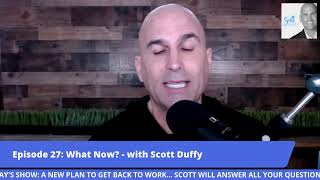
Scott Duffy walks through the CDC/FEMA reopening plan from April 2020: a phased approach starting May 1, followed by six months of mitigation. He covers vaccine timelines (Johnson & Johnson targeting April 2021), unemployment and stimulus updates, and practical pivots for businesses like contactless tech and reconfigured workspaces.
Chapters
Good morning, everybody and welcome to what now with Scott Duffy. It is good to have you here today. It is Wednesday. It feels like it's Friday night. It has been a very busy day. It's been a very busy week. I hope you all are doing so well today. Again, this is Scott Duffy with what Now. And I want to welcome you from wherever you are tuning in today. We're coming to you live each and every day from YouTube, Facebook, Periscope and LinkedIn. And you can hear us nationwide throughout the day on Dash Radio as well as download the podcast. And again, I want to thank all of you for joining from wherever you are, wherever you're listening. And if you're new to this program, I'd love to ask you to do one thing and that's it, and that's this. If you wouldn't mind, please write down your name.
The industry that you're in and the biggest questions that you have or things that you're going through today so that I can adjust this show for you. This show is all about you. My goal is to deliver the things that you need each and every day to help you to stabilize yourself, personally stabilize your business and prepare you, help to set you up to come out even stronger on the other end of this crisis. And like Monday and Tuesday, today's Wednesday. And we got a heck of a lot of news today. And you know, it's really interesting because, you know, there's some, there's some tough, some tough data out there for us to digest, but also a lot of really good news. And a new plan is emerging for getting all of us back to work starting May 1. And so what I'm going to do is share with you everything that I know about this plan and, and what that means for all of you across the country and give you an update on stimulus payment from the government. So I'm going to give you an update. What I've learned today with regard to unemployment and where that sits on getting personal stimulus deposits. They're not checks for most of us. Give you an update on the PPP program. Some new news and ways that you can apply have emerged this morning. So, so I want to share that with you today as well. And also I've got some incredible examples of how companies are adapting right now. I've just some insane examples about how companies are adapting. People I know whose businesses are really taking off and I think what is different about them and we'll talk about this in just a few minutes when we get started is the mindset that they have and the questions that they're asking themselves every day, they are really working hard and to put themselves in the right mindset, to position themselves to be more open to the feedback they get, to be more adaptable and flexible based on what they learn and to just forget what they know and learn whatever it is they need to learn, acquire whatever new skills they need to acquire to go out there and pivot their businesses. And so I'm going to share with you some other just like really new and super examples that I have I've heard over the past 20, 24 hours.
So with that, we got about 15 seconds and we're going to go live on radio. So I want to just again thank all of you for joining. And while this is propagating across the Internet, if you're new to this show you're watching on Facebook, YouTube, Instagram, Periscope or LinkedIn, if you could write down your name, the industry that you're in and the biggest challenges that you're having or questions you want answered so I can take care of those and answer those today and shape the show around you, that would be totally amazing. So thank you.
So here we go.
Good morning. My name is Scott Duffy and this is WHAT now with Scott Duffy. I want to welcome you from wherever you're listening. You can tune in each day at 10:00am Pacific Time to watch the live broadcast on YouTube and Facebook, listen nationwide on Dash Radio or download the podcast this show. It's for entrepreneurs, small businesses and those thinking about starting their own company. It's for people affected by this economy. Maybe they lost their businesses, their job, they were furloughed or saw their consulting contracts canceled. It's for people who are asking, what do I do now and how do I come out of this crisis even stronger? On today's show, we're going to focus on a new plan to get back to work. So there is a plan that has been emerging and we're starting to see some of the details come out, being drawn up by the CDC and FEMA and being presented to the president for how we reopen our economy. It's a staged approach. It begins as soon as May 1st. And so I want to share this plan with you so you can not only anticipate what may be coming, but also to help position you to pivot your business or whatever it is that you're doing to be in the best position to really thrive when this economy begins to open up. So some really cool, cool stuff that's coming out right now and look, when we come back and we go back to normal, it will be a new normal. And it's not like we're going to one day flip a switch and it's going to be like it was back in February. Life will not return to that type of normal for an awful long time. We're going to talk about that, but we're going to begin on our road, our path to a new normal. And it looks like starting May 1st. And I'm going to share with you what that is going to look like. So again, you can get ahead of that for you and for your business. So.
Let'S start with some news today. First, the US which by the way is the world's third largest population, set a single day record for deaths over the past 24 hours. From COVID 19, the death toll rose by 2,228 people overnight. It's amazing to over 28,000 people who passed away from COVID 19 in the US with 600,000 reported cases across the country. New York passed 10,000 deaths overnight. Now remember, deaths are a lagging indicator. So even when the infection rate, the new infection rate of COVID 19 stabilizes, I've been sharing with you that the death rate is actually a lagging indicator. So you have a large number of people who are infected who may have been put on ventilators or may have other health issues. And so they're hanging on and they'll pass away later. So again, our infection rate appears to be stabilizing, but the death rate continues to go up. And that's going to happen for the next couple of weeks.
We also in the past 24 hours have seen the biggest drop in the Dow Jones, the S and P and The NASDAQ since April 1, 18 year lows on oil and March retail sales have seen the biggest drop that they've ever seen in history. So we've had this kind of the death lag toll going on. We've got some crazy things going on kind of with the economy. The data does not look good, but again, that doesn't necessarily affect you and me and we'll talk about that. In the travel industry, which I love, I love the travel industry. I mean, I started a company 10 years ago. It was like Expedia, but it was for private jets. It was called Smart Charter. And we ended up, I ended up selling that to Virgin, it became Virgin Charter and was rebranded and, and all that kind of stuff. I just love the travel industry. I love the space, I love to travel. I love the people in it. And I really miss it. And so when I take a look at the travel industry and the effect that COVID 19 has had, it's, it's really just a. It's a bummer for me. I think the next two to three years are going to be really tough for that business, ranging from hotels to airlines and all the people, travel agents, everyone that's interconnected in that space. And I think as we get back to work and I think about travel, I start to think about other types of spaces and work environments that are going to look and feel a lot different. I'm also close to a lot of people in the co working space. For example, the wework types of businesses in the country and those types of businesses are also going to be completely upended by this economy. You know, think about it. It's going to be very hard for someone like we work to sell as an example. Coming to a place where a lot of people are packed tightly and sitting next to each other and using the same work area that don't necessarily know one another. Instead, what you're going to see is businesses like that shift to spaces where you have more personal, smaller, private workstations. There's just, there's so much that's gonna happen in that space. Okay, so that's the tough news, that's the bad news. Now let's talk about some of the good news and what the government appears to be planning to help us to get back to work.
The CDC and FEMA have created a plan to reopen America. Now, this provides guidance to state and local governments on how to ease mitigation restrictions like stay at home orders in a phased out way to support a safe reopening of the country. This is really important. President Trump wants to have this plan in place within days. He wants to announce what this plan is going to look like by the end of the week. And he wants to reopen. And it looks like, according to the CDC and fema, it will be safe to reopen some parts of the country by May 1st. Now, what will happen is they're putting together this plan. It's going up in front of the president. So the President will take a look at it, they will approve this plan or a version of this plan, and then the President's going to take it to the governor shortly, so in the next few days and give them the power to implement this plan in their states. And it's really important to note that this plan for getting back to work, even though the same framework will be in place. There'll be a different timeline for each community because Covid has really impacted communities differently. As an example, we got 50 states plus territories that make up this country. Of those 50 states, about 30 of those states have had very little effect from COVID They have a very low infection rate, a very low death rate. There really has not been much that's happened in those states, but they've been under a safe, kind of a safe at home type of lockdown. It's the other 20 states where we see the biggest problems. And of those 20, there's five states where the majority of the cases are. And so again, a rollout is going to happen, framework in place, but a rollout is going to happen on a county, on a state, and then on a national level. That's what it's going to look like. Now, the plan is going to roll out in three phases. Here's what it's going to look like. The first priority in our rollout is going to be to open community settings where children are cared for, including K through 12 schools, daycares and locally attended summer camps to allow the workforce to return to work.
Now think about this. The first thing they want to do is they want to help get kids into a safe environment where they can be taken care of and occupied so the rest of the workforce can get back to work. That's number one. Now, by the way, by the way, think about that and how it relates to your business. As kids are going back to these environments and people are going back to work, what does that mean for your business? What will people need? How will they want it and how can you adapt? How can you adjust? How can you be flexible to give them what they want the way they want it and monetize this opportunity. Second, in terms of the plan, the model indicated that there will be a 30 day shelter in place, okay? As this being rolled out, followed by a six month lifting of all mitigation. So the way this initial plan, I was reading like crazy before I got on today, so I don't fully have it all groked, but what it looks like is that a rollout plan, the framework will be effectively a seven month rollout plan. Okay, so think about this. So we start to go back to work.
Kids go back to open community settings, to schools, to daycares, things like that. Certain parts of the workforce will be able to go back to their office. And then what will happen is there will be a rolled out, phased approach to complete mitigation where there's no stay at home at all. So figure that life is going to feel a lot like it does today, a lot like it does today for six months from the time this starts in your community.
And third, mitigation will be needed so people will not be able to go back to normal where kids are back in schools and daycares and where people are back out in the office and transacting like they were before.
Before March 9, until vaccines or broad community immunity is brought online. So that's the looks like, it looks like this is a 6 month, 7 month mitigation rollout plan. It looks like it's going to start with communities, then states and then the federal government. It looks like the president is going to lay out this framework and give localities the ability to, to enforce it. And that's what it looks like we're, we're in for. And so I would expect there to be some kind of announcement with more details by Sunday, by the end of this week. And I gotta tell you, I know it's a long time. You know, six, seven months is a long time.
But sometimes knowledge alone is curative. Sometimes just knowing what to expect and what to plan for, really helpful for all of us. It can help to stabilize our mood, our mindset, help to stabilize our businesses. Again, the biggest challenge sometimes is just not knowing. And so I think that having a plan in place is going to be a really, really, really big help. And it's important that we get this plan in place quickly because it's important for people to begin getting money flowing regularly into their pocket. I read a statistic this morning that showed that 28% of the population in the United States believes they will not be able to pay for food or rent by the end of this month if they can't get back to work. That's 28% of the population, which is pretty crazy. Now, with regard to this rollout, I just talked about the framework when evaluating communities, the community that you may be in. Here's how they're going to break down whether or not a community is eligible to begin this mitigation plan and get people back, back out there and let go or release the stay at home. First. They're going to break communities into three different categories. The first category is low mitigation. A low mitigation category is where the virus never really spread. So we know that there's 30 states that have really had low that where the virus really, really never spread that all that much. And so those are gonna be the first communities or counties that are gonna be Kind of released from stay at home orders. The second is moderate mitigation. Moderate mitigation communities were former hotspots with controlled recovery. So former hotspots that they've gotten kind of, they've gotten past the hard stuff, they're in recovery, they're seeing a lower, much lower infection rate. And that's the second is the moderate, is moderate mitigation. The third is significant mitigation communities. Significant mitigation communities are those that are currently still suffering. That's New York, that's California, that's Seattle, that's Illinois, that's Louisiana and some other parts of the country. Those are going to be your significant mitigation areas. So they're either current hotspots, they're emerging hotspots, or they have moderate mitigation in place, in place. But they're signs that if they go out too fast and they open things up too fast, you can have a really high infection rate again quickly.
Now, these reopenings have, have to also follow four conditions. I know this is a lot of stuff, but this is all just coming out, it's all just emerging. And I really want you guys to be, I want you to know, I want you to know because again, sometimes just knowing, having a sense of what's going on can be so helpful in terms of our mindset. I think that the biggest challenge, the biggest struggle that I've had over the past several weeks, it's just not knowing from one day to the next what to expect. And because I don't know what to expect or what to plan for, I don't know what to do. And because what I don't know what to do, what happens is I start to get all jiggity. It starts to make me nervous and I start. So I think knowledge alone can be curative for some of these things. So it's a lot of data, but I'm going to keep going. Now, a reopening is going to have to meet four conditions. Okay, so what we've talked about, just so we're on the same page here, is we've said that the CDC and FEMA have created a plan to reopen America. They're presenting that to the United, to the President. When that plan is finalized, the President will present it to the governors of the different states and give them the power, the ability to roll that out and implement it in their states. We talked about there being a phased approach to this, to this rollout of getting us all out of the home, getting rid of the stay at home orders it's going to roll out in three phases. We talked about first, they want to get the kids back into school and into daycare so people can go back to work. We talked about how this model starts with a 30 day stay at home period and then moves into a six month mitigation period where over time more and more industries, people, communities are able to go back to work and not stay at home.
We talked about how it works and how communities are broken into three different groups. Low mitigation, moderate mitigation and significant mitigation communities. And depending on where you are, how deeply the virus is impacting you at the time that they kind of are making decisions, will determine when you can leave the home. And then finally reopenings. So a reopening in a community has to follow these four conditions. The first is the incidence of infection is genuinely low. So again, we know several states and territories have an incredibly low infection rates. So if you the rate of infection is genuinely low, great candidate for being opened up for business on May 1 and the stay at home orders being canceled. The second is a well functioning monitoring system has to be put in place that's capable of promptly detecting any increase in incidents. So they not only want to let you get back to work, you no longer have to stay at home, but if this thing breaks out, there's a breakout in your community. They want to be able to know like that so they can respond. Number three.
A public health system has to be in place locally in that community that can respond quickly if there's a high increase of cases. Number four, a health system has to have in your community enough staffing and inpatient bed capacity to respond effectively in case there's an outbreak. So basically they want to make sure that if they say we're going to lift the order, you don't have to stay at home. They, they want to make sure if there's an outbreak, we know about it quickly, we can respond to it quickly. And there's enough hospital capacity, there's enough workers and beds and stuff to be able to mitigate this problem and take care of it quickly. So.
That's that. That is what we're learning today about the CDC and FEMA plan to get us back to work and to eliminate these stay at home orders. Now every single thing that I'm seeing and every single thing that I'm hearing has a caveat. There's an asterisk and what that note says is that, you know, at the end of the day all of this changes or becomes.
All this changes.
These models could be thrown out, out the window if we get a vaccine and we have a vaccine in place. So let me talk to you about a vaccine because a lot of people don't understand this. So Johnson Johnson appears to be ahead in the developing a vaccine for COVID 19 space. Now, there's a lot of companies that are, there's a lot of groups that are working on this. I know globally there are over 70 different vaccines that are currently in development. They take time to test.
Johnson and Johnson is saying this morning that if everything goes perfect and they have a vaccine they're working on today and everything goes perfect, that that vaccine would not be able to be released until April of 2021. So it would take one year from today in order for, in their estimation, a best case scenario of having a vaccine in place. Now for perspective, a typical vaccine takes three to five years on average to create, test and bring to market. So to do it in a year is like unbelievably fast. But it gives us an indication of how long this is going to take. So I shared with you what it appears the government's plan is going to be for lifting stay at home orders across the country. It starts the one month stay at home and then goes into a six month slow roll plan for getting everybody out of these stay at home orders.
What about big events? What about big events, big sporting events, concerts and entertainment, things like that? Here's what we know today. So Live Nation is the biggest producer, I think they're the biggest producer in the world of concerts and live musical events. Their CEO is telling us that he does not believe they will be able to do live events for one year. So until April of 2021, do not expect there to be live concerts, concert tours, things like that, that aren't digital.
So we're talking one year that's around the same time that a vaccine in the best case scenario would be able to come available. So I need you to think about this. If you are in the event business, you could be a concert promoter, you could be a motivational speaker, you could be a business trainer. You're going to have to get your arms around this idea that it will probably be one year before you're going to be able to do things the way that you used to do them. So your business is going to have to pivot, it's going to have to pivot online. You may have to get into a completely different business altogether. But again, I just want you to be mindful of that. Now the Question is also, look, can we speed it up? So I know that, you know, it normally takes three to five years for a vaccine to get created, tested and approved in the United States. And I know that Johnson Johnson is saying that in a best case scenario with the FDA doing everything it can to help, like eliminate regulation, do whatever it can, they're saying it will take one year, April of 20, 20, 21. Can we speed that up? There's a risk. At the end of the day, there's a risk. So we've heard the president talk about using malaria medications, using different malaria medications in order to treat COVID19 symptoms and help to get people well faster. And he's really been put in words, we're stockpiling. The US Is stockpiling these medications in order to have them available if it's determined that Covid 1919 can be cured by these things. Here's the thing. If you try and speed something like this up too much, there can be negative side effects. In Brazil this morning, they actually stopped testing one of these for Covid use. I'm going to get the name wrong. The Hydro Corta Cordoba Jigger. Because they found that when they were using this with a lot of people in testing, it was creating heart issues, irregular heartbeats, and symptoms that they thought were actually too dangerous in too many people to continue testing. So, you know, a year is quick. But I think, I do think it's important that we do have some time to see what these medications are going to do to us when they're used at scale. Sometimes the cure could be worse than the disease. And so we just need to make sure again to protect ourselves. So.
Damn, that's, that's a lot, that's a lot of stuff today. So normally I'm able to kick this part off in the first 10 minutes. This took 30. Because I think it's so important for us to understand the path to getting back to some kind of new normal so that we can prepare ourselves and, and we can adapt in order to be able to come out of this thing stronger.
With that. What I want to do is I want to say hi to a few people. I want to answer your questions and then we're going to get into today's lesson. I have updates on unemployment, personal stimulus. I have updates on Eidl. I have updates on how several companies are adapting. But most important, you're going to want to listen to this.
I have some updates. I really spent time on this this morning. I have updates on ideas on how you can adapt based on what I shared with you over the last 30 minutes, how you can adapt your business based on what it looks like the government's going to do to help us get back to a new normal. So these updates should be, should be super helpful for you. But first, I want to say hello. First of all. Hello, Julie. It's good to see you. And good morning to Duchess. Sarah Lakin, Great to see you again. Terry Simpson to Sarah, Good morning. And Patrick Carney to Carrie Jacobs. It's great to see you. I hope we're doing well. Cheryl, wonderful to see you. Helen. Brian Breen, always good to see you. Christy, wonderful to see you. Bobby Joe to Sita to Michael.
To Dick, to Bruce, to Jennifer, to Ilion to Alexi. I just want to say thank all of you, thank all of you for joining today. Wherever you're joining today, whether you're watching on Facebook, on YouTube, Periscope, Instagram, LinkedIn, if you're watching on any of those places, please drop your name in the industry that you're in and the biggest challenge you're having or question you have so I can answer those things today. That would be awesome. All right.
Let's talk about money.
So we have new information on unemployment.
Getting unemployment, deciding whether or not to file has really become a big question for lots of people that are still at work. And here's why.
If you make less than, I believe it's around $38,000 and you're getting your state's unemployment plus the additional $600 from the government.
You may make more on unemployment than you do going to work. And so what we found is people, people at around that $30,000 a year range are having a really tough decision to make whether or not they should apply for unemployment and take that and leave their job. And again, unemployment, there's a cutoff, it ends. Or they should stay with their job and potentially risk that job being eliminated and then filing for unemployment later. So I had somebody call me yesterday and ask me what they should do. And so again, I think it's a personal choice. We did the math and we looked at it, but again, it seems to be right around that point. I also want to share that I know a lot of people, 17 million people have applied for unemployment in the last three weeks in this country. And my understanding is like another 10 million will over the next week. So here's the thing.
The people that applied, a lot of them applied early and didn't hear anything back. The states were completely overwhelmed and overrun. And so.
The good news is That I have heard from several people in the last three, four days that they're starting to get their unemployment checks. And so I think that's great news. I don't think that the issue here is that the government isn't trying to do everything it can. I really believe the government is trying to do everything it can to get money into individual and into businesses hands as fast as it can. The problem is timing. The problem is there's no system that was created to do this. The problem is the amount of overwhelm from the number of the sba. The SBA has approved more loans in the past week than in its biggest year ever. Times like 10. That's how crazy it is. And so. So here's the thing. So with unemployment, the good news is that is starting to get to more people. By the way, if you've never applied for unemployment, you've never had it. You always hear about unemployment checks. It usually doesn't come in a paper check, not anymore, anywhere in the country. It comes as a card. It looks like a debit card. And you know what? I'm gonna tell you a story. Let's laugh a little bit. We'll have me. So I remember I've shared with you. When the market crashed in 2008, I lost everything and I went way underwater, went way in debt. And I applied for unemployment. And I remember I was. You know, I'm a proud person, just like you. You know, I'm. I'm a proud person. I. At the time, I didn't want anybody to know that I applied for unemployment. And I lived in this area, like one of the wealthiest kind of areas of the country. I lived in this area in Newport beach where I was also trying to, you know, as an entrepreneur, you know, sometimes we gotta fake it till we make it, you know, or if we're going through a tough time, we gotta put on a brave face because we. Nobody wants to hire somebody or nobody wants to invest in somebody that's down all the time, right? Or looks like they've been beat up or that's all they talk. So I'm putting on a brave face. I'm out there in my neighborhood and I'll never forget. This was like one of the most painful things at the time that ever happened to me in my life. Now it's just a thing. You know, I learned that in life there's big things and there's little things. At the end of the day, they're all just things. And it's all just the way you look at it. So with this, I was at Rite Aid, and I had to buy something, and I had no money in my bank account. I had zero money in my bank account. I have two babies. I am so scared. I have.
I'm trying to go back there, but I don't want to go back there because it makes me sick of my stomach still.
And I hate the way I feel right now. Maybe some of you guys can relate.
So I had two babies, and I don't want anybody to know. But what I had is I had this unemployment card, okay? So it looks like a debit card. So unless, you know, you can just go to the register and you can swipe, and nobody's gonna know the difference. So here's what I did. I grabbed the things that I needed, and I. I was circling around the area saying, you know, hi to people from my neighborhood. Oh, my gosh. Say hi to people from my neighborhood. And I was waiting for that area to open up. I was basically waiting for nobody to be at the cashier in case there was a problem. So I got my chance. It opened up. I dart up to the cashier. I give him my stuff. I go to run the thing. I never used it, so I didn't have my PIN set up. Oh, my gosh. So I run it. And just as I'm running it.
I said to the guy, I had two guys from my neighborhood, two super wealthy successful guys from neighborhood walked up behind me, and they get in line, and they're like, hey, Scott. And I'm there, and I'm like, sweating right now. I'm just hoping this thing works. And so, hey, Scott, I'm sweating.
And I said to the guy out loud in case there was a problem, I go, you know, that's a gift card I got over the holidays. And so if it doesn't work, just let me know. I'll give you a different card, thinking I'm covering my tracks. And this kid, oh, my gosh, he holds up the card and he says, this isn't a gift card. This is an unemployment card. That's what this is. In front of everybody else in line, including those two guys. And my stomach just fell to the floor. And I look at that now, and I'm like. I'm like. I'm like, first of all, I know those two guys much better now. And I've shared this story with them, and they both been in the same kind of situation in their life. The thing about today is this. The thing about today is it is freaked up for Everybody, it's not easy for anybody. We are all going through the same thing. Whatever it is that you're feeling, if you. I just don't want you to feel this. I don't want you to feel alone. There's no reason to feel alone because we are all going through it. And by the way, I share those experiences about my life because, like, it took me years to turn around. I did. But I just want you to know that you're not alone and that we all go through it, you know, and if you're talking to me and you're sharing your worst day, gosh, the odds are I can beat you or we can go head to head on that. And that's what's cool, is that all, all of us go through the same thing. It's just. Nobody wants to talk about it, okay? But I'm going to talk about it. If it helps you, I'm going to talk about it. So if you have not applied for unemployment because you're held up in your head and you go, but you don't want that to happen, you know what? 17 other million people applied in the last three weeks. Go ahead and apply for it. It is a government program that's there for you. It is there to help you. That's what it is there for.
Okay? So, sorry I got sidetracked. But, you know, it's the truth.
It's the truth.
It's the truth. I mean, you know, during that time, you know, I'm holding that unemployment card, right? And I'm thinking myself, oh, oh, my gosh. But you know what? I. You know what I did? You know, I. I had other things that happened. I, I remember, I remember.
Having no gas in my cars. I just want some perspective here. I'm a guy that made millions of dollars. Like, I'm a guy that was what had been really successful doing what I did. Shit, I sold the company that I was in when I did this to Virgin. I mean, go all over the Internet. You'll see me with Richard Branson on CNBC and Fox and all this kind of stuff. Like, I was like, living the time of life. It changed like that. And like, for many of you, it may be the same thing. It may have changed like that. You woke up on March 9th or 10th, and three days later you were out of work. Or a week later you had a restaurant and they shut the city down, you know, and there was nothing you could do. I was in the travel industry. I was in the travel industry. We had an oil spike. The Price. Check this out for the plane. So in my industry, if you had private jets, if my average trip that I would sell somebody to take a private plane from Van Nuys Airport in L. A to Teterboro in Jersey, that trip was $38,000 on average. Okay, one day, a couple weeks later, a few weeks later, that trip was almost $90,000. Because of the spike in. In the price of oil in 2008, that year, the market crashed it completely. So if you feel like you've been upended, I get it. I totally get it. I've been there myself. We're all going through it again. I keep coming back to this thing. I want you to know that you're not alone. I want you to know that after that, after feeling like I was living in the life of my dreams, within a year, two years, I had two cars that were. Had no gas in them in the driveway. I was totally out of gas. Had to literally get. When I got some money in a bucket, like one of those cans, gas can, go, walk there, walk back to put gas in the car in the driveway. I remember times hiding the cars, right? Like moving the cars to different places because I didn't want somebody to repossess them. So all that's behind, right? All that's behind all that kind of stuff. And if you're going through any of this stuff, it's going to be behind you, too. I just want you to know that you're not alone. So here's the thing. Unemployment has started to reach people this week. That is really good at more scale personal stimulus. Did you get a deposit? The government is telling us that by the end of the day today, they believe about 80 million people in the United States will receive a deposit from the IRS into their account. If they have. If the government has your. Your banking information, they get it from your 2018-19 returns. If they don't, you go into our group, you join our group. What now with Scott Duffy, you go and you look down and there's a link. And the link will take you to a place. There's a blue dot. You click on it, it will take you to a place where you put in your Social Security number, you authenticate yourself, you put in your banking information, and boom, they know how to get you that money. So this is really good news. The Eidl program. Honestly, I don't know what the hell's up with the Eidl program. The Emergency Income Disaster Loan program, that program. Oh, by the way, let me stop here. This has got Good news. Sarah got hers this morning. This is good. Bobby Joe received the stimulus. Incredible amount. But she did get a deposit. This is great news. I talked to two other people today that also did also receive their stimulus check. So. That is so cool. Awesome. Eidl. So the Eidl, again, it is. They've just been completely overrun with a number of applications. The program had $10 billion in it that was funded toward it when this market corrected. And, um, what they told us, the government told us, is that if we applied for the Eidl, we could get up to a $10,000 advance on up to a $2 million loan or grant. We would know within three days the answer, and that money would be deposited into our accounts. I still don't know anyone that's gotten this Eidl loan or even heard back, but. But here's what I do know. If you took. You just do the math. And if you just do the math, $10 billion. And let's say the average person got 10,000 just for round math. So everyone got the maximum $10,000. That would mean that a million people would be able to get that $10,000. We've already had like three and a half million people that have applied for that. And because that fund is basically so oversubscribed now, what they've done is taken the maximum loan amount from $2 million down to $15,000, and they're trying to get more funding for it. So I don't have. I don't know what to tell you about the Eidl and how to position yourself better for it. I just know. I just know kind of what I know here. Now, I'm gonna try this. I don't know if this is gonna work, but if you're watching. By the way, if you're watching this on Facebook, YouTube, LinkedIn, Instagram, Periscope, I'm going to put something up again. I don't know if this is going to work. I'm moving to a whole new streaming thing on Monday. But let's see if this works. Here's a picture.
Okay, Here's a picture. This is a picture that was grabbed off of the tv. Okay? This is of Jim Cramer. When I think about the PPP program, this picture comes to mind. I think that this is everything that could be wrong with a stimulus program. Okay? Like. Like a government stimulus program for small business. If you take a look at the top of the screen, you see Jim Cramer here, the background that superimposed that backdrop, what it says is the Dow's best week since 1938. Looks like the market is great, right? It's the Dow's big best week. This is the biggest companies in America. It's their best week. Now, if you look at small business, if you look at people, you look in the ticker below, at the same time it says the Dow's best week since 1938. Here's I've captured for you. It says, breaking News. More than 16 million Americans have lost their jobs in three weeks. How's that for a dichotomy? How's that for the Dow's best week since 1938? On the top and below, we More than 16 million Americans have lost their jobs. I think that one of the challenges that we're running into right now isn't necessarily that the government isn't trying to do everything it can to get small business money. The problem is I think things look different in many ways for small business, for micro businesses, for entrepreneurs, for mamapreneurs, for datapreneurs, for independent contractors, for sole practitioners, than they do for big companies. And the biggest issue that we face, the biggest difference for all of us, big versus small, is timing. It's a timing issue for getting this money into our accounts. I'll share with you again, you're not alone. I'll share with you. 68% of small businesses now say if they don't get cash in the next three, if they don't get cash immediately in the next three months, they'll be out of business. That's almost 70% of small businesses in the United States say that if they don't get cash immediately, they'll be out of business within the next three, three months. How could it be that way? Most small businesses, micro businesses, Most small businesses, micro businesses, sole practitioners, have only two weeks of cash on hand. Have only two weeks of cash on hand.
28% said they won't make it to the end of this month. So again, you aren't alone. And what I want to recommend, what I want to recommend to you as it relates to stimulus is I want to recommend this. If you are applying for a PPP and you haven't done it yet, go to a community, a local or regional bank or a credit union. Community, local, regional bank or credit union. These are the places that are really making things happen for small businesses and small businesses quickly. I think that the bigger banks, the Wells Fargo's, the chases of the world, I think what they're doing.
Which is hard for small business, is they're taking care of their bigger Companies first, their bigger clients, the companies with the biggest payrolls first. They're eligible to get the most money first. They have the strongest balance sheets first. And it will show the biggest propensity to be able to pay the loan off. And here's why.
This isn't just, this isn't a political statement. It's fact. So when the market crashed in 2008 and 2009 and there was stimulus and there were again, the programs were different. But the memories are similar for the banking industry and for business.
There were relief programs that were made available. The challenge with the relief programs is many of these programs either had like low interest rate or they were supposed to be forgiven or stuff like that. But when the Obama administration took over for the Bush administration, what happened was the government went back and relooked at the loans in a certain category and some of those loans kind of terms changed or forgiveness changed. And I think that what's happening is I think that the big banks have sticker shock at what happened in 2008, 2009, and so their requirements are higher. They really want to make sure the businesses that they serve best first are going to be the ones they think have the biggest chance of surviving so that they're able to mitigate their own risk real quick because we don't have much time. By the way, I hope you're finding some of this valuable. If you're finding this valuable, I just ask you one thing and one thing only. Please share, please share this in your groups, your communities, with your peeps, with other entrepreneurs, with anyone that's struggling, people that need to know this information.
Let's talk about, to wrap things up, the pivot. Let's talk about some of the pivot pivots that are going to take place. So I shared with you at the beginning of this show in the top half, what the CDC and FEMA are doing to create a plan to reopen America. What is being presented to President Trump, what President Trump will present in part, in large part, to governors to begin waiving stay at home orders and getting America back in the workplace and back to work. And we talked today about what that rollout looks like. We talked about in terms of phases, who they want to get out, how they want to get the kids taken care of first. They want kids to be able to get back to school in daycare and things like that, so that the parents can go back to work and work more and harder, longer hours if they need to, in order to get income coming back in. So we've talked about that. We have talked about from a community, a local basis, from a local standpoint. We've talked about what communities will be prioritized to open up first, second and third. So super, super, super important.
We have talked about what's going on in terms of stimulus. We've talked about what's up with unemployment, we've talked about what's up with Eidl, with the ppp. We talked about those things. We talked about people who are getting money into their account right now, personal stimulus. Now let's talk about adapting what we know based on this plan this morning. Is that the rollout to get us back to a new normal where we're all back to work, where stay at home orders are lifted, completely lifted in our communities. Looks like in most cases a seven month process. It starts with the 30 days of stay at home followed by the six months that I shared earlier. When we go back to work, it's going to be different. So I want you to start thinking about this, just some ideas. The workplace is going to be a lot different. This creates opportunities for entrepreneurs. If you're in the travel business, if you're in the spa business, if you're in the yoga, the studio business, think about these things.
Number one.
Automatic doors. This is going to become a huge industry. Think about this. People don't want to touch things that other people have touched, right? So automatic doors, voice activated elevator buttons, voice eye facial, payment systems. I remember that when I had to go and buy food for the first time and I was told I couldn't touch anything, I had to pay with my ATM card and key in my pin. That was before I started to use things like Google Pay and Apple Pay. So again, if we don't want to touch things other people have touched, what does that mean for your business? What does that mean for you in terms of being able to innovate and think of new things that customers are going to need. When you go into the workplace, think about this, this idea of having big open workspaces, warehouse type workspaces that have been so cool and hip, particularly in technology for the last 15, 20 years. I don't know if those are going to be around. Instead I would be thinking about offices will probably have more dividers inside of them. Desks will probably be spread further apart and desks being spread further apart. So think about how you can create the next generation working environment with desks being spread further apart from.
It means that as a business owner I would need to have more, I would have to have more space I'd have to pay for to get the same people to come to work, amount of people. So that means I would probably opt to have more people working from home. Okay, so think about this. So now if more people are working for home, who's got the business that helps that business get the people set up at home? There's a business idea there.
Super cleaning is going to become a big thing. So super cleaning is going to be in common areas like kitchens and lobbies and things like that around phones. People are going to want to know that those areas are clean and they're safe. And so I would expect companies to perform what might be called, I'm just naming it a super cleaning service and post on a regular basis when the area has been super cleaned. UV lighting systems. I got a lot of friends that are in the solar business. You know what's going to be hot is UV lighting systems. Think about this. UV lighting systems that are able, when people are not at work in off hours, to be able to light a space in a way that you would maybe in a hospital in order to super clean and super disinfect the space. If you're in the, if you're in the airline business, if you're in the hotel business, if you're in the spa business, I think that one of the things that's going to stand out as much as anything will be how you clean and disinfect your space as much as the services that you provide. I think this is going to become just as important to all of, to all of these things also. I would expect that things like masks, certain kinds of gowns, certain kinds of different things like that may be a common thing in schools. You know, imagine if you're an airline. So I know from, I was talking to a friend who used to run an airline in Europe and he was telling me that what they're doing now is they are taking these systems that are used, have been used for years in hospitals, these big systems, and they're making them small and mobile and they're UV light systems. And they're now testing, going into planes and when the crew is changing the cabin out so your plane landed, you deboarded, now there's a gap and the crew is in there cleaning up. They could mo in a mobile way, go around this thing that looks like a wand and literally with UV light, just like in a hospital, disinfect the whole space. Is there a business there for you? Is that something you should be doing on your plane, in your hotel room? In your spa, does that get more people there because they think it's safer? I got to tell you, I love hot yoga. I love hot yoga. I don't know if I want to go to a hot yoga place or a bunch of people have sweated and touched everything unless I know that between things it's been cleaned. So, again, these are just different ideas of things that may evolve in the new normal kind of workplace that you may want to be thinking about. If you have a security business thinking about a security system or adding to your security system.
Some type of keypad, although we don't want to touch the keypad, so some kind of other entry mechanism that lets people into a workspace that lets me know not only that they're badged and credentialed to get in, but also that they are. They've done their antibody testing and they've got antibodies to fight Covid, or they've done some kind of immunity type of thing, inoculation, you know, vaccine, whatever it is. Think about, maybe you could adapt that into your business. If you're an employer, is there a new opportunity? You know, we have things like ring. You know, the ring thing, it's a security camera, right? So the ring is a security camera. And so people are putting these rings on their door so they can see, they can get a notification on their phone when somebody has rang their doorbell. They. It's motion activated, so boom. It can see when you're working or when somebody's come to your front door and who it is. It's a cool service. You don't think Amazon created that because they wanted your house to be safer? Amazon, like Amazon, owns that. They have that business because they want to be able to track your package and make sure that it's there at the front door. And if somebody stole it, they want to see who stole it and be able to prove to you that they delivered it. Here's the question. Is there an application like that for business? If you're working from home and I'm an employer, am I going to feel safe knowing that you're there to your own devices, not even knowing if you're at your desk? Or is there something that sits next to your camera on your computer or something like that that is an indicator of when you're actually at your computer and you're working? So they really know what it is that they're getting paid for? The biggest challenge with independent contractors today is this lack of accountability because they are not an environment where they can be managed effectively. And so how do you create. If you're a trainer? If you're a trainer, how do you create the model? How do you become the gal or the guy that creates the model? You're the best of the best in the world at what you do, teaching people how to manage other people in this new workplace when they're at home and how to hold them accountable and what kind of technology should they be using. So I got a ton more, but I don't have any more time today. So I just want to thank all of you. I know that we had some questions. I've only got about 60 seconds, so let me take a look through here really quickly and see if there's anything I can buy off quickly. Let's see here.
Yes. Disc profiles. I love disc profiles. I use them with every one of my new hires. And let's see.
Yes. If you are looking. If you want to track where your money is with the IRS to get a payment, go to irs.gov. there's a. Get my payment tracking tool that. Thank you so much. That is a great. That is a great, great.
That's a great recommendation here. Okay, cool. All right. That is it. That's it for today. I want to thank all of you for joining. If you found this valuable, please share it. Please share it with your family and your friends. We have so much coming, so many great things, so many great guests. Starting next week, this is what now with Scott Duffy. You can tune in each day at 10am Pacific time to watch the live broadcast on YouTube and Facebook, listen nationwide on Dash radio throughout the day or download the podcast. You all have a wonderful day and until we meet again tomorrow, keep breaking through.
More from Scott









Business & Burgers-Sequence Collection bracelet for National Entrepreneurship Week

