Scott Duffy interviews Chase Jarvis of CreativeLive, Business & Burgers: Season 1 Ep. 8
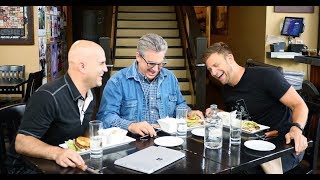
This is a transcript of a Business & Burgers episode (Seattle) where hosts Alan Taylor and Scott Duffy interview photographer-entrepreneur Chase Jarvis (co-founder of CreativeLive). Chase recounts his early life, how he discovered photography (inherited cameras from his grandfather, college on a soccer scholarship), his view that everyone is creative and creativity is a practice (daily making, neuroplasticity), and founding CreativeLive to share creative education. He cites milestones: CreativeLive launched in 2010, their first class drew ~50,000 viewers, and the platform now serves over 10 million people; he also discusses the freelance/side-hustle economy and offers practical advice (do the work, be different, charge for value). The episode interleaves restaurant/burger scenes and closes with a short rapid-fire segment and a teaser for the next guest.
Chapters
I'm Alan Taylor. My buddy Scott Duffy and I are in search of the best burger in America. Each month we visit a new city to try some of the top restaurants, pubs and brewhouses while sitting down for a candid conversation with some of the top entrepreneurs, athletes, entertainers and celebrities. I don't know about you, but I love talking business over a burger. Welcome to business and Burgers.
Scott and I are in Seattle to meet with some brilliant minds and we first head over to Quinn's Pub right off pike street, which is one of our next guest's favorite eateries. Award winning photographer, director and media maven Chase Jarvis Co founded CreativeLive back in 2010 to share free creative education with aspiring artists and entrepreneurs worldwide. In addition to his work creating campaigns for Nike, Apple, Red Bull, Starbucks, and other Fortune 100 companies, Chase is widely recognized for creating Best Camera, the world's first photo app to share images to social networks, which kicked off the mobile photography sharing craze with a global social following. Chase Jarvis and CreativeLive host the world's largest live streaming creative education website, weekly live video podcast, and Chase Jarvis Live interviewing the world's best creators, innovators and entrepreneurs.
Look at that, right on time. How you doing?
Thanks for joining us.
Thanks for having me.
I really appreciate it.
So welcome to business and burgers. We're about to dig in and find out a little bit more about the great Chase jars.
A burger's included though.
There's a burger included.
There is a burger coming.
Scott is going to take care of us and I understand you know him.
Yes, Chef. Scott and I go back probably more than a decade.
Wow, nice. So I'm an artist and you're an artist. Every photo is a story and I think it's a beautiful thing.
For sure.
I'd love to hear your story.
Oh, you guys, there's not enough burgers. Bring out the. No, no. My story is a pretty simple one, actually. I grew up local here to Seattle, was a jock as a kid growing up, mostly because I spent a lot of time repressing the creative side because when I was growing up to be the creative kid was a little bit weird. Like, oh, I'm creative, but I don't really want to talk about it. So I did exactly the opposite. I was the captain of the football team and the soccer team and ended up going to college on a soccer scholarship. But the whole time I had a connection to photography and it really stemmed out of what I love to do. I was active, as I said, as a skateboarder a BMXer. And if you look back early in my career, those were the first things I was photographing. And it wasn't about trying to be famous or make a bunch of money like you're just going to pay me anything to hang out with my buddies and skate and surf all over the world. Happy to do it. It was easy. It's a no brainer. That's cool. And that really parlayed into having to learn the business aspects of creativity, of being an artist.
And how did you choose photography?
Oh, man. Well, there was two key things that.
Or did it choose you?
I felt like it chose me. There were two key, pivotal aspects to that one. One is, as you know, I went to college on a soccer scholarship, Division 1. We were in the national championship year before I got there. So there was in the media attention, a large Division 1 school. And there were always cameras and TV folks around. And so started looking at that even in high school, seeing yourself in the newspaper, like, wow. It wasn't that it was about me or my friends. It was about there was a moment that was captured, some story, and to me that was intriguing. And then another thing, my grandfather, just short of my college graduation, it was horrible. But he dropped dead of a heart attack and totally unforeseen. And yet the silver lining in that was he was an amateur photographer, collected cameras. And on his passing, I was given all of his cameras. So I threw all those cameras in a bag. And my then girlfriend, now wife Kate and I, we went to Europe and basically lived out of a bag. And I taught myself how to take pictures walking around Europe for six months, that's so awesome.
That is awesome.
Is creativity something that you're born with or is it something that can be taught?
First of all, answer the question directly. Everyone is creative. It's one of the things that differentiates us from other species on the planet is we can put unlikely disconnected things together to form something new and useful. We all have creativity inside us. And that's one of the things that I've turned my life to now recently is really projecting. How can we make the world a more creative place? How can we unlock the creator that's inside of every person?
So inside of a company, if I'm running a small business, what are a couple of ideas I can take back to the office to help unlock creativity in my company?
Good.
Within my culture?
Yeah, sure.
I think there's a handful of things, first of all. And the most important is that creativity isn't some gift. That's anointed it is a process. It is a process of putting something out there, of discovery and rediscovery. The simple act of making something every day, the act of creating, whether it's a photograph a day or creating music, it literally rewires. You've heard of neuroplasticity. It rewires your brain to be able to create new solutions to other problems. And at the end of the day, let's just be crystal clear that creativity underpins the solution to every problem the world will ever know. Whether it's world hunger, whether it's the climate crisis. If you think about creativity with a capital C rather than just photography, painting, drawing and art, you start to understand that this is a really, really critical aspect of our culture. And how can we look to shepherd that into the new generation so that we get the benefit of the creativity of everybody?
And I think that creativity is a crucial aspect of being an entrepreneur.
Absolutely.
Does it trip you out that when you went on your journey to Europe and you've got your bag of cameras that you can do a lot of that work on a phone today?
Absolutely. There's a phrase that I popularized and have a trademark for called the best camera is the one that's with you. What I started experiencing is like, okay, if this is the pinnacle of the game, I'm actually having more fun. Fun taking pictures in between shots with my then flip phone. And soon to be different versions of different phones. Everyone that had a camera, I started really engaging with that camera. When that little informal tool starts to bring more joy than the big production, you know, it calls into question what are we calling photography. So the fact that now the tools and technology is so good that anyone is a photographer, to me, that's just underpinning my overall message, which is that there's obviously creativity in every person.
So I know we've got some great.
Burgers on the way.
Ah, beautiful, man.
Good to see you, Scott.
Chef Scott.
Thank you so much.
Tell us what we have here.
Well, this is one of our vegetable based burgers. We do so much meat here that we offer like two or three different vegetarian options. So this one is a burger made with quinoa farro and smoked lentils. And there's also charred vegetables inside and herbs. And then we have a avocado aioli, fresh heirloom tomato butter, lettuce on a homemade English muffin. And then we have our fried cheese curds.
So really good.
Now, how long have you been here?
Gosh, I think since 07, so almost 10 years.
And you and Chase know each other, and I guess you freed up for us.
Good to see you.
I know.
How many restaurants do you guys have today?
4 now.
4 now.
Less event spaces as well. So this whole concept was inspired by the whole gastropub movement in London, and.
That'S really what this is, is a.
Spin on traditional pub food.
Absolutely. You put a classically trained chef in the kitchen, what happens to fish and chips or what happens to, you know, that sort of thing, as well as bringing in beautiful fish and. And awesome meat.
Thank you so much for asking us.
Yeah.
Good to see you guys.
Thank you.
All right.
Burgers are awesome.
Appreciate it. Yeah. All right.
Okay. I don't know about this here.
I know about it already. Go.
Boy, that is a good veggie burger.
That is amazing. I love you. Scott. Can we have two bites? 10.
So you've created a lot of success. Success. And one of the areas that you've created a ton of success is in creating a successful and sustainable and thriving business.
How do you do that as an artist? Sure.
Well, first and foremost, success can be measured in a lot of ways. Notoriety, you know, recognition from your peers, from your industry, from others, Facebook likes. But certainly, like, making a business, making a living and making that sustainable is something that's really important. And I think one of the key mantras for me is you have to be good at your craft. So there's no shortcutting that you got to put in the 10,000 hours. You've heard about that. The hard work. You gotta put in the work. You gotta put in the hard work, man. Nothing happens without hard work. So I think the other mantra besides the hard work is about how can you be different, not just better? And where do you add value in a way that other people can't? I think something that's fascinating is that we used to be very siloed in that, you know, you were a radio show host and you might have been a business builder, and I was a photographer, but the reality is it's the first time in the history of the world that we don't require permission to be whatever we want to be. And, you know, thanks in part to technology, we now can share at scale, like whether if I take a picture and share that I don't need to go through a publisher, through an art gallery, through. I can just hit publish on my phone. And if you put those two things together, you realize that when we were just a photographer, now I look at myself as a photographer, a director. I hosted my own show. I Founded two companies. To me that's an empowering message that anyone out there at home can take and really sort of live a life and make what they want. You see people making careers, livings and lives out of what they love. And you've heard about the freelance economy. 53 million Americans will freelance this year. That means like a side hustle and something like by 2020, half of the US working population is going to have a side hustle. And where do they learn about all those side hustles? It's not at a four year university.
Sure.
It's at somewhere like CreativeLive.
At what point do you say I can't give any more, I need to be paid for my art and my.
Talent Now I think that's a really interesting. Yeah, super good question. The idea of value, that you understand that what you make has value is the first step in charging money. That's a message to the folks at home. What you do has value. Especially if you're tapping into the thing that you're uniquely talented or excited about because you know this as an entrepreneur. Stuff's gonna get hard. And when it's hard, you better be working on something that you like, that you care deeply about. Because if you're just solving some market opportunity, when stuff gets hard, you're gonna not. It's easy to quit. Yeah, it's easy to quit. Versus if something you're really, really passionate about, then you can understand that you add value. And when you understand that you can add value, it's really. Or it's much easier to ask for money.
What was your original inspiration for CreativeLive, which I love.
Thank you. So CreativeLive was founded on the basis that we are all creative. As a photographer, one of the things that I brought to my industry was telling the story of what it was like to be a photographer through making videos on the Internet. And as social media came up, I was telling that story very publicly. I was the first or one of the first photographers to really. What I talked about is give a look inside the black box of photography or even like larger photography and filmmaking. How do you make a living here? What is it like? And I started telling stories about what it was like to do that. And at first that was just like radical because I was giving away all the trade secrets. And at first it was vilified. But what I saw was that information wants to be free. And at some point this whole thing called the Internet was going to reveal the fact that this information is everywhere. And so it suddenly becomes not about what you know, but about how can you really put your personal stamp on it. And when I realized that accidentally, I built up the following of say a million people who were paying attention to what I was doing as a photographer. And in listening to that audience and listening to that community, I realized what they wanted was they wanted to tap into that thing that I had experienced. The ability to make a living in a life doing what you love. So I got together with my good friend and we said, wow, how could we bring this in sort of a platform format to the world? And so I rang up a handful. You know, when you get to the top of an industry, your peers are the tops of other industries. So I rang up my friends who are great filmmakers, photographers and designers and said, hey, I want to build this platform. I don't know what it's going to be like, but if you want to come and share your secrets, I think we've got a little bit of a model here. And so we did that. Our first class had 50,000 people. And so now we have folks like Richard Branson, Mark Cuban, Ariane Huffington, Pulitzer Prize winning photographers, New York Times best selling authors, folks like Tim Ferriss, Marie Forleo. The list just, it's an epic list of about 1,000 creators who are the best in the world at whatever it is that they do in the creative sphere. And they're looking for outlets to reach a large audience and to share what they've learned with the world. So CreativeLive just is that platform that makes it all possible.
How does one find that space of.
Releasing that creativity actually start making something like on a daily basis, whether you're taking pictures, reading and writing, you know, the daily creative act is one of the things that illustrates to you what's possible and experiment. Do a handful of things and you'll naturally gravitate to the things that you're excited about. To me, that's something that we're just starting to see explode, at least in culture here in the US I think Europe is right behind us and we see basically the rest of the world is starting to tap into this idea that you truly can create a living and a life doing what you love. And it's the first time that people are leading with passion and what a better world.
Yeah, that's so cool.
Right? When people are going to work doing what they love, what about the person.
That maybe never viewed themselves as creative? And so we're telling them just to get started, right. And sharing just metaphorically push that button. Yes, but they're afraid that it has to be perfect.
I have no idea what you mean.
So they never get started.
Yes. But that's why I'm prescribing a daily activity. Because if you can do things in small steps, you start to be okay with small failures. That's what happens some of the best. You know, Jared Leto is another guy who's on CreativeLive and he. He talks about only really being able to succeed because he fails on a daily basis. So often trying lines out for the new movie or trying a new disposition for a character. And it's through doing that so often that you get comfortable with small failures and you're willing to take something on.
You ready for some business and burgers graffiti?
Bring it.
I'll go first. Yeah. What are you most proud of?
Serving other people. The fact that creative life serves more than 10 million people all over the world is something I wake up and I'm thankful for every day.
Awesome.
Awesome.
If a person feels stuck, what's the first thing they should do?
Look inside of them and think about what matters to them. And do that.
What do you hate?
People who are haters.
It's so easy to chop something down and to be cynical. The reality of trying to add value and be kind and generous to me, that's what's exciting.
You've been married for almost 20 years.
Crazy, right?
Secret to being in a great relationship.
Give and ask nothing in exchange for giving.
Isn't that fun?
Yeah. You'll always get more. If your primary mode is giving and support, it's amazing that the love will come back to you.
You know what? You're a pleasure.
Thank you so much. Appreciate it. Much gratitude for having me.
Creative entrepreneur.
Thank you.
Thanks for joining us.
Are you done with that? Is this.
Yeah. You can have whatever you like.
That fascinating snapshot into Chase Jarvis world left Scott and I pondering the countless bits of wisdom Chase has learned over the years. Here's some food for thought. Don't just be better. Be different. Find your point of view. When you know the work you do has value, it becomes much easier to charge money to unleash your inner creativity. Do something creative every single day.
Next time right here on Business and Burgers. My mentor Barry Maguire joins us to talk about his successes past and present. From Meguiar's car care products to his number one rated TV show, Car Crazy. Barry has been a key figure in the automotive industry for decades. He has some wise words of advice for young entrepreneurs and old right here next week on Business and Burgers.
Check out more episodes of Business and Burgers and our B and B blog at our website, businessandburgers.com also, don't forget to visit our Business and Burgers Facebook page and give us a big thumbs up. Join us each Wednesday for an all new Business and Burgers presented by Microsoft, where we get to the meat of a successful business.
More from Scott









Business & Burgers-Sequence Collection bracelet for National Entrepreneurship Week

