Scott Duffy interviews Courtney Brown CEO of Sense of Style, Business & Burgers: Season 2 Ep. 5
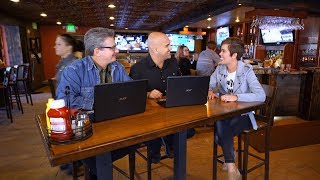
Courtney Brown built Sense of Style from a $5,000 loan from her mother into an e-commerce fashion brand staffed almost entirely by stay-at-home moms. She ditched trunk shows for online sales, stayed bootstrapped, and deliberately keeps growth to 15-25% yearly to protect her mission of flexible work for mothers.
Chapters
I'm Alan Taylor. My buddy Scott Duffy and I are in search of the best burger in America. Each month we visit a new city to try some of the top restaurants, pubs and brewhouses while sitting down for a candid conversation with some of the top entrepreneurs, athletes, entertainers and celebrities. I don't know about you, but I love talking business over a burger. Welcome to business and Burgers.
This week we're at the popular ski town of Park City, Utah. But we're not here to hit the slopes. Instead we're stopping by at the Westgate Park City resort to check out Draft Sports Bar and Grill, a local gastropub best known for its award winning burgers, Stone Hearth pizzas and loaded apps. A best of state winner four years running, Their gourmet burgers are a perfect reward after a long day on the slopes. Joining us is Courtney Brown, CEO of Sense of Style, a popular online fashion retailer staffed by a team of talented stay at home moms. Courtney has not only succeeded in her mission to empower women, but she's also created a multi million dollar company to from stay at home mom to CEO, Courtney gives a new meaning to the term work life balance by offering her employees flexible hours, the ability to work remotely and a family friendly work environment. What some companies would consider an inconvenience, Courtney views as her most valuable assets. And the results show with three straight years of 2 to 300% growth, Courtney proves that success in business and family are not mutually exclusive.
Courtney, it's great to see you.
It's so good to see you again. Thanks for having me for sure.
I want to introduce you to my buddy Alan Taylor. This is Courtney Brown.
Nice to meet you.
Courtney. This Sense of Style, I'm really grateful that you were able to join us today. And one of the things that I love the most about Courtney is the way through her business and through entrepreneurship, you found a way, a model for empowering women and creating tremendous women entrepreneurs. And we're going to talk about that today.
Well, thank you. Those are kind words. But that's what we're all about at Sense of Style. And honestly, that's my life's mission and purpose.
So tell us about Sense of Style.
So Sense of Style is a hundred percent e commerce online women's fashion brand. So we sell everything from shoes to apparel.
Now do you have all women at the company?
We have all women. We have 30, I think to date, 32 employees. Except I'll be honest, there is one dude. Oh my gosh, my husband, our COO.
You mean, the guy right over there at the bar, John.
He doesn't let you go anywhere.
You know what we like to call him?
What?
Mr. Sense of Style.
Mr.
Sense of Style.
He's wearing a big hang tin shirt. I can tell from 1973.
It's awesome.
So what was your inspiration for doing this? I understand there's a lot of working mothers involved too.
It all started because I was a stay at home mom. We had just adopted our first child. And after years of infertility and the adoption struggle, I thought, you know what, I have it. I have this beautiful, precious daughter and I'm set. I'm gonna be a Utah Pinterest mom. And I got into it and I thought, you know what? This is, this is wonderful. But this isn't everything I need. I need something else where I feel like I'm contributing to my family, my community, the world and myself. And I even hesitate to even say that now 10 years later because women get so super uncomfortable when other women admit that perhaps motherhood isn't the end all. And sense of Style came from that place.
And then how did you expand your vision? That started with you started with me to include so many other stay at home moms.
So that's, I mean, it kind of happened organically in the fact that when you first start a business, who do you talk to first? Your best friend, who is probably your neighbor, who is your sister, your mom, those people you interact with? It's no different than probably who you guys started your businesses with. And they just all happened to be stay at home moms. And as we grew in scale and found problems, we found ways to use this incredibly underutilized, talented workforce in the hours that they had to scale our business.
When you have this workforce that we're describing, where the workforce is, their stay at home moms, they can maybe work a couple hours a day or part time, whatever the amount of hours is. How do you schedule that or plan that into your business and rely on that?
Couple things. One, I like to say we work with the time that women have. Corporate America says it's 9 to 5. We usually start working around 10 or 11. After school, kids are off to school. We do stop at 5, but we get back on at 9 and we work until midnight. We live in a digital age. We have technology that allows for all of this. We have harnessed incredible softwares and incredible companies to allow us to connect remotely. Of course it has huge challenges, but I am such a believer in this that we will work through those challenges because it's not about the time they're sitting at their desk. It's about getting the job done.
I think because of that culture thing of nine to five, it's not acceptable. And more companies need to hear you and me and Scott and this show talking like this. Because the reality is get the job done. Do the best job possible. However you get it done, that's up to you.
That's what we're all about.
Is that great? Right? And you know what's great is the burgers are here.
You have outdone yourself.
Oh, where's the fries?
What's better than a side of fries? How about tatchos? A pile of crispy tater Tots loaded with bacon, diced tomatoes, scallions and gouda cheese. These tots mean business and if Scott and Courtney are lucky, I might even share. To go with our totchos is the award winning Ghost Burger, an 8 ounce Angus beef patty topped with house made ghost pepper barbecue sauce and ghost pepper jack cheese. And I've been warned that this burger has a kick to it, but I'm up for the challenge. We'll be right back for these tasty burgers after a word from our sponsors. I'm Alan Taylor, this is Scott Duffy. We're business and burgers. We're on the road with our new Acer SwiftOne laptop. You know, Scott, these are great for students or business people on a budget.
They are. They've got all the essentials, including Windows 10, and they're a great value.
Throughout April and May, you can get your new Acer SwiftOne from CDW for just $289.99. That's over $100 in savings. The Acer Swift One with Windows 10 Pro and Microsoft Office is a super light, thin, powerful and ext economical way to get the power and functionality that you need to run your business. Pick up one for yourself or get a few for your team today at CDW for just 289.99 each. This deal is only good throughout April and May, so don't wait. Get your new Acer Swift 1 today.
While you're taking out bites. We've talked a lot about your vision or what I'd like to learn more about is how being a female entrepreneur is different than being a male entrepreneur. You know, from the standpoint of getting started, going out there and selling your vision and raising capital and things like.
That, the intention of it a lot of times is different in the get go, right? You get a lot of male entrepreneurs that start in college, female entrepreneurs are kind of at a different stage in life. They're often a little older, so maybe they've still started a family. And it's like something comes up and they're like, this could work. You know, we may be solving a problem, but we didn't set out to start a business. Because I live in a culture where women's roles are so incredibly traditional. There are certain jobs and certain roles and responsibilities that are absolutely acceptable. You know, if I were to chose to be a nurse or a school teacher, even a blogger, an influencer, all of those roles are somewhat acceptable. But I decided, you know what? Fashion CEO, good for you. And so I value family above all else. How can I take that and this and bring them together and do it well?
You know, you said something that's so important is you have your foundation built on the right values, love of family, making sure that you want to do the best you can do at whatever you do.
Yeah.
And then also women have this unbelievable ability to multitask that I'm afraid most guys don't have.
What if you could harness the power of that stay at home mom who's an incredible multitasker, who yearns for something, Even if it's 10 hours a week, something that she can put her name on and said, that's mine, but also doesn't want to sacrifice that home and family. That is the workforce model we have built. Our business on sets of style is 100% bootstrapped company. Wow. Other than the very first $5,000 loan I got from my mom, it has all been just all bootstrapped or bank financed.
I think that a lot of people just figure or assume that most businesses raise capital. They raise capital to get started, but less than a third of businesses in the United States will ever raise capital. And the ones that do have typically been in business for three years or more. So this idea of bootstrapping, how did you do it?
Everything went back in. Everything. We're an inventory based business. We're a consumer good. We've decided that the reason we're gonna do that is it's intentional. It's intentional because we want to continue to support our mission of empowering women. We have decided that we're not going to have a crazy, crazy growth rate any longer. We had a few years of that 200, 300%, but we want to sustain our own growth between 15 and 25% a year with our own cash. And it's by design so that we can continue to employ stay at home Moms that we can continue to work out this workforce model.
You know, it's interesting you said that women have had to come up through this cultural thing of the, you know, your job is over here, but you've learned to adapt and turn that negative into a positive because the way you approach things is so much more thoughtful. And I think there's something very attractive to being approached with humility, grace, dignity in a business environment.
Yeah. I have a question. Is that just something that you think people say or men say, even though it comes from the heart or as a woman, is that what you like? What's your experience?
Well, how much venture monies in Silicon Valley right now is going to women? Not a lot.
And is that because fewer women are pitching, or is that because of other reasons?
Both. We're just coming upon it. It's 2017, but how many generations of female CEOs have we had?
So I think the ones that are doing it, like Mary Barra from General Motors, are doing it with such great dignity that it's almost like it reminds me of. That's the way it should be.
I completely agree. It's. You asked if that was my experience. It takes an incredibly strong woman.
Which I believe all women are strong, but it takes an incredibly strong, confident woman to walk in to let's call an entrepreneurship group and be the only female in the room. Not everyone can do that. We've got to change that. We've got to make it so there's 3, 4, 5, 10 women in the room. So that perspective that you just said, Allen, is heard. I was this woman, you guys. I was the one working in the time that she had to build this company. That woman is now my employee, and that woman is also my customer.
Did you ever want to quit?
Sometimes? I still want to quit every day.
But I love that you're still smiling about it and you still love what you do.
Can we be honest about that? It's really hard, and I fail a lot. We don't talk about failure enough. People connect when we hear about the hard times, not about the perfection.
So what was the hardest time you experienced?
Hardest time. Five years ago, we did a 180 on the business plan and almost walked away. We started over.
What happened?
Remember, I kind of said it was a hobby company up until that point. The business plan we had created, we started going direct to consumer via craft shows, trunk shows, in home parties. Right. Because I wasn't going to start a brick and mortar. I had very little capital. How could I get to the Consumer easiest. And that's how I found. And I realized it wasn't scalable. We had hit our peak on that and I wasn't making any money. Like I said before, all the money went back in, back into the inventory. And I thought, I've either got to walk away or I've got to change this.
So you pivoted. So I pivoted, which again, There it is, 100% online.
And I got rid of all of my revenue and started again.
Wow.
Wow. What was it that kept you in the game?
I think. Well, first of all, I think my personal core competency is perhaps grit. I just keep going.
I love that.
That is so powerful and awesome.
Well, the fact that she actually knows it. That's the best part.
That is so awesome.
It's like you figured out, you know what I've got. Stick to itiveness.
That's it. I'm not the smartest person in the room. I don't have the most business experience, you guys. I have a sociology degree and the.
Ability to go, I screwed up.
Yep. Failed. And then I pivoted.
Yeah.
We were saying earlier that we believe that everyone in the world like they fail, but entrepreneurs pivot.
When did you learn that? What?
I could have shared that with me.
A few years ago.
I think you may have said that to me.
I love that. I might just steal that.
So I was just reading a Boston Consulting Group study that showed that of the 36% of the 27 million businesses in the United States were owned by women. But what's interesting is that those businesses grow at a rate of over 30% faster than their male owned counterparts. Why do you think that's the case?
That actually really surprises me.
And why?
And because I sometimes think that women sacrifice growth for time. And my question back to the Boston Consulting Group would be, to what point, to what revenue level does that continue to hold true? Because I can see it in those in the small business, in the smaller businesses. Absolutely. Because I think entrepreneurship for women, you're allowed to do both. You can have a home and family and you can have this business that you love.
But for those women that are actually watching this show that want to get into business for themselves, do you have any tips for them?
My first tip would be just start, don't wait, don't think that you have to have perfect market conditions and an incredibly long drawn out business plan. Start somewhere. Number two, use the incredible free resources that are around. This show is a great resource. There are incredible podcasts. We have chamber of commerce and the SBA and even companies like Microsoft that you can go in and get business consulting and loans and loans in their stores. Number three, it's okay to grow at your own rate. Don't look and think that because Silicon Valley, 300% growth year over year, that's not the only way that people in this country do business. You just starting and keeping going and growing it little bits by little bits by little bits. That's okay.
Yeah.
And I was going to say, I think grow at your own pace is universal. We have to just stop listening to what the noise says and stop thinking.
There's only one way to do it. Do what works best for you, for your life, your family and your business.
Courtney Brown, you have a great sense of style and business.
Thank you so much.
No hug for you because I'm going to finish my burger.
Oh, me too.
All right. Courtney's family friendly business model has given us a lot to think about. So here's some food for thought. Work life and family life don't have to be more mutually exclusive. It's all about finding that right balance. Create a work schedule that fits your business needs. Not all work days have to be 9 to 5. It's okay to grow at your own pace. Sometimes slow and easy wins the race.
Next time, Scott and I return to draft for the burgers and we meet up with our buddy, Scott Schwab. Scott is the co founder and president of Bottega, an online vocational program that gives the next generation of coders the skills they need to succeed in the workplace. Scott's amazing struggle with chronic illness gave him the grit and determination he needed to become the successful entrepreneur he is today. Join us as we talk technology and the future of education. That's next time right here on Business and Burgers.
Check out more episodes of Business and burgers and our BNB blog at our website, businessandburgers.com and don't forget, visit business and burgers on Facebook and give us a big thumbs up. See you next time right here on Business and Burgers.
More from Scott









Business & Burgers-Sequence Collection bracelet for National Entrepreneurship Week

