Scott Duffy interviews Dan Fleyshman, Business & Burgers: Season 1 Ep. 17
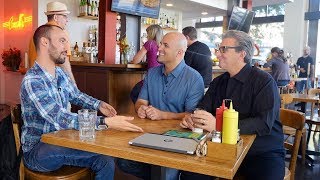
Dan Fleyshman went from working multiple jobs in high school to launching an energy drink, an online poker site, and becoming an angel investor. He now runs pitch events, wrote a book on low-cost startups, and operates a charity distributing backpacks to homeless people.
Chapters
I'm Alan Taylor. My buddy Scott Duffy and I are in search of the best burger in America. Each month we visit a new city to try some of the top restaurants, pubs and brewhouses while sitting down for a candid conversation with some of the top entrepreneurs, athletes, entertainers and celebrities. I don't know about you, but I love talking business over a burger. Welcome to business and burgers.
Cassell's hamburgers is a Los Angeles staple. Founded back in 1948, Cassell's recently reopened in the historic Hotel Normandy. While the location may have changed, the soul of Cassell's has not. Al Cassel's original principles of being a hamburger shop with a focus on premium beef ground daily in house still holds true with chef Christian Page. Today we sit down with Dan Fletcher. Dan started his journey into entrepreneurship at the age of 17 when he took a risk and spent his college savings to trademark the catchphrase who's ya Daddy? After licensing the catchphrase for $9.5 million to a major brand in the UK, Dan went on to create the wildly successful who's ya Daddy energy. Dr. Dan's passion for poker led him to leave his Hoojah daddy empire to create the coolest poker website around. Dan's site, Victory Poker, went on to become one of the top online poker sites in the world. Today. Dan is a prolific angel investor and spends his time mentoring the companies he has invested in. His charity, Model Citizen Fund has provided tens of thousands of backpacks loaded to the brim with food and supplies to the homeless. And his book how to Set up youp business for under $1,000, is flying off the shelves.
You have got such a fascinating story, right? Such a great journ. Why don't you tell us kind of a little bit about your background and how you got to this point today.
So it all started in high school. I was working three jobs and I saved up a bunch of money for college. Instead of putting the money into college, I saved my 43 grand. I actually ended up starting a company because I trademarked the catchphrase, wait, wait, wait, wait.
Before you even go there, wait, you put aside your 43 grand. How did you make that money?
So I was working three jobs simultaneously almost every day of the week.
While you're going to high school.
While I'm in high school. I was working at Ruby's Diner. I was working for Oldie discounts stockbroker under the table. He's paying me 20 bucks an hour. Which was like, it's still good now. Fifteen years ago, in high school and you know, and I was working at Qualcomm Stadium. Peanuts, Cracker Jacks, cotton candy.
Are you serious?
You say every single day, if I wasn't number one out of the 80 food reps, I would like beat myself up. So every day I would be the first one out. As soon as the game, like an hour before the game would start, I would be out there selling cotton candy. Game was over. I'd be selling in the parking lot if I had to. Just. So I hit 1200 in sales. 800 sales per night. Because we got a 23% commission. So all of a sudden if you make 250 bucks a night plus tips in high school and you have a stockbroker and you're working as a waiter, it starts to add up.
That is awesome.
Unbelievable, right?
Talking about a driven man.
I had to because we were so poor. So I saved up all this money and I trademarked the catchphrase, who's your daddy?
Where did that idea come from?
My friend kept saying it all the time. And I just researched and it happened to be available. And I found this trademark attorney in San Diego and he was great. As we started realizing it was a thing, we just trademarked it for everything with 300 products. So at this point now I realized how to get a better manufacturer. I started going to clothing conventions and I get really lucky. I leave the big convention in Vegas called Magic. I'm going back to San Diego and it happens to be a convention called Action Sports Retail show that I didn't know about. So I just drive on a Friday morning to the convention. I get there at 8:40 in the morning, show starts at 9. And I start hunting around trying to find the president or CEO, whoever runs the convention. They're obviously a bit busy because it's showtime. I happen to find the guy. I convinced him to sell me a booth for 3,500 bucks. He kind of laughed at me at first. He's like, kid, like people order three months in advance. You're here at 8:45. Right? But he says, the booth I'm going to give you is right at the front check in. But it's going to be really good for the first day. And there's not going to be a single person Saturday, Sunday. I said, I'll take it, I don't care. Because if I'm right by check in, every single human has to pass by me and I'll just work my magic. Yeah. I end up getting a bunch of orders there. So it goes well. But the best thing that happened is my next door neighbor Booth is a $400,000 booth of Calvin Klein.
Wow.
I make BFFs with the President there because he's bored out of his mind because he thought he was smart by getting that booth there and didn't realize that Saturday Sunday is going to be a ghost town. He gives me his card Monday morning. I don't call him Monday morning. I flew to New York without telling him to his showroom. I just walk in and pretend like I have an appointment. And the secretary, I make nice with her and she says, oh yeah, he's right over here. He's like, whoa, what are you doing here, buddy? And I. Whatever. And he ended up working for me for four years. He left there. What?
I didn't see that coming. Yeah, that was awesome.
So another lucky thing that happened because of that was he introduced me to these guys, Christopher Wicks and Christian Wicks, father and son duo. They own the licenses for like, Fender guitars and Hang 10, Ocean Pacific and Body Glove, all these legendary brands. And so I would drive back and forth from San Diego to downtown la and he became my mentor. When we were only doing a million and change in sales, he got us a $9.5 million licensing deal from Starter Apparel just for the UK. So now all of a sudden, we have this nine and a half million dollar deal under our belt with a huge brand. And then when we were 23, a few years later, we're in thousands of stores. Now we're 23 is when we launched the energy drink. And that's when it all changed. Because then I really didn't sleep. I went and knocked on every door and I got us 43 distributors. Budweiser, Coors, Miller, Pepsi. And I knew I was never gonna be the biggest drink in the world. I just wanted to be the best tasting. So I found the chemist from Gatorade. He happened to have the cranberry pineapple formula that Red Bull didn't want. And I won flavor of the year six months later. Wow. And he had his secret. A green tea energy drink that nobody had ever done before. Remember back then, Red Bull, Rockstar Monster were all black or silver cans. I made bright yellow, bright red, bright green, so you could see it in the cooler. And I made it for $1.99 while they were $2.99, so that if you bought it and then you tasted it, you would actually rebuy it. So it's funny to see. It's cool to look at, but it's Actually a real product. From there I went and met with Ralph Albertson's Costco, everybody, and we just spearheaded. I got into 55,000 retail stores in America by the second year.
And today an angel investor in how many companies?
24 companies.
How old are you now?
I just turned 35.
So you're like the old man of the sea at this point with all.
Of what you've done around all these little tech wizards. I'm ancient history.
So how did you go from energy drain to online?
So after the 10 year anniversary, I started when I was 17, when I was 27, on the actual anniversary from the corporate date, I resigned from the Hoosier daddy so I could start an online poker site. I just loved poker and I saw a big void. There was 550 poker sites but no cool site. So I didn't want to be the biggest site in the world. I wanted to be the coolest site. So there's only about 30 or 40 poker pros that are actually like famous. Ish. So I went and signed 21 of them. And I did that because they'll now wear my patches on television shows all over the world because they're already playing on television shows all over the world paid for by my two competitors. So they're spending $9 million on production on a poker TV show and three of the nine players are wearing Victory Poker.
How did technology assist in all this? As the years went on, even just.
Five years ago, the Twitter, Instagram, Facebook, when they were, they were existent but they didn't do what they do now. Now Facebook ads are just magical. I can spend $10 and market to somebody who's 41 to 47 year old woman that likes pets in Wisconsin and I'll know if she cares for five or ten bucks. So nowadays with technology it's just mind boggling what you can do. All these entrepreneurs that are watching, you can take your idea, set up a site on like a WordPress.com, register on GoDaddy for 10 bucks, work with HP and Microsoft and all these great brands that are providing you so many services for free or for 50 bucks or $100. You don't need tens of thousands. That's why I wrote the book about under $1,000. Most things are free or 20 bucks or 100 bucks. I couldn't say that to you five years ago. Five years ago I would tell you if you don't have 100 grand, don't start.
Let's finish off with online poker.
Yeah.
So we had a really Great run. Became the third largest poker brand on the market against 550 sites. And then tragedy happened called Black Friday and online poker was shut down in America. So we weren't shut down. Technically I was number one site for a minute. But what happened was our competitors were miscoding credit card transactions. So if you deposited 200 bucks it would say PS3 like poker stars, but it would try to pretend like it was PlayStation. I ended up paying back the 41,000 people within four days just so I could sleep at night and be comfortable because my competitors didn't. Which worked out really well. I did 83 news interviews within that week. That got me hired as a consultant for four different land based casinos. I was actually the CEO of a casino for a year because of me being the clean cut good boy in the poker market and everybody else was the bad guy. I by default became the go to guy. He goes to the top.
At Cassell's, they grind their Colorado Angus beef daily to provide the freshest, highest quality beef around. Today Scott and Dan went for burgers topped with avocado on a fried egg. But I just had to try a tuna melt. I know, I know it's called business and burgers, but I just couldn't help myself. I love a good tuna melt.
I. Alright, so let's talk about this. You are an angel investor in 24 companies. What is the first thing that you look for in a company? What are you looking for?
So one of the first things, my first reaction when somebody's trying to pitch me is I put the onus on them. Because every day I get 30 or 40 messages on Facebook, hundreds on Twitter, Instagram, emails. My best way to say no is by saying yes. I say okay, so the best way.
To say no is to say yes.
Yes. You know why? Because then now they have to do work. When I speak on stage, I give up my phone number, my email, how many people call me.
Wow.
The same way when they pitch me, I say, okay, send me your business plan, your projections. I don't want a 40 page business plan. Send me a 10 page one. Just show me that you researched it and know what you're talking about, it's not just the idea in your head. And then call me on Monday. How many people call me?
Barely any. So I say yes to thousands of people a year, but I only invest in six companies a year. Wow. The next thing I look at is why? Why do they need the money and why do people care about what they're opening? So I look for all the aspects. If they hit multiple things on the checklist, then I can write a check.
In addition to being invested in all these companies, you run pitch events in front of hundreds of people.
Elevator night.
Elevator night. If I am standing in front of a group of 500 people and I have three minutes to present as an entrepreneur, what do I really need to focus on and nail in those three minutes?
This one's easy because before every event, I do a training session, like a crash course for entrepreneurs. Each of our events is 300 people, 12 startups, 5 minutes each. Nobody pays to attend and nobody pays to pitch. In the first minute, you say who you are, what you've done in your past. Minute two, explain why your company matters, why anybody in this room full of millionaires cares to cut you a check. Minute number three, really explain the meat of who your competitors are, how big the market is, what's going to happen when you come out. Minute number four, how are you going to make this roll out and become a real thing? Minute five is wrapping all of it together, explaining how much you're raising and why and what the value is to the investors and how to get a hold of you.
And this doesn't have to cost a lot of money. I know you have a fantastic book that came out this year, and it's how to Start a business for under $1,000. So, you know, I think there's a lot of people out there that think, you know, first of all, before I get started, I have to go and raise a bunch of money and put together, like, all the resources and everything I'm going to need. But tell us about your book and your philosophy.
So the main reason I created the book was there's just too many things to set up shop now that are free. The only things that actually cost a thousand bucks that are in that book are your trademarks and corporations. If you haven't spent the time to do a business plan, which is free, and a SWOT analysis of what your strengths, weaknesses, opportunities, and threats are, and Google search your competitors and find out everything about them, good and bad, which is free. If you haven't done all those things first, why am I going to write you a check? Right?
You know what it sounds like? Business 101 for millennials and new business in the new Age.
Really?
Because things have changed, haven't they?
It's just so much easier now. I could never do this stuff five years ago.
Let's talk about your charitable work, because I love what you do and your mission can you share that with us?
Sure. So basically, I make these backpacks for the homeless. Each one has 150 items inside. Yeah. And essentially, I wanted something that was very straightforward and simple.
So you've got everything from toothpaste to hand sanitizer.
Socks is the number one most requested item. So it has. Half of it is about food and drinks. Okay. Water and snacks. And then the other half is, like, sunglasses, a poncho, a sleeping bag.
First of all, how many of these backpacks have you given away?
Tens of thousands.
Tens of thousands of backpacks.
Wow.
And we're gonna give people away that they can get connected with you in the charity deck to contribute as well.
You know what?
In a world of takers, you're such a giver even to create this book, because it's absolutely true. It doesn't cost a lot of money. It doesn't take a lot of energy. For people that watch this show, I gotta say, this is a tremendous resource. Thank you for doing this. Another good deed from Dan Fleischman.
Everybody that watches the show, they can put in the code elevator and they can get the book for free, brother. Good. Pleasure. I'm gonna keep eating this burger. You eat your burger. You eat your burger.
We're gonna finish up here. Thanks for being with us. Thanks for all that you do.
Absolutely. Thank you.
That's aw.
Dan has a remarkable drive, and hearing about his success so early in life left us with some serious food for thought. You don't need a ton of money to start your business. Get started today. An idea isn't enough. Have a business plan ready before approaching investors. Dan has proved drive and hustle can take you from minimum wage to a millionaire in a matter of years.
Next time, we're back at Cassell's Burgers to meet with one of the smartest people in the world, Walter o'. Brien. Walter, known by his hacker handle Scorpion, was a high IQ child prodigy who started programming at the age of 9 and was a national coding champion at age 16. Today, Walter runs Scorpion Computer Services, where he and his engineers create applications for the US Military and Microsoft, among others. Walter's life story is so interesting that CBS turned it into the hit show Scorpion. Hear his amazing story from Walter himself right here next to next time on Business and Burgers.
Check out more episodes of Business and Burgers and our B and B blog at our website, businessandburgers.com and don't forget, visit Business and Burgers on Facebook and give us a big thumbs up. We'll see you next time. Right here on business and burgers.
More from Scott









Business & Burgers-Sequence Collection bracelet for National Entrepreneurship Week

