Scott Duffy interviews David Meltzer: Bouncing Back, Business & Burgers: Season 1 Ep.12
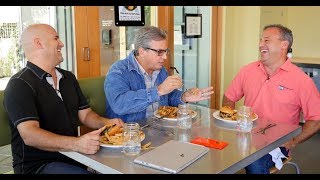
This content was created by Scott Duffy. This content was uploaded by Scott Duffy. This is a YouTube video titled "Scott Duffy interviews David Meltzer: Bouncing Back, Business & Burgers: Season 1 Ep.12" featuring a conversation between Alan Taylor, Scott Duffy, and David Meltzer. The episode, created on November 21, 2017, involves discussions about entrepreneurship, personal growth, and business strategies over a meal, with David Meltzer sharing insights from his career and personal experiences.
Chapters
I'm Alan Taylor. My buddy Scott Duffy and I are in search of the best burger in America. Each month we visit a new city to try some of the top restaurants, pubs, and brewhouses while sitting down for a candid conversation with some of the top entrepreneurs, athletes, entertainers, and celebrities. I don't know about you, but I love talking business over a burger. Welcome to business and burgers.
David Meltzer has spent the last 25 years as an entrepreneur in the legal, tech, and sports and entertainment fields. He knows how to leverage hall of Fame relationships in sports and business. Today, as CEO of Sports One Marketing, a global sports and entertainment marketing agency founded by David Meltzer and NFL hall of Famer Warren Moon. With their many charitable organizations, such as Crescent Moon foundation and Meltzer Mission, this duo has displayed a commitment to their community, empowering youth and adults alike.
How are you, brother?
What's up, brother?
Good to see you.
Thanks for having me. All right.
So you starving?
You know why you're here?
It's all about the secret sauce of a successful business, right?
Yeah.
I know that you and Scott go back a long way, but I want.
To know more about this Jerry Maguire story because I love that movie.
Jerry Maguire was based off of a guy named Lee Steinberg. He's a Berkeley guy, humanitarian. But Lee hired me to be the CEO of his company. Not because I'm a great lawyer, not because I have great negotiation skills, but actually because of Windows CE. I had the first time telephone with Windows CE called the PCephone. Samsung manufactured it. Lee hired me because his vision of sports was that technology would be the future of sports. And I had this technology background. So I became the CEO of Jerry Maguire.
That is so awesome.
I have a question.
What is the biggest lesson that you learned working for Lee?
Was to be kind to my future self. To treat everyone as if they were going to help me or help themselves in the future. So to be kind to your future self was to think about giving before taking and make sure you treat everybody with respect.
I love that. How did you get started? You grew up in a big family, right?
Yeah, I grew up as a single mom and five boys, one girl. And I wanted to be rich because the only times that I wasn't happy was when there was a problem. Money wise. Grew up, my mom taught me great values, worked my way, got college scholarship and then to law school. And I had this one crucial time in my life. It's a very important lesson. I had a DA's offer. I was a very good litigator and I also had this technology offer to put legal research books online from a very large publisher. So I asked my mom, should I be a lawyer or should I sell technology? And my mom, who loves me more than anyone, told me that I should definitely be a real lawyer, because the Internet was going to be a fad. And so it was the first time I ever went against the wishes of my mom and realized that just because someone loves you doesn't mean they're going to give you good advice.
You have to be really careful who you listen to. Right. Because people who give advice, they may have the best intention in mind, but the thing is, they've never been in, like, they've never done that thing or been in those shoes versus somebody who gives counsel. That's somebody who's walking the exact same shoes that you want to walk in.
Right.
They've already been there and done that. So what comes out, you know, what comes from them is pretty powerful.
The easiest way to get to a situation is to ask the guy who's sitting there, how'd you get there? And all that dummy tax that was paid, you don't have to pay. So I definitely agree with that.
So thank you.
Oh, thank God. I'm starving. What are we having?
Chef Nick has whipped up one of his signature burgers for us, simply known as the burger. Nick starts with 100% Washington all beef patty, adds creamy blue cheese arugula for a fresh veg bite, and tops it all off with his house made bacon jam. That's bacon, caramelized onions, and balsamic. Sizzled to perfection. Do I need to say more? Let's eat.
Oh, my God.
Wow, that's good.
That is amazing.
But what I want is, I want.
Some of the secret sauce.
Your successful business and what it took to go from being a millionaire in a short time to losing everything and then starting over.
My secret sauce is four ingredients. First is gratitude. Gratitude gives you perspective. And no matter what happens, especially as an entrepreneur and a businessman, things don't happen the way you anticipate them to happen. So to look at everything in the past and be thankful for it, to see everything in the present, and to be thankful for it only makes your future even brighter, which allows you to actually manifest all the big dreams of a big entrepreneur or a big businessman. The second ingredient has been empathy. Now, empathy is interesting because most people think of empathy as sympathy. But, you know, I can't be poor enough to make you rich, sick enough to make you well. But empathy is much more powerful. It's Forgiveness. And the thing that you need to learn to forgive is yourself. Believe it or not, you can't give what you don't have. Forgiveness brings peace to all your business. And so I had to learn to forgive myself so that I wasn't so hard on others. In fact, even when I first started with West Publishing, you know, selling legal research online, I was the youngest executive, and I ran this big team of 770 people, and my vice president was Dave. You got to calm down. You got to ease off of them. I said, what are you talking about? I was taught you should treat everyone like you treat yourself. He said, in your case, you can't because you're so hard on yourself. You gotta ease up.
I'm hard on myself that same way. And I'm willing to work 24 hours a day.
Who does that?
Nobody. Right?
But I expect everybody around me to.
Do that as well.
Unless you're an entrepreneur.
So there's gotta be a tempering of our spirit, you know, our stallion spirit.
How did you do that?
You had to really look and see a balanced life. And if you couldn't have balance, like a lot of entrepreneurs can't, you have to allow and empower other people to have that balance. And they can't care about everything that you care about at equal value because they don't have the same values.
And then what's the third piece?
Third one's really critical. It's accountability. Accountability is interesting because we get it confused with liability. And so I always tell people, if you truly want to liberate yourself, realize that you're accountable for everything in your life. And when something happens to you, there's only two questions you need to ask. One, what did I do to attract this into my life? And what can I learn from it so it doesn't happen again? Or if it's something good, what do I do to learn to keep on making it happen again?
Where was that tipping point that made you thankful? Grateful, accountable?
I mean, when I became a multimillionaire, I retired in my 30s, surrounding myself with the wrong people and the wrong ideas, and I was on the downward spiral, not even being aware of it. I walked into my huge Rancho Santa Fe home, and I overheard my wife, who I knew since the fourth grade, talking to her uncle, who also knew me since then, and she was crying, saying, I'm not sure, you know, Dave's gonna pull himself out of this. I'm really scared. I don't know what to do, and I'm not happy. I was heartbroken. And her uncle really fired me up because he said, you know, I've known Dave since he was 10 years old, and everything's always gone his way. He goes, I can't wait to see what he's going to do now that his back's against the wall. She then came to me and said, hey, I'm not happy. Go back. And I want you to outline who you were, because you're not living your life the same way. Even in the fourth grade, when I didn't like you, you're not living in this space. And that's where I outlined my four ingredients.
All right, so what's the fourth one?
The fourth one is applicable to everyone. It's effective communication. Effective communication allows you to connect to spirit, to be inspired. And it occurs with everything you need to connect with. Everything's relative to you. That's what I always say. We're all one because in some essence, when we become aware of others and everything, we're one, and that's relativity. Well, effective communication allows us to connect and inspire each other. And the interesting thing with technology, coming from a technology background, is that it's not just this idea that I can't get these millennials or young people to pick up a telephone and communicate or to look someone in the eye, right? They're always texting or Snapchatting or Instagramming or whatever it is. It works the other way, too. You know, one of my favorite stories is that I talk to grandparents all the time. I speak around the world, and I'll say, what's the most important thing to you? And they all have the same answer, their grandkids. But yet they won't take 10 minutes to learn technology so that they not only can communicate effectively with their grandkids, but also look cool. All of a sudden, we spark that interest, and we give them the motivation of connecting to the most important people in their life.
As an entrepreneur, you know, we all have ups and downs and we have highs and lows, right? And it's all about how we deal with them, is when you focus on what you're grateful for, what happens is, you see, most people, they focus on what they don't have. But this, it doesn't matter what's going on gets you to focus on what you do have. And to me, that's where the whole thing really clicked.
The principles, the virtues, the values, the engineering you put into your life. Just like a beautiful car without a great engine ain't going very far, is it?
No. And my key question to everyone Is, you know, they come in and I've had all the money in the world, both now, twice in my life, this time the right way. I ask them, you know, if I could guarantee you happiness, if I could guarantee you purpose from the time you open your eyes till the time you close it, would it be enough? And everybody thinks about it and says yes. I didn't talk about the big house, the Ferrari, the multi millions of dollars. I didn't even talk about health. Happiness is it. And so when we're happy, all of those other things come.
The common theme that we seem to find with people that are successful in business, financially, whatever it is they do, they all seem to have this rise and they all had a fall, right? They all had a period in their life where they lost everything or things went sideways. They're at that lowest point and they don't know what to do. What's the first piece of advice you give them to turn it around?
I would literally say two things when you're feeling that way is one, breathe.
Our brains take most of the oxygen, believe it or not. And I forget the percentage. I don't like statistics anyway. Only statistic I've ever heard that's true is 99% of all statistics are made up. So whatever percentage your brain takes of oxygen, it's a lot. And for whatever reason, when we get into these anxious spots in our life, we stop breathing. And so I believe taking in that oxygen and looking up and looking what's in front of us, using gratitude, empathy, accountability and effective communication, everything will come to us at the right way, at the perfect time.
Give me in order, what is most important to you in life? And tell me why.
So what's most important to me in life is truth. I've learned that 90% of everything I want in my life can be bought. And so money was always very, very important to me. And money can come and go and you can buy better health, better education, better experiences, the best burger. But the truth can't be bought. And the truth vibrates the fastest. And why is that? Important is because the closer we live to the truth, the more we can be aware of. So my constant focus is to be, to live in integrity. Now I will tell you to be honest, I don't do it all the time, every day. It's progress, not perfection. I try to live as close to the truth.
The truth will set you free, as it says in the book.
Good book, right? Absolutely.
So the truth in being honest is one. What's second?
Second is to create Abundance, and it's through shifting the paradigm of value. So if the 10%, you can't buy on Earth, the 10% is the truth, and that creates awareness. Well, then the other has to be the 90%, which is abundance. But most people, what they do is they try to take. What if I shifted the paradigm? And I shifted the paradigm by only giving value, and that's where abundance come in. So my second greatest value is to create abundance. Because the void now is on the universe's side, and the universe is exact. I know the universe will come back to me. That's where sayings like this come in. I get 10 times what I give. No, it's mathematically impossible. The physics of the universe don't work. But it comes so efficiently and effectively, it feels like 10 times more.
One of the things you're amazing at is your internship program. Can you. Can you share with us how you built a successful internship program?
Yeah. So I built it on teaching four principles to create a culture that will either help within my organization or outside the organization, where I'm actually planting seeds to be kind for my future self. So my personal mantra is to empower others. To empower others to be happy. So by bringing in the interns and teaching them not only how to do these things, but how to teach other people to do them. So what happens is I hire the ones that are aligned with my business the most, and then I assist the other ones and going to other businesses. And when that happens, I now have an empowered person who's aligned with my culture to do business with.
Interesting. Starting with values and culture, even with it with interns.
So I love how you teach about abundance. And Dave Meltzer, you have an abundance of blue cheese right here.
You're a brave man.
Thank you, dude.
Awesome to see you, man.
I love you. Thank you.
Thank you for having me.
Thanks for the burger.
The burger, the burger.
All right.
Awesome.
Having Lee Steinberg as an early mentor taught David valuable lessons that are lasting him throughout his career. Here's some food for thought. Choose a mentor who sits in the situation you would like to be in and find out how they got there. Gaining empathy for others by learning to forgive yourself will help to bring peace to you and those around you in your business. Taking accountability and knowing what is and is not working will help set your path straight.
Next time on Business and Burgers. Rand Fishkin may be best known for his popular Whiteboard Friday series, watched by tens of thousands of marketers each week. But Rand also is known as the wizard of Moz as founder and former CEO of Moz, one of the marketing world's fastest growing software companies, Moz focuses on improving professional marketers, web traffic and customer acquisition using SEO, social media, content marketing and more. Over six years as CEO, Rand grew Moz from seven employees to 134, revenues from 800,000 to 29.3 million, and traffic from 1 million to 30 million annual visitors. But at the helm of every successful business is a personal story, and Rand's utter transparency is a breath of fresh air of which every entrepreneur can relate.
Check out more episodes of Business and Burgers and our B and B blog at our website, businessburgers.com and don't forget, visit Business and Burgers on Facebook and give us a big thumbs up. We'll see you next time right here on Business and Burgers.
More from Scott









Business & Burgers-Sequence Collection bracelet for National Entrepreneurship Week

