Scott Duffy interviews Daymond John Shark Tank, Business & Burgers: Season 2 Ep. 11
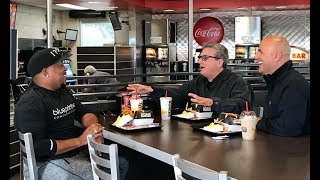
Daymond John talks entrepreneurship over burgers at Carl's Jr., discussing his investment in Bubba's boneless ribs, lessons from Shark Tank, and why he started Blueprint + Co, a workspace for experienced entrepreneurs looking to build their next venture.
Chapters
I'm Alan Taylor. My buddy Scott Duffy and I are in search of the best burger in America. Each month, we visit a new city to try some of the top restaurants, pubs, and brewhouses while sitting down for a candid conversation with some of the top entrepreneurs, athletes, entertainers, and celebrities. I don't know about you, but I love talking business over a burger. Welcome to Business and Burgers.
Today on Business and Burgers, we've caught ourselves a shark. Shark Tank's own Damon John has invited us to a local Carl's Jr. To try the new Baby Baby back rib burger featuring ribs from one of Damon's Shark Tank catches Bubba's boneless ribs. I remember that episode. And guess what? Two things I burgers and baby back ribs. Damon's reputation precedes him. Everyone knows about the meteoric success of FUBU and all the great deals Damon has made over his nine years on one of our favorite TV shows, Shark Tank. So sit down, grab a burger, and kick back. We're going to learn about entrepreneurship from one of the best, and we get to do it in a shining example of entrepreneurial success. Carl's junior at Hardee's. In 1941, Carl Karcher could not afford his dream of opening a restaurant, so he purchased a hot dog cart instead. Business boomed, and only four years later, Karl opened his first restaurant. Today, what started as a hot dog cart has grown into 3,800 restaurants and 90,000 employees worldwide.
Damon, awesome to see you.
Thanks for having me.
Hey, man, good seeing you. Thank you.
Yeah, yeah. So I understand that you just came from film and Shark Tank, and there's one company that we want to talk about today that you've invested in, which is Bubba's. So why did you invest in that business and that entrepreneur?
Well, I mean, you know, first, let's talk about the entrepreneur. The name is Al Bubba Baker. He rookie of the year in the NFL. Won that, I think, in the 78 or 79 for the Browns, right?
Yeah.
Big, massive man. He comes on the show and he says, you know, when I got married, you know, my wife, I loved her so dearly, but she didn't like ribs. And he loves to cook, right? So, you know, well, why don't you like ribs? She said, because it gets my hands messy. You know, of course, behind every great invention, it's an unhappy wife. Of course. Right. He goes out and he finds a way to patent the process and the product and the ability to remove bones from a rib and serve it without the bones. And there's A patent on it. This is the first food thing.
Does it need, like, hands on it or is it like, how does it work?
Well, you know. Well, of course, I would have to kill you if I told you that. But there's a process and there's a scientific way to remove it. Now all of a sudden, I eat this and I go, wait a minute. People love ribs, right? But I say, wow, there's so many other processes and products you can do here. You can do a rib quesadilla, you can do a rib salad. You can do a lot of things that you've never been able to traditionally do with that. I said, all right, I'll do the deal. I do the deal. The deal almost falls through about four or five times because we can't find co packers that will actually do this. Everybody thinks it's easy. Al says it's not. They don't listen to them. People who are third and fourth generation meat production producing families won't listen to them. We go out and find this great company called Ristelli, who ends up also joining in as our partner. And bang. Then we have the rib.
Awesome. That's awesome. And here we are, Carl's junior At.
Hardee's, and right in front of us sits one right in front of us.
You know, and after a while, you know, we got the word out. And Carl's junior At Hardee's who said, you know what? We make some of the most amazing burgers in the world.
So it's actually a rib on top of a beef.
It's meat on me.
It's meat on me.
It is a boneless baby back rib on top of a bur.
That's a real rib. I mean, that's.
This is a real rib. This is not the processed stuff that you may see from other places where they, you know, they put a bunch of guk on, like a waffle that's shaped like a rib.
Okay, so wait, so that you just showed me the top. So on the bottom here, like, there's more goodness, right?
Oh, yeah. Well, first of all, the sauce is amazing. But on the bottom. Yes. They decided to.
I see onion rings.
Yeah, you have onion rings there. You have pickles. And you can, of course, get it with cheese. Yeah, you can also get it with double ribbon.
Okay.
If you wanted to. And they.
And this comes in a half pound. And a lot of different.
Yeah, a lot of different variations. And you can also get double rib, no burger.
Okay.
And this is running for about 60 days.
Okay. So can we just Take a bite of this.
I think we take a bite. All right, here we go, baby.
One, two, three.
I'm gonna let you speak for yourself. I already know how it tastes. It's amazing. That's why I'm here.
Oh, my God.
That is so good.
Delicious.
We taste burgers all over the country. We do food trucks, we do burgers with lobster, wagyu beef, all that kind of stuff. I'm telling you, this burger is awesome.
That's important coming from you guys.
But what's amazing too is this doesn't like, this is fast food, but this feels like it came from a gourmet burger joint.
Well, there's a lot going on, obviously, with Daymond. John, your book, the Power of Broke.
Yeah.
I gotta tell you, I just think right from the name, it just says a lot about you. Because I think at a certain point we look at our lives and we go, where do we learn the most? And that must have been your inspiration for the book.
You know, it is. Because, you know, after, you know, I'm shooting my ninth year on Shark Tank, right? Nine years of seeing entrepreneurs, and I see entrepreneurs all around the world. And many entrepreneurs believe the old theory, you need money to make money. You need to know somebody, you need to have a famous last name. And if over 65% of the wealthiest people in the world are self made men and women, that means they were broke, they didn't have any money. Right? And if you look at athletes and lotto winners, the stats are that about three years after winning the lotto or out of the league, they don't have any money. That means money didn't do anything for them, Right. I want people to understand that they have the power to do what they wanna do. Don't make excuses, because nobody's gonna come to your house and pick you up off the couch and say, I'm gonna make you rich. That's not gonna happen. Right? And that's what I try to share in the book. And I give them the techniques to leverage their intellectual value or leverage whatever they have or people around them. And, you know, you just have to break the cycle the way people think.
You know, it's interesting because you talked about nine years on Shark Tank, fubu, and people may think of that. That's just the part of the story that they know. Of course, they don't know how you got started. $40 on where you came from.
$40. A couple of hats. I sold one hat, then I sold another one, then I sold another one. Mark Zuckerberg had one friend, then he had another friend and another friend. And you know, most of the time it's like that. It's really just going through it and actually being broke. You learn the process and your failures fairly small and on a very low level. So that when you are ready to scale, you've already been through the crap.
I'm looking at your shirt right now, Blueprint plus Co. And I was just back in New York at your office and I had a chance to actually experience what you're building. Could you share with our viewers what you're doing in New York?
Yeah, you know the weworks and co workers shared spaces out there. I think they're great. You want to start a company, you don't need to go and have this big office. You know, go get a nice WeWork place or something like that. You're on like minded people and maybe you're all raising capital, whatever it is. And that is for entrepreneurs who are very green and early or just starting up right. And I think they need to learn, they need to be around like minded people. But I realized it wasn't a place for fellow sharks and experienced people to be around like minded people. You know, people like, you know, you've been broadcasting for years and where are you gonna go and meet people that are just like you on a normal basis that are working every single day? People think that when you get to our level of business you need to stop learning. You don't, you still need to learn. Things right now are changing so fast with social media conversion. How we shooting content these days, how we're relating to people. What do the millennials want? What do the Gen Z want? I developed a place where established businesses to put two or three people there. So I have people like the Honest company has a desk over there. I have people like Ashley Stewart has a desk over there. Catherine Zeta Jones has her new brand is over there.
So if somebody wants to find out more information, where can they go?
They can go to blueprintandco.com but the Blueprint and Co Blueprint a N D company.
How about Innovation Labs?
So Innovation Labs is a program I have.
Is that we go into corporations and we talk to them about how to create innovation within the people that work at the corporation. People in a corporation, even though they have the corner office, they need to know how to help run the business and create and be innovative. Because again, things are changing so fast. Look, retail shops are closing down every single day. Amazon just bought a Whole Foods. Whole Foods, that's going to change the entire way that you are experience the acquisition of groceries, that's going to either kill the other grocery stores or make them step up. Because every time things change, you know, somebody loses and somebody wins.
So who's the target audience for Innovation.
Lab entrepreneurs or intrapreneurs?
Intrapreneurs Innovation Lab is for corporations to show them how to get their staff to think more out of the box. For everyday entrepreneurs, I have Daymond John Success formula, and then I also have a digital curriculum called Damon on Demand. Sure, you can go on to the curriculum because, again, you have to change. Right. But I have a digital curriculum that's interactive, so we can upload new information just like you upload an app and update an app.
That's awesome. You know, one of the things I wanted to ask is you took this baby back rib burger.
Right.
And a company that you helped to, I think, really take off.
Yeah.
And with any company that grows, particularly you do a big deal, like a deal with Carl's Jr. And Hardee's, you know, there's growing pains. And I'm wondering, what can we learn about maybe some of the challenges that you guys have had in terms of growth and some of the successes that you've had as well?
Sure. In my business, if I sold somebody 20 shirts and they sold them out one day, they're calling me for more shirts. Their program, because this is fresh food. They can't just do that. And we can't just raise a bunch of pigs in 10 days and say, all right, guys, get naked. Right. So I started to have to learn about perishables and how this business works. It's way different than the business that I'm in.
Sometimes I think people think their success in one industry is going to translate seamlessly to another.
No, the fundamentals can translate in regards to, you know, principles. Principles. You know, like, you know, I always share my principles on customers. There's only three ways to deal with the customer. Acquire a new one, upsell a current one, or make one, buy more. For frequently, there's only a current two ways to operate a business. Sell more, reduce costs. But when you look at something like this, I would have normally, and maybe this is why I'm not in the food business, I would have said, all right, let's get a whole bunch of ribs, let's put them in the freezer, and then we'll always have them. But you know what? Then they're going to be stale, freezer burn, a lot of things like that. Right. The customer is going to taste the Difference, Right. Stuff like that. So it's just a lot of things you have to learn. And the good thing about working with maybe a Carl Jr. Or any strategic partner is let them do what they do best and you do what you do best. And if that works, you both can agree upon it, then the customer is gonna have a happy experience.
I got a question. What do you do best?
What do I do best? I found great strategic partners. Number one, I always am concerned at the end of the day, how does the customer feel? Because a lot of people get caught up in too many other things. This is what I want people to feel. This is what I. It doesn't matter what you want people to feel. How do they feel? And then sometimes people only want to listen to the ones that say, I want to listen to the ones that say, no, this could be better. You know, something like a burger, 10 people can eat it and 10 people can have a totally different reaction to it.
Can you give some advice to entrepreneurs that do have to carry inventory about maybe how to grow or what they should be thinking through as they're growing and scaling?
I mean, a really good question. You know, they say the top reason why entrepreneurs are successful is to have a mentor. And a mentor always is going to do these three things. They're going to tell you not to scale too quick. They're going to tell you not to take in money too fast. And they're also going to tell you to concentrate on exactly, very small and precise things that you want to do. You should always take the minimum amount of inventory you can. And today we're at a day and age where that entrepreneur is making shirts. They can go and get pre orders on that shirt. They can take the person's money that ordered the shirt. They can go down to the screen printer and get them ran off and then sell it to them and not have inventory. Yeah, right. But a lot of them, they're like, I just need a bunch of inventory. Why? Well, let's say I want to do a bunch of advertising.
Yeah.
Well, if you get a million dollars to do a bunch of advertising, well, now you don't have to sell $100,000 worth of shirts. Now you have to sell $10 million worth of shirts. Right. So a lot of times it's telling them, hold on, relax. Because entrepreneurs always just want to sell, sell, sell as much as they can. But again, going back to the customer, don't sell as much as you can. Make it the best experience you can for the one or two or 10 or 100 customers you have.
I want to know what you want people to know about Daymond.
John. I had went and I had gotten physical and I had a surgery and they had taken out half my thyroid, right? Because they said there was a lump on my thyroid. They said, I don't know, there could be something wrong with it. It's. It's better off you take it out. Two weeks after they take it out, they say, hey, we found out it was stage two cancer that was on my thyroid, right? One group of people that tend to not take care of themselves is entrepreneurs. They don't take care of themselves. They're so busy trying to work 24 hours and do everything else, or they take that money and they put it back in the company when they need to go and take care of themselves. They say, I'll get to it tomorrow because I have to take care of this. And there is no success if you don't have your health, right? How many people we've seen, you know, unfortunately, have lost their lives, right? I think that's what people. I want people to know about me because if I save a couple of lives, then I've done everything I could.
You know, so we were talking earlier about our kids and all of our kids, and I'm curious if you could, if you were talking to your youngsters today, your kids, what's the one lesson? If you don't teach them one lesson about life that you've learned that you.
Want them to, it would have to be that they have to have a job and then they have to have their. And do their homework, right? Because, you know, anybody will be successful if they do what they love. But that's so easy just to say. And somebody's like, okay, well, I got to pay the bills. Thank you. About doing what I love. But, you know, you gotta pay the bill, do your day job. But your homework is really what's gonna make you rich. I worked at Red Lobster for five or six years while starting Pooboo. So that was my day job and FUBU was my homework right now. So that's what I would tell them in that case. And then the next thing would be, you know, really surround yourself with like minded people, people that have the same objectives around you. Because, you know, often it's the people around us that set the goals that limit us or to set the goals that raise us up. And if you have a whole bunch of people saying it can't be done or will, you'll never do it, or you're gonna embarrass yourself. You embarrass us.
I embarrass him all the time.
Well, you do it. You don't tell him he's gonna do it. Right.
It feels like almost like the first thing you need to look for in a great mentor is that they're going to be honest with you.
Of course. And a great mentor will only be honest with you if they have no interest in your business and or what you're doing. And I believe life is a series of mentors.
I once had a venture capitalist up in San Francisco tell me he said you always need to have two mentors and you need to be mentoring two people half your age. And he said that will not only help them and send good energy into the universe, but it will also keep you fresh being around those young ideas.
Absolutely.
Yeah.
Today's kids who know how to work social media and they can educate the entire world.
I think he gets a lot of joy out of lifting entrepreneurs and people up.
Yeah.
And in a greedy way. Guess what? I learn myself too. I learn from every single person.
The teacher is the student.
Exactly.
Yeah.
Awesome.
Thanks for having me, man.
Great burger. Which I am going to finish.
Alright. Me too.
Damon is a seasoned entrepreneur and it shows. His vast experience left us with some great food for thought. Every time things change, somebody wins and somebody loses. It's how you adapt that makes the difference. Take care of yourself. You can't have success if you don't have your health. Often it's the people around us who raise us up or knock us down. Surround yourself with like minded people. Next time. Scott and I sit down with football legend Rudy Rudiger to discuss something that both football players and entrepreneurs can relate to. Overcoming the odds. Rudy's amazing underdog story has inspired people all over the world and we consider ourselves lucky to sit down and share a burger with him. So join us next time as we talk sports, business and following your dreams right here on Business and Burgers.
Check out more episodes of Business and Burgers and our BNB blog at our website, businessandburgers. Com. And don't forget, visit business and burgers on Facebook and give us a big thumbs up. We'll see you next time right here on Business and Burgers.
More from Scott









Business & Burgers-Sequence Collection bracelet for National Entrepreneurship Week

