Scott Duffy interviews John Ashworth: Business & Burgers: Season 1 Episode. 7
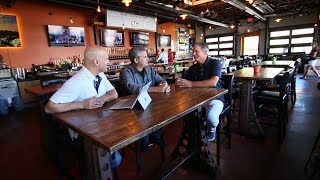
John Ashworth went from caddying on tour to founding Ashworth Golf, then Link Soul. He talks design philosophy, why partnerships matter, and his work preserving golf courses and training caddies, all while eating burgers in Oceanside.
Chapters
I'm Alan Taylor. My buddy Scott Duffy and I are in search of the best burger in America. Each month we visit a new city to try some of the top restaurants, pubs and brewhouses while sitting down for a candid conversation with some of the top entrepreneurs, athletes, entertainers and celebrities. I don't know about you, but I love talking business over a burger. Welcome to business and burgers.
We're back in one of our new favorite beach town communities, Oceanside, California. The local taphouse and kitchen lth strives to be one of Oceanside's go to restaurants for fresh, made from scratch quality food. And since it's our friend John Ashworth's favorite eatery and now one of our favorites too, we're happy to return to Oceanside for another great burger. John started his career as a pro tour caddy. And after noticing a distinct lack of style and quality in golf apparel, he started his own clothing company that revolutionized the way golfers dress. With Ashworth Golf, John set out to create clothing for the man or woman who wanted to go from the office to, to the course, to the restaurant, all without changing clothes. And that's exactly what he did. Today, John continues to design clothing with a focus on everyday Joe with his latest golf and surf inspired brand link Sole.
One of the things that I find so interesting about your background is your major in college. Can you share with us what that was?
It was agronomy. Agronomy was a study of turf grass. I, I was a junior, I was taking a lot of philosophy classes, I was talking to my dad and I go, I don't know what to major in. I went to school to play golf. He goes, well, I don't see you open up a philosophy shop anytime soon. I don't think that's an option. Maybe, but I don't know. So anyway, I decided on the ground because I wanted to be close to golf. And I thought I could get into either golf course design or you know, superintendent or something like that. Just be outdoors and around golf.
So after college, how did you get your start around golf?
My first job was actually at a golf course called Whispering Palms where I was the assistant superintendent. But the killer was getting up every morning about 4:30 to get to work. And that just crushed me. After about nine months, I go, I gotta tap out, I'm out of this. I can't do this. You know, a good friend of mine I grew up with who was a pro golfer, Mark Wiebe. And we were always buddies and I was kind of flagging I didn't know what I was doing. He goes, hey, why don't you come caddy for me? I'm trying to get my card. We'll go on mini tours. We'll go to the regional, the sectional, and the final tour school. And I said, God, that sounds great. That's awesome. You know, and so off we went. You know, he was a great player, and he ended up going through the stages and got his card. And my thing was, hey, if you get your card, I'll go caddy for you for a year on the tour. That'd be fun, right? He was a rookie and, you know, he was trying to, you know, cut his teeth out there. And I was making, I think it was maybe 225 a week, plus 5% of whatever he made. Right. So that year, he won, like, 19 grand.
Oh, my God.
So 5% of 19. You can do the math, right? Yeah, yeah, yeah. So a fair amount of nights I was in my car, actually.
So when did you make some serious money on your career with golf?
His sponsor was. Became my partner, Jerry Montiel. Great guy. He had been successful in another business, and he was buddies with the weebies, so he was sponsoring Mark. And when I was done, I didn't want to be a lifetime tour caddy at that time. He asked me, hey, what are you gonna do? I go, I don't really know. He goes, I'm starting this new company. It was a sporting goods store in Denver, Colorado, because why don't you move out and help me start this thing? And we opened up two really nice stores, bought all the merchandise.
Now, this is your step into apparel.
This is my step into app. You know, when I traveled around the country caddy and too, I got to see what everybody was wearing, so. And I always was very conscious of how I dressed. You know, as a golfer, I was always embarrassed of the golf apparel. Even when I was a buyer for that retail shop, I was like, looking at this stuff going, this stuff is crap. You know, I mean, played in college, we had to wear these polyester uniforms that were just, ugh. There was always this in the back of my head, like, somebody's gotta come up with something better. This stuff sucks. You would never wear that. And then you would go out to a place like this. Right, right. But why have two things? Why can't you combine it and make clothing that works for both? Unfortunately for Jerry and his partner, the economy was terrible. I don't know if you remember, interest rates were like 17%. It was just like a Real stagnant period. So he decided to close up the shop. He said, hey, look, if you help me close this up, we'll figure out another bit. Very entrepreneur. Entrepreneurial, right? So we actually got that all done, and we moved on. We were driving down the Highway 5, and I said, look, if we can come up with a clothing company that actually serves golfers. And it looks completely different. There's all these shops that buy clothing for golf, but all the golf clothes look all the same. And I just thought, hey, we can do our own. And he goes, God, that's a great idea.
So, John, when did you start Ashworth Golf?
We actually started, I would say, 1986. And originally it wasn't Ashworth. It was. You know, when you start anything, the name's always a tricky thing, right? I mean, it's like. And it's such an important thing. And the name of the company originally was charter Golf. And Jerry, he was the one that said, hey, why don't we call it Ashworth? That was his idea.
It's a good name.
So, yeah, it's a good name. So we went with it. We went with it.
This looks unbelievable. So, Daniel, what do we have for you?
All we have here today our blue collar cap burger. And it's a mix of navel brisket and chuck. And it's got butter, lettuce, some fresh tomatoes, a dill pickle, and some onion marmalade on there. And we've got here what John's eating, our quinoa burger. It's topped with blue cheese and arugula and avocado with our red pepper aioli, and it's also on a pretzel bun. It's to die for.
This blue collar burger is huge. Scott and I had to take a minute to figure out how to sink our teeth into this gigantic beast. The brisket and chuck patty weighs in at just over a pound. And with the toppings piled high, that first this bite was no easy feat. But, oh, was it worth it. The burger and the sweet onion marmalade are a match made in heaven. Those sweet and savory flavors are countered beautifully by that tangy, cool crunch of a dill pickle and the refreshing bite of the locally sourced tomato. The blue collar burger hits all the best flavor profiles and a little bit more lth. Owner Gabe Hogan wanted his restaurant to embrace and better the community around it. Everything from the tables to the reclaimed wood floors to their one of a kind tap system was created and installed by local craftsmen. The beautiful modern industrial interior screams southern California style, the decor, the tap list, the food on the menu, all reflections of the Oceanside community.
So, John, when you started your company, you had a partner. What advice can you give to entrepreneurs about having a partner?
You know, it's tricky. You know, it's. It's very tricky. Just make sure it's the right partner. I was very lucky. I mean, Jerry was amazing. I mean, he taught me so much and he was a great partner.
And so did he handle kind of more of the business and you handle.
More of the design?
Yeah, I was more on the creative side, designing, making the clothes and production. And he was more on the financial and administration. So we had definitely established roles, you know, and they, they morph as you go. I mean, it's okay to disagree as long as at the end of the day, whatever way you go, you support that, whatever that decision is. If everybody agrees all the time, then somebody's not need it anyway. Right?
That's a great point. I think that with partnerships, so many times people jump into it, they get into business and they think that they'll figure out all the stuff that's important to a partnership kind of sometime way down the line, and they keep kicking the can. And I think kind of, in my experience, what I've learned is if you're looking to potentially partner up with somebody in a business, there's some things you should look for. The first is you want to look at complementary skill sets, which I think is what you were just talking about. The second thing is complementary temperaments. You know, if you have two Uber type A's going at it every day, that may be kind of difficult to manage in the business. The third thing is complementary networks, non overlapping networks. And I think that if you can find those three things, it's a great place to start. But I also think that when you go into a partnership, it's really important to put together. I mean, I call it like your partnership prenup. Because partnerships can be tough. And if you look at the best of them, maybe 50% of them work out and 50% of them end in some kind of divorce. So asking yourselves questions like what's the ownership percentage going to be? Who's going to put in money and how much money are they going to put in? How much time are you going to commit to this business? How are you going to make decisions? How are you going to account for expenses? If more money needs to go into the business, who's going to be responsible for putting that money into it if things don't work out they go sideways, kind of what's the mechanism for us divorcing and splitting and maybe one partner paying the other, buying out the other partner. So I think those are all really important things to think through, if you can up front.
I bet you not many people do that.
I think you're right.
It's a tough approach, but it's probably the right approach.
I think that one of the misperceptions that many people have is that when somebody builds a successful company, sometimes they look at that person and say, you know, maybe that was easy. Maybe they had some kind of thing that was going for them when they got started that was different than me. What kind of advice would you give to those entrepreneurs that are thinking themselves? I don't have all the resources.
You just got to do it. You know what I mean? It sounds corny, but it's like, you know, if you never, never go, you never, never know, you're not going to have all the answers. There's always going to be roadblocks. You have this sort of map in your head and you got to adjust on the fly and, you know, but if you have a good idea and if you have the right stuff and you can finance it, you know, then you got to go for it.
When you left Ashworth, you went and designed a golf course. Tell us about that.
That was an experience. Scotland's a huge inspiration to me. The whole Lynx golf culture, you know, it's so different. I fell in love with it. I really wanted to do it. It's been two years, commuting back and forth, got the planning permission, you know, all the zoning, everything done. But then I brought in a partner, a local guy, unbeknownst to me, really kind of ended up screwing me and my other partner in the process.
So eventually you went back to Ashworth, the company sold?
Yeah, I went back as a consultant and then they sold to Adidas. I mean, that was a very short term thing for me. I ended up starting Link Soul, which is my company now.
Killer company.
Tell us about it.
Yeah, well, it's pretty much the evolution of everything I've learned. I still felt like there's a niche in the golf market now, today, still in the golf world. There's like all these athletic brands came in and it's all 100% polyester stuff.
Well, isn't that a trip? Because it's like deja vu, right? Because it started as polyester and then when you went to market with Ashworth, you guys were coming natural and now it's back to polyester performance.
Yeah. I left for a few years and look what happened. Right. You know you're a product of your environment, right? I mean, I've always been on the coast. I surf. Guys in our company surf. We also play golf, but we do it recreationally where a lot of companies, everybody's focused on the pro golfer. I'm focused on the recreational, everyday guy that grinds and works and he wants to get out and get some exercise, you know, so that's why our clothing. I think you could. You could wear it to the office and go, hey, I'm gonna play this afternoon at 3 and then I'm gonna have dinner with my wife.
What's your greatest accomplishment?
When you think about it, I'm hoping I haven't done that great thing yet. You know what I mean? Like, I still have a lot of things I want to do. Oceanside's a great local community, by the way. It's amazing. And there was a golf course which I played in high school. You know, the council put it up for rfp. They were trying to get developers to come in and develop this golf course to get rid of it. It's been a really important part of the community. And a group of us got together and we put in our own plan and we won. And we now run a golf course. So far, it's so good. I mean, the people love it, what we've done to it. And we're starting a leadership and caddie academy at Goat Hill Park. So you get these kids in the neighborhood that are maybe, you know, It's a tough neighborhood too. We got about eight kids up there. They're just great kids. It'll be from 13 to 17 years old. You know, my goal is to get some kids to college that would never go to college. And then they're out on their own, then they're doing their thing, you know, I mean, as you guys know, Right? So I'm hoping that's my greatest thing. It's not done yet, though. I still gotta do it, so.
I love the Lynx and I love your soul. Lynx soul. I love it. I can't wait to go and experience your brand.
Good.
Thanks for eating with us.
Yeah, thanks for having me.
Thanks for hanging out.
Thanks for coming to my local spot.
Yeah, exactly right.
And it's good.
John's local spot is quickly becoming one of my favorite spots. LTH has given us one fantastic burger after another. John's story was a lot to digest, as was that gigantic burger. Here's some food for thought. It's okay to disagree with your business partners, but both parties must fully support whatever decision is ultimately made. Always vet your potential business partners and make sure you have contracts in place before entering into a partnership. Just go for it. As John says, if you never go, you'll never know. No more excuses. Get started on your business today.
Next time right here on Business and Burgers. My mentor, Barry Maguire joins us to talk about his successes past and present. From McGuire's car care products to his number one rated TV show, Car Crazy, Barry has been a key figure in the automotive industry for decades. He has some wise words of advice for young entrepreneurs and old right here next week on Business and Burgers.
Check out more episodes of Business and Burgers and our B and B blog at our website, businessandburgers.com and don't forget, visit Business and Burgers on Facebook and give us a big thumbs up. We'll see you next time right here on Business and Burgers.
More from Scott









Business & Burgers-Sequence Collection bracelet for National Entrepreneurship Week

