Scott Duffy interviews Lee Rhodes, Founder Of Glassybaby, Business & Burgers: Season 1 Ep. 10
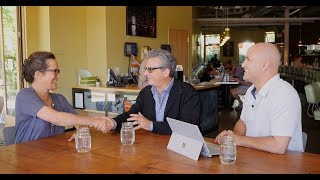
A Business & Burgers episode filmed in Seattle that mixes a restaurant segment at Skillet Diners with an interview of Lee Rhodes, founder of Glassybaby. Rhodes—a three-time cancer survivor—describes how a simple hand-blown votive inspired a retail, experiential brand (studio opened 2004; moved to Madrona 2007), the company’s handcrafted production (four glassblowers, nine minutes per piece), and an explicit philanthropy model (White Light Fund 501(c)(3)). She reports ~30% annual growth, projected ~ $20 million revenue for the year (yielding ~$2 million in giving), and cumulative giving approaching $5 million to date.
Chapters
I'm Alan Taylor. My buddy Scott Duffy and I are in search of the best burger in America. Each month we visit a new city to try some of the top restaurants, pubs, and brewhouses while sitting down for a candid conversation with some of the top entrepreneurs, athletes, entertainers, and celebrities. I don't know about you, but I love talking business over a burger. Welcome to business and burgers.
We're back in Seattle to try another tasty Pacific Northwest creation at Skillet Diners. Chef Nick Novella, executive chef at Skillet Diners, is proud to be part of the culture of the food that has been developed here. And Scott and I just can't wait to try one of his famous creations. Lee Rhodes joins us to talk about the exponential growth of her company, Glassy Baby. Lee is the first woman to ever receive Entrepreneur magazine's prestigious Entrepreneur of the Year award. And for good reason. Lee's focus is on doing good. A three time cancer survivor, Lee uses her business as a means to raise money for charities that help people, animals, plants, and the earth heal. She wants to bring hope to those who are ill and help them to heal. Aside from all the good that comes from Glassy Baby, Lee's business has been wildly successful with multiple hot shops popping up all around the Seattle area.
I am so fired up today for this burger and to introduce you to Lee Rhodes. So every time I come to Seattle, my friends are always telling me about Glassy Baby and all of your killer products. I see them everywhere. And so, Lee, Allen, Allen, Lee Rhodes.
Good to meet you. Thank you. So what we do here on business and burgers is we're looking for the secret sauce, as we say, for a successful business. And we've seen that you've had a real nice success going right now with all of what you're doing and the philanthropy that you're doing also, it has a meaning for you. So we're hoping that you can share with us some of your secret sauce.
Absolutely.
How did you get started?
Well, I dropped the tea light into a little vessel that someone had hand blown at my house and it lit up and we're kind of in the mecca of American glassblowing here with Dale Chihuly and Phil, Chuck School and all. Lot of glass blowers living here. So I went around town and had more made and eventually we came up with a shape, which is the iconic glass movie shape with a little bit of ice in the bottom. We opened our own studio in 2004 right here near Green Lake, and then we moved to Madrone in 2007, and we've been there making them ever since.
So a lot of things are going to happen, from a lady that started in her kitchen to becoming a national company to an international company and not.
Just a national company. Entrepreneur magazine's company of the year.
W. First woman.
First woman.
Even better, right?
Well, it just seems silly.
No, I love it. This whole philanthropy part of what you do. Can you talk about that a little bit? Because I know that it means a lot to you personally.
Well, when Glassbury started, I was going through cancer treatment, and so I would be in chemotherapy rooms and seeing a lot of people who didn't have what I had. They couldn't pay for parking, they couldn't pay for good food or anyone to sit there with them. And it was eye opening for me that everyone didn't have the same resources to heal and get well that I did and do. At the same time that I dropped a tea light into that little vessel, they kind of came together. Because what that tea light in that vessel represented to me was 30 seconds of taking a really deep breath and finding kind of a calm in my body and my spirit.
Tell me about how you got the name Glassy Baby.
I think the name Glassy Baby exemplifies the entire company because what happened was we had these little glasses that we were making, and all my friends are having babies, so we call them Glassy Baby. And people would light them at their house for me when I was sick and then spread them around to all their friends and family. So the Glassy Baby name stuck.
What business would you say that you're in? Are you in the candle business? Because it seems like you create happiness and that's part of what your business is also.
Yeah, I think we're experiential business, but I think we're uniquely situated in that. We're retail because you have to buy it, but you can't buy the experience you're going to have with it. And it just is an enhancement and it makes life better in every way. Having a glassy baby, that is awesome.
Lunch is served.
Lunch is here. Skillet is very meat centric. My kind of place. So Chef Nick whipped up something special for our vegetarian friend Lee. An heirloom tomato burger with fresh spinach, caramelized fennel, and onions on a vegan potato bun. For Scott and I, Chef Nick brought us one of Skillet's signatures, the fried chicken sandwich. Fennel crusted fried chicken thighs topped with charred pickles, jalapeno aioli and kale on a Vegan potato bun. I can see why Chef Nick constantly has to fend off people from trying to steal his recipe. This is insane. The fried chicken thighs are antibiotic and hormone free, which speaks to the ideals of the people behind Skillet. Skillet is part of the Eat Local movement that has been spreading across the country. The food Nick creates is driven by heritage and sustainable farms. As Chef Nick likes to say, at Skillet, they keep it fresh and made with love from source to plate.
Well, now that the food's here, time to dig in.
Let's do it.
Yum. This looks amazing staring into that.
Here she goes.
Very brave.
That looks delicious.
It's really too big. It's really too big.
Oh, it's heavenly.
I want to know about you being an entrepreneur and more about the philanthropy. And, I mean, how much things have changed since you started out in your kitchen there, because we're talking some big numbers here.
I didn't wasn't planning on starting a business, so it kind of just happened, Right? And the glassy baby itself, giving anyone and everyone that 30 seconds or an entire evening of calm and kind of a wonderful place to be and thing to be around, all naturally happened. Now we grow 30% a year. And now we're going to be close to 20 million in revenue this year, and that means $2 million in giving. And I think that as those giving numbers begin to grow, we're at 5 million, almost 200,000 to date.
When you started the company, first of all, did you know that you wanted to be in that business, or is that something that just kind of happened by accident?
Oh, it all happened by accident. I wouldn't even. I don't even know how to define what this business is. We're in the business of helping people figure out what it is that makes them feel better and them heal. Their ability to use something as a language. I mean, Glassy baby, they all named and they all have stories.
It's all handmade.
They're all handmade.
Everything's handmade.
It takes four glassblowers nine minutes to meet each glassy baby.
Wow.
And every one of them is unique. Even if they're the same color and name are totally different when you put a tea light in them. What we didn't anticipate was how we would become a language for people. So it's easier to say congratulations or celebrate with a glassy baby than it is to kind of come up with your own words. We celebrate the little moments in life and lighting a glassy baby or giving someone A glass of baby and then having them light it makes them think of you. They remember who gave it to them and when and why. And so they're little impacts and moments in people's lives, but that have enormous impact. Right?
Impact, Scott.
That's right. So we were talking to one of our friends, Noah, and he always says start with impact and income will come later.
It's interesting in an age old business of glass blowing and candle making and now you have to meld that with technology in order to stay in connection with your businesses. Talk about that a little bit.
We use Skype and we use traditional telephone and lots of texting. We collaborate best when we communicate well. But I think in terms of collaboration, most of us are women at Classy Baby. I think that beyond the vision, I count on everyone's collaboration and strategy and the growth where we should go to open new stores.
Women all over look up to you as a hero. Talk to us about some of the challenges that you may face as a female entrepreneur and how you overcome those.
I think as women we generally have 17 things to do during the day. And I know even in my household, my husband has a job and he's so supportive and kind to me, but he has a job that he goes to too. And I have a job I go to in the morning, but I also have children and the refrigerator that's empty and got to figure out what we're making for dinner are the dogs walked. And I think that women need to, number one, kind of give themselves a break, that everyone's not going to be perfect. Bad hair all the time. Mostly no has always meant yes for me. So every single time I've.
That's a good one.
Asked she's an entrepreneur.
Every single time I've asked for something and people have said no, I think that must be a really good idea because it seems hard. And in a man's world, which, you know, they like to put everything in a box, organize, shuffle, move on women, we like everything a little more fluid. Oh really? Maybe we'll add that in, maybe we won't. And I think so. No to me means, wow, that must be hard. That must be a hard concept or challenging that somebody hasn't really thought of before. Everyone has said no to us from the beginning. You can't sell one thing. You can't make anything sell anything made in America. You can't give 10% of revenue away. And I don't think anyone else in the world does. So I'm not recommending it for us. It's just been every single time we run into an obstacle and people say, no, that won't work or you're not going to be able to make that happen. That, to me means, especially as a woman, like, okay, that means I better figure out how to make it work. So we're constantly doing that as women.
So let me get this clear. Do you give 10% of gross revenue away, not just 10% of the net profit?
No, we never use the word profit.
Wow.
Wow.
I mean, you talk about the word impact.
Yeah, that wasn't over my head.
And where does that money go?
So immediately the cash register, we take it and it goes into something called the white light fund, which is our 501C3. And from there we give it all over. We basically give it to anyone that asks. I like uncompensated cancer care. I like to pay for people's parking. I like to pay for their chemo food, whatever they need or something that pay for something that might hinder them from getting to treatment. That's what I found a lot of when I was in treatment. So that's my pet. But we give to animals. We give to anything that really that would help people heal. That's really kind of our.
Again, it's hard to understand a person like you that is so driven from the heart because you're a business person.
Absolutely super creative.
Yeah. It's unfolding. Every time we pull away another layer, there's more, which I love. I love that about you. But do you think it is because you are driven from compassion? What would you say is your driving force?
I think that the driving force is every single day we wake up and I remember I'm lucky. I'm one of the lucky ones. Every single day, I just feel a certain responsibility towards making sure that everyone feels that same place in themselves that I get to feel every day. Gratitude. Gratitude and kindness and fulfillment.
For women out there, where are some good places to go to find role models and mentors?
Mostly you should just follow the things you love, as in all life, like buy the stocks of the stuff you buy. And I think that go find the people that are doing things you love. A woman, Gretchen Mather started Gretchen's, of course, here in Seattle. It was the first delivery lunch anywhere. And I think she was the beginning of it. She really helped me out. I was the point of not wanting to continue with sassy babies very early on. And she said, yes, you are. You're crazy. You're on something completely unique. She knew early on that Scotty Baby was going to be something bigger than me.
You seem to be so driven by purpose. Is there one core value that drives you?
Everything needs to be authentic. For me, I really appreciate people telling me exactly what they think. I really appreciate waking up every day feeling that luckiness. But I authentically feel that every single day. I feel lucky. I don't care if.
Giving away $5 million is probably five times more than I've ever made. At Glassy Baby, we come up with something that's important. It is real. And I think that is what's important to me, staying authentic and real. And I think it will make a difference. I think we make a difference, and I think that it's hard to find something more powerful in that.
And what is the biggest advantage that women entrepreneurs have today?
They have the advantage of still always being thought of as someone that people feel sorry for and say, oh, well, maybe next time. It's a great way to be. I mean, always kind of always shooting above your pay grade is great. And I think women do it every day. It's great to be a woman and have the opportunity to continue to disprove things that have already been proven. And doing it as a woman shouldn't matter at all in 2016, but the fact that it does makes it all.
That more powerful at the end of your life. What do you want people to say about Lee Rhodes?
I hope people remember that you can make a difference. And even if it doesn't make any sense at all, 10% of revenue is not something that should work anywhere.
Well, Lee, what I think I like about you best of all is you truly are authentic, and it's a beautiful thing to see. I want to actually.
You are so cool. I just want to come give you a hug.
It's always refreshing to meet someone like Lee who is driven by compassion and by the desire to help others. So here's some food for thought. Don't underestimate the small things in life, for a glowing candle in a colored glass can have an enormous impact. Communication is key to good collaboration. Pursue the things you love, and the money will follow.
Next time on Business and Burgers. We return to Skillet to try another one of Chef Nick's signature burgers. Joining us is hall of Fame quarterback Warren Moon. Warren was already a respected NFL champion, but he knew he had to plan for life beyond football. So he turned his love of baking into a thriving business. W. Moon's Chocolate Chippery. It was such a success, he sold the chippery to Mrs. Fields in the 1980s. Warren went on to become a sports commentator as well as a philanthropist with the Crescent Moon foundation, giving in need children the resources to complete their education. All this and more. Next time on Business and Burgers.
Check out more episodes of Business and Burgers and our BNB blog at our website, businessandburgers. Com. And don't forget, visit Business and Burgers on Facebook and give us a big thumbs up. We'll see you next time right here on Business and Burgers.
More from Scott









Business & Burgers-Sequence Collection bracelet for National Entrepreneurship Week

