Scott Duffy interviews Les Stroud: How To Thrive in a Competition, Business & Burgers: Season 2 Ep.7
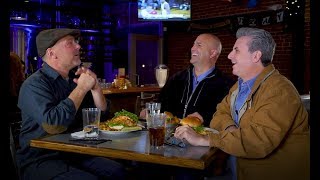
Les Stroud, creator of Survivorman, talks about pitching his show to networks for $11,000 and the difference between documentary filmmaking and reality TV. He spent 15 years as a survival instructor before the series launched around 2001, and now focuses on music to connect people to nature.
Questions this video answers
$11,000.
About 16 years.
2001.
About 15 years.
The VX1000.
Chapters
I'm Alan Taylor.
My buddy Scott Duffy and I are in search of the best burger in America. Each month we visit a new city to try some of the top restaurants, pubs and brewhouses while sitting down for a candid conversation with some of the top entrepreneurs, athletes, entertainers and celebrities. I don't know about you, but I love talking business over a burger. Welcome to business and burgers.
Today we're in beautiful Grants Pass, Oregon, my hometown, to grab a burger at Climate City Brewing Co.
Alongside the Delicious hoppy craft beers produced at Climate City, they also know how to make one tasty burger. Joining us is Les Stroud, the Survivor Man. Les took what many thought to be an unsellable show and turned it into one of the top docuseries of all time. Les films cast him into the wild all alone to fight for survival for days at a time. Completely self shot on small cameras, Les spawned a whole new genre with Survivorman. The show was a blending of two of Les passions, filmmaking and nature. Like a true entrepreneur today, Les has pivoted to one of his earliest passions, music. With his art, Les has one driving purpose, to connect people to nature.
Well, Les, thank you for joining us. I know you've been traveling a lot, and as the Survivor man, you're all over the whole world. Why don't you meet my buddy, Scott Duffy. It's good to see you, brother.
Good to see you.
So here we are, Grants Pass, Oregon. And you're Canadian, right? You got what, eight seasons of Survivor man under your belt now?
Oh, it's actually longer than that. Survivor Man's never gone by seasons. It's been such, it's, it's been a unique show from the get go. So I don't even operate in the. In the course of seasons like most shows will say. I do 13 episodes every year, 26 episodes, whatever. Survivorman's been going for 16 years.
I was gonna say, because I looked at when you started, it was like 15, 16 years ago, 2001.
Wow.
Including the pilot.
How did you get going with this? Oh, boy.
Well, as you know so much in life, I think what happens as we get older, we build experiences, right? And I think that a lot of times each experience just feeds back in on itself until you add them up and then you start focusing where you're going, but you're using them all. So with Survivorman, I had already done rock and roll for a long time and I worked on rock videos. And then after that I became an outdoor adventurer and then I started teaching survival. And one day One day I just put the two together. I thought, you know, these things should be filmed and they would make some really great films. And I called up a. I did a cold call. I'm very big believer in the cold call. Because the worst, worst thing that can happen with a cold call is somebody says, no, that's it. That's all they can do. So I did a cold call to a network. I said, here's my idea. Me alone, seven days, no camera crew. I'll bring you back the Odyssey on film. And they said we were looking to do something exactly like that. And we didn't know who to call.
Because he was like, this guy is the genesis of reality, real reality television.
Whoa, whoa. I'm gonna interrupt you right there and say what I do and what I did and still do is I'm a documentary filmmaker. My passion was Jacques Cousteau and that type of stuff. So Survivorman is a documentary series. This is the skeleton of a Hewa man, my father. I'm here with his son. And today we performed a come out in ceremony and brought the bones out of the ground. The problem is reality TV began around the same time, and I got kind of confusingly lumped in with reality. I hate reality tv.
And I stand corrected. You're absolutely right, because it doesn't. It's like we don't know what to call it, and you do. So now we know.
Well, and that's been the beauty of Survivorman. You know, when it first hit and there was nothing else on television at all like it. But that was the thing people would say, you know, your show just looks so different from everything else on all those channels. And I was hooked. And that was the genesis.
It's so interesting, the idea of a cold call, because I always. I was so interested in how in the heck did you sell this idea? You know, what did you do? But you just got on the phone, and you never know who you're going to get on the other end in the timing.
Even more than just got on the phone. I mean, you have to picture me in a pair of track pants and a T shirt, sitting on the edge of my bed pretending to be from a. This is Les Strel calling from Wilderness Spirit Productions. And I've got this idea, you know, but I'm like, in my bedroom, right? I think that often the answer to a lot of situations is if you have a great idea, it's always going to be a great idea. Now, someone might beat you to the punch, but a great idea if inside you Go. You know what would be cool? Yes is the answer. If you're saying you know what would be cool, then likely case scenario is 99% of the time it would be cool. So what are you waiting for?
So now, when you got what you asked for, which was the yes, I was ready.
No, not. I was like, good. Because I was more like, good, this is a good idea and I'm glad you saw it. Now I'm gonna go kit and nail it for you. I mean, that first show, which we'll call it the Pilot, I mean, they paid me $11,000. That's all I made that year. That's all I did that year. I mean, I played some gigs as a musician and made some side money, but I had two little toddlers at home and a house to pay for. But I knew this was going to be the beginning of something. I didn't think it was going to go as big as it did and spawn a whole new genre, but I knew that it was going to be well for me.
What was the genesis of the show, though? I mean, were you a guy that loved survival and outdoor? Where did it come from?
All right, so one of Richard Brandt's things is always that when you see a need or you see that you can better something, go for it. And for me, survival films, the only time you saw them at all, they were produced by someone who did survival. Well, the film would suck, or they were produced by someone who did television for a weekend magazine format, six minute clip, and the survival would suck. And I basically thought to myself, no, I know good filmmaking and storytelling, but I'm also a survival instructor. Let's put them together.
So you were already a survival instructor?
Oh, for 15 years.
Oh, okay. There you go. Okay, so you, you, it was just a no brainer for you both.
Skill sets, that's what I mean. Skill sets tend to fall back on themselves as you get older in life. You, you know, someone says, hey, can you do this? And you go, well, actually, yeah, I used to be a lifeguard. I can do that. You know, next thing you know, you're doing something. Where'd that come from?
I used to be a lifeguard.
There you go. And you just never know. So I was, I had done rock videos and I was a musician, performing musician, but, But I was then also an adventure guy. Like I said, they went together.
You know, I think there's so many entrepreneurs out there that feel like every day they're in survival mode.
Oh, my God. Right? Yeah.
And I'm curious what have you learned about surviving that can be applied to entrepreneurship?
There are a lot of cliche, stereotypical realities. There's three styles of executive producers that are connected to the television network. Now, the television network is my end client. That's who I'm selling my show to. In between me and them is the guy is the gatekeeper, that's the executive producer. There's three kinds of those. Those who understand art and are risk takers. It is a creative industry. We're talking about the medium of film, filmmaking, storytelling. Those who understand art and do some risk taking, but also really pay attention to the budgets and the bottom lines. Those who are bean counters, the ones on the left side I love Survivorman, would not be on television if Steve Burns, who was producing Science Channel and Discovery at the time, had not been a creative risk taker. He's a powerful man in the industry and a wonderful man. He understood taking a risk and he said, I think you got something, let's try it. The bean counter would have said, give me your numbers. I can't prove this out, so let's not try it.
Give me your numbers has always been goodbye to me too, because I'm like you. I'm the same way.
How do you prove out an idea? I mean, it's so prevalent today with social media. What are your social media numbers? You know, half the. I mean, there are social media companies right now making a fortune off of corporates and they're feeding them nonsense because they'll go, oh, we're going to do analytics for you. Analytics. And we're going to show you your analytics. And in the end, so often, 20% of the time, the analytics tell you a good story. 80% of the time, it's just a bunch of nonsense.
Real quickly going back to the idea of surviving as an entrepreneur.
See, but what you did was you led me down the path of what. What I consider myself to be. I consider myself to be an artist. I, with my insecurities would say, well, I'm a mediocre one, but I'm a driven one. So I see wonderful artists and then I envy them. Of course, they can't get out. They have no ambition, so they can't make it happen. I'm that other guy in the middle. So the reason why I go down that when it comes to survival and survival in the business sense is every bit of business trade off I had to do in the industry of television, I was dragged kicking and screaming to. I hate the fact that I'm excellent at TV contracts. I Could nail your contract for you. And I will know every detail and every line.
Because you've made every mistake along the way.
Because I made those mistakes and I've read them a hundred times. Business is never pretty. Not really. Creation is pretty. Art is pretty. You know, the magic moment is in the middle when business and art can actually coexist together. Because you achieve the art, but you have the sensibility of the business. Because I'm not the businessman. And that's why when you.
He survived.
I survived big time. And that's the last survival pun you get for this interview. You just used your only pun.
Oh, lunch is here.
Oh, my goodness.
What have we here?
He gets a wagyu burger.
I get the wagyu burger. Wait a minute, hold on. I heard there was a Lamborghini burger.
You want the Lamborghini?
I'm a car guy.
I'll take the.
You take the wagyu burger.
All right, here's the car guy.
No, no, no, no. I get the top.
Sorry, boys, I'm eating.
What is. But this is the Lamborghini burger.
Yes, sir.
With palm frites, fresh ground lamb, wagyu beef stuffed with blue cheese and cranberries.
And then we got the tater tots over here.
These are some Cajun tots.
Cajun tots, yes.
And those are some palm frites.
And what did he get?
Regular beer battered french fries.
Okay, cuz I'm a regular guy.
And this. This looks really interesting. You got the onion. Onion rings on here.
This is not an average burger. For an average guy, this burger is over the top. Fresh wagyu beef, peppered bacon, mozzarella, crispy onions and cheddar cheese.
Wow.
Lettuce, tomato and onions.
Well, you did an awesome job. I can't wait to get my chops around this.
Thank you.
You guys enjoy. Sink your teeth.
Appreciate it.
Let me know how it is.
Right on. Climate City Brewery does a good job of serving up some awesome looking burgers.
Wow.
All right, so how do I do that?
You have to stretch your mouth. You gotta do some exercise. This is what it boils down to.
When you get these complicated, super complicated big contracts sent to you. What's the first thing that you think?
The way I've been able to do so well with Survivorman is because I let the stubborn artist in me flare up. And I walk into every meeting knowing I have no issue whatsoever walking out, walking on the deal. That's a tough place to be when you have toddlers at home. You've got to be able to Say, if they don't come my way to this point, I'm going to turn around and walk away from my television series, my career, millions of dollars.
Have you ever done it? Have you ever walked away?
I've never walked away, but I've never needed to.
I've had to walk out before.
It's not fun, but you got to be able to stand there and you got to muster up all the courage and all the faith that you have in yourself and what you know is right. And when. When you feel it and you know it, you gotta turn and walk.
So now you're in the process of pivoting from documentaries to music.
I wanted to feel.
Her wind blow across my face.
And I love to ask you, how do you make that pivot from a place that you've been and you recognize for being a leader for so long into another space?
It's a very difficult thing to do. It's like anything. It's very easy to sell your soul and stick with what is good for the money and the bottom line and not keep your integrity and be miserable and be miserable. All of my risks are extremely calculated.
And that's so important in business.
Also.
I think some people, they just let it fly. Right. Without thinking through. That's such an important tool.
That's right.
And I.
No way. I do think it through, and I run it by people and I make sure things, you know, and I get outside opinion and so on and so forth. Now, Survivorman, the reason why I could go on as long as I have 16 years is because they left me alone. See, I've owned. That's the other tip. I've owned Survivorman since day one. I've never sold. They came to me one time when Survivorman became big. They came to me and they actually said, they being the TV networks. This is great, Les. Yeah. We're moving into the next season here. We're gonna commission this now.
What? Yeah, no, we're going to commission the show. Now, to commission a show means they're going to pay for the whole thing, which means they own the whole thing. Well, I didn't say this, but the implication in my answer was, so for four and a half years, I've taken all the risk trying to get many different networks to buy into my show, to get it on television. You were just one of those networks, and now, because it's a hit, you're going to step in and own it, the brand, the marketing, the merchandising, everything. And I just. I. And this was okay. This Is one of those moments I stared him down. I said, no, that's okay. They could have walked away from me. Instead, they created a whole bunch of shows to copy mine.
So. But you know what? You still, your show is authentic. They cannot duplicate authenticity.
No, they can't.
And so no matter how hard they tried, there's only one less draft.
Well, that's because authenticity is something that you can be. You can't do it. You can only you're either authentic or you are not. There's no, oh, we're gonna pretend to be authentic.
So you pivot.
Talk about. So I pivot.
My pivot is again, more of a metamorphosis and a growing than a pivot. But for example, I'm not turning my back on Survivor man now. That was a lesson I learned really quickly. When was I've developed this sounds horrible. A legion of fans. Small legion, but it's a legion of fans.
I'm one.
And everybody knows.
The worst thing I could do would be to ignore that and say, I'm just doing music now.
You know, I'm very glad to hear this, by the way, because as a fan, we want you to do your music because we want to love that too.
Well, it would mean that I wasn't proud of what I did as Survivor Man. I'm very proud of what I did as Survivor Man. So I'm looking for the ways to still bring what I bring as Survivorman to the fans but still metamorphosize as an artist. I don't know how to describe it other than I'm staying true to my true to my mission, true to what.
I want, which was there already, even when, like you said, it was always there.
You always have to have a base mission. I would prefer if your base mission was not to make money, but your base mission had some kind of altruistic value to it. My base mission from day one with Survivorman was to connect people to nature. Simple. That's it. I just want you to go back out and love the wilderness again. Love nature. Go on the trails, hunt, fish, hike, sea, kayak, canoe. Whatever you do, just connect to nature. My passion has never been making money. I've done well because my creative entities have done well, but my passion has been nature. And then because I'm a natural performer and I'm a ham and I love the stage and I love storytelling and you must love music and I love music. So now of my music celebrates nature. The two albums I'm about to launch and were being produced by Mike Klink, who's a powerful, legendary rock producer. Slash plays on it. Steve Vai plays on it. These guys only got involved because they saw that the albums were focused on reconnecting people to nature and in some cases, a call to action. So they're now getting involved and so many others are getting involved in my music. Because the baseline mission is the why, why, why do this? Why do I do Survivorman? Why did I do Survivor Man? Why do I do my music? Because I want to connect people to nature, and this is how I do it. So you have to have the why. And everything can flow from that.
Our interview with Les was so full of great advice, we just couldn't fit it into one episode. Make sure to tune in next time for part two of the Business and Burgers Les Stroud special. Here's some food for thought. Don't be afraid to cold call. The worst they can do is say no. When you see a need and you see you can better something, go for it. Find your why and let everything flow from that. Make sure to come back right here next time for part two of Les Stroud's interview. Here's some of what we have in store.
And then along comes this little camera called the VX1000. I basically invented the selfie stick. Should have patented that one. Had my selfie stick. Nobody else was doing that. Everything that I had to do as a creator was different than any other TV show.
That's right here.
Next time on Business and Burgers.
Check out more episodes of Business and Burgers and our B and B blog at our website, businessandburgers.com and don't forget, visit Business and Burgers on Facebook and give us a big thumbs up. See you next time right here on Business and Burgers.
Sam.
More from Scott









Business & Burgers-Sequence Collection bracelet for National Entrepreneurship Week

