Scott Duffy interviews Mitch Thrower of Events.com Business & Burgers: Season 2 Ep. 1
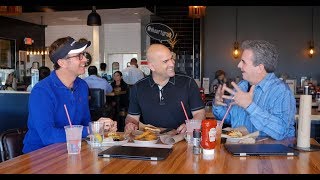
Mitch Thrower built Triathlete magazine and Events.com, a SaaS platform for event registration. He shares lessons from selling his magazine, raising capital, and choosing partners with integrity and intelligence. His triathlon background taught him that entrepreneurship requires the same endurance as racing.
Chapters
I'm Alan Taylor. My buddy Scott Duffy and I are in search of the best burger in America. Each month we visit a new city to try some of the top restaurants, pubs and brewhouses while sitting down for a candid conversation with some of the top entrepreneurs, athletes, entertainers and celebrities. I don't know about you, but I love talking business over a burger. Welcome to Business and Burgers.
It's great to be back. And where better to kick off season two of Business and Burgers than sunny San Diego, California, hanging out at the Grub burger bar where they believe in taking the time for laughing out loud, small moments and big dreams. Joining us is Mitch Thrower. Mitch is a financier, entrepreneur, author, and 22 time Ironman triathlete. After a harrowing injury as a young man, Mitch bounced back and became a professional triathlete. Mitch followed his passion, but quickly realized that money was not going to follow. So he let his passion guide him on a path to entrepreneurship. His first venture, Triathlete magazine, quickly became the leading triathlete magazine in the sports world. After selling his magazine, Mitch turned to Digital and created Events.com, a state of the art SaaS event registration application that makes planning any event easier than ever.
Mitch, awesome to see you again.
Hey, thanks for having me. Good stuff.
Great to meet you, man.
Nice. Really wonderful to meet you.
So tell us your story.
I am originally from the east coast. I'm an entrepreneur. I started my first company a long time ago, back in the Jurassic period. So we created a platform that sold Eurorail passes to college students. And then I migrated into sport because I had an injury, actually fractured both my knees and I had two surgeries on each leg.
Wow.
Wait, wait, wait. How'd you do that?
One was preseason lacrosse and the other one I was skiing, but I fractured both knees. So I had two surgeries on each leg and then had that Forrest Gump moment when they told me I could run again. Wow. But that was what catapulted me into the athletics and sport. So I followed the sport of triathlon, moved to California, and got down to Ironman in 1994. And I'll never forget, I was in the back, not anywhere near the front. And they said, and now winning the Ironman for the grand prize of. And it was a very small number at the time. I thought, okay, I'll have to figure out another way to generate revenue in and around my passion.
When I was in college, I used to do the half marathons, like the AFC half marathon and stuff like that. And Do Athlon Triathlon. And it seemed that every time I picked up a triathlon magazine or I went to a site to book an event, there you were.
Triathlete was the title that we owned. So I did a leveraged buyout. And that's what happened was when I realized that being a professional triathlete, it would be really hard to generate capital. People say, sometimes do what you love and the money will follow. I think that's there's a missing link there. I think it's find where the money is flowing in what you love, and then put yourself in that.
So the path from going from your knees to getting into a sport like triathlon, what was the thinking behind that?
You know, it was part of recovery. So I remember there's actually a videotape of me when I couldn't swim from one end of the pool to the other. And it was when I first started recovering from my knee surgery. It was part of recovery. And I met a few athletes and people that were training in and around that facility, and we had just an incredible, you know, incredible contact. They were running. I started running again when they told me I could run, and I just fell in love with. Because it's like everything in life when it's taken away from you and then you get it back, you can appreciate it. And I really started to appreciate just the capacity of being able to move.
So the question I have is you started in traditional print, and then you transferred kind of into the digital space. And I'd love you to talk about kind of that transition and how, as an entrepreneur, we have to continue to evolve with our market.
Going way back before the print. I did have some experience in digital, so I was one of the early adopters in technology back in the CompuServe, AOL days, even before that, in the bulletin board days. And so I had a digital splash, then got into the world of really, it was print. We were printing a media piece for basically students that were doing travel, and then print with triathlete. But I think it was pretty apparent that this revolution was going on and people were doing things differently.
You have to evolve yourself and your company. And sometimes one side of your company, because it's being successful, outgrows another side, and then your whole company shifts. That's happened to me recently.
It's true. Transitions are so important, or pivots. You know, the whole buzzword, we're pivoting where we're iterating the business. And it's the same in triathlon as in business. Is you have to transition really quickly. But now, if you're an event organizer, you have a bigger challenge, and that is you have multiple companies servicing you. So you've got one company doing your app, one company doing your registration, one company maybe doing your analytics, one company doing your timing and scoring. And so part of what we're working on with Events.com is bringing that back all into one platform.
And technology is the enabler to all bringing it under that one roof.
It is because you want to save people time, you want to make their lives easier and frankly, help them make more money.
At what point did you decide you need to bring that all under one roof?
For us, it was what's the right strategy? And looking into the eyes and hearing the stories from the event organizers that we've known for a quarter of a century plus and saying, what are your problems? And then how can we solve those problems? Technically, we're building what's, you know, the Buzzword is a SaaS platform or a software as a service platform to manage the event ecosystem or to help event organizers have a better platform to manage their event, understand their participants, understand the demographics, and look at what we have here today.
Mitch and I are trying the jive turkey burger ground in house. This pesto seasoned turkey is a tasty alternative to your standard beef patty, topped with bacon, Swiss cheese sprouts, avocado on a wheat bun that is baked right in house. This is a healthier option that really delivers. Scott's guacapulte burger looked out of this world. That all beef patty, chipotle aioli and homemade guac had me wondering. Maybe I should have ordered one of those too. After tasting these burgers, it's no surprise that the Grub Burger bar was voted 2016's Best Burger in San Diego by iheartmedia of San Diego.
If you were to look back at yourself when you first got started 20, 25 years ago, what lessons would you share with yourself as an entrepreneur?
There's a few. First pick really wisely, your partners, part of Buffett's theology, so to speak. But it's you want to find someone who has high integrity, great motivation and great intelligence. And if you have any of the three that are missing, you've got a problem. Because if you think about it, if you have someone who's really intelligent, great motivation, but no integrity, well, that's a bad person. Another core component in a triathlon, you swim, bike and run, and in the swim, you sight on the buoys. But when you start as an entrepreneur, you really don't have any buoys.
So swimming on the side of the buoys, that's kind of like the buoy is your goal.
That's right.
The buoy is the goal. And you have a series of goals that you get to on the way. And there's this wonderful magic trick that all entrepreneurs should know about. And it's the due diligence checklist, which are effectively all the buoys that you need to pay attention to as you're building and assembling your venture. And you keep all of the documents and you keep line of sight on all of the things that you need to remember. So I recommend entrepreneurs get a copy of a due diligence checklist when they're starting the company and they follow that as a route.
Yeah, there are some places to go for that.
Yeah, I was going to say, would my attorney.
You can Google it online and find a due diligence checklist.
I have never heard of that. Just so you know. So I'm really happy I'm here today.
And when you're going to go to sell your business or merge with another company, they're going to ask you for your due diligence checklist, which is the report on your company. Most people just don't pay attention to those things on the way up. So it's important to start with the end in mind.
I think what you just said is so important. Start with the end in mind. And with a due diligence checklist, what it does is it enables you to focus on the things that are going to be most important and that you really need to track as you're building your business.
Another one would be learn how to say no. Which is a difficult thing for many entrepreneurs because they get really hung up on the concept of creativity. And creativity, in a way, is intoxicating because if you think about everything in this room was once a neuron. Everything touching us right now was once a neuron, and yet now it exists. And so people get really hung up on the fact of creating something and they forget along the way that they're trying to create value in the process of creating something.
What are some of the tips that.
You'D give around raising capital successfully?
So there's a book that I highly recommend called Venture Deals and it's recommended for any entrepreneur. It's a great book. Also to understand that venture capital, private equity, private investment has its own ecosystem and there are different categories. There's angel investors and family offices. Then there's venture capital, which is a completely different playbook. And then there's private equity. And private equity wants to invest in ongoing concerns that have expansion capacity. And venture capital is getting the new business started at a certain stage of traction. And angel and seed is really more startup and idea. And so understand the ecosystem of where you should be looking for capital. Because if someone said, hey, I have a new idea, I'm going to go talk to a private equity shop, that's the wrong place to go to look for capital and also ask for help. That's the other thing I would encourage entrepreneurs to do is ask every person you've ever pitched for capital for the post pitch interview and find out what they did right, what they did wrong. Ask for criticism, because you really can't do much from praise, but you can learn a lot from criticism. So get feedback in the process.
That's a great idea.
Can you imagine having the tenacity to go back in and say, all right.
So you said no, right, but help me out. What did I do wrong? What did I do right?
So I actually have a funny story there where we had a venture that we started and we submitted proposals and we got the Dear John letter saying, thank you, we don't think the market will ever get big enough. And so I met the venture capitalist at a conference. We started talking. He had already said no, so it was easier to sit on the same side of the table with him and saying, what do you think about this? And can you come give us some post? No advice, no kidding. Two months later, we had a wire in the account for $5 million.
Wow.
From this person who had said no. So if you ask for help as opposed to capital, sometimes it helps them frame what you're doing in a different way.
Approaching the person that said no with the right attitude is the most important part of it, because now you're in it to learn. And just that mindset to that other person may go, I like this person. Yeah.
And so most people forget the second two parts of no. And that is no why and no when. So if you say no, it's because of these reasons, and you need to find out what those reasons are. And then you say no. Okay, you're saying, no, but when would you invest in this venture? And then they'll say, well, you hit these three milestones. Then, sure enough, when you hit those three milestones, get back in touch with that investor.
When I think about triathlon, I've got to go back to triathlon. When I think about triathlon, right, you've done your swim, you've done your bike, now you're on the run and it feels like your whole body is breaking down. What have you learned about being in that moment as a triathlete that you apply to business?
Entrepreneurship is definitely an endurance sport and it's something that most people don't go in with the long view and don't go in thinking about the fact that this is going to take twice or five times as much time as I think it would. It's going to cost two times or five times as much as I thought it would and they don't prepare for that. And just like in a triathlon, by the time you get to the run in a long distance triathlon, you really have to have that stick to itiveness.
So, Mitch, you know, we all have such busy lives these days, so how do you stay focused and know what to stay focused on?
I think focus is probably one of the biggest challenges for an entrepreneur, especially someone who's going to start something because entrepreneurs will naturally see opportunity in everything. My father had a phrase which was wouldn't it be great? Wouldn't it be great if X? Wouldn't it be great if Y? And one of the issues I have a mentor, his name was Bill Kotowski before he passed away. And he shared with me something when I was in my wouldn't it be great stage. And he said, you really need to be aware as an entrepreneur that it takes the world a long time it to catch up to your vision for it. And so focusing, I mean if. But you have personal focus, you have business focus and there's so much noise, but it's really focusing on the things that you need to focus on in that moment.
It's learning how to live in the now and deal with what you're dealing with right now and kind of being conscious of everything. But deal with what is most important right now. To perpetuate yourself forward.
Correct. And that's people, that's place, that's what you're working on. That's email priorities. Because we get all these crazy emails.
Clean, clear communication is so important. I'm trying to learn how to communicate better and I'm trying to teach my people. Let's make these communications really clear because at the end of the day we're all in this together.
An email is such an overwhelm. We do something called nntr, which means no need to reply because otherwise you end up in these one sentence back and forth threads that consume your time. And so if you just add nntr, it's like lol, but it's nntr. No need to reply.
It's just FYI.
Kind of another thing organizations can do which is really powerful is throughout the organization, have a policy of no questions and problems without a solution or suggested solution. Because usually the people that bring up a problem have already thought about a solution, but they're like, what should I do here? So if you mandate in your organization, hey, this is great, find issues, bring them to us, but also bring potential solutions along with the problem. Even if they're crazy, sometimes they're the best solutions. So you're right about your communication recommendation is get it clean, get it concise, and have an action step. I've always had this wacky formula using initials again, rrhm. Lmr.
Oh my gosh.
Right Multiplied by mda. But if you take the first letter of each of these words, I think to create a business that today that can create massive value, you need to create a business that has reliable, renewable, high margin, low maintenance revenue that's multiplied or collects massive data. So that's the method, I think, to create value in today's society. That I think is the formula for startup success now.
Excellent job.
Thank you so much. I don't know what's more impressive, the fact that Mitch has completed 22 Ironman triathlons or his path to success as a serial entrepreneur. Our talk with Mitch left us with some serious food for thought. Pick your partners wisely. Find someone who has integrity, great motivation and great intelligence starting a company. Get a copy of the due diligence checklist and use it as a roadmap. Always ask for a post pitch interview. You can learn a lot from constructive criticism.
Next time on Business and Burgers. We sit down with Brian Smith. After emigrating from Australia to Southern California at the age of 29, Brian noticed a distinct lack of sheepskin boots in America. So he imported some boots, conducted a test run and Ugg Australia was born. Today, Ugg is a leading international fashion brand with sales exceeding $1 billion for international each of the last five years. Brian's 17 years of building Ugg into a top brand have made him a leading business expert. Join us for his sage advice next time on Business and Burgers.
Check out more episodes of Business and Burgers and our B and B blog at our website, businessandburgers.com and don't forget, visit Business and Burgers on Facebook and give us a big thumbs up. We'll see you next time right here on Business and Burgers.
More from Scott









Business & Burgers-Sequence Collection bracelet for National Entrepreneurship Week

