Scott Duffy interviews Nick Greer & Randy Garn from Skipio, Business & Burgers:Season 2 Ep. 13
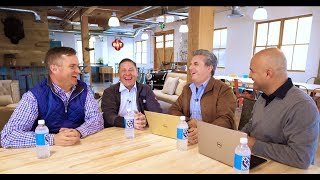
Nick Greer and Randy Garn, co-founders of Skipio, discuss their personalized text messaging platform for customer engagement and their leadership approach. They run daily 15-minute power stand meetings and treat relationships like a bank account: make three deposits before you ask for something. Skipio helps businesses stay connected to customers through automated, personalized texts.
Questions this video answers
November 21, 2017.
Helps businesses reach their customers through personalized text messaging.
A daily standing company meeting described as a 'power stand' lasting 15 minutes.
Do "three gives and then an ask."
Understand, Agree, and Commit (UAC).
Chapters
I'm Alan Taylor.
My buddy Scott Duffy and I are in search of the best burger in America. Each month, we visit a new city to try some of the top restaurants, pubs, and brewhouses while sitting down for a candid conversation with some of the top entrepreneurs, athletes, entertainers, and celebrities. I don't know about you, but I love talking business over a burger. Welcome to business and burgers.
Today we're back at Star Mill to try another amazing slider from Black Sliders. Joining us are Randy Garn and Nick Greer of Skip IO, an app that helps businesses reach their customers through personalized text messaging. Buddy since college, Randy and Nick proved that you can go into business with your friends and be successful. In fact, they've made it their mission to help their clients cultivate authentic relationships that will help keep their customers engaged and business. Boom.
All right, Nick, Randy, awesome to see you guys today. I want to introduce you to my friend Alan Taylor.
What's up, my man?
Good to see you guys. Thank you for letting us work in your space.
Lots of work.
All right, so here's the deal. So I was here last year this time last year, and the Star Mill was like a disaster. It was old working mill. Right. It had been closed for years. It was all wood and busted up and broken down. You guys came in, you transformed it into what now is the. Like, this is amazing.
Yeah.
What was the vision that you had?
I don't know. We're still trying to figure out that vision, you know, but four and a half years ago, came in, saw this building, and it was obvious it had to come back to life. It was obvious there was a legacy that was created here. You know, the building spoke to you, said what it should be, and you could hear what it ought to be. And with time and with a lot of effort, it turned into what it is today.
So we walked in this morning, and we walked in on the most interesting conversation you were having. You guys were all standing around, and you had this, like, company meeting, all standing up. And I thought maybe it was something special for us, but evidently, this is what you guys do.
Really, that's what it is, is a power stand. 15 minutes, gathered around. Let's talk. You're not sitting down, and we're standing up.
The entire company.
The entire company. And we stand around, we talk about what's going on, let's talk about our wins, let's talk about our improvements, and let's train on one issue. And it's powerful. It's a lot of fun just to walk through that process.
I mean, we're up front with our employees. There are struggles, especially when you're starting a company and we're completely open with that and say, okay, here's the struggles. How do we grow from here? How do we keep looking about, not focus on what went wrong, but what's going right.
I thought what was really killer was the amount of energy in the room and in the group. People were cheering, they were rooting for each other. Right. People from different departments, every department got to speak and share highlights about progress that they were making in their group.
You know, I actually felt good.
I thought, I want to be involved with this.
I mean, the energy was, we are taking applications.
Yeah.
I don't apply.
I'm just saying you're going to have.
To send me an alert.
It was interesting is when you were talking about, I asked you about the vision that you had for this, you said that it almost like sounded like it happened organically. Is that the way you approach business as well?
Yes, 100%. I think the problem though, with entrepreneurs and businesses is you. Why there's so many entrepreneurs as opposed to the entrepreneurs is the fact they want to know from A to Z. You don't know A to Z.
That's a great point.
But if you don't know A to.
B some days, but you know what, that's okay. As long as you're progressing to B, then you're going to figure out how you get to C. And there are some days you have those aha moments. You're like, wait a minute. Because I saw victory today, it gave me confidence to get that victory tomorrow.
My company is made up of a lot of young people. They don't get to understand what it's like to be an entrepreneur, to just be happy to get from A to paycheck B. But how do I talk to my employees? How do I explain to them I'm an entrepreneur?
Too often as human beings, we look at, we have a job and I call that the three letter swear word. This is not just a J, O, B. If you're going through the motions, then we're failing as a company because we're failing you and you're not growing.
Sometimes in small companies, what entrepreneurs want to do is they want to hide the losses and they don't want to shout those out loud. So how do they feel? Confident enough or safe enough to be able to share?
It's because they feel that love from you that you're not asking them, you know, out of, hey, your job's on the line, or, hey, you know what? Give me the answers I'm looking for. It's like, no, I love you, but how do we do this together? Because I need you help me help you help us.
Does that cross a line with employees? Are you asking them to go the extra mile? Which doesn't fit into the employee handbook?
First, it's not, I need you, what can I do for you? Or what? It's like, let me help you. And guess what? That's in return gets you what you need from them. So being vulnerable, being vulnerable in that situation.
One of the things that I've always liked teaching, I read a book called the no Complaining Rule. They can come with you with a complaint or an issue or a struggle, but they need to come with a solution, right? The hardest thing for people to really do is everybody wants just direction. You teach your employees how to think and to be innovative and create ideation. You're going to have a really, really good company.
So the bad news is, I'm hungry. The good news is the burgers are on their way.
Love it.
Perfect.
Today we're breaking the rules to try Black Slider's most popular sandwich, Scooter's Southern Fried Chicken Slider. It may not be technically a burger, but it tastes amazing nonetheless. This slider proves the power of simplicity. Perfect fried chicken paired only with ranch dressing and romaine lettuce on a Tuscan bun. Simply perfection.
You just mentioned how hard it was to get Aaron and Black Sliders over today because of how booked they are. But you got a great relationship. And I've never met anybody as amazing at building relationships as you. My question is, how do you build a great business network?
Really? You can't do business without. Without having a relationship with somebody.
I actually look at relationships as almost like a bank account. You can't. If you don't put things in, if you don't put money in, you can't go withdraw it. It's about having true experience with people. If you go out and you do things with people and never talk about business and build a real, genuine relationship with them and do things, the law of reciprocity, it will come back to you.
They have to know what your true intent is. I mean, it's easy to read through and understand what person's, you know, what one person's intent may be in that relationship. A lot of times it's to get personal gain. Money should never lead. It should only follow. But a lot of times in relationships, the money is leading instead of following.
Okay, so let's say I'm building whatever kind of company it is, a widget company. And I want to build relationships within my industry. So I want to take people out to do cool things and have experiences. How do I make that, I guess, how do I make that not seem ungen. You know what I mean? Disingenuous.
You've got to transfer value, right? And a lot of times I see in relationships is like, what can I do for them and help them? But that also takes time. Relationships take time. And especially relationships where you're actually doing business together are the best kind of relationships.
I love doing business with my friend and I try and honor that relationship. But whether it's just Scott or the big company, Microsoft, or the big car companies we work with or whatever it is, we get to a point in our lives where we want to use brands that we trust, we want to deal with people that we love, because then we're investing in that relationship and, you know, we only have one life. And you better enjoy what you're doing and you better be able to stand behind what you're doing even if you lose money to keep your word.
At what point and how do you ask for the order?
There's great networkers, but they never get the order.
That's right.
I think the biggest thing is, is communication. One thing a good friend of mine taught me years ago is that there's three things. Understand, agree, and commit. Uac. If you get those things right, if you, if they fully understand, then you can agree to it, then you can commit. Because a lot of people jump to commitment before they fully agree, understand what's going on because of the relationship. Right? To have great, meaningful, transactional relationships, you've got to be good at being able to understand, agree and fully commit that the expectations are aligned reality.
You've got to look at every relationship that you have and ask the question, why? Why am I connected to you, Scott? Why? Because you deepen that in that type of, I guess, that perception when you're going into a relationship and when you ask yourself that question, it's amazing what comes out of that. I asked myself 18 years ago, why did I meet this guy, the little man with the plan, you know, running around campus, you know, yeah, seriously, ball of energy. But why? And we always wanted to work together. Dave Norton, our other partner, why? Why were we such good friends? Like, why do we all get along? And also now this company created together, it's like, oh, I see what we were being prepared to do. Now today, I'm Always asked if you.
Could go and change one thing about how you've lived your life, or at least in business, right. What would you do? And the biggest mistake that I think I've made in my career is that I thought that what it took to be successful was outworking everyone else. But the thing over time that I've learned is really it's all about relationships, particularly the older that we get. And I think that's part of what you're talking about is just getting to know people well.
I mean, think about this for a second. In our day and age, we talk about social media and we're talking about hundreds, if not thousands, tens of thousands of relationships, connections. Those aren't real relationships. It has to be deeper.
That's just one tool.
That's one tool. But you know what, what really matters, like what Randy does well, and I know what you do well, Scott, is it's deepening, getting those roots down into those relationships.
I think it used to be that we do business and we build relationships face to face. It was all personal. And then came the telephone and then came the Internet and email and Internet marketing. And email marketing. I'm finding that email marketing is getting a lot tougher staying in touch with people, having content. And I'm finding a lot of power behind text. And I was hoping you guys could share a little bit about Scipio and kind of where you see text going in terms of relationship management.
Texting is a powerful tool. Now, granted, we have to be very careful as businesses to not abuse what texting can do.
Everything you can do in email via text now through our service. And so I could send 3,000 people that message and it be authentic and come to them on a one, on one basis. One thing that I try to teach people is to do three gives and then an ask. Don't always be in transactional. You got to deliver content, you got to deliver, you know, things that will be benefits to them. And then you can give an ask. But again, that comes back to building relationships. So three gives it an ask.
I think personalizing it too, to them. You know, if you have a bunch of, I mean, links on there and it's very robotic and it's very not so personal. They feel they see right through it. We talk about the intent of relationship. You can see the intent is only for you to gain and not for them to get or gain. You know, from the very beginning, we talked about this old mill built in 1888. You talk about the old and the new, and there is beauty with the old you look about technology today, technology is the new cutting edge. Always changing, always adapting. Today it's different than it was yesterday. But relationships, they're old. The way that relationships are made and they're had, it's old. It's not through technology. Meaning those deep relationships are only helped through technology, but not technology alone. It has to be used with those old fashioned, old fashioned ways.
I am so pumped for entrepreneurship for 2017 and looking forward, we're going to see things accelerate so fast. So my final thought is, is that as an entrepreneur, get gritty, think of ways that we're going to change this country, this world, and it's just a great time to be alive.
That's awesome. Thank you.
Great meeting you.
Thanks brother.
You're awesome, Mr. Duffy.
Scott, always good, my man.
Randy and Nick gave us some great insight into the power of building genuine relationships and they left us with some great food for thought. You don't have to know A to Z. Just take one step at a time. Teach your employees to think and be innovative and you will have a great company. In business relationships. Money should never lead. Money should follow.
Next time on Business and Burgers, we sit down with Rachel Hersher, founder of Influencer network and Social Tools Dashboard, SocialBoost.com and founder and publisher of Today's Mama, a nationwide network of mom bloggers. Rachel has been recognized as one of Utah Business Magazine's 30 Women to Watch and one of the top five CEOs to watch on Twitter by BusinessWeek magazine. She joins us at Edge Steakhouse for the most decadent, most extravagant, most indulgent burger we've ever had on the show. That's next time right here on Business and Burgers.
Check out more episodes of Business and Burgers and our BNB blog at our website, businessandburgers.com and don't forget, visit business and burgers on Facebook and give us a big thumbs up. See you next time right here on Business and Burgers.
More from Scott









Business & Burgers-Sequence Collection bracelet for National Entrepreneurship Week

